
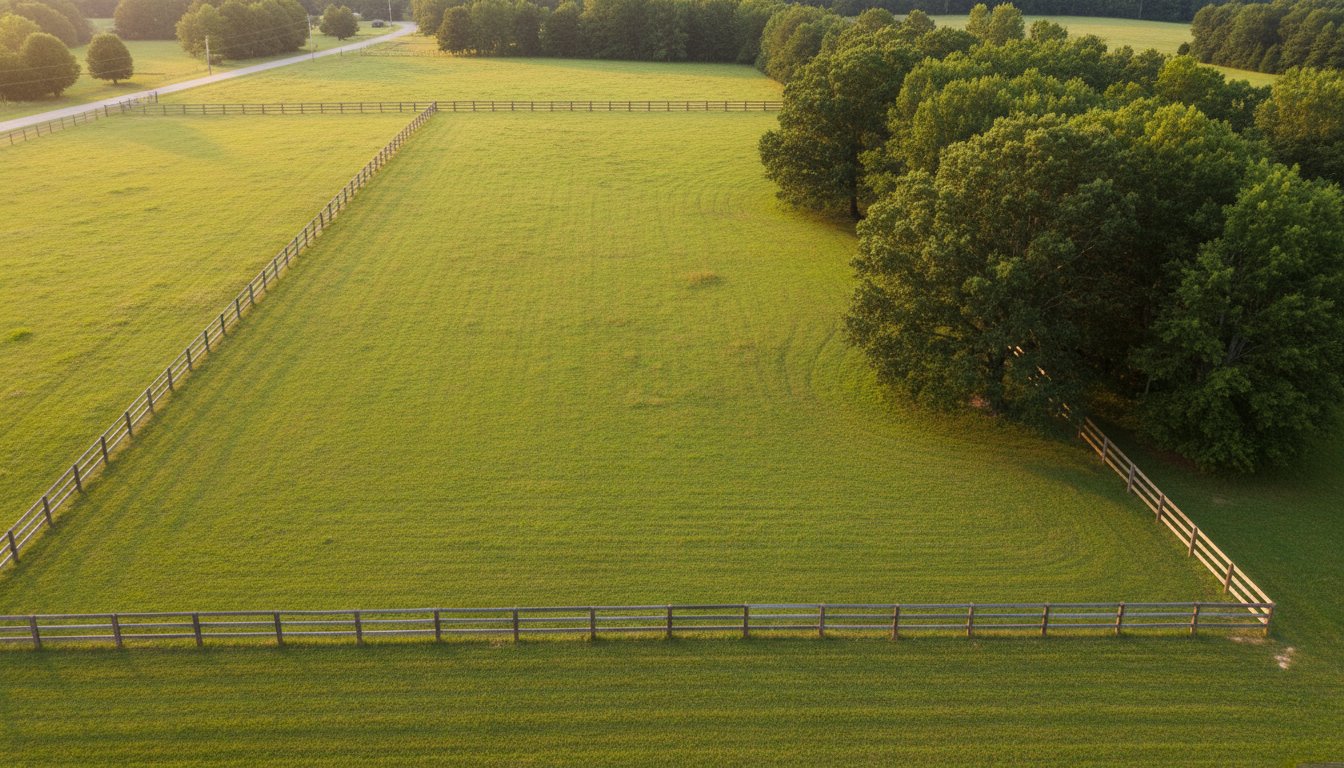
In 2025, the USDA reported that average land values hit a record $4,170 per acre, but that single number doesn’t help you much in 2026. You’ll see a desert lot in Arizona for $1,500 while a wooded acre in Tennessee commands $45,000. It’s frustrating to deal with conflicting data when you’re trying to figure out how much is an acre of land without the typical real estate fluff. You want a fair price, and you don’t want to wait months for an appraiser to call you back.
We’re cutting through the red tape. This guide gives you the current 2026 price ranges for every region and the specific factors, like utility access and road frontage, that dictate your land’s worth. You’ll get the facts you need to value your property accurately or find your next investment. We’ve simplified the process into three clear steps to help you move from a confusing search to a guaranteed cash offer. Let’s look at the numbers and get your deal moving today.
Key Takeaways
- Understand the 2026 national average price and why broad figures are often deceptive. Get the real facts on land pricing today.
- Pinpoint the four major factors that determine your property’s worth. Location and zoning rules dictate your final price tag.
- Determine how much is an acre of land in your specific region. Compare low-cost desert parcels with high-yield agricultural tracts.
- Follow a simple four-step process to calculate your land’s true market value. Stop guessing and start using actual sold data.
- Learn how to skip high commissions and sell your land directly to buyers. Cut the red tape and move your property faster.
What is the Average Price of an Acre of Land in 2026?
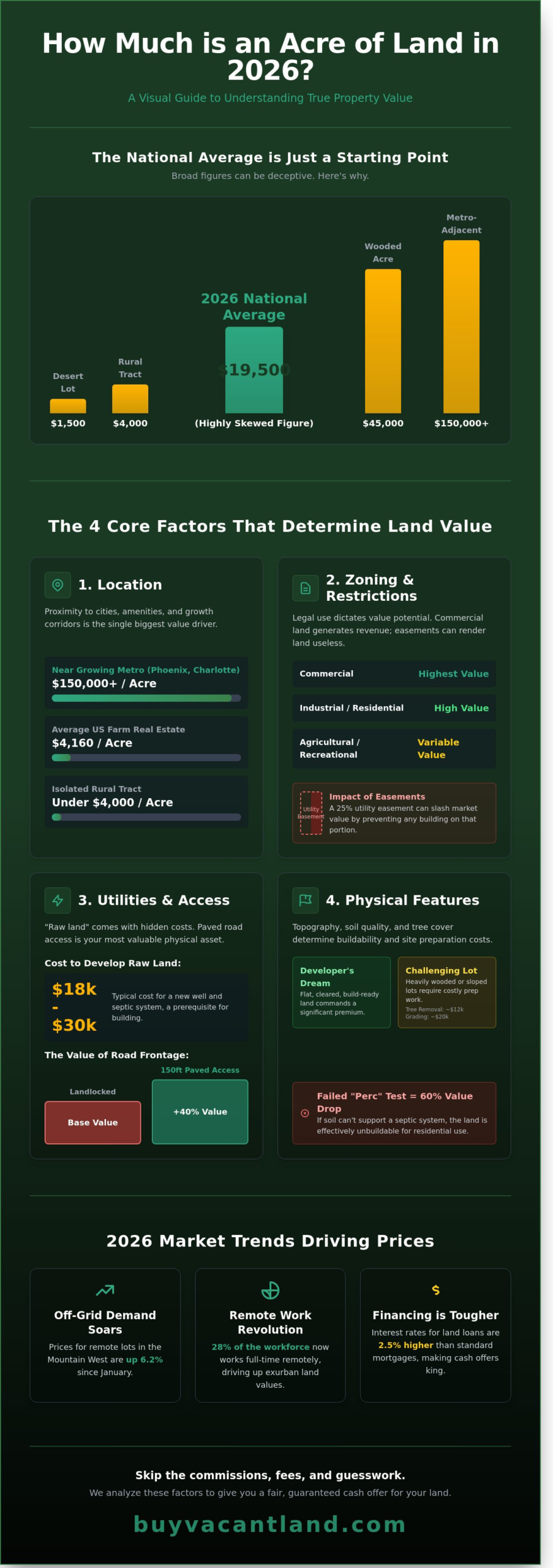
Land prices are shifting fast. In 2026, the national average for one acre of vacant land sits at approximately $19,500. This figure provides a basic starting point, but it doesn’t tell the whole story. You need to understand what is an acre to value it properly. An acre represents 43,560 square feet of potential. Knowing how much is an acre of land depends entirely on its location and its intended use. Current data shows rural residential land demand increased by 4% over the last twelve months. People want space. They want out of the city. Identifying your land category is your first step. You must know if your dirt is Agricultural, Residential, or Recreational before you look at the price tag.
Why National Averages are Only a Starting Point
Don’t fall into the median versus mean trap. Averages are deceptive. They combine $500,000 commercial parcels with $500 desert lots. This creates a skewed middle ground that doesn’t exist in reality. Large-scale ranch sales also distort the data. A single 10,000-acre transaction at a low price per acre drags down the perceived cost of small residential lots. It makes your property look cheaper than it actually is. Land value is the intersection of scarcity and utility. If your land has road access and power, it’s worth more than the national average suggests. We ignore the noise and look at your specific plot to give you a fair cash offer.
2026 Market Trends Impacting Land Costs
The 2026 market reflects new American priorities. Off-grid living has moved from a niche interest to a mainstream demand. Prices for remote lots in the Mountain West rose 6.2% since January. This trend is fueled by the 28% of the workforce that now works remotely full-time. These buyers are driving up exurban land valuations. Financing these purchases is getting harder. Interest rates for land loans are currently 2.5% higher than standard 30-year mortgages. This makes how much is an acre of land a question of liquidity. Many buyers can’t get a loan. We solve that problem. We pay cash. We close fast. You pay zero commissions and zero fees.
- Agricultural: Often the lowest price per acre due to large volume.
- Residential: High demand in 2026, especially near infrastructure.
- Recreational: Prices vary wildly based on hunting or water rights.
The 4 Major Factors That Determine Your Land Value
Pricing land isn’t a guessing game. It’s a calculation based on four critical variables that dictate market demand. If you’re asking how much is an acre of land, you must look at location first. Proximity to a growing metro hub like Phoenix or Charlotte can push prices to $150,000 per acre. Conversely, isolated rural tracts might stay under $4,000. Data from 2024 shows the average U.S. farm real estate value reached $4,160 per acre. This national figure provides a baseline, but your specific lot’s physical and legal traits will move that number up or down instantly.
Zoning: The Difference Between $5k and $50k
Zoning dictates the property’s ceiling. Residential zoning allows for housing, while industrial zoning might permit high-value warehouses or storage facilities. Commercial land often fetches the highest price because it generates revenue. Unrestricted land is popular in rural areas because it offers freedom, but it can also limit traditional bank financing. You must also check for easements. A utility easement covering 25% of your lot will slash your market value. You own the dirt, but you can’t build on it. This restriction turns a prime lot into a liability for most buyers.
The Hidden Cost of “Raw” Land
Raw land lacks basic services, and those services are expensive to install. In 2024, adding a new well and septic system costs between $18,000 and $30,000 depending on the state. Road frontage is your most valuable physical asset. A lot with 150 feet of paved road access is worth 40% more than a landlocked parcel. Soil quality is the final hurdle. A failed “perc test” means the ground won’t absorb waste. If you can’t install a septic system, your residential lot’s value can drop by 60% overnight because the land is effectively unbuildable.
Physical access and terrain also determine your final payout. Flat, cleared land is a developer’s dream. It commands a significant premium over heavily wooded or sloped lots. If a buyer has to spend $12,000 on tree removal and another $20,000 on grading, they’ll deduct those costs from your offer. If your land is difficult to develop or lacks access, you might prefer to get a fair cash offer and skip the expensive site preparation. We handle the technical details so you don’t have to worry about perc tests or clearing costs.
Regional Price Comparison: Where is Land Cheapest?
Location determines your final cost. If you want to know how much is an acre of land, you must look at the state line first. The Southwest remains the leader for low-cost, high-acreage desert parcels. In 2024, states like New Mexico and Arizona offer raw land for as little as $1,500 per acre. These prices attract investors looking for volume, but the land often lacks water, power, or road access. You trade convenience for a low price tag.
Midwest prices follow a different logic. Here, soil quality and commodity yields drive the market. In states like Iowa and Illinois, land is an industrial asset. High-quality tillable ground can reach $15,000 per acre. Experts at Iowa State University track several factors influencing farmland values, including interest rates and crop prices. When corn prices rise, land prices follow immediately.
The Southeast provides a pragmatic middle ground. In 2023, timberland and development sites in Georgia and South Carolina averaged $4,500 to $7,500 per acre. This region offers a balance of affordability and high growth potential. It’s a prime target for those who want land that is ready for building without the coastal price surge.
Most Affordable Regions for Vacant Land
New Mexico and Arizona offer the lowest entry points for large tracts. You can find 40-acre parcels for under $60,000 in rural counties. This land is cheap because it’s raw. You might spend $25,000 just to drill a deep well or bring in solar power. Don’t overlook the Rust Belt for value. In 2023, vacant residential infill lots in cities like Gary, Indiana, or Detroit sold for less than $4,000. These lots already have road access and utility hookups nearby, providing a different kind of affordability.
High-Value Regions and Premium Markets
Coastal states face extreme scarcity and strict building codes. In California or Washington, land prices often rival the cost of a finished home in the Midwest. One acre near a major metro hub can exceed $250,000. When calculating how much is an acre of land in these premium markets, you must also factor in the 15% annual appreciation seen in high-growth corridors. The Rockies are also spiking. Recreational land in Montana with mountain views now commands $12,000 per acre. Urban sprawl is the main driver. Developers buy 100-acre farms and convert them into expensive residential subdivisions, pricing out individual buyers.
How to Value Your Specific Acre: A 4-Step Process
You need a hard number. Guessing leads to properties sitting on the market for 200 days without a single call. Determining exactly how much is an acre of land requires looking at the right data, not just what your neighbor hopes to get for their property. Follow this direct process to find your land’s true market value.
Finding Accurate Comparable Sales
Zillow works for houses, but it’s often inaccurate for raw land valuations. It focuses on active listings. These numbers represent what sellers want, not what they get. You need to use county tax records instead. Search for recently recorded deeds from the last 90 days. This 90-day rule ensures you see the current market pulse. Sale prices in these records are the only truth in real estate. If a lot sold for $10,000 in cash last month, that’s your baseline. Listing prices are often 15% to 20% higher than the final transaction price.
The “Bulk Discount” in Land Buying
Size changes the math. A 100-acre tract always costs less per acre than a 1-acre lot. Think of it like a grocery store; you pay less per ounce for the gallon of milk than the pint. Retail buyers pay the convenience premium for small lots because they’re ready for a single home. You can use this to your advantage during negotiations. If you see a 5-acre lot priced at the same rate as a 1-acre lot, the seller is overreaching. A 40% difference in price-per-acre between small and large parcels is common in rural markets. Always calculate the price-per-acre for different sizes to spot these discrepancies.
Step 3: Account for Improvements
Raw dirt is the base price. You must add value for existing infrastructure. Fencing, cleared brush, or a gravel pad can increase value by $3,000 to $7,000 depending on the quality. In 2024, clearing costs alone can run $2,500 per acre. Don’t leave that money on the table if the work is already done. Conversely, if the land is a thicket of invasive species, subtract the cost of remediation from your offer.
Step 4: Consult a Specialist Marketplace
General sites miss the details. Use land-specific platforms to see real-time inventory. These sites show you exactly how much is an acre of land in your specific zip code right now. Look for properties that have been on the market for less than 30 days to see what’s actually moving.
Buy or Sell Your Land Faster on Our Marketplace
Knowing how much is an acre of land is only the first step. You need a platform that turns that knowledge into a closed deal. BuyVacantLand.com connects sellers directly with targeted land buyers nationwide. We eliminate traditional real estate red tape. You won’t pay high commission fees here. Our platform focuses exclusively on vacant land. There are no homes and no distractions to clutter the process. We put your property in front of 12,500 monthly investors looking for raw land right now. You get speed, simplicity, and a direct path to cash.
Why Sellers Choose a Land-Specific Platform
Mainstream sites bury land listings under thousands of suburban houses. We do the opposite. Sellers choose us for zero commission listings that maximize total profit. You save the standard 5% to 6% agent fee on every sale. Our streamlined process lets you list your property in 4 minutes or less. You reach a national audience of cash buyers and developers. This isn’t a local game anymore; we bring the entire market to your screen. You get your fair cash offer without the headache of long escrow periods or bank inspections. We focus on the 98% of land buyers who want raw dirt, not a fixer-upper home.
Finding Your Perfect Acre
Searching for property shouldn’t feel like a chore. Our search tools are built for the unique needs of land buyers. You can filter by specific zoning codes, exact acreage, and price points. We provide access to owner-financed deals that traditional banks won’t touch. You’ll find off-grid opportunities across all 50 states. Many listings include 20 to 30 high-resolution photos and GPS coordinates for immediate scouting.
If you’re ready to move, list your land for sale today and reach active buyers. Stop worrying about how much is an acre of land and start seeing real offers. We simplify the transaction so you can move on to your next project. It’s fast, free of hidden fees, and designed to work for you. Our platform handles the heavy lifting while you keep the equity you’ve earned. Join the thousands of landowners who have bypassed the traditional system for a better way to sell.
Maximize Your Property Value Today
Knowing the current market value is the first step to a successful sale. In 2026, national averages show a 4.2% increase in rural land value compared to 2025 figures. Whether your property is a remote $4,000 desert lot or a $25,000 suburban plot, the market is moving fast. You’ve seen the data on regional shifts and the four core factors that dictate your final price. Now it’s time to turn that knowledge into a liquid asset. Don’t let your property sit idle while taxes accrue.
Determining how much is an acre of land shouldn’t be a guessing game. Our specialized, land-only marketplace connects you directly to motivated buyers without the middleman. You get transparency and speed. We offer zero commission listing options to keep more money in your pocket. It’s a simple process to get your land in front of thousands of active investors today. Stop waiting for a sign and start the closing process immediately.
List your land for sale on our national marketplace and take control of your investment. You’ve got the numbers; we’ve got the buyers.
Frequently Asked Questions
Is buying an acre of land a good investment in 2026?
Buying an acre of land is a smart investment for 2026 because rural inventory remains low while demand for outdoor space grows. USDA data showed a 7.4% increase in land values recently; this upward trend is expected to continue at a 5% annual rate. You’ll see the highest returns in counties with at least 3% population growth. Land doesn’t depreciate like a car or require the constant maintenance of a rental house.
How much does it cost to clear an acre of land for building?
Clearing an acre of land costs between $1,500 and $5,000 for light brush and up to $15,000 for heavy timber. These prices include debris removal and stump grinding based on 2024 contractor averages. Always get three written quotes to ensure you don’t overpay for site preparation. These clearing costs directly impact how much is an acre of land worth to a builder or developer looking for a ready site.
What is the cheapest state to buy land in the US right now?
New Mexico is currently the cheapest state to buy land, with remote desert parcels selling for as little as $500 per acre. Arkansas and West Virginia also offer high affordability, with raw land prices often staying below $3,000 per acre. You’ll find the lowest prices in areas with limited utility access or rugged terrain. These low-cost states allow you to secure a deed without a massive down payment or a bank loan.
Can I buy an acre of land with a traditional mortgage?
You can’t use a traditional 30-year mortgage for raw land; you need a specific land loan or a construction loan. Lenders usually require a 20% down payment for improved land and up to 50% for unimproved acreage. Interest rates for these loans typically sit 1% to 2% higher than standard home loans. Local credit unions or Farm Credit offices are your best bet for financing because they understand local property values.
How do I find out the zoning of a specific acre of land?
Check the county’s official Planning and Zoning Department website and use their interactive GIS map. Enter the Assessor’s Parcel Number (APN) to see if the land is zoned R-1 for residential or A-1 for agricultural use. If the online map is confusing, call the zoning office directly for a free summary. Knowing the zoning is critical before you ask how much is an acre of land in a specific zip code.
What are the annual taxes on one acre of vacant land?
Annual property taxes for an acre of vacant land typically range from $50 to $500 depending on the state. Most counties assess raw land at roughly 1% of its market value. For instance, a $10,000 plot in Texas might cost $100 per year in taxes. If you qualify for an agricultural exemption, your bill could drop by 80% or more. Always check the last three years of tax history before buying.
What does “unrestricted land” mean for the price per acre?
Unrestricted land means the property has no Homeowners Association (HOA) rules or strict deed restrictions. This freedom adds a 15% to 20% premium to the price because you can park RVs or build tiny homes without interference. You still have to follow state health department rules for septic systems and wells. Many buyers pay more for this flexibility. It’s the fastest way to own property without someone else’s oversight.
How much value does road access add to an acre of land?
Legal road access increases land value by 30% to 50% compared to landlocked parcels. A 1-acre lot with paved frontage might sell for $20,000, while a landlocked lot in the same area struggles to sell for $10,000. Landlocked property is a massive liability because you can’t get a building permit without a recorded easement. If you buy land without a road, expect to pay $5,000 in legal fees to secure access.


Join The Discussion