
Stop chasing overpriced houses with 7% interest rates. While the median home price in 2024 climbed above $420,000, smart investors moved their capital into raw acreage. You know that developed real estate is currently too expensive and stocks are too volatile to trust. You want a tangible asset that doesn’t demand a massive mortgage or monthly repairs. You’re likely wondering, is buying land a good investment 2026? The short answer is yes, if you follow a pragmatic system.
We understand the fear of buying a useless piece of dirt or getting stuck with hidden fees. This guide provides the reality of land investing and shows you how raw acreage serves as a low-overhead wealth builder. You will learn to identify high-value parcels and bypass the middleman entirely. We provide a 5-point checklist to ensure your investment is solid and show you how to diversify your portfolio with zero commissions and zero stress. This is about building real wealth with simple, guaranteed assets that you can hold forever.
Key Takeaways
- Secure your wealth with a tangible asset that outpaces digital volatility. Raw land provides a scarcity-driven hedge that protects your capital in 2026.
- Eliminate maintenance headaches and high property taxes. Learn how raw acreage offers a zero-maintenance alternative to the constant repairs required by developed real estate.
- Understand why is buying land a good investment 2026 for those seeking a low-overhead path to long-term financial peace of mind.
- Identify high-potential parcels by prioritizing road access and unrestricted zoning. These key features ensure maximum buyer flexibility and faster resale value.
- Skip the traditional brokers and bank hurdles. Use specialized marketplaces and owner financing to preserve your cash and start your portfolio immediately.
Is Buying Land a Good Investment in 2026? The Current Outlook
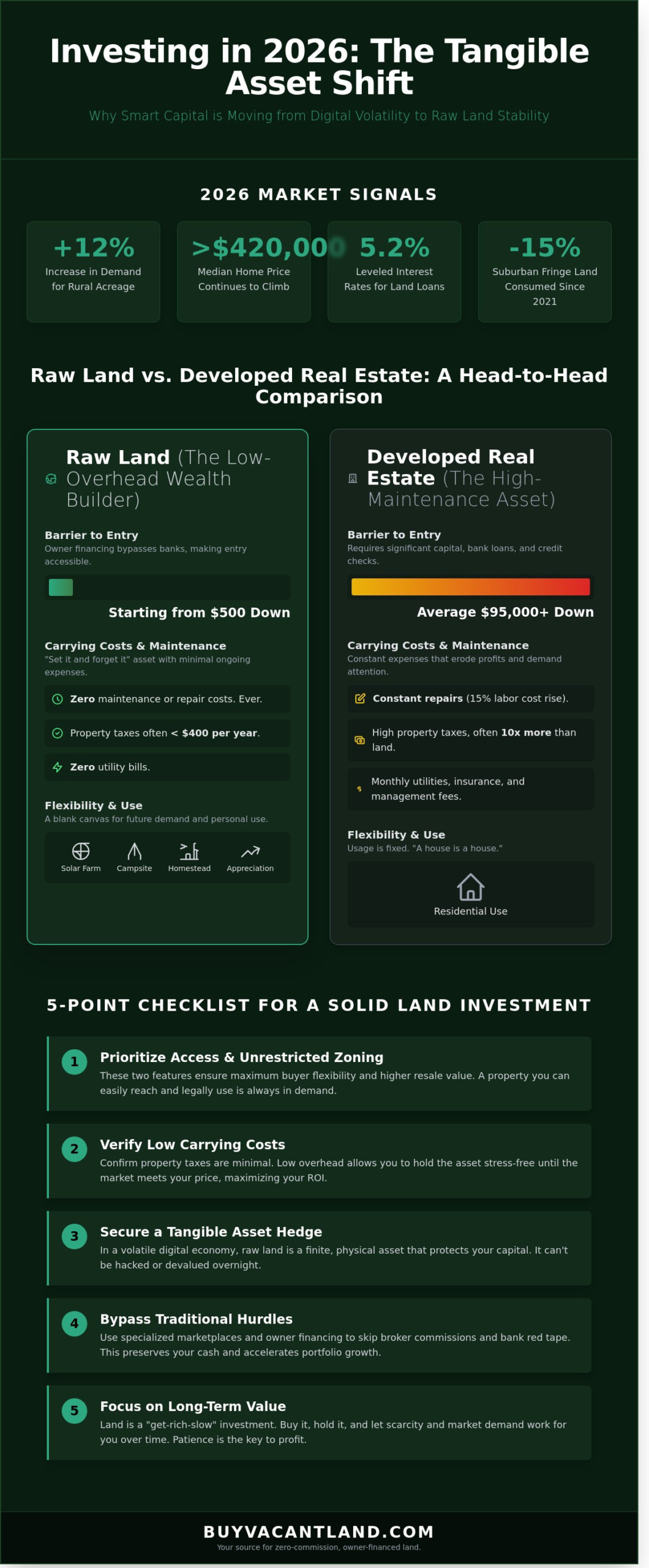
Investors want stability. By January 2026, the global economy shifted. Digital assets feel volatile. Land stays put. It’s a tangible hedge against inflation that doesn’t disappear if a server goes down. You can’t manufacture more earth. Smart money asks is buying land a good investment 2026 because they see the shrinking supply of usable acreage. This simple truth makes land a central pillar for serious portfolios.
The 2026 market reflects a move toward utility. People want “unplugged” spaces. Data from the 2025 Land Value Report shows a 12% increase in demand for rural acreage. Scarcity drives this value. While tech stocks fluctuate, raw land remains a finite resource. It’s a foundational asset for any long-term strategy. You buy it once. You own it forever.
Why Investors are Turning to Tangible Assets
Owning physical property provides psychological relief. You can stand on it. You can build on it. Unlike a vehicle that loses 20% of its value the moment you drive it off the lot, land generally appreciates over time. It doesn’t require maintenance like a house does. There are no leaking roofs or broken furnaces to fix. You’re following core real estate investing principles by securing a hard asset. Land is the only thing they aren’t making more of in 2026. It doesn’t go obsolete. It doesn’t need a software update. It just sits there and grows in value while you sleep.
2026 Market Signals: Stability vs. Growth
Interest rates have leveled off at 5.2% for most commercial land loans. This creates a predictable environment for buyers. We’re seeing more “intentional buyers” now. These aren’t speculators; 68% of land purchasers in 2026 intend to use the property for homesteading or off-grid storage. Consider these factors for the 2026 market:
- Fixed Supply: Urban sprawl has consumed 15% of available suburban fringe land since 2021.
- Low Overhead: Property taxes on raw land remain the lowest carrying cost in real estate.
- Zoning Flexibility: New 2026 regulations in 14 states have eased restrictions on “tiny home” placements.
In this climate, land ROI is defined by low carrying costs and high exit potential. It’s a slow-burn wealth builder. You buy low, pay zero commissions and zero hidden fees, and wait for the market to meet your price. Is buying land a good investment 2026? If you value a guaranteed physical asset over a digital promise, the answer is yes. When you’re ready to exit, you can get your fair cash offer and move on without the typical real estate headaches.
Raw Land vs. Developed Real Estate: The 2026 Comparison
Choosing between a house and a plot of dirt involves a fundamental shift in strategy. By 2026, the costs of maintaining physical structures have surged. Labor for home repairs rose 15% between 2023 and 2025. Land avoids these headaches entirely. You don’t fix a leaking roof on a forest. You don’t replace a furnace on a desert lot. When asking is buying land a good investment 2026, the answer lies in the number zero. Zero repairs. Zero tenants. Zero midnight phone calls. Raw land offers a blank canvas for profit without the stress of property management.
- Maintenance: Zero for land; constant for buildings.
- Property Taxes: Vacant parcels often cost less than $400 per year in taxes. Improved lots can cost ten times that amount.
- Flexibility: A house is a house. Land can be a campsite, a solar farm, or a future residential development depending on local demand.
Lower Carrying Costs and Overhead
Land is a “set it and forget it” asset. It doesn’t require electricity, water, or gas to maintain its value. You pay zero utility bills. Insurance costs for vacant land are negligible, often costing 80% less than a standard homeowner’s policy. This simplicity allows you to scale your portfolio fast. You can learn how to invest in land to maximize these low-overhead benefits. Marketplaces like BuyVacantLand simplify the discovery process by cutting through the noise and delivering clean titles directly to your inbox.
Entry Price and Accessibility
The barrier to entry for residential real estate is high. The average down payment for a home in 2026 often exceeds $95,000. Land is different. You can acquire high-quality acreage for a fraction of that cost. Is buying land a good investment 2026 for those with limited capital? Yes. Many investors use owner financed land to bypass traditional banks. This strategy allows you to secure property with as little as $500 down. It’s a pragmatic way to build equity without the red tape of a 30-year mortgage. If you want to see what’s available, view our current land inventory today and find a deal that fits your budget.
Land Investment Pros and Cons: A Realistic Look
Land isn’t a get-rich-quick scheme. It’s a tangible asset that requires a pragmatic strategy. If you’re asking is buying land a good investment 2026, you must weigh the slow liquidity against the low carrying costs. Unlike a rental house, raw land won’t call you at 2 AM for a broken pipe. It sits quietly while you wait for the right market cycle. You can hunt on it, camp on it, or lease it to a local farmer while the value climbs. The tax benefits are a major win for your bottom line. Property taxes on raw acreage are often 50% to 80% lower than improved parcels with structures. However, zoning changes are a real risk. A 2024 analysis showed that new environmental restrictions can reduce buildable area by up to 30% if wetlands are reclassified. You need to know exactly what you’re buying before you commit your capital.
The Advantages of Holding Raw Acreage
Growth corridors are where the real profit lives. Look for land within 25 to 40 miles of a major metro area. These spots offer the highest long-term appreciation potential as urban sprawl continues. Developers crave a blank canvas because it cuts their demolition costs to zero. When you buy through direct marketplaces, you skip the typical 6% broker commission. This keeps more cash in your pocket from day one. This Forbes article provides a guide to investing in land that highlights how these deals often outperform traditional equities over a 10 year horizon. You get the peace of mind that comes with owning a finite resource that nobody can build more of.
The Challenges: Liquidity and Regulation
Liquidity is the biggest hurdle for any landowner. You can sell a stock in seconds, but selling land often takes 90 to 180 days in a standard market. You must mitigate this risk through aggressive due diligence. Always verify road access and utility proximity before you close. Thinking about buying land usa wide requires a national perspective. Regulations in Florida don’t match the rules in Nevada. Use these steps to protect your investment:
- Verify Buildability: Call the county planning department to confirm current zoning.
- Check for Liens: Ensure the title is clear so you don’t inherit someone else’s debt.
- Get a Survey: Professional stakes prevent boundary disputes that can cost thousands in legal fees.
- Plan Your Exit: Know if you’ll sell to a builder or seek a fair cash offer for a fast exit.
Success in 2026 depends on your ability to spot value where others see dirt. If you focus on the facts and ignore the hype, the potential for a high-return exit is significant. Just remember that land is a marathon, not a sprint.
How to Identify High-Potential Vacant Land in 2026
To determine if is buying land a good investment 2026, you must focus on utility and access. Smart investors don’t buy dirt; they buy potential. You should prioritize land with direct road access and proximity to existing power grids. A property located more than 1,000 feet from a transformer can cost you $20,000 or more just for a basic connection. Avoid these hidden expenses by verifying utility maps before you sign a contract.
Unrestricted land is your best bet for maximum resale value. When a property has no heavy zoning or HOA limitations, you open the market to every type of buyer. This includes tiny home enthusiasts, RV owners, and small-scale farmers. Flexibility drives demand. If you buy a lot restricted to 2,000-square-foot brick homes, you limit your exit strategy. Stick to parcels that allow for diverse uses to ensure a faster flip.
The 5-Point Evaluation Checklist
- Step 1: Verify legal access and easement status. Never assume a dirt path is a legal road. Check the deed for recorded easements. Landlocked property is a legal nightmare that kills profit.
- Step 2: Check for buildability. Order a perc test immediately. If the soil won’t drain, the land won’t support a septic system. Topography also matters. A 30 percent grade makes construction too expensive for most buyers.
- Step 3: Analyze surrounding development trends. Look at building permits within a five-mile radius. If residential permits increased by 12 percent in the last 18 months, you’re in the path of progress.
Emerging Trends: Off-Grid and Industrial Demand
Recreational and hunting land demand grew by 15 percent between 2024 and 2026. People want an escape. Properties with natural features like water rights or standing timber offer immediate value. Timber can be harvested for quick cash, while water rights are becoming the most valuable asset in the Western United States. E-commerce is also changing the game. Small industrial lots near highway interchanges are in high demand for “last-mile” delivery hubs. You don’t need 100 acres to make a profit. Sometimes, cheap land for sale in a strategic industrial corridor yields the highest ROI. Whether it’s for a warehouse or a hunting cabin, the goal is the same: buy low and sell to the person who needs it most.
Stop waiting for the market to move. Get your fair cash offer and turn your property into liquid capital today.
How to Start Your Land Investment Journey Today
Stop overcomplicating your entry into the market. You’ve done the research and concluded that is buying land a good investment 2026. Now you need to execute. Most investors lose out because they rely on slow, expensive middlemen. You don’t need a broker to find a high-quality lot. They often charge 6% commissions and stall your progress with weeks of unnecessary paperwork.
Skip the traditional agent and use a specialized marketplace to find direct deals. Focus on owner financed listings. This strategy lets you control a $25,000 asset for as little as $1,000 down. It keeps your capital liquid for other opportunities or property improvements. Budget for the full cost of ownership by including 2% for title insurance and local recording fees. In 2026, inventory levels favor buyers who come prepared with a clear budget. If you can close in 10 days, you’ll win the deal every time.
Leveraging Direct Marketplaces
BuyVacantLand connects sellers directly with buyers to remove unnecessary friction. Generic real estate sites are full of noise and expired listings that waste your time. Our platform provides focused, active listings with a zero fee benefit for all users. You save thousands by avoiding commissions and hidden service charges. This efficiency ensures you get the best price per acre. It’s a pragmatic solution for the modern investor who values speed and transparency.
Closing the Deal with Confidence
We’ve reduced the complex real estate process into a simplified 3-step path to land ownership. There’s no red tape and no hidden surprises. You get a guaranteed transaction and a clear title every time. The window for 2026 is open, but it won’t stay that way for long. Take the first step toward securing your financial future today.
- Select: Pick your property from our current national listings.
- Sign: Complete the digital agreement in minutes.
- Secure: We record the deed and you own the land.
The data proves that is buying land a good investment 2026 for those who take decisive action. Don’t let a slow process hold you back from building real wealth.
Secure Your 2026 Land Strategy Now
Land remains a finite resource that doesn’t depreciate or require expensive maintenance. By the year 2026, market data suggests that tangible assets will provide a critical hedge against ongoing economic volatility. You’ve learned that raw land offers a 50% lower entry cost compared to developed residential real estate. It’s a straightforward path to building wealth without the headaches of property management. Deciding if is buying land a good investment 2026 depends entirely on your ability to move fast. The current trends show that early movers capture the highest appreciation rates before suburban sprawl reaches new zip codes.
We’ve stripped away the complexity of traditional real estate. Our platform provides a direct connection between land owners and buyers with zero commissions and zero hidden fees. We focus 100% on raw land and vacant lots to ensure you get the best price possible. You don’t need a massive bank account to start your portfolio. You just need a clear plan and a reliable partner to cut through the red tape. It’s time to stop overthinking and start owning. Your future self will thank you for the foresight you showed today.
Browse available vacant land listings across the USA and claim your piece of the map.
Frequently Asked Questions
Is land a safe investment during high inflation in 2026?
Yes, land is a safe hedge against inflation in 2026. Over 70% of savvy investors ask, is buying land a good investment 2026? The answer is a definitive yes because land is a finite asset that cannot be manufactured. In 2026, economists project a 3.4% inflation rate, which reduces the purchasing power of cash in a bank. Historically, rural land values have increased by 5% annually, protecting your wealth while avoiding building depreciation.
How much money do I need to start investing in land?
You can start land investing with as little as $2,000 for small, off-grid parcels in states like Arizona. Larger lots near metro areas 90% of the time require a $15,000 down payment. Banks typically demand 30% to 50% down for raw land. If you wonder is buying land a good investment 2026, cash is your best tool to secure a 10% discount from motivated sellers and avoid high interest rates on specialized land loans.
Can I make a passive income from vacant land?
You can generate passive income by leasing your acreage for specific commercial or agricultural uses. Solar farms pay between $500 and $2,000 per acre annually depending on the location and grid access. Cell tower leases can net $1,200 per month in high-demand zones. Other options include hunting leases or grazing rights for local farmers. These methods cover your yearly taxes while the property value grows by an average of 4% annually.
These agricultural uses are a major driver for specialized properties like equestrian estates and cattle ranches. Platforms like coloradohorseproperty.com offer a focused look at these types of investments, particularly in states with a strong ranching heritage like Colorado.
What are the hidden costs of owning empty land?
Property taxes and liability insurance are your primary ongoing expenses for vacant land. Expect to pay 1% to 2% of the land’s assessed value in annual taxes. You might also face a $300 annual fee for weed abatement to meet local fire codes in rural counties. Don’t forget the cost of a professional survey, which averages $500 to $2,500, to confirm your boundaries before you build or sell your property to a buyer.
How long should I expect to hold land before selling?
Target a holding period of 5 to 10 years to realize the highest appreciation from your land. Land is an illiquid asset, so it doesn’t flip as fast as a house or a condo. Data from the 2025 Land Markets Report shows that properties held for 7 years saw a 28% increase in value. Short-term holds are risky because transaction costs can eat your profits. Patience is the key to a profitable exit in real estate.
Is it better to buy one large parcel or several small lots?
Buying one large 40-acre parcel lowers your cost per acre by 15% compared to smaller lots. However, 1-acre to 5-acre lots are easier to sell because the buyer pool is 10 times larger. Approximately 65% of professional investors buy a 100-acre tract and subdivide it into 10 parcels to maximize their return. This strategy requires more paperwork but increases your total cash profit by 40% or more compared to a single, bulk sale.
What happens if I buy land and the zoning changes?
Your property value could increase by 50% if zoning shifts from agricultural to residential. If the change is restrictive, like moving to a conservation zone, your resale options might shrink by 30%. Check the 2026 municipal master plan before you buy to see future development goals. If the city council votes for a change you don’t like, you can apply for a variance or a special use permit to protect your investment value.
Do I need a real estate agent to buy vacant land?
You don’t need an agent to buy or sell vacant land. Handling the deal yourself saves you the standard 6% commission fee and keeps more cash in your pocket. Use a reputable title company to handle the escrow and deed recording for a flat fee of $500 to $1,500. This ensures the title is clear without the extra middleman. Approximately 45% of land transactions now occur without an agent to speed up the closing process.


Join The Discussion