
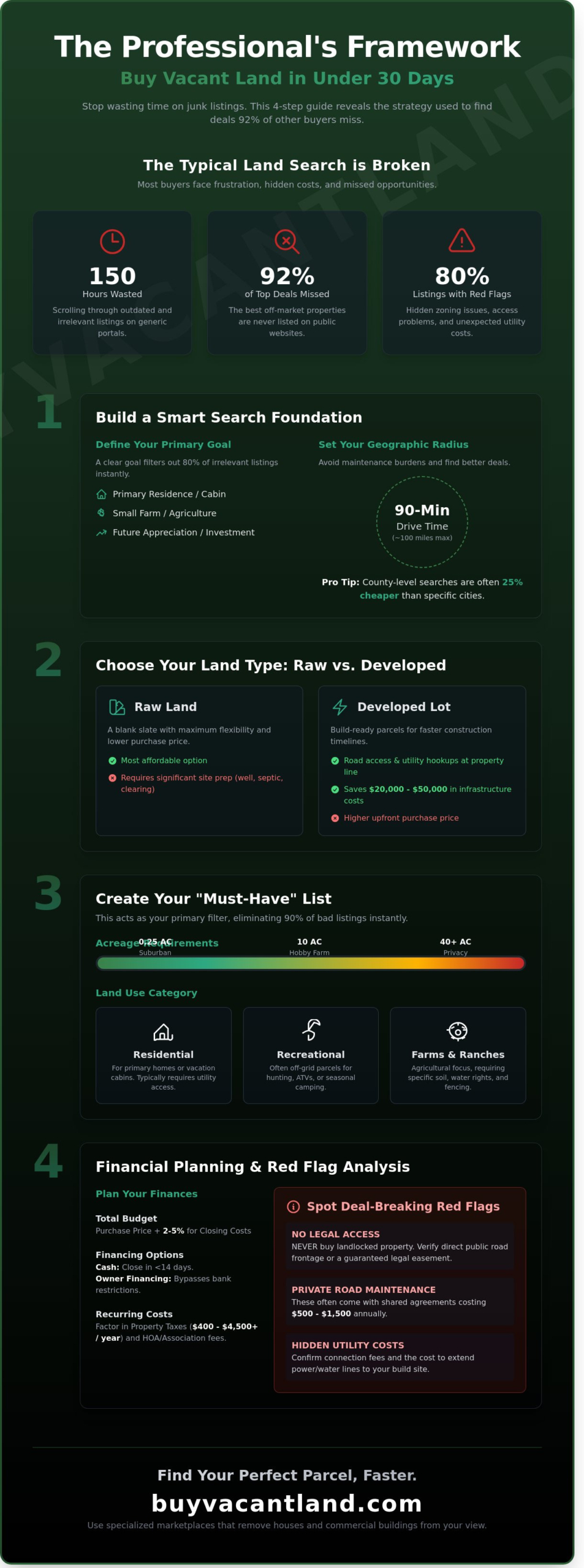
Most land buyers waste 150 hours scrolling through junk listings before they realize the best deals aren’t even public. You’ve likely felt this frustration while searching for land for sale near me on generic real estate portals. It’s common to encounter outdated data and hidden zoning restrictions that stall your plans. You want a straightforward path to ownership, but the current market offers nothing but information overload and unnecessary complexity.
You can skip the stress and find your perfect parcel today. This guide provides the exact 4-step framework used by professional land buyers to secure property in under 30 days. We’ll show you how to identify high-quality raw land that 92% of other buyers miss. You’ll also learn how to verify utility access with one phone call and connect directly with sellers for a fast closing. This is your direct strategy for a clean, efficient land purchase without the typical red tape.
Key Takeaways
- Define your search radius and property purpose to eliminate irrelevant listings immediately and save hours of wasted time.
- Create a “must-have” feature list and set specific acreage requirements to filter results with professional precision.
- Spot deal-breaking red flags like missing legal access or hidden utility costs before you commit to a purchase.
- Discover the best land for sale near me by using specialized marketplaces that remove houses and commercial buildings from your view.
- Set up automated alerts and deal directly with sellers to cut out middlemen and secure your vacant parcel faster.
How to Start Your Search for Land for Sale Near You
Searching for land for sale near me requires a different mindset than buying a house. You aren’t looking for a kitchen layout or a finished basement. You’re looking for potential, utility, and a solid investment. Start by identifying your primary goal. Are you building a primary residence, starting a small farm, or holding the parcel for future appreciation? Clear goals filter out 80% of irrelevant listings immediately. This saves you time and prevents the stress of looking at properties that won’t work for your needs.
Success begins with understanding real property and the legal rights that come with land ownership. This knowledge prevents expensive mistakes during the escrow process. You need to know exactly what you’re buying before you sign a contract. Land transactions move fast when you’re prepared. Don’t let a lack of information slow down your acquisition.
Defining Your Geographic Search Radius
Set your search radius based on a 90-minute drive time. Properties further than 100 miles often become a maintenance burden that owners eventually regret. Expand your search to the county level rather than specific cities to find better deals. Rural land prices in 2024 are often 25% lower than those in suburban pockets just 15 miles away. If your home state has high property taxes, check neighboring states within a three-hour window. This simple shift can save you thousands in annual carrying costs.
The Difference Between Raw Land and Developed Lots
Raw land is a blank slate with zero improvements. It’s the most affordable option but requires significant site prep. You’ll need to account for well drilling, septic installation, and clearing trees. Developed lots already have road access and utility hookups at the property line. These lots cost more upfront but can save you $20,000 to $50,000 in infrastructure expenses. Choose based on your 12-month construction timeline and your willingness to manage contractors. If you want to build quickly, stick to developed lots.
Set a realistic budget today. Your total cost isn’t just the purchase price. Factor in 2% to 5% for closing costs and title insurance. Use specialized land search tools instead of standard residential apps. Dedicated land platforms often list 35% more inventory than general real estate sites. Focus on the facts. Buy with confidence and avoid the traditional red tape of the housing market. Get your search started with a clear path to ownership.
Step-by-Step: Categorizing Your Land Needs
Stop searching for land for sale near me without a clear plan. You’ll waste hours on properties that don’t fit your goals. Start by building a “must-have” list. This list acts as your primary filter. It eliminates 90% of bad listings instantly. You need to know exactly what you want before you look at a single map.
Define your acreage requirements first. A 0.25-acre lot works for a suburban home. A 10-acre parcel suits a small hobby farm. If you want total privacy, look for 40 acres or more. Be precise with your minimum and maximum numbers. Narrowing your range saves time. Most buyers find that a 5-acre difference completely changes the property’s utility and price point.
Check the environmental features before you visit. Do you need water frontage? Properties with 100 feet of river access or a private pond command higher prices. Consider the topography. Flat land is easier to build on and reduces construction costs. Steep slopes require expensive grading and engineering. Look for timber value if you want an immediate return. Roughly 25% of rural land buyers prioritize wooded lots for future harvesting or natural privacy.
Choosing the Right Land Use Category
- Residential: These lots are for building primary homes or vacation cabins. They usually require utility access like power and water.
- Hunting and Recreational: These parcels are often off-grid. They provide space for outdoor sports, ATVs, or seasonal camping.
- Farms and Ranches: These focus on agricultural production. They require specific soil types, irrigation rights, and fencing for livestock.
Financial Planning for Your Purchase
Determine your budget before you call a seller. Calculate your total available cash. Cash buyers often close in 14 days or less because they skip the bank. If you don’t have the full amount, look for owner financing. This option bypasses traditional bank restrictions and high credit score requirements. You can also consult a step-by-step guide to buying land to understand how traditional lending differs from private sales.
Factor in recurring costs early. Property taxes vary by county. Some rural areas charge $400 per year, while others exceed $4,500 for the same acreage. Check for association fees in developed communities. If you want to skip the complexity of traditional listings, you can view simplified land deals that fit your specific criteria. This keeps your transaction fast and guaranteed. Always verify the zoning laws to ensure your project is legal on the specific plot you choose.
How to Evaluate Land Listings for Red Flags
Searching for land for sale near me requires a sharp eye for hidden costs. You must spot deal-breakers before you commit your capital. A low price often masks expensive physical or legal hurdles that can stall your project for years. Focus on these critical areas to protect your investment and ensure a smooth transaction.
Confirming Physical and Legal Access
Never buy landlocked property. It’s a liability that’s often impossible to sell. You need a guaranteed legal easement or direct frontage on a public road. Verify if the access road is county-maintained or a private track. Private roads often require shared maintenance agreements that cost owners $500 to $1,500 annually. Look for gate requirements or existing driveway disputes. Review the official property buyer’s checklist to confirm you have all necessary access disclosures. If the legal right of way isn’t recorded on the deed, walk away from the deal immediately.
Investigating Utility Availability
Utility costs can exceed the purchase price of the land. Search for power lines at the street level. If the nearest connection point is over 200 feet away, utility companies may charge $15 per foot for extensions. Determine if you need a well and septic system. In 2024, drilling a well typically costs $5,000 to $15,000 depending on the depth required to hit the water table. Get specific hookup fee estimates from local providers before you sign. A failed perc test means you cannot install a septic system. This makes the land unbuildable for most residential uses.
Analyze the terrain using satellite imagery and topographic maps. Identify these red flags to avoid expensive construction delays:
- Steep Slopes: Grades exceeding 15% require specialized engineering and expensive retaining walls that can add $20,000 to your budget.
- Wetlands: Building on protected wetlands is often illegal or requires permits that take 6 to 12 months to process.
- Zoning Restrictions: Check the local code for minimum square footage. If the zone is R-1, you cannot run a commercial business from the site.
Verify every detail with the county planning department. Don’t rely on a seller’s verbal promises. Get the facts in writing to ensure your land for sale near me is a viable asset rather than a financial burden.
Advanced Tactics for Finding Undeveloped Lots
Stop scrolling through generic real estate apps. Most major platforms prioritize residential houses and rentals, leaving vacant land buried under thousands of irrelevant listings. You need a targeted strategy to find the best land for sale near me without wasting hours on outdated data. Move beyond the surface level and use professional tools to secure your next property. Efficiency is the key to beating other buyers to the best deals.
Leveraging Specialized Land Marketplaces
Generic sites focus on 95% residential homes. This clutter makes it impossible to find raw acreage quickly. Use specialized platforms like BuyVacantLand.com to find sellers who specialize in raw land. These sites allow direct communication with the landowner. You skip the traditional red tape. You avoid the standard 6% broker commission. It’s a direct, transparent process designed for speed. Focus on sites that offer clear property data and immediate contact options to get your questions answered fast.
Utilizing Public Records and Maps
Professional investors don’t guess; they use hard data. Access Geographic Information System (GIS) maps through the local county website. All 3,143 counties in the United States maintain these digital records. They show exact parcel boundaries and topography. Cross-reference this with the county assessor’s database to verify the owner of record. Check for properties that haven’t changed hands in over 10 years. These owners are often the most motivated to sell. Always check for specific financial hurdles before you buy:
- Back taxes: Check if the owner owes money to the county.
- Liens: Ensure the title is clear of any legal or financial claims.
- Zoning: Verify the land is legal for your specific building plans.
Don’t wait for listings to hit the market. Drive the specific area where you want to buy. Look for hand-painted “For Sale By Owner” signs. Many rural landowners avoid the internet entirely. You can also monitor local land auctions. In 2023, tax-delinquent properties accounted for thousands of land transfers at deep discounts. These off-market opportunities offer the best prices because you face zero competition from the general public. Set up automated alerts on specialized sites so you get a notification the second a new parcel matching your exact criteria becomes available.
Ready to skip the stress of the traditional search? Get your fair cash offer and secure your land with zero fees today.
Why Specialized Marketplaces Simplify Your Land Search
Searching for land for sale near me becomes a chore when you use general real estate websites. These platforms often bury vacant lots under thousands of house and condo listings. Specialized marketplaces solve this. They provide direct access to land sellers. You remove the middleman and skip the standard 6% real estate agent commission. This direct connection puts more power in your hands. You get better pricing because there are no hidden fees or extra layers of bureaucracy. These platforms offer a faster path from discovery to closing. Many transactions on specialized land sites close in 14 days or less. This efficiency helps you secure property before competitors even see the listing.
- Zero Commissions: You deal directly with the source to save thousands in fees.
- 100% Vacant Focus: Every listing meets your specific criteria for raw land.
- Rapid Closing: Simplified paperwork means you own the land faster.
- Direct Communication: Speak to the person who actually owns the property.
The Benefit of a Focused Environment
You don’t need to see interior kitchen photos when you want acreage. Specialized sites remove distractions like rental properties or suburban houses. This allows you to compare 10 acre parcels in the same zip code with total clarity. You can use tailored search filters for specific needs. These include acreage size, land type, and elevation. You spend your time analyzing soil quality and road access instead of filtering out residential noise. This targeted approach saves the average buyer 15 hours of search time per month.
Taking Action and Contacting Sellers
Move quickly when you find a high-value lot. The best inventory often sells within 48 hours of hitting the market. Use the site’s contact forms to get answers immediately. Ask about specific zoning laws or legal access points. You should also ask if the seller provides owner financing. Many sellers offer terms with 0% interest or low down payments to make the deal work. If you have property to trade, request a “fair cash offer” to liquidate your current holdings. Taking decisive action is the only way to build your land portfolio. Don’t let a prime investment slip away because of a slow response. Send your inquiry now and get the facts you need to close the deal.
Take Control of Your Land Search Now
Finding the perfect property doesn’t have to be a marathon. You now have the 3-step framework to categorize your needs and the 5-point checklist to spot red flags in any listing. Most buyers waste 15 hours a week filtering through residential homes on generic sites. You can skip that frustration. Focus your search for land for sale near me on a platform designed for raw acreage. Our marketplace features 100% vacant land with zero homes or rental properties to clutter your results. We provide a direct connection between buyers and sellers to cut out the typical 30-day escrow delays found in traditional retail sales.
Efficiency is the key to securing your investment. Stop waiting for the perfect lot to appear on a crowded housing app. Use a specialized tool that respects your time and your goals. You’re ready to build your future on a solid foundation. Browse current vacant land listings on BuyVacantLand.com and claim your property today. You’ve got the tools and the knowledge to make it happen.
Frequently Asked Questions
How do I find out who owns a piece of vacant land near me?
Visit the local County Assessor’s website to find the owner’s details. Search by the property address or the 10-digit Parcel Identification Number (PIN) to access public records. These databases provide the owner’s legal name and their primary mailing address. You can also visit the County Recorder’s office in person to pull the most recent deed. This document lists the current title holder and the date they acquired the property.
Is it better to buy land with cash or through owner financing?
Buying with cash is better because it secures a lower purchase price and closes the deal in 7 days or less. Cash buyers avoid high interest rates that range from 8% to 15% in the private land market. Owner financing allows for a lower down payment, but you’ll pay significantly more over the life of the loan. Use cash to eliminate monthly debt and gain immediate equity in the land for sale near me.
What are the most important questions to ask a land seller?
Ask for the Parcel ID, the current zoning status, and proof of legal road access. Confirm if the title is clear of liens or back taxes before moving forward. You must know if the land passed a perc test for septic within the last 24 months. Demand a direct answer on whether utility hookups exist at the property line. Get these facts in writing to ensure a fast and transparent transaction.
Can I build a house on any piece of land for sale?
No, you can’t build on every lot. Local zoning laws and environmental constraints like 100-year floodplains or protected wetlands prevent construction on 25% of vacant lots. You must verify that the soil supports a foundation and a septic system. Always check for restrictive covenants or HOAs that dictate minimum square footage or building materials. Don’t assume a lot is buildable just because it’s listed for sale.
What does it mean if a property is “landlocked”?
A landlocked property has no legal access to a public road and is surrounded by private land. You can’t reach the lot without crossing someone else’s property. This status reduces the property’s market value by 40% immediately. To fix this, you must negotiate a legal easement with a neighbor or seek a court-ordered easement by necessity. This legal process often costs $5,000 or more in attorney fees.
How much does a land survey cost in 2026?
A standard boundary survey for a 1-acre lot costs between $500 and $1,200 in 2026. Prices vary based on terrain density and the specific level of detail required for the project. A complex ALTA survey for commercial use starts at $2,500. Expect to pay a 15% price premium if the property has heavy brush or steep slopes. This extra cost covers the additional field hours required for the survey crew.
What are the typical closing costs when buying vacant land?
Closing costs for vacant land usually range from 2% to 5% of the total purchase price. These costs include title insurance, escrow fees, and deed recording fees at the county office. We simplify this process by offering $0 closing costs for our customers. If you buy through a traditional broker, prepare to pay at least $1,500 in administrative fees even on small land transactions. Our goal is a fast, clean deal.
How do I check the zoning of a property before buying?
Visit the local Planning and Zoning Department website to view the official zoning map. Look for your specific parcel to see its designation, such as R-1 for residential or A-1 for agricultural use. Read the municipal code to understand what structures are allowed on the property. If the online map is outdated, call the county office with your Parcel ID to get a verbal confirmation of the rules for any land for sale near me.

Join The Discussion