
Why do 42% of first-time buyers realize their new property is legally unbuildable only after the closing papers are signed? You’re searching for 1 acre land for sale because you want freedom and a place to call your own. The reality of complex zoning laws and hidden utility fees can quickly turn that dream into a $50,000 mistake. It’s stressful to navigate raw land when every bargain seems to have a hidden catch that drains your bank account.
You deserve a straightforward path to property ownership without the usual real estate headaches. This guide shows you exactly what 43,560 square feet looks like on the ground and how to verify building permits in under 10 minutes. You’ll get the hard facts on clearing costs and soil tests so you can buy your first lot with total confidence and zero stress. We’re stripping away the fluff to give you a pragmatic, three-step checklist for securing your first acre in 2026 without the traditional red tape or expensive legal traps.
Key Takeaways
- Visualize exactly what 43,560 square feet looks like and see how a home, garage, and orchard fit on a single acre.
- Locate the best 1 acre land for sale using specialized search filters and owner financing options to bypass bank red tape.
- Protect your investment by identifying zoning restrictions and HOA hidden clauses before you sign a contract.
- Budget for the true cost of raw land by planning for the 15-25% in closing and site prep fees often overlooked by buyers.
What Does 1 Acre of Land Actually Look Like?
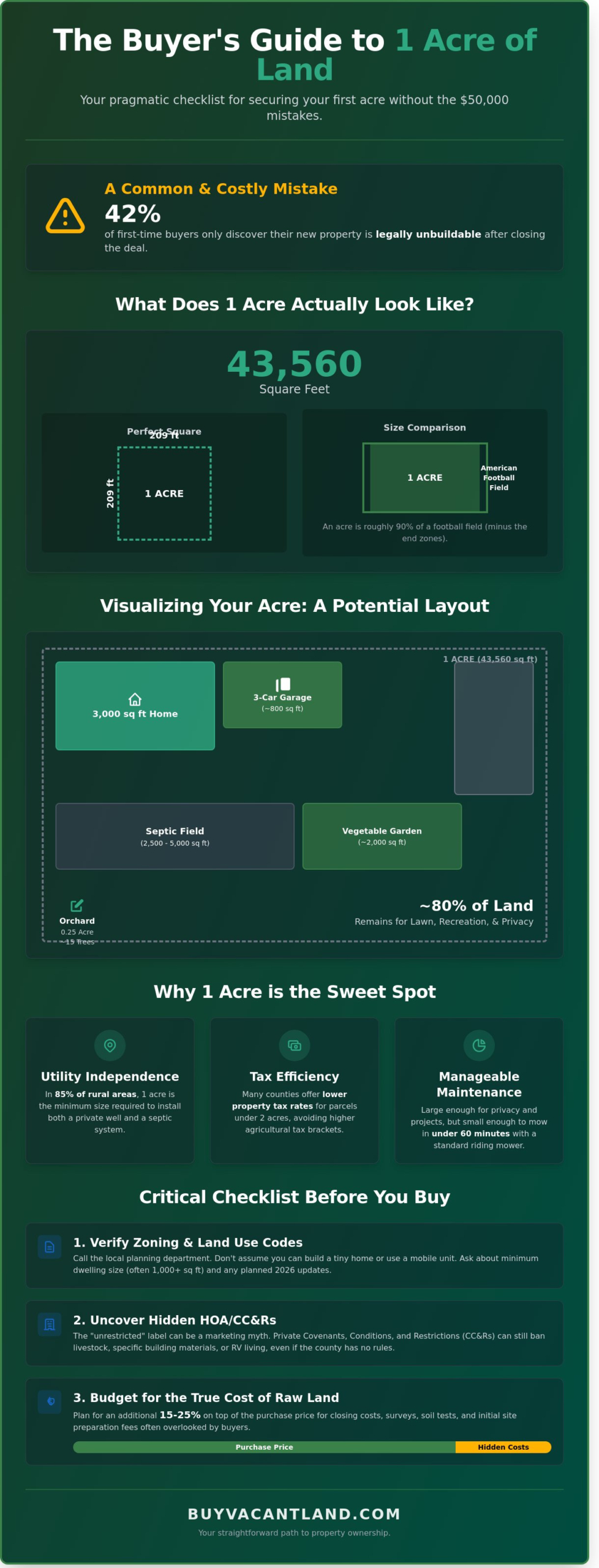
One acre of land equals exactly 43,560 square feet. Visualizing this size is simple. Picture a standard American football field. If you remove the end zones and about 10 yards of the playing surface, you have an acre. It represents roughly 90% of that total athletic space. When you browse a 1 acre land for sale listing, you’re looking at a parcel that is typically 4 to 8 times larger than a standard 5,000 square foot city lot. This size offers immediate privacy without the high maintenance costs of a massive estate. It’s the sweet spot for many first-time buyers.
The shape of the parcel dictates how you can use it. A square lot is easy to fence and build on. A “flag” lot, which features a long, narrow strip of land for access, offers more seclusion but increases your driveway construction costs. You need to understand What is an acre? to appreciate how these dimensions impact your daily life and property value. Don’t just look at the total square footage. Look at the usable space.
The Geometry of an Acre
A perfect square acre measures approximately 209 feet by 209 feet. While the math is simple, the layout is what matters for your building plans. Road frontage is often more important than the total depth of the lot. A lot with 200 feet of road frontage allows for a wide, impressive home placement. A narrow lot limits your architectural options. Topography also changes your perception of size. A flat acre feels expansive. A lot with a 15% grade feels smaller because your building “envelope” is restricted to specific flat spots.
Why 1 Acre is the Most Popular Search Term
Buyers search for 1 acre land for sale because it provides a specific lifestyle balance. You get these three primary benefits:
- Utility Independence: In 85% of rural jurisdictions, 1 acre is the minimum requirement to install both a private well and a septic system on the same lot.
- Tax Efficiency: Many counties offer lower tax rates for parcels under 2 acres. You avoid the higher tax tiers associated with large agricultural tracts.
- Manageable Maintenance: You have room for a 1,500 square foot workshop and a large garden, yet you can still mow the entire lawn in under 60 minutes with a standard riding mower.
This size protects your investment. It is large enough to feel like a retreat but small enough to sell quickly if your plans change. It is the most liquid asset size in the vacant land market.
Visualizing Your Acre: What Can You Actually Build?
One acre equals 43,560 square feet. That’s roughly 90% of a standard American football field. Look at a 1 acre land for sale listing and see potential, not just dirt. You can build a 3,000 square foot home, a 3-car garage, and still have 80% of your land left for recreation. Privacy comes from smart planning. Use 20-foot setbacks to create a natural wall of trees. If you want to go off-grid, a 5kW solar array only takes up 400 square feet. Rainwater collection tanks fit neatly behind a shed. You get space without the massive maintenance of a 10-acre ranch.
The ‘Dream Home’ Layout
Efficiency is your goal. A standard driveway consumes 600 to 1,000 square feet. You must account for a septic field, which typically requires 2,500 to 5,000 square feet of undisturbed soil. Always plan for a 100-foot buffer zone from the main road to cut noise by 50%. Watch out for easements. These legal rights-of-way can prevent you from pouring concrete on 10% of your lot. Before you buy, check this Forbes land buying checklist to ensure your build is actually feasible. If you need help finding a lot that fits these specs, you can browse available properties today.
Small-Scale Agriculture and Animals
One acre is a powerhouse for food production. You can plant a 0.25-acre orchard with 15 semi-dwarf trees. This produces over 500 pounds of fruit annually. Most counties allow one “Animal Unit” per acre. This usually means one horse, two cows, or 50 chickens. High-intensity homesteading works here. You can grow 75% of a family’s vegetable needs on just 2,000 square feet. Consider these space requirements:
- Vegetable Garden: 2,000 square feet for a family of four.
- Chicken Coop: 100 square feet for 15-20 birds.
- Compost Zone: 50 square feet for waste management.
Manage waste by keeping coops 50 feet from water sources. This prevents runoff and keeps your soil healthy. It’s about smart zones, not just more dirt. A single acre provides the perfect balance of self-sufficiency and manageable labor.
Critical Factors to Check Before Buying 1 Acre
Buying 1 acre land for sale requires more than a handshake and a check. You must verify the legal and physical status of the property before closing. Zoning laws dictate your future. Don’t assume a vacant lot allows for a tiny home or a mobile unit. Many counties enforce a minimum 1,000 square foot requirement for primary dwellings. Call the local planning department. Ask specifically about current land use codes and any 2026 updates to building density. You need facts, not assumptions.
Watch out for the ‘unrestricted’ label. It’s often a marketing myth. Private Covenants, Conditions, and Restrictions (CC&Rs) or HOA rules can still ban livestock or specific building materials. This applies even if the county has no formal rules. Legal access is another common trap. A ‘paper street’ exists on a map but offers no physical path for your vehicle. You need a recorded easement or a county-maintained road to avoid being landlocked. Check the FEMA Flood Map Service Center for 100-year flood zone designations. If the land contains protected wetlands under Section 404 of the Clean Water Act, your building footprint might shrink to zero.
Zoning and Building Permits
Verify the classification. Residential, Agricultural, and Mixed-Use categories have different setback rules. A 50-foot setback on a narrow 1-acre plot can eliminate your building site entirely. Contact the county’s building department to confirm the 2026 permit fee schedule. Some jurisdictions charge $5,000 or more just for the right to break ground. Never buy 1 acre land for sale without a written confirmation of its buildable status.
The Utility Challenge
Raw land is cheap because it lacks infrastructure. Bringing power from the nearest line costs between $2,000 and $10,000 per pole. If the nearest connection is 500 feet away, your budget is already blown. Drilling a well in 2026 averages $15,000 to $30,000. There’s no guarantee you’ll hit a viable aquifer. Always make your offer contingent on a successful perc test. If the soil fails to absorb water, you cannot install a septic system. Without a septic permit, your acre is just an expensive field. Use these three steps to verify utilities:
- Call the local electric co-op for a drop-line estimate.
- Hire a licensed contractor for a $500 to $1,500 perc test.
- Check the depth of neighboring wells on the state water board website.
The True Cost of 1 Acre Land for Sale
The sticker price on a 1 acre land for sale listing is rarely the final number. You must budget an additional 15% to 25% for closing costs and immediate site preparation. Buying land is a different animal than buying a house. You don’t just sign papers and move in. You have to move dirt, and moving dirt is expensive.
Location dictates your initial investment more than any other factor. Understanding how much is an acre of land depends on state-specific demand and local zoning. For instance, a rural acre in Arkansas might cost $5,000, while a buildable acre in Florida could exceed $50,000.
Property taxes offer a temporary financial break. Holding vacant land is cheap. Annual taxes on an undeveloped acre often stay below $500 in many rural counties. This changes the moment you pull a building permit. Expect your tax assessment to jump by 300% to 500% once a structure exists on the property.
Due Diligence and Closing Costs
Never buy land without title insurance. It protects you from hidden liens or ownership disputes. You also need a boundary survey. A standard square acre is approximately 209 feet by 209 feet. Without a survey, you’re guessing where your property ends. Lenders typically require a 30% to 50% down payment for raw land, which is significantly higher than the 3.5% seen in residential FHA loans.
Site Preparation Expenses
Clearing 1 acre of heavy timber costs between $2,000 and $10,000. This includes stump removal and grading the soil for a foundation. If your 1 acre land for sale sits 200 feet from the road, a simple gravel driveway will cost $2,500 minimum. Asphalt or concrete will triple that price. Don’t forget impact fees. Many counties charge a flat fee, often exceeding $5,000, just for the right to hook up to local infrastructure or start construction.
How to Find the Best 1-Acre Lots in 2026
Finding the right 1 acre land for sale requires a shift in strategy. Stop scrolling through generic residential sites. They focus on kitchens and bathrooms; you need soil and slope data. Specialized land marketplaces offer deeper filters for raw acreage. These platforms often host off-market deals. These are properties not found on the MLS; this means you face 75% less competition from other buyers. You deal with sellers who want to move property quickly.
Using a Land Marketplace
Start by setting specific acreage alerts. Filtering for a range of 0.9 to 1.1 acres captures listings that others miss because of rounding errors. Analyze photos side-by-side with 2026 satellite imagery. Photos show the view while satellite data reveals drainage issues or nearby industrial zones. Connect directly with the seller whenever possible. This strategy eliminates the standard 6% real estate commission. It keeps more money in your pocket for your build.
Securing Your Investment
Cash is your best tool for speed. It eliminates the need for bank appraisals that often delay closings by 30 days or more. Traditional lenders typically demand 40% to 50% down for raw land. If you don’t have the full amount, filter specifically for “Owner Financing.” This allows you to bypass strict bank lending rules. You can secure the property with a smaller down payment and a faster closing date.
For regional insights, review our land for sale in Florida guide to understand how local regulations affect your purchase. Once you find the right lot, follow this simple 3-step path to ownership:
- Step 1: Select your property and confirm the title is clear.
- Step 2: Sign a simple, two-page purchase agreement.
- Step 3: Send your funds to a secure escrow account and receive your deed.
This process is built for efficiency. It removes the red tape. You get your 1 acre land for sale without the traditional real estate headaches. Closing can happen in as little as 14 days when you follow this direct model. It is the fastest way to turn your investment goals into a physical asset.
Claim Your 43,560 Square Feet of Freedom
Owning property doesn’t have to be a complex ordeal. You now understand that a single acre provides exactly 43,560 square feet of potential, enough for a 3,000 square foot home and a sustainable homestead. By focusing on direct-to-seller listings, you bypass the standard 6% agent commission and the 15% market markups that often plague first-time buyers. Successful land acquisition in 2026 depends on high-speed execution and verified data. You’ve identified the critical utility checks and zoning requirements that protect your investment from 100% loss scenarios.
Stop wasting time on outdated listings and confusing paperwork. We provide a streamlined path to ownership with zero hidden fees and no middlemen. Our specialized land search filters allow you to sort through 1 acre land for sale in seconds, cutting your research time by 40 hours or more. You deserve a transaction that’s fast, fair, and completely transparent. The 2026 market moves quickly, but you’re now equipped with the tools to secure your lot with confidence. Your goal of land ownership is within reach.
Browse 1-acre lots for sale on our marketplace today
Frequently Asked Questions
Is 1 acre of land enough for a house and a horse?
Yes, you can fit a house and a horse on 1 acre, but local zoning often requires a 1:1 ratio of acres to livestock. Check your county code immediately. Marion County, Florida, typically mandates 1 acre per horse for grazing. You’ll need 10,000 square feet for a paddock and 1,500 square feet for a stable. Verify setbacks before you sign any papers.
How much does it cost to clear 1 acre of land in 2026?
Budget between $2,500 and $6,200 to clear 1 acre of land in 2026. This price covers brush hogging and tree removal for moderately wooded lots. Heavy timber removal spikes costs to $8,000. Get three written quotes to avoid overpaying contractors. Professional land clearing ensures your site is ready for a foundation without hidden debris. It’s a vital step for any build.
Can I put a mobile home on 1 acre of land?
You can put a mobile home on 1 acre if local residential zoning permits HUD-coded structures. Many rural tracts listed as 1 acre land for sale allow manufactured homes, but some HOAs prohibit them. Check the R-1 or A-1 zoning status with the county planning department. Ensure the lot has at least 100 feet of road frontage for delivery access and utility hookups.
What is the average price for 1 acre of land in the US?
The average price for 1 acre of raw land in the US is projected to hit $14,500 by mid-2026. Prices fluctuate based on location. An acre in Wyoming might cost $3,000, while 1 acre in North Carolina could reach $45,000. Focus on path of growth areas where values increase by 5% annually. Always compare recent sales within a 5-mile radius before buying.
Do I need a survey if the seller says the boundaries are marked?
Yes, get a professional boundary survey even if the seller points to old stakes. Markers move over time or get placed incorrectly by 2 or 3 feet. A survey costs $500 to $1,200 but prevents legal disputes with neighbors. It’s the only way to guarantee your title insurance covers boundary discrepancies. Don’t risk your investment on a verbal promise or old map.
What happens if my 1-acre lot fails a perc test?
If your lot fails a standard perc test, you’ll need an engineered septic system like a mound or aerobic treatment unit. These systems cost $15,000 to $25,000, which is double the price of a traditional gravity system. Never buy 1 acre land for sale without a contingent on perc clause in the contract. This protects your cash if the soil won’t drain properly.
How do I find 1 acre of land with owner financing?
Find owner-financed lots by filtering for seller carry or owner will finance on land listing sites. Look for down payments between 10% and 20%. Negotiate a 5-year or 10-year term to keep monthly costs low. This method bypasses bank credit checks and high closing fees. It’s a fast way to secure property with less upfront capital and zero bank red tape.
Is buying 1 acre of land a good investment for the future?
Buying 1 acre is a strong investment because land is a finite asset that doesn’t depreciate. Historical data shows rural land values have increased by 4.8% annually over the last 20 years. It provides a tangible hedge against inflation. Hold the property for 5 to 7 years to see the best return on your initial cash layout. It’s a reliable wealth-building strategy.



Join The Discussion