

Stop guessing about your final bill at the closing table. Most buyers walk into a deal expecting a home-style closing, only to get blindsided by specialized fees or bank rejections. You need a predictable budget. Understanding the closing costs for land purchase is the only way to protect your investment from the start. While traditional lenders often shy away from raw acreage, you don’t have to let their hesitation stop your progress.
It’s stressful to face unpredictable fees at the finish line. You want a transaction that’s fast, transparent, and certain. This guide delivers a clear breakdown of every fee you’ll encounter in 2026. You’ll learn how to navigate appraisals that cost up to $1,500 and surveys that typically range from $200 to $1,200. We also show you how owner-financing strategies can bypass traditional bank hurdles and lower your upfront expenses significantly.
By the end of this article, you’ll have a complete financial roadmap. We cover everything from title insurance premiums to environmental due diligence. You’ll gain the confidence to execute a deed transfer without fear of hidden title issues. We strip away the complexity and get your land deal across the finish line with speed and ease.
Key Takeaways
- Expect a simpler financial process than a home purchase. Land transactions involve fewer fees and faster timelines.
- Master the specific closing costs for land purchase. Account for title searches, insurance premiums, and county recording fees.
- Eliminate hidden costs with due diligence. Verify zoning and property boundaries before you commit to the purchase.
- Save on upfront bank fees. Use owner-financing or cash purchases to bypass expensive lender requirements.
- Secure a clean legal transfer. Use a title company or attorney to handle the deed and finalize the deal with certainty.
What Are Closing Costs for Land Purchase?
Closing costs represent the final hurdle before you own the property. These are the mandatory fees paid at the end of a real estate transaction to settle the deal. When you ask, What are closing costs?, think of them as the price for a clean transfer of title. They cover the administrative work, legal filings, and title verification required by the county and state. Budgeting for closing costs for land purchase ensures you aren’t surprised by a bill when you’re ready to sign.
These fees provide the necessary infrastructure for a secure transaction. You are paying for verification, documentation, and recording. Verification proves the seller has the right to sell. Documentation creates the legal proof of the transfer. Recording makes it official with the county records office. It’s a straightforward process designed to protect your investment and ensure your ownership is undisputed.
Land vs. Residential Closing Costs
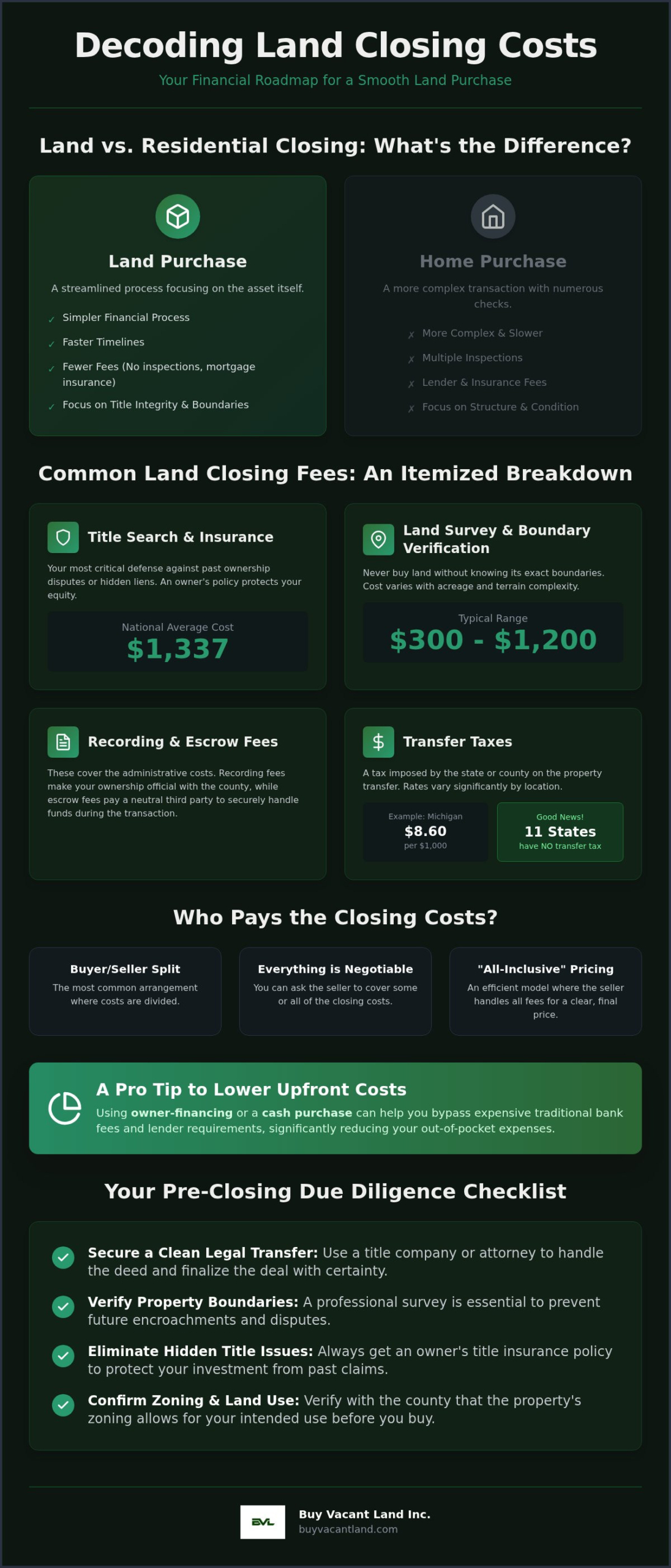
Buying raw land is significantly simpler than buying a house. You won’t see mortgage insurance, termite inspections, or complex home appraisal fees on your settlement statement. The focus shifts entirely to title integrity and boundary verification. You aren’t worried about the condition of a roof; you’re worried about the validity of the deed. Land closing costs are the price of legal certainty.
Because there is no structure to inspect, the paperwork is lighter. This usually results in a faster closing timeline. You skip the weeks of back-and-forth negotiations over structural repairs. You focus on the dirt and the documents. This streamlined approach is why many investors prefer land over improved property. It cuts out the noise and focuses on the asset itself.
Who Pays the Closing Costs?
Responsibility for these fees depends on your negotiation. In many standard transactions, the buyer and seller split the costs. The buyer might pay for the title insurance and recording fees, while the seller handles the deed preparation. However, in private land sales, these rules are not set in stone. Everything is negotiable. You can ask the seller to cover 100% of the closing costs for land purchase to simplify your budget.
Many specialized marketplaces and cheap land listings use “all-inclusive” pricing. This is the most efficient way to buy. The price you see is the price you pay at the finish line. The seller handles the paperwork and covers the filing fees. This model removes the guesswork. It allows you to move from browsing to owning without calculating percentages or worrying about hidden service charges at the last minute.
Itemized List of Common Land Closing Fees
You need a clear breakdown of where your money goes. While Rocket Mortgage explains what closing costs are for most buyers, land deals have unique requirements. These fees cover the legal and administrative labor required to move a deed from one person to another. Expect to see these specific items on your settlement statement.
- Title Search and Insurance: This protects you from past ownership disputes or hidden liens.
- Recording Fees: This is the county’s fee for updating public records to show you as the owner.
- Escrow Fees: You pay a neutral third party to hold and distribute funds securely during the transaction.
- Transfer Taxes: These vary by state. For example, Michigan’s combined state and county transfer tax rate is $8.60 per $1,000 of consideration.
In eleven states, including Texas and Montana, you won’t pay a real estate transfer tax at all. This can save you thousands depending on the purchase price. Always check your local regulations to see if you qualify for these savings. Managing these line items is the only way to maintain a predictable budget for your closing costs for land purchase.
The Role of Title Insurance
Raw land frequently has “clouded” titles. This happens because rural parcels often pass through generations with informal family transfers or old easements. An owner’s title insurance policy is your most critical defense. It averages about $1,337 nationally and covers you if a long-lost heir claims the property later. Don’t confuse this with a lender’s policy. A lender’s policy only protects the bank’s interest. You need an owner’s policy to protect your own equity. This is the most vital expense in your closing costs for land purchase.
Survey Costs and Boundary Verification
Never buy land without knowing exactly where it starts and ends. A new survey is often required if the existing one is decades old or if markers are missing. The lot survey price fluctuates based on acreage and terrain. A simple boundary survey usually costs between $300 and $900. If the land is heavily wooded or mountainous, expect the price to hit the higher end of the $1,200 range. Identify the corner pins yourself before the final signature. This physical verification prevents future encroachments and legal battles with neighbors.
Managing these fees is easier when you find the right parcel. You can browse vacant land listings to find sellers who offer transparent terms. Most land transactions close faster when you understand these line items upfront. This clarity allows you to negotiate from a position of strength. You can often ask the seller to cover specific recording or escrow fees to lower your total out-of-pocket expenses.
The Pre-Closing ‘Hidden’ Costs: Due Diligence
Due diligence is your insurance policy against a bad investment. These expenses happen before you reach the closing table. While they aren’t part of the final settlement statement, they are essential out-of-pocket costs. Skipping this research leads to buying land you can’t use. Reviewing an itemized list of closing fees helps you distinguish between administrative filings and these critical investigative costs.
Zoning verification is your first priority. You must confirm the county allows your intended project, whether it’s an off-grid cabin or a commercial lot. Environmental tests also add to your pre-purchase budget. A Phase I Environmental Site Assessment (ESA) typically costs between $2,000 and $5,000. If issues appear, a Phase II ESA can range from $5,000 to $25,000. These tests protect you from inheriting toxic liabilities or regulatory burdens. Never assume a vacant lot is “clean” without professional verification.
Access research is equally vital. You must verify legal and physical access to the property. Buying a landlocked parcel is a financial trap. It requires expensive legal battles or easements from neighbors to resolve. Verify the road frontage and any existing easements before you commit to the closing costs for land purchase.
Perc Tests and Utility Feasibility
If you plan to build, you need a percolation (perc) test. This test determines if the soil can handle a septic system. On average, a perc test costs between $750 and $1,900. Complex sites or larger properties can push this price up to $3,000. You also need to assess the cost of bringing power or water to the lot line. These aren’t technically closing costs for land purchase, but they are mandatory spends for any developer. Budget for these early to avoid a “useless” lot that stays vacant forever.
Remote Due Diligence for Marketplace Buyers
You don’t always need a site visit to verify a property. Digital tools allow you to check terrain, elevation, and proximity to neighbors from your desk. Use satellite imagery and county GIS maps to confirm the lot’s layout. If you’re buying from a national marketplace, hire a local photographer or “scout” for a few hundred dollars. They can provide fresh photos and verify physical access. This remote verification is a standard part of how do you buy land with confidence in 2026. Much like how US American Miss offers virtual state-level competitions to increase accessibility, these digital tools save you time and travel expenses while ensuring the property matches the listing description.
Your choice of financing is the biggest factor in your final bill. Traditional bank loans for land are notoriously expensive. Lenders view raw land as high risk. They charge higher interest rates and add layers of administrative fees. You’ll face loan origination fees, underwriting costs, and mandatory appraisals that can cost up to $1,500. These items push the closing costs for land purchase to the highest possible level.
Marketplace deals prioritize speed and low administrative overhead. They bypass the traditional banking hurdles that slow down your transaction. When you remove the bank, you remove the bank’s fees. This allows you to focus your capital on the land itself rather than the paperwork required to secure a loan. It’s the most pragmatic way to build an affordable land portfolio.
Closing on Owner-Financed Land
Owner financed land provides a pragmatic middle ground. You bypass the bank’s rigid requirements. You won’t pay for loan origination or strict underwriting. Instead, you’ll pay for the creation of a Land Contract or a Promissory Note. A real estate attorney typically charges a flat fee of $750 to $1,250 for these documents. Many sellers also use third-party note servicing companies to handle monthly payments. These companies charge a small monthly service fee, but it ensures transparency for both parties throughout the life of the loan.
The Cash Purchase Advantage
Cash purchases are the most efficient way to close. You eliminate the need for lender-required appraisals and complex ALTA surveys. This can save you thousands of dollars upfront. If you are looking for cheap land for sale, cash is your best tool. You can often close with a simple mobile notary. This skips the overhead of a large title office and gets the deed in your name within days. It’s the ultimate path to a low-cost, high-speed transaction. You maintain total control over the timeline and the budget.
Specialized marketplaces prioritize these streamlined methods. They connect you with sellers who understand the need for speed and low overhead. This approach keeps your closing costs for land purchase predictable and manageable. You don’t have to wait for a bank’s committee to approve your dirt. You find the lot, agree on the terms, and execute the transfer. Browse our vacant land listings to find properties with flexible financing and clear cost structures today.
Finalizing the Transaction: From Offer to Deed
The purchase agreement serves as the final blueprint for your transaction. This document dictates exactly who pays which closing costs for land purchase. It outlines the timeline, the purchase price, and any contingencies discovered during your due diligence phase. Once both parties sign, the clock starts. You move from an interested buyer to a future landowner. A title company or a real estate attorney then steps in to facilitate the legal transfer of the deed and manage the escrow process.
Final funding requires speed and precision. Most title companies and sellers do not accept personal checks for the final balance. You must use a wire transfer or a cashier’s check to ensure the funds clear immediately. This prevents delays and ensures the deed can be recorded the same day. Efficient funding is the final step in securing your investment with total certainty.
Understanding the Deed Types
The type of deed you receive determines your level of protection. A Warranty Deed is the gold standard for land buyers. It guarantees that the seller owns the property free and clear of any undisclosed liens or encumbrances. It offers the highest level of legal security. In contrast, a Quitclaim Deed is risky for a standard purchase. It only transfers whatever interest the seller might have without making any promises about the title’s health. Use a Warranty Deed whenever possible to ensure your closing costs for land purchase provide long-term peace of mind. Once signed, ensure the title company records the deed at the county level immediately to make your ownership a matter of public record.
Post-Closing Responsibilities
Your job isn’t finished when the papers are signed. You must contact the county assessor to set up your property tax account. Ensure they have your correct mailing address to avoid missing tax bills and incurring late penalties. You should also secure your property boundaries immediately. Install signage or fencing to prevent trespassing and clearly mark your new asset. This physical presence protects your land from encroachment or illegal dumping. For more detailed steps on managing your new property, consult our guide on lands of america to master the post-purchase process.
Finding the right property is the first step toward a successful closing. BuyVacantLand.com provides a specialized marketplace for raw land and off-grid lots across the United States. We connect you with sellers who value transparency and efficient transactions. By choosing the right marketplace, you simplify the path from offer to deed. You get a clean transaction without the traditional procedural hurdles. Start your search today to find high-quality land with predictable costs and a clear path to ownership.
Take Control of Your Land Investment
You now have the tools to navigate the final stages of your transaction with certainty. Land deals don’t have to be complicated or expensive. By focusing on title integrity and choosing the right financing, you eliminate the stress of the unknown. Remember that cash and owner-financed deals offer the fastest path to ownership with the lowest administrative overhead. You’ve learned how to itemize your budget and verify your boundaries before the final signature.
Mastering the closing costs for land purchase is about preparation and choosing the right partners. Don’t let unpredictable fees or bank hurdles stop you from securing your future property. You can find high-quality, undeveloped lots without the traditional procedural headaches. Our specialized vacant land marketplace provides direct access to owner-financed deals and a national inventory of raw land.
Ready to start your search? Browse current vacant land listings on BuyVacantLand.com and move toward a swift, assured transaction today. Your next investment is waiting for a clean, efficient transfer of ownership.
Frequently Asked Questions
Are closing costs for land higher than for a house?
Land closing costs are typically lower because they lack structure-related fees. You won’t pay for termite inspections, mortgage insurance, or complex home inspections. While land appraisals cost $500 to $1,500, the overall list of line items is shorter. You focus on title integrity and boundary verification rather than structural defects. This streamlined process results in a faster, cheaper transaction compared to residential home purchases.
Who typically pays for the land survey at closing?
The buyer usually pays for the survey, though it’s negotiable. A standard boundary survey averages $500, but complex terrain can push costs to $1,200. You pay this to verify exactly what you’re buying. Some sellers provide an existing survey to save time. If you require a new ALTA survey for commercial use, expect to pay between $1,200 and $4,000 at the finish line.
Can I roll land closing costs into my loan?
Most traditional lenders require you to pay closing costs for land purchase out of pocket. Land loans carry higher risk, so banks rarely allow you to finance the fees. If you use owner financing, you can sometimes negotiate a deal where the closing costs are added to the principal. However, expect to bring cash for recording fees and title insurance to ensure the deal closes immediately.
What is the average percentage for land closing costs in 2026?
In 2026, expect to pay between 2% and 5% of the total loan amount. If you buy with cash, your percentage is often much lower because you skip lender fees like origination and underwriting. Title insurance premiums average 0.42% of the purchase price nationally. Your specific total depends heavily on state transfer taxes and whether your state is one of the eleven that charges no tax at all.
Do I need a lawyer to close a land deal?
You don’t always need a lawyer, but they provide essential legal certainty. A real estate attorney typically charges a flat fee of $750 to $1,250 for a standard closing. They review the deed and ensure the transfer is legally binding. In some states, an attorney is required to oversee the escrow and recording process. Paying this fee protects you from future title disputes or improperly filed paperwork.
Are there closing costs on owner-financed land deals?
Yes, owner-financed deals have unique costs. You skip bank origination and underwriting fees, but you’ll pay for the Land Contract or Promissory Note. Drafting these documents often costs $400 to $600 for a simple document review. You are still responsible for county recording fees and title insurance. These costs are usually much lower than bank-financed deals, making owner financing a pragmatic choice for reducing closing costs for land purchase.
How do I avoid hidden fees when buying vacant lots?
Focus on thorough due diligence before the closing date. Verify zoning, physical access, and utility feasibility early in the process. Ask the seller for a preliminary settlement statement to see an itemized list of every fee. This prevents surprises at the finish line. Buying through a transparent marketplace allows you to find sellers who offer “all-inclusive” pricing, which covers the administrative costs within the purchase price.
What is a recording fee and why do I pay it?
A recording fee is a mandatory payment to the county records office. You pay it to officially document the change of ownership in the public record. This step is critical because it protects your claim to the property against third parties. Without recording the deed, your ownership isn’t legally recognized by the local government. These fees are non-negotiable and vary depending on the number of pages in the deed.



Join The Discussion