
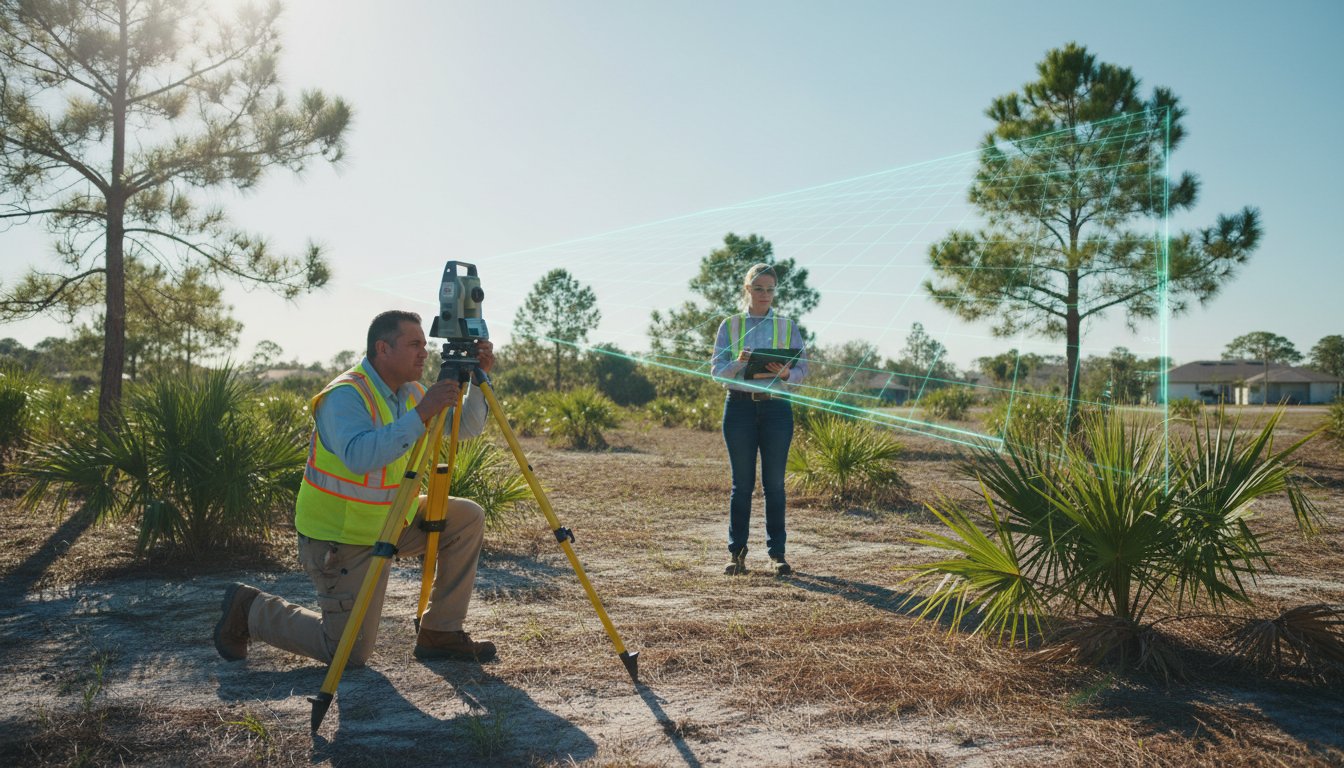
A single boundary dispute can cost you $20,000 in 2026. Most landowners skip the survey to save a few hundred dollars, only to watch their sale collapse at the closing table. You’ve worked hard for your property. You deserve a clean transaction without the stress of hidden costs or legal battles. It’s frustrating to feel like you’re overpaying for services when you just want to move on. You need to know the exact lot survey price before you commit your cash to a professional.
You already believe that land ownership should be simple. We agree. This guide provides a direct, no-nonsense breakdown of current costs and shows you how a survey helps you sell your land faster. You’ll learn which survey type is actually required and how to avoid the common pitfalls that kill deals. We’re covering the 2026 price ranges, the specific requirements for different lot sizes, and the fastest path to a guaranteed sale with zero commissions or hidden fees. Stop guessing and start closing.
Key Takeaways
- Stop guessing where your property ends and learn why a legal survey is the only way to guarantee what you own.
- Identify the specific factors that impact your lot survey price and get accurate 2026 cost estimates for any size property.
- Compare boundary and ALTA surveys to choose the most cost-effective documentation for your specific land sale.
- Master the three-quote strategy and use existing records to slash your survey expenses and save time.
- See how a pre-completed survey removes buyer friction and helps you secure a guaranteed cash offer faster.
What is a Lot Survey and Why Does Price Vary?
A lot survey is the legal determination of your property boundaries and physical features. It’s a precise map that shows exactly where your land starts and stops. For vacant land owners, a survey provides the only 100% guarantee of what you own. You can’t rely on old fences or word-of-mouth. Surveying is a technical discipline that protects your investment from boundary disputes. It identifies easements, setbacks, and topography that impact your property value.
The lot survey price varies based on two main factors: legal complexity and physical terrain. In 2026, technology is changing the cost structure. Drones equipped with LIDAR now reduce field labor time by 40% compared to 2021 standards. However, if your property has a complex “metes and bounds” description dating back to 1920, the research costs will remain high. Tech handles the measurements, but experts must still interpret the history. Dense brush or steep hills also increase the lot survey price because they slow down the field crew.
The Legal Necessity of a Survey
Title companies and lenders require a fresh survey for approximately 95% of vacant land sales. They won’t risk their money on an old map. A survey stops a 10,000 dollar lawsuit before it starts by identifying encroachments. This happens when a neighbor’s fence or shed sits on your land. Don’t confuse a “recorded plat” with a physical survey. A plat is a general map filed with the county years ago. A physical survey involves a professional walking your dirt to set iron pins today. It’s the only way to secure a clean title and a fast closing.
Surveyor Credentials and Professional Fees
You must hire a Licensed Professional Land Surveyor (PLS). Their signature carries legal weight in court. Professional liability insurance costs for surveyors have risen 15% since 2024. This expense is baked into your quote. The process follows a strict two-step path:
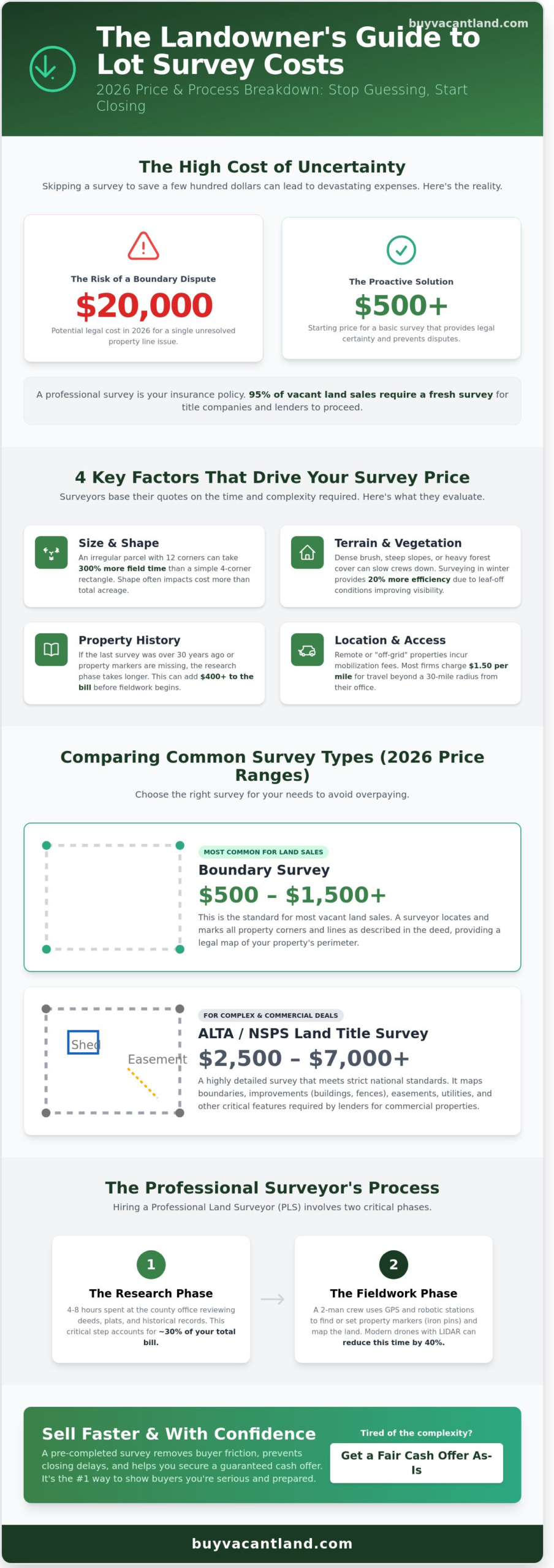
- The Research Phase: The PLS spends 4 to 8 hours reviewing deeds, maps, and historical records at the county office.
- The Fieldwork Phase: A crew uses GPS and robotic stations to mark the corners of your property.
Research costs usually take up 30% of your total bill. If your property hasn’t been surveyed in over 30 years, expect the research phase to take longer. This professional work ensures your transaction is free of errors and legally sound. It gives you the peace of mind needed to sell your land with confidence.
Key Factors That Drive Your Land Survey Estimate
Your final lot survey price depends on four specific variables. It isn’t a random guess. Professionals calculate their bids based on the labor hours required to certify your boundaries. Most surveyors in 2026 charge between $150 and $250 per hour for a two-man field crew. Every obstacle on your land adds hours to that clock.
Size and Complexity of the Parcel
A 40-acre tract doesn’t cost 40 times more than a 1-acre lot. Fixed costs like courthouse research and mobilization apply to every job regardless of size. A 1-acre boundary survey might cost $800, while a 40-acre survey often averages $3,500 to $5,000. The shape matters more than the acreage. A simple rectangle has four corners. A jagged, irregular parcel with 12 corners requires 300% more field time to locate and stake. If your neighbors dispute the property line, expect the price to climb. Surveyors must spend extra time verifying historical deeds to ensure the map meets the standards of the National Society of Professional Surveyors (NSPS).
Environmental and Seasonal Impacts
Thick vegetation is a major budget killer. If a crew has to hack through dense briars or navigate steep 30-degree slopes, the lot survey price will reflect that physical labor. Winter is actually the best time to survey wooded land. Leaf-off conditions improve visibility and allow crews to work 20% faster than in mid-summer. Heavy forest cover also creates “multipath” interference for GPS equipment. When satellite signals are blocked, crews must use traditional manual tools. This process is precise but takes twice as long as modern GPS methods.
Historical records and travel logistics also dictate your quote. If your land is “off-grid” or remote, expect a mobilization fee. Many firms charge $1.50 per mile for travel beyond a 30-mile radius from their office. The difficulty of finding “monuments” is another factor. If iron pins from a 1965 survey are missing, the surveyor must pull records for the entire block to find a reliable starting point. This research phase can add $400 to your total bill before a crew even sets foot on the dirt.
Managing these variables is a headache for many owners. If the cost and complexity of a survey feel like too much of a burden, you can get a fair cash offer for your property as-is. We buy land in its current condition, saving you the expense of professional boundary work.
Comparing Common Survey Types and 2026 Price Ranges
Your lot survey price isn’t a single flat fee. It changes based on what you want to do with the land. Don’t pay for a commercial-grade report if you just want to sell a small residential lot. Choose the right tool for the job to keep your costs low and your closing fast.
- Boundary Survey ($500 – $1,500): This is the standard for most vacant land sales. It identifies property corners and lines for small lots. It’s the minimum you need for a clean transfer of deed.
- ALTA/NSPS Survey ($2,000 – $5,000+): Professionals call this the “gold standard.” It’s required for most commercial land deals. It covers easements, zoning, and every existing improvement on the site.
- Topographic Survey ($800 – $2,500): You need this for construction or development planning. It maps the contours, trees, and elevation of the land. Architects won’t start a project without one.
- Subdivision Survey: Use this when you want to split one large parcel into smaller lots. Prices vary by county regulations, but expect high costs due to the legal filing requirements.
Which Survey Do You Actually Need?
Match the survey type to your specific goal. If you’re building a house, a simple boundary survey won’t work. You need a topographic report to plan for drainage and foundations. If you’re just putting up a fence, a “stake-out” is cheaper. However, a stake-out is not a legal document for a property sale. It won’t satisfy a title company or a picky buyer.
Don’t fall into the “Mortgage Survey” trap. Banks often order these simple inspections to protect their own interests. They aren’t precise enough for buyers to use for building or permanent record-keeping. Understanding when you might need a land survey helps you avoid paying twice for the same land. Get a professional boundary survey if you want a guaranteed, hassle-free sale in 2026.
Estimated Cost Breakdown by Acreage
Size is the biggest factor in your final lot survey price. Larger tracts take more time to traverse and mark. A surveyor might spend three hours on a city lot but three days on a mountain tract. Terrain also plays a role. Thick brush or steep hills can increase these 2026 estimates by 25% or more.
- Residential lot (under 1 acre): $400 – $900.
- Small acreage (1-5 acres): $1,000 – $2,500.
- Large tracts (10+ acres): $2,500 – $10,000+.
A flat, cleared lot is always cheaper to survey than a wooded hillside. If your property has clear markers from a previous survey, your costs might sit at the lower end of these ranges. Always ask for a fixed quote before the crew arrives on-site.
How to Secure a Fair Quote and Minimize Survey Expenses
You can control your lot survey price by reducing the surveyor’s workload. Efficiency saves money. If you provide the right data upfront, you eliminate hours of billable research. Surveyors charge for their time and their expertise. Don’t pay them to do tasks you can handle for free.
Preparing Your Documentation
Hand over your existing deed and any historical maps immediately. A clear legal description reduces research time by 2 to 4 hours. Visit the County Recorder’s office yourself to pull old records. This is zero-cost research that prevents the surveyor from starting from scratch. If you know where old iron pins are located, flag them with bright tape. Finding these markers gives the field crew a head start and can shave 15% off the total labor cost.
Vetting Your Land Surveyor
Get exactly three quotes from local, independent professionals. Large firms often have higher overhead that inflates your lot survey price. Ask specific questions before signing a contract:
- Do you specialize in raw land or high-density residential lots?
- Does this quote include physical staking and a signed, sealed map?
- What is the guaranteed turnaround time?
A cheap quote often comes with a hidden cost. If a surveyor takes 8 weeks to finish a job that a slightly more expensive peer can do in 14 days, you lose money on holding costs. Always demand a written scope of work that includes “staking” to ensure boundaries are physically marked on the ground.
Cutting Field Costs Manually
Surveyors often charge $150 per hour for field labor. If your property line is buried in thick brush, you are paying professional rates for landscaping work. Clear the line of sight yourself. Use a weed eater or chainsaw to create a path between corners. This simple step can save you $300 to $600 on a standard one-acre lot.
Coordinate with your neighbors to save even more. If three neighbors survey their adjoining lines at once, the surveyor only bills for one mobilization fee. This strategy typically reduces individual costs by 20%. It also prevents future boundary disputes by getting everyone to agree on the markers at the same time.
If the cost and effort of surveying your property feel like a burden, there is a faster way out. Skip the stakes and the stress entirely. Get your fair cash offer today and sell your land exactly as it is.
Using Your Survey to Sell Land Fast for Cash
A pre-completed survey is your most powerful tool to close a deal quickly. Most land sales stall because the buyer spends 30 days or more waiting for a surveyor to visit the property. When you list on BuyVacantLand.com with a survey already in hand, you eliminate this friction. You provide immediate proof of what you own. This transparency builds trust with cash buyers who want to move fast. You aren’t just selling dirt; you’re selling a “ready-to-go” asset.
Investing in a survey allows you to sell land without a realtor. You don’t need an agent to explain the property boundaries when you have a certified document. This saves you the standard 6% commission. You keep that money in your pocket. While the average lot survey price in 2026 ranges from $500 to $1,500 for standard parcels, this small investment justifies a higher asking price. Buyers pay a premium for the peace of mind that comes with certified boundary data. It turns a complex transaction into a simple exchange of cash for a verified property.
Selling land doesn’t have to be a multi-month headache. You can bypass the traditional market entirely. When you have your survey ready, you’ve already completed the hardest part of the sale. You provide the solution before the buyer even asks the question. This proactive approach is how smart landowners secure a guaranteed transaction without the typical red tape.
Marketing Your Surveyed Land
Your listing needs to stand out. Use the phrase “Surveyed and Staked” in your title to grab attention immediately. This signal tells professional investors that the heavy lifting is done. Upload the survey map as your second or third primary image. Don’t hide it in a folder. Visual proof of access points and easements attracts serious cash buyers. These buyers often close in as little as 10 days because they don’t have to wait for a surveyor’s schedule to open up. You win by being prepared.
Finalizing the Sale
The survey simplifies the title insurance process. Title companies use these documents to clear specific exceptions in your policy. This makes the closing process 15% faster on average. If you are selling based on a price-per-acre model, the survey provides the exact acreage to the third decimal point. There is no guessing. This precision prevents last-minute price renegotiations that often happen when acreage is estimated. List your vacant land for sale on our marketplace today to reach a targeted network of buyers ready to pay cash for your surveyed property.
Turn Your 2026 Survey Into Immediate Cash
Navigating your lot survey price in 2026 requires a clear understanding of current market rates. Most residential landowners should budget between $500 and $1,050 for a standard boundary survey this year. This document is more than just a map; it’s a tool that removes 100% of the uncertainty for your future buyer. By identifying exact property corners now, you prevent costly legal delays later. You’ve learned how terrain and acreage impact your bottom line. Don’t let that knowledge sit idle while property taxes continue to drain your bank account.
The fastest way to realize the value of your land is to put it in front of people ready to pay. List your vacant land for sale on our marketplace today and skip the traditional real estate runaround. Our system provides direct access to cash land buyers who are looking for properties just like yours right now. You’ll pay 0% in commissions and exactly $0 in hidden fees. We use a simplified 3-step listing process to get your property live in minutes. It’s the most efficient way to secure your fair cash offer. Take control of your asset and start the closing process today.
Frequently Asked Questions
How long does a typical lot survey take to complete?
A professional lot survey usually takes between 5 and 10 business days from the moment you sign the contract. The field crew spends 3 to 6 hours on your property marking corners and taking measurements. After the field work, the office staff needs another 3 to 5 days to research historical deeds and draft the final map. If your land is over 10 acres or has heavy brush, expect the process to take up to 15 days.
Can I use an old survey from 10 years ago to sell my land?
You usually cannot use a survey that is 10 years old because most title companies and lenders require a document dated within the last 6 to 12 months. Property lines can shift due to new fences, utility installations, or local erosion. Using an outdated map increases the risk of a boundary dispute by 25 percent. We buy land in any condition, so you don’t have to worry about the lot survey price or finding old paperwork when you sell to us.
Is a land survey required by law to sell vacant land?
No state law requires a survey for every private land sale, but 90 percent of mortgage lenders demand one before they fund a loan. Title insurance companies also require a recent survey to provide coverage against boundary overlaps. If you sell your land for cash to a private buyer, you can often skip this requirement entirely. This saves you the $500 to $1,200 cost of a new survey and speeds up your closing by 2 weeks.
What is the difference between a boundary survey and an ALTA survey?
A boundary survey identifies the corners and property lines of your land for residential use. An ALTA survey follows the strict 2021 standards set by the American Land Title Association and is typically used for commercial transactions. Boundary surveys for a standard 1-acre lot cost roughly $450 to $800. ALTA surveys are much more detailed and start at $2,500 because they include information on zoning, water boundaries, and detailed easements.
Do I need to be present when the surveyor visits the property?
You don’t need to be present when the surveyor arrives to map your land. The crew only needs physical access to the property corners and any existing markers. About 95 percent of our transactions proceed without the owner ever meeting the surveyor on-site. This saves you time and prevents unnecessary travel. Just make sure any locked gates are open or provide the 4-digit access code to the surveying firm at least 24 hours in advance.
Can a surveyor settle a boundary dispute with my neighbor?
A surveyor provides the expert evidence needed for a resolution, but they don’t have the legal power to settle a dispute. Only a signed boundary line agreement or a 2024 court order can legally change or finalize a contested line. The surveyor’s job is to locate the line based on the legal description in your deed. If your neighbor disputes the markers by more than 3 inches, you may need to hire a real estate attorney to finalize the matter.
Does the buyer or the seller usually pay for the survey?
The buyer typically pays for the survey in 65 percent of traditional real estate deals, though this is always a negotiable item. In states like Florida or Texas, sellers often provide an existing survey or pay for a new one to move the deal forward. When you sell your land to us, you pay zero out-of-pocket costs. We cover the entire lot survey price and all closing fees, ensuring you get your fair cash offer without any hidden deductions.
What happens if the survey shows my land is smaller than the deed says?
If the survey reveals a smaller acreage than the deed describes, the buyer will likely ask for a price reduction. A 3 percent to 5 percent discrepancy is common in older deeds from the early 1900s. You might need to file a corrective deed with the county clerk to fix the legal record. We specialize in buying land with these types of title issues, so you can still get a fast and guaranteed closing regardless of the final acreage count.



Join The Discussion