
Most people think buying dirt is simple. It isn’t. In fact, industry data shows that 30 percent of raw land buyers encounter zoning hurdles that stop their projects entirely before they even break ground. If you are asking yourself how do you buy land without losing your savings, you aren’t alone. You want a piece of the map to call your own, but you’re likely tired of banks rejecting land loan applications or feeling paralyzed by the fear of buying a lot you can’t actually use.
You deserve a straightforward path to ownership. This 2026 guide provides the clear roadmap you need to verify your property’s potential and secure your title with total confidence. We cut through the red tape to help you find affordable parcels that fit your specific needs. We break the entire process down into a simple sequence covering professional due diligence, smart financing alternatives, and a fast path to a guaranteed closing. Stop guessing and start building your future on solid ground today.
Key Takeaways
- Master the 5-step process to secure vacant land with speed and certainty.
- Use our non-negotiable checklist to verify zoning and legal access before you commit to a deal.
- Understand how do you buy land using cash strategies to bypass high interest and bank delays.
- Find the perfect lot on specialized marketplaces that cut through the noise of traditional real estate.
What Does It Mean to Buy Vacant Land in 2026?
Buying vacant land is the most direct path to property ownership. In 2026, the process remains a powerful way to build wealth and secure your future. What is Vacant Land? Legally, it’s real property without existing structures or active utility connections. You aren’t paying for a finished kitchen, a roof, or a garage. You’re paying for the dirt and the future possibilities it holds. This distinction is vital. When you buy a house, you pay for someone else’s choices. When you buy land, you make your own.
The benefits are clear and immediate. Entry costs are lower than any other real estate sector. You can often secure a parcel for a fraction of the price of a developed home. This gives you total creative freedom. You decide what happens next. Land also serves as a reliable hedge against inflation. Market data from 2025 shows that rural land values in several growth corridors increased by 5.8% annually. If you want to understand how do you buy land, you must adopt a due diligence mindset. Success requires checking zoning, access, and soil quality before you sign any paperwork. Do the work early. It saves you from expensive mistakes later.
Raw Land vs. Developed Lots
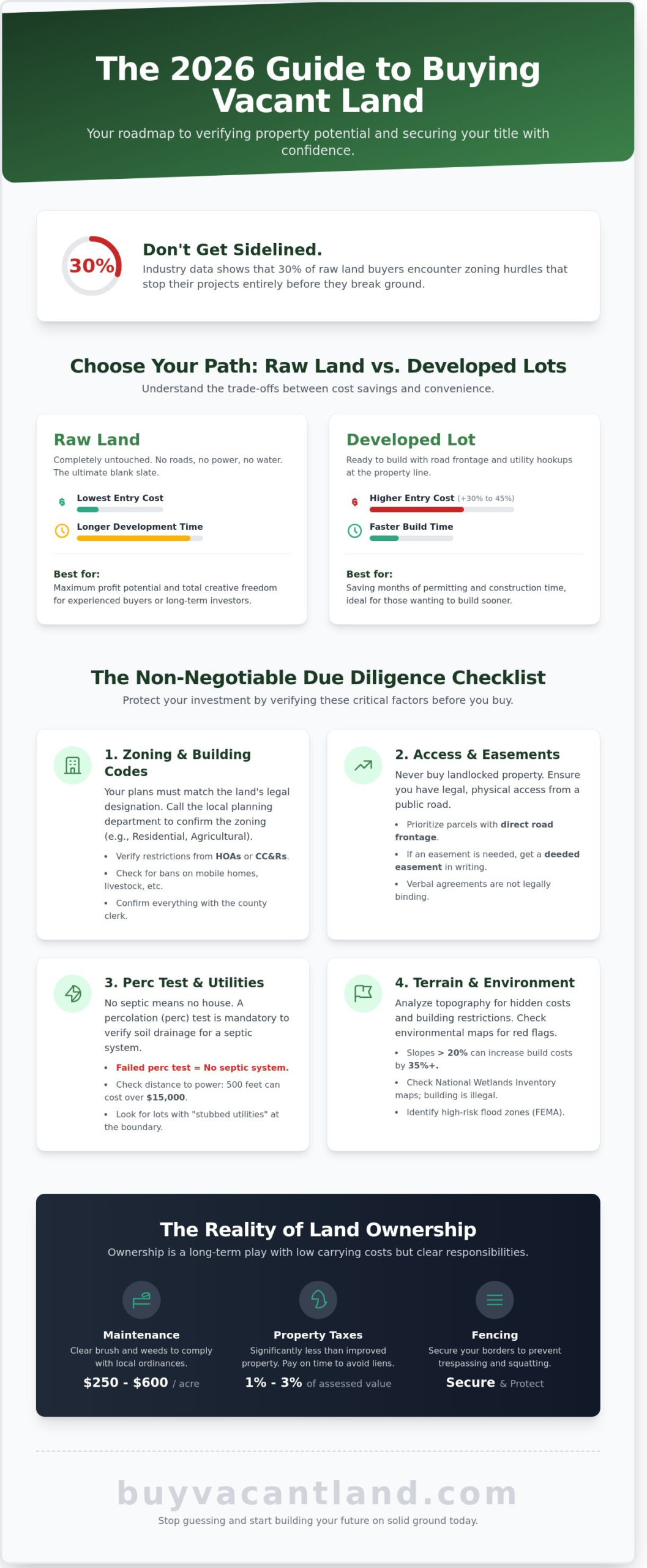
Raw land is completely untouched. It has no road access, no power, and no water. It’s the cheapest way to buy, but it requires heavy lifting. You’ll need to install every piece of infrastructure yourself. Developed lots are different. These parcels have road frontage and utility hookups ready at the property line. You’ll pay 30% to 45% more for a developed lot, but you save months of permitting and construction time. Choose raw land for maximum profit potential. Choose developed lots for a faster build time.
The Reality of Land Ownership
Owning land is a long-term play. Most investors use a buy and hold strategy. This works because carrying costs are low. Property taxes on vacant land typically range from 1% to 3% of the assessed value, which is significantly less than improved residential property. You won’t deal with broken toilets or tenant complaints. However, you still have responsibilities:
- Maintenance: You must clear brush or manage weeds to stay compliant with local ordinances. Expect to pay $250 to $600 per acre for professional clearing.
- Fencing: Securing your borders prevents trespassing and squatting.
- Taxes: Pay these on time to avoid government liens or tax foreclosures.
The process doesn’t have to be hard. We focus on speed and simplicity. If you’re wondering how do you buy land without the stress, look for sellers who offer a clear path. We eliminate the middleman. That means zero commissions, zero fees, and zero closing costs. You get a direct transaction that values your time and provides immediate peace of mind.
Conducting Due Diligence: The Non-Negotiable Checklist
Buying land requires more than a handshake. You need cold, hard facts. Researching the parcel prevents expensive mistakes. This is the core of how do you buy land safely and effectively. Skip this step and you risk owning a worthless dirt patch. Follow this checklist to protect your investment.
Zoning and Building Codes
Call the local planning department immediately. Ask for the specific zoning designation. Residential, agricultural, and commercial zones have different rules. Unrestricted land sounds like freedom, but it often still has county-level health and safety codes. Always check for Homeowners Association (HOA) rules or Covenants, Conditions, and Restrictions (CC&Rs). These private rules can ban mobile homes or livestock even if the county allows them. Verify everything with the county clerk to ensure your plans are legal.
Access and Easements
Never buy landlocked property. If you can’t drive to it from a public road, walk away. Beginners should avoid parcels without direct road frontage. An easement is a legal right to cross someone else’s land to reach your parcel. Get this in writing. A deeded easement stays with the land. A verbal agreement vanishes when the neighbor sells. If you’re looking at rural options, a USDA loan might require specific access standards for approval. Ensure the title report confirms legal access before you sign.
The Perc Test and Utilities
You need a percolation (perc) test before you buy. This test measures how fast water drains through the soil. If the soil fails, you can’t install a septic system. No septic means no house. Check the distance to the nearest power pole. Bringing electricity 500 feet can cost over $15,000 depending on the local utility provider. Look for land lots for sale that already have stubbed utilities. This means water and power lines are already at the property boundary, saving you thousands in site prep costs.
Terrain and Environmental Constraints
Analyze the topography carefully. Slopes greater than 20% increase construction costs by 35% or more. You’ll spend your budget on retaining walls instead of your home. Check the National Wetlands Inventory maps. Building on protected wetlands is illegal. It will stop your project instantly. Look for these red flags early:
- Standing water or marsh plants.
- Extreme rock outcroppings that require blasting.
- High-risk flood zones identified by FEMA.
If the technical details of land ownership feel like too much of a burden, you can always get a fair cash offer for your property and move on to your next goal. Efficiency is the key to successful real estate transactions. Do the work now or pay for it later.
How to Pay for Land: Financing and Cash Strategies
Traditional banks hate raw land. They view it as a speculative risk because there is no structure to serve as collateral. Most conventional mortgages require a finished home to secure the loan. If you are asking how do you buy land without a house already on it, you must look beyond big-box lenders. Land-specific lenders, such as farm credit bureaus, do offer loans. However, they typically demand down payments of 30% to 50%. This high barrier keeps many beginners out of the market. You need a strategy that bypasses these hurdles. For a comprehensive breakdown of every financing option available, our complete guide to how to buy land in 2026 covers evaluation, financing, and closing strategies in full detail.
Cash is King in Land Sales
Owner Financing: The Land Buyer’s Secret
Owner financing bypasses the banking system entirely. You pay the seller directly in monthly installments. It is a private agreement between two parties. This strategy is the best way to answer the question of how do you buy land when you have limited capital. If you want to master every detail of this approach, our complete guide to owner financed land walks you through the exact five-step process to find, negotiate, and close your deal without a single bank interview. The benefits are clear:
- Flexible Terms: You negotiate the down payment and interest rate directly with the seller.
- No Credit Red Tape: Sellers often care more about your down payment than your credit score.
- Zero Bank Fees: You skip the loan origination fees and strict banking oversight.
You must use a formal, written contract for these deals. This document protects your equitable interest in the property. Without a recorded land contract or deed of trust, you risk losing your investment if the seller faces legal issues. Always ensure the agreement clearly defines the payment schedule and the process for transferring the title once you pay the final balance. This method turns a complex real estate transaction into a simple, manageable monthly expense.
The 5-Step Process to Buying Your First Parcel
Buying land isn’t like buying a house. You need a process that cuts through the noise and protects your capital. First, define your goals. Are you building a homestead, starting a farm, or holding for investment? Set a firm budget before you look at a single acre. This clarity saves weeks of wasted time. Once your finances are ready, you can focus on the technical details of how do you buy land efficiently.
Step 1: The Targeted Search
Don’t waste time on generic real estate sites. Most platforms prioritize residential houses and bury raw acreage in deep menus. You need specialized marketplaces to find lots for sale near me that fit your specific criteria. Use a professional search guide to filter results by topography and utility access. Look for ‘For Sale By Owner’ (FSBO) listings. These deals often eliminate the standard 6% agent commission. This puts more equity in your pocket from day one.
Step 2: The Offer and Contract
Once you find a parcel, submit a formal purchase agreement. This document is the foundation of how do you buy land without legal headaches. It must include the price, legal description, and closing date. Include strong contingencies. A perc test contingency is mandatory if you plan to install a septic system. If the soil fails to drain, you walk away with your deposit. Submit an earnest money deposit, typically $1,000 or 1% of the purchase price, to show the seller you’re a serious buyer.
Step 3: Closing and Title
The closing phase is where the legal transfer happens. Hire a title company or a real estate attorney to manage the paperwork. They perform a title search to ensure no hidden liens, back taxes, or boundary disputes exist. Purchase title insurance. It’s a one-time fee that protects your ownership against future claims. This step is non-negotiable for protecting your investment. The final step of buying land is the recording of a new deed at the county office.
Ready to simplify your property journey? Get your fair cash offer and close your transaction without the traditional real estate red tape.
Finding the Perfect Lot on a Specialized Marketplace
Finding the right property is the final hurdle in your journey. You already know the technical steps for how do you buy land, but the actual search often feels like finding a needle in a haystack. BuyVacantLand.com changes that. This platform focuses exclusively on raw acreage and vacant lots. You won’t find suburban houses or commercial buildings here. You find land. Whether you need a 40 acre hunting tract or a 0.25 acre residential lot for a custom build, the listings are curated specifically for land buyers.
The marketplace model is built on transparency. Direct-to-seller platforms remove the noise of traditional real estate. You don’t have to worry about inflated prices meant to cover massive marketing budgets. Instead, you get a direct line to the source. This simplicity is the most efficient way to secure a property in 2026. It’s about getting you from a search result to a deed in the shortest time possible.
Why Specialized Marketplaces Win
General real estate sites are cluttered. They prioritize high commission residential sales over vacant land. BuyVacantLand.com provides precision. You can narrow down 1,000 listings to the 5 that actually matter in under 60 seconds. Use specialized filters to sort by acreage, price, and intended use. This saves you hours of research. You won’t waste time looking at properties that don’t fit your vision.
The direct connection between buyers and motivated owners is a game changer. Understanding how do you buy land becomes much easier when you remove the middleman. Traditional agent commissions for land can reach 10 percent of the sale price. By using a specialized marketplace, you bypass these high fees. This keeps more cash in your pocket for development or investment. The process is lean, fast, and focused on results.
- No Clutter: Every listing is a piece of land, not a fixer-upper house.
- Direct Access: Speak directly with sellers to get questions answered fast.
- Zero Commissions: Avoid the high costs of traditional real estate agents.
- Speed: Streamlined platforms allow for faster closings and less paperwork.
Taking the Next Step
The path to ownership is clear. Stop scrolling through cluttered sites and start looking at real opportunities. Start your search for the perfect parcel on BuyVacantLand.com today!
Secure Your 2026 Land Investment Today
Buying land doesn’t have to be a slow or confusing process. You’ve learned the 5-step framework and the essential due diligence steps required for a safe transaction in the current market. Knowing how do you buy land in 2026 means prioritizing speed and direct data. Current 2025 industry data indicates that rural land demand remains high, with inventory levels in key growth states like Texas and Florida shifting 15% faster than in previous years. You don’t want to wait while prices climb. Use the checklist. Secure your financing. Move with confidence.
We’ve built a specialized land-only marketplace that gives you direct access to land owners across the entire United States. This national coverage ensures you find the exact lot you need without the usual real estate headaches or middleman delays. We remove the fluff and focus on results. You get a streamlined path to ownership with zero unnecessary fees. It’s time to build your portfolio or find your getaway spot with a partner that values your time. Your future property is ready for you to claim it.
Find your next investment: browse vacant land listings now!
Start your journey now and turn your property goals into a reality.
Frequently Asked Questions
Is buying land a good investment in 2026?
Buying land is a solid investment in 2026 because the supply of developable property remains finite while population growth continues. National land values have shown a historical average annual appreciation of 3% to 5% according to Federal Reserve data. You gain a tangible asset that doesn’t depreciate like a vehicle or require the constant maintenance of a rental house.
Investors prioritize land during inflationary periods to hedge against currency devaluation. It’s a low-overhead strategy for long-term wealth building. You won’t deal with leaking roofs or broken HVAC systems. Your primary costs are just property taxes and insurance.
Can I get a loan to buy vacant land?
You can get a loan for vacant land, though lenders typically require higher down payments than traditional home mortgages. Expect to provide a 20% to 50% down payment depending on the land type and your plans for development. Local credit unions and the USDA often provide the most competitive rates for raw acreage in rural areas.
Land loans are considered higher risk by banks, so your credit score should be above 680 for the best terms. Lenders will also want to see a professional land survey and a clear plan for the property. If you’re building immediately, a construction-to-permanent loan is often your best financial path.
What is the biggest mistake people make when buying land?
The biggest mistake is failing to verify zoning laws and utility access before closing the deal. Research shows 1 in 4 buyers discover hidden restrictions after the sale that prevent them from building. Always check if the soil passes a percolation test for septic systems before you commit your cash.
Without a “perc” test, you might own a lot you can’t legally inhabit. This error turns a cheap investment into a permanent financial burden. Never take a seller’s word for it. Verify every claim with the county planning department yourself.
How much are closing costs for a land purchase?
Closing costs for a land purchase usually range between 2% and 5% of the total sale price. These costs cover title insurance, recording fees, and escrow services. If you want to know how do you buy land without these extra expenses, some direct cash buyers cover 100% of these fees to simplify the process.
Always review the Settlement Statement 24 hours before your scheduled closing date to avoid surprises. You’ll see line items for property tax prorations and any transfer taxes required by your state. Keeping these costs low helps you maintain a better profit margin on your investment.
Do I need a real estate agent to buy land?
You don’t need a real estate agent to buy land, as many transactions happen directly between the buyer and seller. Approximately 10% of real estate transactions are “For Sale By Owner” according to NAR reports. Buying direct saves you from paying a 5% to 6% commission fee that typically gets baked into the price.
Use a reputable title company or a real estate attorney to handle the paperwork and ensure a legal transfer. They’ll perform a title search to make sure no old liens or back taxes exist. This approach keeps your transaction fast and cuts out the middleman.
What happens if I buy land that is landlocked?
Buying landlocked property means you have no legal right to cross neighboring parcels to reach your own lot. You must negotiate an easement with an adjacent owner or file a lawsuit for an “easement by necessity” to gain access. Legal fees for these cases can exceed $5,000 in many jurisdictions and take months to resolve.
Always confirm a recorded easement exists in the county records before you sign any contracts. A property without a legal road or driveway access is often worth 50% less than accessible land. Don’t assume a dirt path on the ground equals legal access.
How do I verify who actually owns a piece of land?
You verify ownership by visiting the local County Assessor’s website or the Register of Deeds office. These public records list the current owner of record and any existing liens or encumbrances. This step is a critical part of learning how do you buy land safely while avoiding potential title fraud or scams.
Cross-reference the parcel ID number with the physical address to ensure accuracy. If the person selling the land isn’t the person on the deed, walk away immediately. A professional title search is the only 100% guaranteed way to confirm the chain of ownership.
Can I build a tiny house or park an RV on any vacant lot?
You cannot build a tiny house or park an RV on every lot because local zoning codes vary significantly by county. Over 70% of residential zones in the United States require a minimum square footage for dwellings that tiny homes don’t meet. Many counties also prohibit RV living for more than 30 consecutive days.
Check the specific “Use Table” in the municipal zoning ordinance to see what’s permitted on your specific parcel. Look for “minimum dwelling size” and “temporary occupancy” rules. Ignoring these regulations can lead to daily fines starting at $100 or more until the violation is cleared.


Join The Discussion