
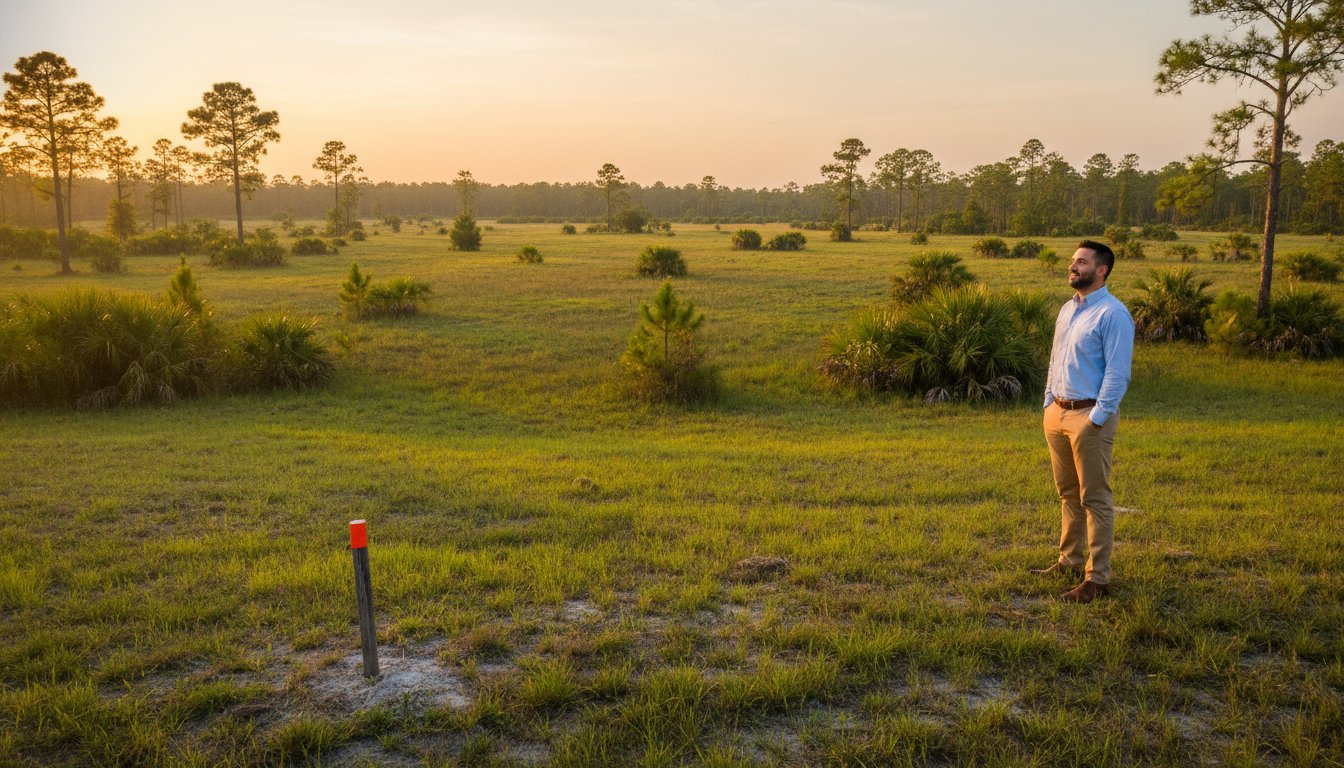
Most buyers spend 180 days searching for land for sale only to walk away because a bank denied their loan or a hidden zoning law killed the project. You know that finding the right dirt is only half the battle. Dealing with traditional lenders and confusing county regulations feels like a full-time job you didn’t sign up for. It’s frustrating to watch a perfect opportunity slip away because of paperwork and red tape.
This guide changes that. We provide a pragmatic framework to help you secure raw land without the stress. You’ll learn how to use owner financing to skip the bank and how to spot hidden development costs before you sign a contract. We’ll show you exactly how to evaluate a property’s potential in under 20 minutes so you can move forward with confidence. Our goal is to replace your uncertainty with a guaranteed path to ownership.
We’re cutting through the noise to give you a clear path to property ownership. We break down the 2026 framework for acquiring land with zero commissions and zero hidden fees. This is your no-nonsense roadmap to finding, evaluating, and securing your next property today.
Key Takeaways
- Learn why raw land is the strongest hedge against 2026 inflation and a direct path to self-sufficiency.
- Categorize your search by intended use to find the right property faster and bypass irrelevant listings.
- Master a no-nonsense checklist to verify legal access and zoning for any land for sale before you commit.
- Navigate the complex world of land financing and learn why cash offers eliminate traditional real estate red tape.
- Discover how to use a specialized marketplace to find raw land deals without the noise of bloated real estate sites.
The 2026 Landscape of Land for Sale in the United States
Buying land for sale is a strategic move, not a standard residential transaction. In 2026, vacant land stands as a specialized asset class. It operates under different rules than the housing market. To succeed, you must understand the fundamentals, starting with what is a land lot and how its zoning affects your future plans. Investors are currently moving toward land to secure tangible value. It’s a hedge against currency shifts and a foundation for self-sufficiency. The 2026 market favors those who own the ground beneath their feet.
The market divides into two clear categories. Improved land includes access to essential infrastructure like power, water, or paved roads. Unimproved land is raw. It lacks these connections. Raw land offers a lower entry price but requires a clear plan for utility installation. Both types provide a level of control that developed real estate lacks. This distinction is the first thing every buyer must identify before searching.
Why Raw Land is the Ultimate 2026 Investment
Raw land is the most efficient way to hold wealth. You avoid the headaches of physical structures. There are no pipes to burst and no structures to paint. Maintenance costs are minimal. While a house depreciates over a 30 year cycle, the land remains a finite resource. Demand for suburban and rural acreage has climbed steadily since 2022. You gain total flexibility. You can hold it for appreciation, use it for weekend recreation, or prep it for future construction. It’s a low-stress asset that grows in value while you sleep. The supply is fixed, but the number of buyers seeking space continues to rise.
The Problem with Traditional Real Estate Sites
Standard real estate platforms are built for home buyers. Their search filters prioritize kitchens and square footage. They often bury land for sale listings because commissions on vacant lots are lower than on luxury homes. This creates a hidden bias in the industry that wastes your time. Specialized marketplaces like BuyVacantLand.com change the game. We eliminate the residential noise. You get a direct, transparent path to the property you want. We focus on speed and efficiency. You don’t need a middleman who doesn’t understand soil tests or easements. You need a platform built for land. We cut the red tape and provide a three step path to ownership.
Identifying Your Land Type: From Residential Lots to Off-Grid Acreage
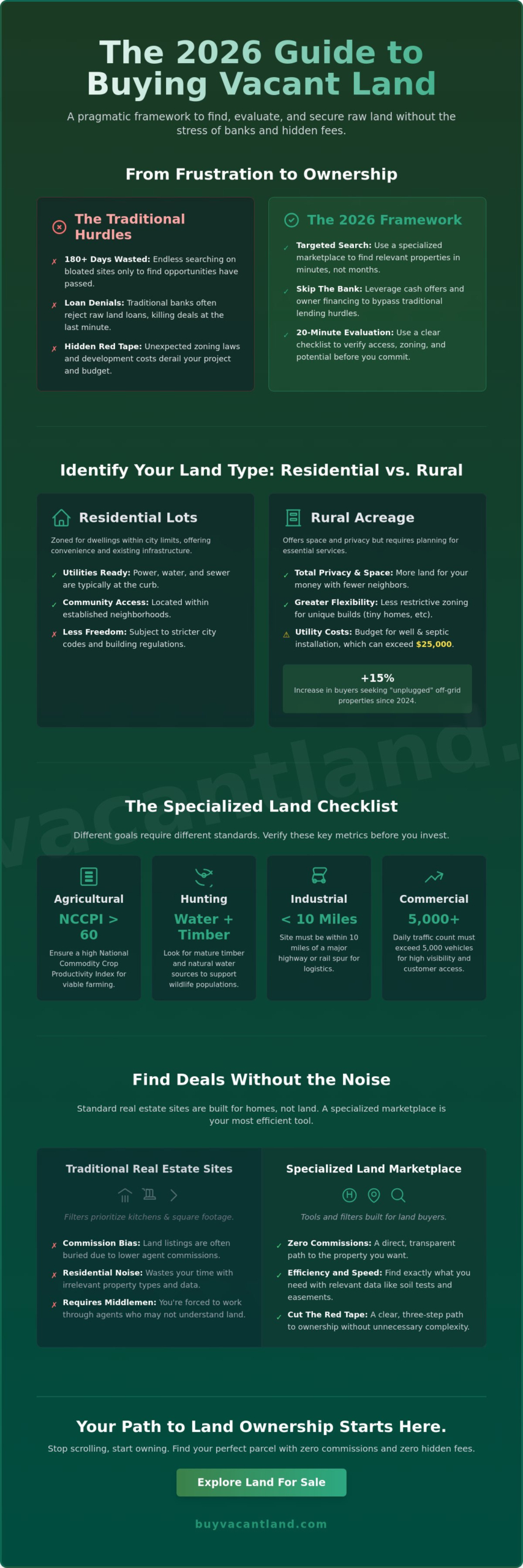
Start your search with a clear goal. Finding the right land for sale requires you to categorize parcels by their intended use immediately. This narrows your focus and prevents you from wasting time on properties that don’t fit your budget or vision. In 2026, the market rewards buyers who move with precision. Decide early if you want a turnkey building site or a raw piece of the wilderness. Your choice dictates everything from your financing options to your long-term maintenance costs.
Residential Lots vs. Rural Acreage
A residential lot is a parcel specifically zoned for single-family or multi-family dwellings. These lots sit within established communities or city limits. You get the benefit of existing infrastructure. Electricity, city water, and sewer lines are typically at the curb. This convenience saves you from the high costs of drilling a well or installing a septic system, which can exceed $25,000 in many states.
Rural acreage offers the opposite experience. You gain total privacy and more space, but you lose immediate access to services. Zoning in rural areas is often less restrictive. You might have the freedom to build a tiny home or a modular house that city codes would reject. Before you commit, use this checklist for buying land to ensure the topography and soil are suitable for construction. Off-grid land is increasingly popular for those seeking sustainability, with 15 percent more buyers looking for “unplugged” properties compared to 2024 data.
Specialized Land: Hunting, Farming, and Industrial
Specialized parcels require a different set of standards. If you want agricultural land, prioritize soil quality and water rights. High-yield farming requires a National Commodity Crop Productivity Index (NCCPI) score above 60. Without senior water rights, your investment could dry up during a drought year.
- Hunting Land: Look for parcels with mature timber and natural water sources. Check local wildlife population data from the 2025 harvest reports.
- Industrial Lots: These need heavy-duty road access. Ensure the site is within 10 miles of a major highway or rail spur for logistics.
- Commercial Vacant Land: High visibility is mandatory. Analyze traffic counts to ensure at least 5,000 vehicles pass the site daily.
Finding the perfect land for sale takes effort. If you currently hold an unwanted parcel that doesn’t fit your 2026 plans, you can get a fair cash offer and simplify your portfolio. We focus on speed and transparency. You get a direct solution with zero commissions and zero closing costs. This lets you move on to your next project without the typical real estate headaches.
Evaluating Raw Land: The No-Nonsense Checklist for Buyers
Buying land is a fast way to build wealth; however, skipping the due diligence phase leads to expensive regrets. You’re looking for land for sale because you want a solid asset. Don’t let a bad deal drain your bank account. Follow this five-step checklist to verify the property’s value before you commit your cash.
- Step 1: Verify Access. You need to confirm both legal and physical access. Legal access is your right to be there. Physical access is your ability to actually drive a vehicle onto the dirt.
- Step 2: Check Zoning. Local building codes dictate what you can do with the dirt. Don’t assume you can park an RV or build a cabin without checking the rules first.
- Step 3: Investigate Utilities. Contact local providers for power and water. If those aren’t available, you’ll need to fund your own infrastructure.
- Step 4: Review the Title. Look for easements or encumbrances. These are legal rights held by others to use your land for things like power lines or driveways.
- Step 5: Perform a Survey. Hire a professional to find the property corners. Never rely on a neighbor’s fence line to determine where your property starts.
Access and Utilities: The ‘Must-Haves’
Don’t confuse legal access with physical access. A property might have a recorded easement on paper while being blocked by a cliff or a swamp in reality. Clearing a path for a driveway can cost thousands of dollars you didn’t budget for. If the property is remote, check the distance to the nearest power pole. Utility companies often charge by the foot to extend lines. These costs add up fast and can easily exceed the purchase price of the land itself.
Water is your next priority. If municipal water isn’t available, you’ll need a well. If you’re building a home, a perc test is non-negotiable. This test determines if the soil can handle a septic system. If the land fails a perc test, you can’t build a traditional house. That makes the land significantly less valuable for future resale.
Zoning and Easements: Avoiding Legal Pitfalls
Zoning categories usually fall into residential, agricultural, or unrestricted. Each has its own set of constraints. You should consult Forbes’ guide to buying land to understand how topography and building codes impact your plans. Some counties have strict minimum square footage requirements for homes. Others might prohibit mobile homes or tiny houses entirely. Get the facts from the county planning department before you buy any land for sale.
Easements can also limit your land use. A utility company might have an easement that prevents you from building a structure on a specific part of the lot. You can find more details on these legalities in our guide on how do you buy land. Protect your investment by knowing exactly who else has a right to step foot on your property. Clarity today prevents a lawsuit tomorrow.
Financing Your Purchase: Navigating Cash, Loans, and Owner Financing
Traditional banks don’t like raw land. They view it as a high-risk asset because there’s no immediate structure to serve as collateral. Most lenders require a 40% to 50% down payment for vacant land. They also demand proof of construction plans and high credit scores. If you aren’t building a home within 12 months, a standard bank loan is rarely an option.
Buying land for sale with an all-cash offer is the most efficient path. Cash eliminates the need for appraisals and long underwriting periods. You can often close a deal in 7 to 14 days. Cash buyers hold the most negotiating power because they offer a guaranteed closing without financial contingencies. It removes the stress of a bank rejection at the last minute.
When you evaluate a deal, look closely at the contract type. A land contract means the seller keeps the legal title until you pay the final installment. A deed of trust is different. It transfers the title to you immediately while a trustee holds a lien on the property. Both are valid, but you must understand who holds the deed during the payment period to protect your investment.
Why Owner Financing is a Game Changer
Owner financing bypasses the banking system entirely. Many sellers offer properties with no credit check requirements, making land ownership accessible to everyone. You can secure a lot with a flexible down payment and low monthly installments that fit your budget. It’s a fast, private transaction. Follow our step-by-step guide to owner financed land to start your bank-free purchase today.
Closing the Deal: Commissions, Fees, and Zero Costs
Standard real estate deals are expensive. A 6% realtor commission can add thousands to your total cost. Buying direct from a marketplace eliminates these middlemen. You deal directly with the owner to keep your costs at zero for commissions. You only pay for essential closing costs like title insurance, escrow fees, and county recording fees. This direct approach ensures you get your fair cash offer without hidden fees or surprise charges.
Finding Your Property on the BuyVacantLand.com Marketplace
Stop scrolling through thousands of house listings just to find one plot of dirt. Most real estate websites are bloated with single-family homes, apartment rentals, and commercial buildings. BuyVacantLand.com eliminates that noise. We focus exclusively on vacant land. You won’t find a single kitchen renovation or roof repair here. Our platform serves land buyers who value speed and clarity over flashy distractions.
Finding the right land for sale requires precision. Our search filters allow you to drill down into the details that matter. You can filter by acreage, state, or specific land use. Whether you need a 0.25-acre lot for a tiny home or 40 acres for off-grid living, you can locate it in seconds. We prioritize transparency. Every listing provides the essential data points you need to make an informed decision without the typical real estate fluff. You see the price, the location, and the potential immediately.
The BuyVacantLand Advantage
We created a dedicated environment where buyers and sellers speak the same language. You deal directly with landowners. This direct line of communication means you get answers about zoning, access, and utilities fast. There are no middleman delays. If you are working with a tight budget, check out our current listings for cheap land for sale to find affordable options across the country. Our 2026 database includes properties priced for immediate liquidation, giving you an edge in a competitive market.
Start Your Search Today
Don’t miss out on the perfect lot because you weren’t looking at the right time. Set up instant alerts for your target counties. You will receive a notification the moment a new property hits our map. Our platform follows a simple, three-step path to ownership that removes the stress from the transaction:
- Step 1: Browse. Search our national database of land for sale using our streamlined filters to find your ideal match.
- Step 2: Connect. Message the seller directly to get your specific questions answered without waiting for an agent to call you back.
- Step 3: Close. Complete your purchase with zero commissions and zero hidden fees.
The traditional real estate model is broken for land buyers. It’s too slow and too expensive. We fixed it. On our marketplace, the number zero is our favorite figure. You pay 0% in agent commissions. You pay $0 in junk fees. You get a direct, honest transaction every time. It’s the most efficient way to buy property in 2026. Browse our current inventory now and secure your piece of the United States today.
Secure Your 2026 Property Investment
Success in the 2026 market depends on two things: rapid action and verified data. You now have the essential checklist to evaluate raw acreage and the financial roadmap to fund your purchase. The USDA reports that the United States contains approximately 1.9 billion acres of land, but finding the right parcel requires a focused strategy. Don’t get stuck in the traditional real estate trap. Standard deals often involve 6% commissions and weeks of unnecessary negotiations. You deserve a faster route to ownership. You can find the ideal land for sale by cutting out the intermediaries. We built a specialized marketplace to give you a direct line to sellers. This system eliminates the red tape and puts you in control of the transaction. You get a direct seller-to-buyer connection with zero commissions and zero hidden fees. It’s the most efficient way to build your portfolio or find your home site. Take the final step toward your goals today. Your future property is ready for you.
Browse National Land Listings for Sale with Zero Commissions
Frequently Asked Questions
Is it a good idea to buy land for sale by owner (FSBO)?
Buying land for sale by owner is a smart move if you want to avoid agent commissions. You deal directly with the seller to speed up the process. This eliminates the 6% standard commission fee often found in traditional transactions. Just make sure to use a title company to ensure the deed is clear. It’s a fast way to secure property without the middleman and unnecessary delays.
What are the hidden costs of buying vacant land?
Hidden costs include property taxes, title insurance, and environmental impact fees. Expect to pay between $500 and $1,500 for a Phase 1 Environmental Site Assessment if the land was previously industrial. You also need to budget for annual property taxes, which average 1.1% of the property value nationwide according to 2025 Census data. These costs add up quickly, so check the local tax records before you sign.
Can I get a loan for raw land without a down payment?
You can get a raw land loan with zero down payment through the USDA Rural Development program. This specific loan requires the land to be in a designated rural area and for you to build a primary residence. Most private lenders require 20% to 50% down because raw land is higher risk. If you qualify for the USDA 502 Direct Loan, you can bypass the traditional down payment entirely.
What is the difference between a lot and a parcel of land?
A parcel is a large, unsurveyed piece of land, while a lot is a specific portion of a parcel that is ready for development. Think of a parcel as the whole cake and a lot as a single slice. Developers take a 40 acre parcel and subdivide it into 80 half acre lots. When you browse land for sale, you’ll usually find lots in residential zones and parcels in rural areas.
How do I know if I can build a house on the land I buy?
Check the local zoning ordinances and the results of a perc test to confirm if you can build. The zoning office provides a Permitted Use list that dictates if the land is residential, agricultural, or industrial. A percolation test determines if the soil absorbs water fast enough for a septic system. If the soil fails this test, you can’t install a standard septic tank, which stops most residential construction.
What happens if the land I buy doesn’t have road access?
Buying land without road access means the property is landlocked, and you must negotiate an easement with a neighbor. An easement provides a legal right to cross someone else’s land to reach your own. Without a recorded easement, you can’t get a building permit or a mortgage. Legal battles for easement by necessity can take 12 to 24 months in state courts, so secure access before closing.
How much does a land survey cost in 2026?
A standard boundary survey in 2026 costs between $500 and $1,000 for a typical residential lot. Prices vary based on the size of the acreage and the density of the vegetation. According to the National Society of Professional Surveyors, complex topographic surveys for hilly terrain can reach $2,500. Always get a written quote to avoid surprises. This step ensures you know exactly where your property lines sit.
Do I need a real estate agent to buy vacant land?
You don’t need a real estate agent to buy land for sale, but you must handle the paperwork yourself. Many buyers work directly with land investment companies to skip the 6% commission fees. You can use a standard purchase agreement and close through a local title company for a few hundred dollars. This direct approach saves time and keeps more cash in your pocket during the transaction.



Join The Discussion