

Your dream of owning a shoreline retreat shouldn’t come with a permission slip from a homeowners association. Most buyers realize too late that a waterfront view often includes restrictive covenants that ban RV parking, limit short-term rentals, or dictate exactly how you use your own dock. Finding waterfront lots for sale no hoa is the only way to gain total property autonomy while avoiding the high monthly fees that eat into your investment. You deserve a legacy property where you make the rules, not a board of directors.
It’s frustrating to pay a 36% premium for water access only to be told you can’t use the land as you see fit. You want the freedom to build what you want when you want. This 2026 guide teaches you exactly how to find and secure unrestricted shoreline land. You’ll learn to navigate state regulations like the Shoreland Zoning Act and manage development costs that typically range from $20,000 to $100,000 per acre. We’ll show you how to cut through the procedural hurdles and find a parcel that offers genuine freedom and lower long-term ownership costs. Get ready to claim your piece of the shore without the red tape.
Key Takeaways
- Identify the core differences between managed property and total autonomy to protect your right to use RVs or short-term rentals.
- Master the due diligence process by understanding Riparian Rights and how they impact your ownership of the shoreline.
- Use tactical search terms to locate waterfront lots for sale no hoa and avoid properties with hidden association fees.
- Simplify your land search by using specialized marketplaces that filter out home listings to focus on raw, undeveloped parcels.
- Distinguish between local zoning laws and private covenants to ensure your property remains truly unrestricted for your specific needs.
The Lure of Waterfront Freedom: Why No HOA Lots are the Ultimate Asset
Owning land on the water shouldn’t feel like living in a managed dormitory. When you search for waterfront lots for sale no hoa, you are looking for property free from private governing bodies. Most buyers don’t realize that a Homeowner Association (HOA) acts as a private government. It has the power to fine you, tell you what color to paint your deck, and even prevent you from parking your boat on your own driveway. Choosing an unrestricted lot eliminates this layer of bureaucracy. You gain the freedom to use your land for its intended purpose: recreation and investment.
In 2026, these lots are becoming a scarce commodity. Developers prefer the HOA model because it allows them to control the “look” of a community until the last lot is sold. This makes existing unrestricted shoreline parcels more valuable every year. Investors and outdoor enthusiasts are snapping up these properties because they offer a utility that managed subdivisions cannot match. You aren’t just buying dirt; you’re buying the right to be left alone. This is the ultimate asset for anyone who values privacy and property rights over neighborhood uniformity.
Total Autonomy Over Your Shoreline
The primary benefit of an unrestricted lot is the ability to build what you want, when you want. You don’t have to submit blueprints to an “architectural review committee” to get permission for a boathouse or a gazebo. If you want to build a dock that extends further into the water, you only need to clear it with state or federal regulators, not a group of neighbors. This autonomy extends to how you use the land before you even break ground. On many waterfront lots for sale no hoa, you can park an RV or set up a seasonal camp while you finalize your construction plans. You control the timeline. You choose the materials. You decide the aesthetic. This lack of oversight is a massive relief for owners who want to avoid the stress of constant compliance checks.
The Financial Advantage of Zero Association Fees
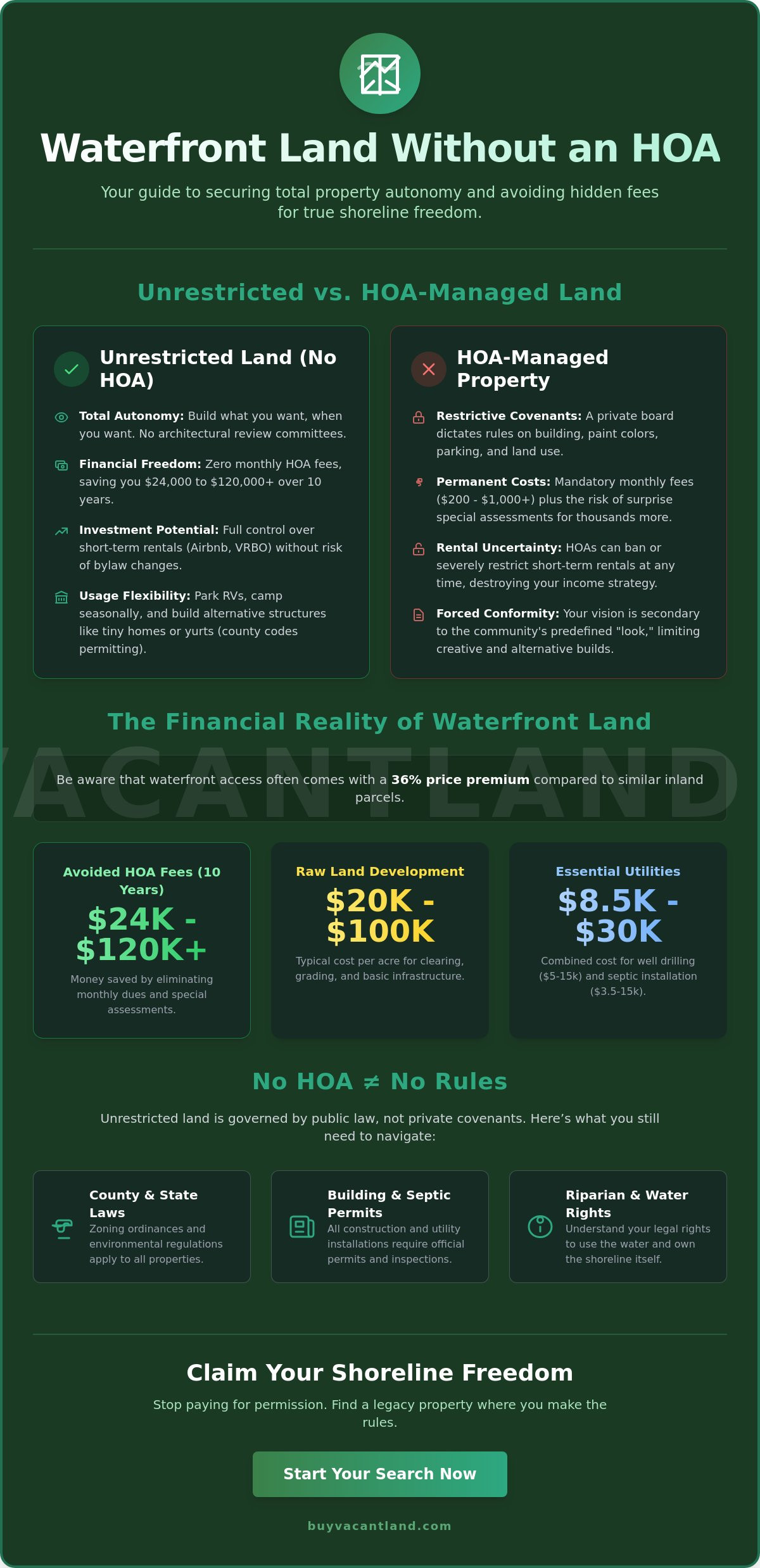
Monthly dues are a permanent tax on your enjoyment. In many waterfront communities, these fees range from $200 to over $1,000 every month. Over a ten-year period, that’s $24,000 to $120,000 spent on administrative costs instead of your actual property. You also avoid the “hidden costs” of waterfront living. If a community lake needs dredging or a private road requires paving, HOA members often face special assessments. These are one-time bills that can reach tens of thousands of dollars. Without an HOA, you manage your own maintenance and keep those funds in your pocket. This financial transparency increases the long-term resale value. Specific buyer niches, such as off-grid enthusiasts and independent builders, actively seek out properties without these recurring liabilities. You save money every month while owning a more desirable asset.
Unrestricted Land vs. HOA Property: A Critical Comparison
Choosing between a managed community and a private parcel is a choice between convenience and control. Managed properties offer a predictable resort feel, but they strip away your decision-making power. In contrast, waterfront lots for sale no hoa provide an unrestricted lifestyle where you are the primary authority. Don’t confuse unrestricted with a lack of quality. Many non-HOA areas maintain high property values through natural beauty and scarcity rather than forced lawn maintenance schedules. You are trading a board of directors for total property autonomy.
It’s vital to realize that no HOA does not mean no rules. Your property is still governed by county zoning and state environmental laws. For example, the Shoreland Zoning Act in Maine regulates development within 250 feet of the water. You must still secure permits for septic systems, which can cost between $3,500 and $15,000 in 2026. Well drilling typically adds another $5,000 to $15,000 to your budget. These are public laws applied fairly to everyone, not arbitrary rules created by a small board of neighbors. Success starts with understanding your riparian rights to know exactly what you own at the water’s edge.
Usage Rights and Building Codes
Unrestricted land is property governed only by public law. This distinction is critical if you plan on alternative builds. Most HOAs ban tiny homes, container houses, or yurts to maintain a specific look. On a private lot, if the county building code allows it, you can build it. This flexibility is essential for buyers who want an off-grid cabin or a modern minimalist retreat. You avoid architectural review committees that dictate everything from shingle color to window placement. The cost to develop raw land in 2026 often ranges from $20,000 to $100,000 per acre, so you want the freedom to spend that money on your vision, not on meeting a committee’s aesthetic demands. If you are new to this process, learning how do you buy land is your first step toward securing this level of autonomy.
Investment Potential and Rental Income
Investors prioritize waterfront lots for sale no hoa because they offer protection for rental income. HOAs frequently change their bylaws to ban short-term rentals like Airbnb or VRBO after owners have already purchased. This can destroy your projected ROI overnight. Without an HOA, your right to rent is much more secure, subject only to local municipal ordinances. This makes unrestricted land a safer bet for long-term wealth building. You can pivot your strategy from a private vacation home to a high-yield rental without asking for permission. If you’re ready to find a parcel that fits your portfolio, you can browse available waterfront listings to see what is on the market today.
Essential Due Diligence for Unrestricted Waterfront Property
Buying waterfront land is a high-stakes transaction. You can’t treat it like a standard suburban lot purchase. When you pursue waterfront lots for sale no hoa, you trade association oversight for personal responsibility. You are the lead investigator. You must verify soil quality, water depth, and legal access without a board of directors to provide a handbook. This process requires a pragmatic approach to ensure your investment doesn’t become a liability. The burden of research is entirely yours, but the reward is total property autonomy.
Start with a thorough title search. You need to identify any existing easements that could grant the public access to your shoreline. Many buyers assume their privacy extends to the water’s edge, but local laws vary. In 2026, the scarcity of these lots makes them prime targets for legal disputes. Verify every boundary before you commit your capital. Your goal is a clean title that reflects the freedom you are paying for.
Understanding Riparian and Littoral Rights
You must know where your property ends and the public domain begins. Riparian rights apply to land adjacent to flowing water like rivers and streams. Littoral rights apply to standing water like lakes or oceans. These legal frameworks dictate your ability to use the water and build structures. Check your deed to see if you own the land to the high-water mark or the low-water mark. This distinction determines if you can build a private dock or if you must share the shoreline with the public. Consult the county recorder’s office to verify these rights. Don’t rely on a seller’s verbal promise; get the legal description in writing.
Environmental and Utility Hurdles
Building near the shore is expensive and strictly regulated. Most waterfront lots for sale no hoa are raw land requiring private infrastructure. In 2026, a conventional septic system costs between $3,500 and $15,000. Drilling a residential well (100-300 feet deep) adds another $5,000 to $15,000 to your budget. You also face federal oversight. The U.S. Army Corps of Engineers requires permits under Section 404 for any dredging or filling of material into wetlands. Violating these rules can lead to fines of $25,000 per day.
State laws add more layers of complexity. For example, the Maine Shoreland Zoning Act regulates development within 250 feet of the high-water line. You must adhere to strict setbacks, which often range from 75 to 125 feet. Basic building permits can cost up to $5,000, with additional fees for septic and electrical work. If you want to maximize your budget, search for cheap land for sale that sits outside of high-risk flood zones. Flood insurance premiums rose by 18% in 2025, and they’re projected to keep climbing. Perform your due diligence now to avoid these financial drains later.
How to Locate Waterfront Lots with Zero Association Fees
Finding waterfront lots for sale no hoa requires a tactical shift. Most mass-market real estate apps bury association details in the fine print or leave them out entirely. You must look for specific keywords in listing descriptions to filter out the noise. Search for terms like “unrestricted,” “no covenants,” and “no dues.” These markers suggest a property is free from private governing bodies. If a listing mentions “amenities” like a community pool or clubhouse, an HOA is almost certainly involved. You want the land, not the social club.
Verify every claim using county GIS (Geographic Information Systems) maps. These digital tools show property tax data and subdivision names. If a parcel is listed with a specific subdivision name, search for that name in the county’s recorder of deeds. If the property is described by “metes and bounds” rather than a lot number in a subdivision, it’s a strong indicator of an unrestricted parcel. The “Legal Description” in the property deed is your ultimate source of truth. It outlines exactly what you are buying and any permanent restrictions attached to the dirt. Don’t rely on a marketing blurb when the legal record is available.
Step 1: Filter Your Search Parameters
Start your search in the “Raw Land” or “Undeveloped” categories. Developers usually categorize HOA-managed properties as “Residential Lots” or “Home Sites” to attract traditional builders. You want the parcels that are often overlooked by the general public. Look for owner financed land to find more flexible options. Individual sellers who offer their own terms are much more likely to own land outside of corporate-managed developments. This strategy narrows your focus to sellers who value property autonomy as much as you do. It also simplifies the path to ownership by bypassing traditional bank hurdles.
Step 2: Verify the Deed and Covenants
Never take a seller’s word for it. Request a Title Commitment early in the process. This document lists every recorded restriction, easement, and lien on the property. Watch out for “dormant” HOAs. These are associations that may not have collected dues or held meetings in years, but their legal authority remains on the deed. They can reactivate at any time and begin enforcing rules or collecting fees. It’s a common trap for unwary buyers. A lack of monthly fees doesn’t guarantee a lack of deed restrictions. You must read the restrictive covenants to ensure the land is truly unrestricted before you sign. If you want to skip the confusion of home-heavy websites, you can browse waterfront land listings directly on our specialized marketplace.
Secure Your Piece of the Shore on BuyVacantLand.com
Traditional real estate platforms are cluttered with residential listings that don’t fit your criteria. When you want the freedom of waterfront lots for sale no hoa, you need a tool built for the task. BuyVacantLand.com focuses exclusively on empty parcels. We remove the noise of existing homes and rental properties. This focus allows you to find undeveloped vacant land without digging through thousands of irrelevant search results. You deal directly with land owners and sellers who understand the value of unrestricted property. This direct communication ensures you get accurate answers about deed restrictions and usage rights immediately.
Our platform streamlines the acquisition process. You don’t have to wait for a middleman to relay messages. You get the facts straight from the source. This transparency is vital when you are verifying the absence of restrictive covenants or checking for owner financed land options. We provide a clear, efficient path to ownership that respects your time and your budget. You want a transaction that is as simple as the lifestyle you are seeking. We make that possible by stripping away the complexity of traditional real estate browsing.
Why a Specialized Marketplace Matters
General real estate sites often hide association fees in small text or leave them out entirely. We prioritize the land itself. You can easily find cheap land and off-grid land that fits your vision for a private shoreline retreat. Our marketplace is designed for buyers who want to move fast. By connecting you directly with sellers, we eliminate traditional procedural hurdles that slow down typical real estate deals. This speed is a major advantage in the competitive 2026 market. Unrestricted lots are becoming a premium asset. You need a platform that treats your search with the urgency it deserves. We offer everything from residential lots to hunting land, ensuring you find the exact type of shoreline you need without the corporate fluff.
Start Your Search Today
Securing your shoreline starts with a simple filter. Head to our homepage and select the waterfront category to see current national listings. You can further refine your search by looking for specific property types like farms and ranches or undeveloped vacant land. Remember that the best waterfront lots for sale no hoa sell quickly. Demand for private, high-autonomy land is at an all-time high in 2026. If you are comparing different platforms, check out our Lands of America guide to see how we provide a superior search experience. Don’t let another season pass without claiming your piece of the shore. Take the first step toward total property autonomy. Start your search now and secure your legacy property on your own terms.
Claim Your Waterfront Freedom Today
Success in the 2026 market depends on using the right tools to cut through the noise. Our marketplace offers exclusively vacant land listings with national coverage across the US. You can skip the distraction of home listings and connect directly with sellers who understand the value of unrestricted property. This direct access speeds up your acquisition and ensures transparency from start to finish. It’s time to stop searching and start owning. Find Your Unrestricted Waterfront Lot Now and secure a property where you make the rules. Your dream of an unrestricted shoreline is within reach.
Frequently Asked Questions
Can I park an RV on a waterfront lot with no HOA?
You can typically park an RV on waterfront land without an HOA, provided local county zoning ordinances allow it. While an HOA often bans recreational vehicles to maintain a specific neighborhood aesthetic, unrestricted land leaves this decision to you and the local government. Always verify “temporary dwelling” bylaws with the county planning department before you buy. Some areas allow year-round parking while others limit it to 90 days.
How do I know for sure if a property has an HOA?
Review the property’s Title Commitment and the recorded deed to confirm the absence of an association. Marketing descriptions for waterfront lots for sale no hoa are helpful, but the legal record is the only definitive source. Look for “Declaration of Covenants, Conditions, and Restrictions” in the public records. If no such document is linked to the parcel’s legal description, you are likely free from a private governing body.
Are waterfront lots with no HOA more expensive?
Unrestricted waterfront parcels often command a higher price because they are increasingly rare. Buyers are willing to pay a premium for the freedom to build without board oversight or architectural committees. While you avoid monthly dues, the initial purchase price reflects the high demand for property autonomy. In many markets, the lack of an HOA is a major selling point that drives up competition among independent builders and investors.
Can I build my own dock on an unrestricted waterfront lot?
You can build a dock on an unrestricted lot, but you must still secure permits from state agencies and the U.S. Army Corps of Engineers. The lack of an HOA simply means you don’t need a neighbor’s permission or a board’s aesthetic approval. You must still comply with environmental regulations regarding shoreline disturbance and water safety. Check local “dock density” rules to ensure the waterway can support new construction before you finalize your plans.
What are the most common restrictions on “unrestricted” land?
Common restrictions include county zoning laws, environmental setbacks, and health department requirements for waste management. Even without an HOA, you must follow the setback rules that dictate how far your home must be from the water’s edge. Wetlands protection laws and flood zone regulations also apply to every property owner. Unrestricted means you are free from private contracts, but you are never exempt from public safety and environmental laws.
Do I still have to pay for road maintenance if there is no HOA?
You may still be responsible for road maintenance if the property is located on a private, non-county road. In the absence of an HOA, neighbors often form a “Road Maintenance Agreement” (RMA). This is a legal contract where owners share the costs of gravel, grading, or snow removal. Check the title for a recorded RMA to understand your financial obligations. If the lot sits on a public, county-maintained road, the government handles all repairs.
Is it harder to get a loan for land with no HOA?
Obtaining a loan for waterfront lots for sale no hoa is not necessarily harder due to the lack of an HOA, but raw land financing always requires more scrutiny. Lenders often demand larger down payments, sometimes reaching 50%, for undeveloped parcels. They focus on the land’s value and your development plan rather than the presence of an association. Having a clear survey and a plan for utilities will improve your chances of approval.
What happens if I buy land and an HOA is formed later?
You cannot be forced to join a newly formed HOA if you already own your property and your deed doesn’t require it. Joining a voluntary association is your choice. However, if a developer previously recorded “dormant” covenants on your land, they could potentially activate a board later. This is why a thorough title search is critical. If your land is truly independent, you have the right to remain outside any new private governing structures.




Join The Discussion