
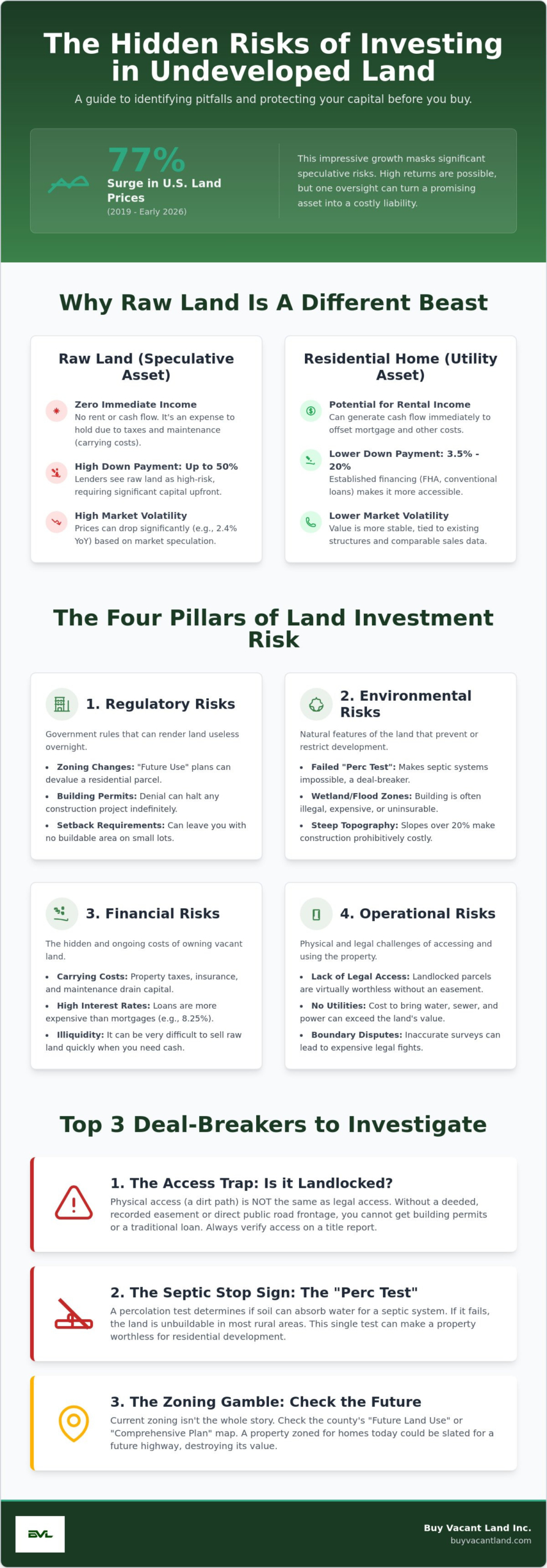
U.S. land prices surged by 77% between 2019 and early 2026. This growth is impressive, but it isn’t a guarantee of success. Raw land is a speculative asset. It requires active risk management and a sharp eye for detail. You likely see the potential for high returns. At the same time, you might fear buying a lot that you cannot build upon. The risks of investing in undeveloped land are significant. Lenders often demand down payments of up to 50% for raw parcels. One oversight can drain your capital quickly.
You want a secure investment without the stress of hidden costs or zoning traps. This guide helps you identify and mitigate the most common pitfalls. You will learn how to navigate recent zoning reforms and manage 2026 property tax rates. We provide a direct checklist of what to verify before you buy. You will understand the total financial commitment required beyond the listing price. This knowledge gives you the confidence to act on a listing with total clarity. Protect your capital and maximize your long-term gains starting now.
Key Takeaways
- Understand the speculative nature of raw land and how to protect your capital from future market shifts.
- Navigate complex zoning laws and access rights to ensure your property remains buildable and accessible.
- Calculate the full financial impact of carrying costs like taxes and maintenance before committing to a purchase.
- Apply a step-by-step due diligence framework to identify and mitigate the primary risks of investing in undeveloped land.
- Use focused marketplace tools to filter for specific land types and find listings that meet your risk tolerance.
What Are the Risks of Investing in Undeveloped Land?
Undeveloped land is property in its most basic state. It has no buildings. It has no utility connections like water, sewer, or electricity. It is often called raw land. Many investors see a low price tag and assume it is a safe bet. This is a mistake. Low cost does not equal low risk. In the land market, raw land is a highly speculative asset. You are betting on what might happen tomorrow. You aren’t profiting from what is happening today. The median price per acre reached $62,365 in early 2026, but that value depends entirely on future potential.
The risks of investing in undeveloped land fall into four distinct pillars. Regulatory risks involve zoning changes and building permits. Environmental risks include soil quality, flood zones, or protected habitats. Financial risks cover high interest rates and ongoing carrying costs. Operational risks involve physical access and property maintenance. Even large-scale land acquisition by institutional players faces these same hurdles. You must understand each pillar to protect your capital. One oversight in any of these areas can turn an asset into a liability. Understanding the risks of investing in undeveloped land is the only way to ensure a profitable exit.
Speculation vs. Utility: The Primary Risk Factor
Buying land to hold is different from buying land to build. If you buy to build, you need utility access and permits immediately. If you buy to hold, you are waiting for the market to move. Market timing hits raw land harder than developed real estate. For example, raw land prices dropped by 2.4% year-over-year between Q1 2025 and Q1 2026. Residential homes rarely see that level of volatility in a single year. Land speculation is the act of buying based on anticipated market shifts rather than current cash flow. If the shift doesn’t happen, you’re stuck with an illiquid asset.
Why Raw Land is Different from Residential Real Estate
Raw land produces zero immediate income. You can’t rent out a vacant field as easily as a duplex. It’s also much harder to finance. As of June 30, 2026, raw land loans from lenders like Country Bank carried rates around 8.25% for a 10-year term. You also need a larger down payment. Most lenders require 40% down for raw dirt compared to 3.5% or 20% for homes. Zoning sensitivity is another major factor. A residential home stays a home. A piece of land can be rezoned by local government, which might limit your development options or wipe out your value overnight. You have less control over the final outcome.
Regulatory and Environmental Pitfalls in Raw Land
Zoning and environmental factors are often invisible to the naked eye. They represent the most dangerous risks of investing in undeveloped land because they can’t be fixed with a bulldozer. A lot might look perfect for a cabin or a warehouse, but local laws might forbid it entirely. When investing in vacant land, you must look past the current use of the property. You are buying the rights to what the land can become. If those rights are restricted, your investment is dead on arrival.
Don’t be fooled by the term “unrestricted.” In the land industry, this rarely means you can do whatever you want. Even in rural counties, state health departments regulate waste disposal. Environmental agencies protect water sources. You might also face building codes that mandate specific materials or minimum square footage. These rules vary wildly between a residential lot in a suburb and off-grid acreage in the desert. Always verify the specific code for your intended use before you exchange funds.
Zoning and Land Use Restrictions
Zoning categories like R1 (Residential), Agricultural, or Industrial dictate your path. A common trap is ignoring “future land use” maps. Your lot might be zoned for a house today, but the county’s 20-year plan could designate it for a future highway or industrial park. This shift destroys residential value. Also, check the set-back requirements. These rules state how far from the property line you must build. On small parcels, aggressive set-backs can leave you with almost no usable acreage for construction.
The Access Trap: Easements and Road Frontage
Never buy landlocked property unless you have a proven plan to secure legal entry. Physical access is not the same as legal access. You might see a dirt path leading to the lot, but if it crosses a neighbor’s property without a recorded easement, you have no right to use it. Without legal access, you cannot get a building permit. You also cannot get a traditional loan. Always demand a title report that confirms a deeded easement or direct frontage on a public road.
Environmental Hazards: Wetlands, Soil, and Topography
The “Perc Test” is the ultimate deal-breaker for undeveloped land. It measures how quickly soil absorbs water. If the soil fails this test, you cannot install a septic system. Without a septic system, the land is unbuildable in most jurisdictions. Other hazards include:
- Wetland Designations: Federal and state laws protect these areas. Building here is often illegal or requires mitigation fees that exceed the land’s value.
- Steep Topography: Slopes greater than 20% make foundation work prohibitively expensive.
- Protected Habitats: Endangered species can halt development for years.
Identify these issues early to avoid a total loss of capital.
Avoid these headaches by doing your homework upfront. You can start your search for undeveloped vacant land on a focused marketplace that categorizes listings by their intended use, helping you filter out high-risk parcels from the start.
Financial Realities: Carrying Costs and Liquidity Risks
Owning raw land is not a passive experience. It is a financial commitment that demands constant attention. Unlike a rental property, vacant land produces zero monthly income. You are responsible for every dollar the property costs while you wait for it to appreciate. One of the primary risks of investing in undeveloped land is the negative cash flow that can deplete your reserves. You must have liquid capital available to cover these ongoing expenses without a tenant to help pay the bills.
The True Cost of ‘Holding’ Vacant Land
You must calculate your annual burn rate before you sign a contract. This includes property taxes, insurance, and basic maintenance. Property tax rates vary significantly across the country. In 2026, states like New Jersey and Illinois have effective rates over 2%. In Colorado, the nonresidential land assessment ratio is a steep 26%. You might also face special assessments. These are one-time fees for local infrastructure like new roads or sewers. If you aren’t careful, cheap land for sale can become a financial burden. If the holding costs exceed the appreciation rate, you lose money every day.
Maintenance is another hidden expense. You must protect your asset. This means clearing overgrowth to comply with local fire codes. It means removing illegal trash dumping or managing squatters. If you ignore these tasks, you risk local fines or lawsuits. These costs add up. They require liquid capital that isn’t tied up in the dirt itself. Do not underestimate the cost of keeping a lot clean and secure.
Exit Strategy and Market Liquidity
Land is an illiquid asset. You cannot sell it with a single click. Finding a buyer for raw dirt takes significantly longer than selling a residential home. The “Niche Buyer” problem is real. You are looking for a specific person who wants to build a specific structure on your specific lot. In a recession, land is often the first asset to drop in price and the last to recover. You need a clear five-year or ten-year exit plan to avoid being forced to sell during a market dip. Without a plan, you might be stuck holding the property for a decade or more.
Financing adds another layer of difficulty. Lenders view raw land as high-risk. As of June 2026, you will likely need a down payment between 30% and 50%. Country Bank, for example, requires 40% down for raw land products. Interest rates are also higher. Expect to pay 1% to 1.5% more than a traditional mortgage rate. These hurdles limit your pool of potential buyers to those with significant cash on hand. Plan for these financial realities early to protect your long-term gains and maintain your peace of mind.
A Pragmatic Due Diligence Framework to Mitigate Risk
Success in land investing requires a systematic approach. You cannot rely on luck or a seller’s word. To manage the risks of investing in undeveloped land, you must execute a strict due diligence process. This framework eliminates guesswork. It replaces uncertainty with verified data. Follow these five steps to protect your capital before you close any deal. A disciplined process is the only way to ensure your investment remains an asset rather than a liability.
- Step 1: Verify legal access. Confirm the property has a deeded easement or direct road frontage. Physical paths are not legal rights.
- Step 2: Visit the site. Never buy sight unseen. If you cannot go, hire a local proxy to take photos and video. Look for issues a satellite map cannot see.
- Step 3: Call the county. Speak with the planning department. Confirm current zoning and ask about any proposed changes to future land use maps.
- Step 4: Test the soil. Order a perc test if you plan to build. Verify the boundaries with a professional survey.
- Step 5: Get title insurance. This protects you from historical claims, hidden liens, or ownership disputes.
The Essential ‘Paper Trail’ Check
Paperwork often hides the biggest traps. You must read the property deed carefully. Look for “covenants” or “deed restrictions.” These are private rules that can limit your build size, animal ownership, or even the color of your roof. Check for back taxes immediately. In some jurisdictions, delinquent taxes stay with the land. This means you become responsible for the debt upon purchase. Verify that no utility liens exist from previous failed development attempts. For a deeper look at the legal mechanics, read our Beginner’s Guide to Buying Land to master the closing process.
Physical and Utility Inspections
Utilities are expensive to move. Do not assume “power is nearby” just because you see a wire. Identify the nearest utility pole. Call the local utility company to get an estimate for bringing power to the lot. These costs can reach five figures quickly. During your visit, look for signs of illegal dumping or environmental contamination like rusted drums or stained soil. A professional land survey is the only way to confirm where your property ends and the neighbor’s begins. Encroachments are common risks of investing in undeveloped land that lead to costly legal battles. Secure your boundaries early to avoid these disputes.
Ready to apply this framework? You can find vetted listings for undeveloped vacant land on our marketplace and start your due diligence today.
Leveraging BuyVacantLand.com to Find Low-Risk Opportunities
Finding a parcel that matches your risk tolerance shouldn’t take months of manual research. Traditional real estate sites clutter your search with houses and condos. This makes it hard to spot the specific risks of investing in undeveloped land. BuyVacantLand.com solves this by providing a dedicated space for land buyers. Our marketplace streamlines the discovery of undeveloped vacant land by removing the noise. You see the dirt, the data, and the potential without distraction.
Efficiency is the core of our platform. You can use advanced filters to target specific land types like Residential Lots, Off-grid Land, or Farms and Ranches. This allows you to focus on properties that align with your development goals. You can also message sellers directly. Ask your due diligence questions about zoning or utility access immediately. This direct line of communication speeds up your verification process and reduces the time spent on high-risk listings.
Financing is often the biggest hurdle for raw land investors. As noted earlier, banks in 2026 frequently demand 40% down and charge high interest rates. You can bypass these traditional roadblocks by browsing owner financed land. Many sellers on our platform offer flexible terms directly. This helps you preserve your liquid capital for the carrying costs and development expenses discussed in previous sections. It’s a pragmatic way to scale your portfolio without the stress of bank approvals.
Why Use a Specialized Land Marketplace?
General marketplaces don’t understand the nuances of raw dirt. We do. Our listings are focused. You won’t waste time scrolling through rentals or suburban homes. Our national reach lets you compare prices and risks of investing in undeveloped land across different states from a single dashboard. This transparency is vital. Many listings explicitly state the status of utilities and zoning. This helps you identify low-risk opportunities before you even pick up the phone.
Next Steps for Your Land Investment Journey
Action is the final step in mitigating risk. Create a free account today to save your favorite listings and track market price trends. If you’re looking at specific regions, review our Florida Land Guide for a detailed look at one of the country’s most active markets. Knowledge is your best defense against loss. Start browsing now to find your next investment parcel with total confidence. Your path to secure land ownership begins with a single search.
Secure Your Future with Informed Land Decisions
You now have a pragmatic framework to protect your capital. Success in the 2026 market requires more than just picking a spot on a map. You must verify legal access and calculate the true annual burn rate of your investment before you commit. The risks of investing in undeveloped land are manageable when you follow a strict, step-by-step due diligence process. Zoning laws and environmental deal-breakers determine your final return. Don’t leave these critical details to chance or guesswork.
Efficiency is your greatest asset in a fast-paced market. Our specialized marketplace connects you directly with sellers across the United States. We focus exclusively on raw land listings. This removes the noise of residential homes and helps you spot low-risk opportunities faster. You can find everything from residential lots to off-grid acreage through our national network. Browse our national listings of undeveloped land today to find your next parcel. Take control of your investment journey with a platform built for your specific goals. You are ready to act with total clarity and confidence.
Frequently Asked Questions
Is buying undeveloped land a good investment in 2026?
It’s a strategic long-term play for disciplined investors. Land prices surged by 77% between 2019 and early 2026. While raw land prices saw a 2.4% year-over-year dip recently, the asset remains a strong hedge against inflation. Success depends on your ability to hold the asset through market cycles without straining your cash flow. You must buy in high-demand areas to see consistent growth.
What is the biggest risk when buying raw land?
The biggest danger is buying land that is legally or physically unbuildable. The risks of investing in undeveloped land center on one factor: utility. If you can’t install a septic system or secure a deeded easement, the land loses its development value. You’re left with a parcel that only generates tax bills. Always verify the “perc” status and legal access before you exchange funds.
Can I get a mortgage for undeveloped land?
Yes, but traditional financing is strict. Most lenders require a down payment of 30% to 50% for raw land. As of June 2026, interest rates for land loans are typically 1% to 1.5% higher than standard home mortgages. Lenders like Country Bank currently require 40% down for raw parcels. Many investors use owner financing to bypass these high bank hurdles and preserve their liquid capital.
How do I check if a piece of land is buildable?
Start at the county planning department. Ask about the specific zoning designation and any environmental protections like wetlands or endangered habitats. You must also order a soil percolation (perc) test to see if a septic system is feasible. A professional land survey is the final step. It confirms your boundaries and identifies any hidden easements that could block your construction plans.
What are the typical carrying costs for vacant land?
You must budget for property taxes, insurance, and basic maintenance. Tax rates vary by state; for example, New Jersey and Illinois have effective rates over 2% in 2026. In Colorado, the assessment ratio for nonresidential land is 26%. Maintenance costs include clearing brush to prevent fire hazards and removing illegal trash. These expenses create a monthly “burn rate” you must cover with liquid cash.
What does ‘unrestricted land’ actually mean?
It usually means the property has no private Homeowners Association (HOA) rules or deed restrictions. It does not mean you can ignore state or county laws. You still must follow health department regulations for waste disposal and local building codes for safety. “Unrestricted” gives you more freedom for off-grid living or unique structures, but the law still applies to your land use.
How do I find out who owns a vacant lot?
Visit the local county tax assessor’s website. You can search for the property using the Parcel ID or the physical address. Most counties provide a Geographic Information System (GIS) map that shows property lines and owner names. If the information isn’t online, a quick trip to the county clerk’s office will give you access to the public deed records and historical ownership data.
Is it better to buy land with utilities already in place?
It depends on your budget and timeline. Improved lots with water and power connections are more expensive but carry much lower risk. Raw land is cheaper but requires significant capital to bring in utilities. If a utility pole is miles away, the cost of extending service can exceed the land’s value. Buying improved land is the faster and safer path for most individual investors.




Join The Discussion