

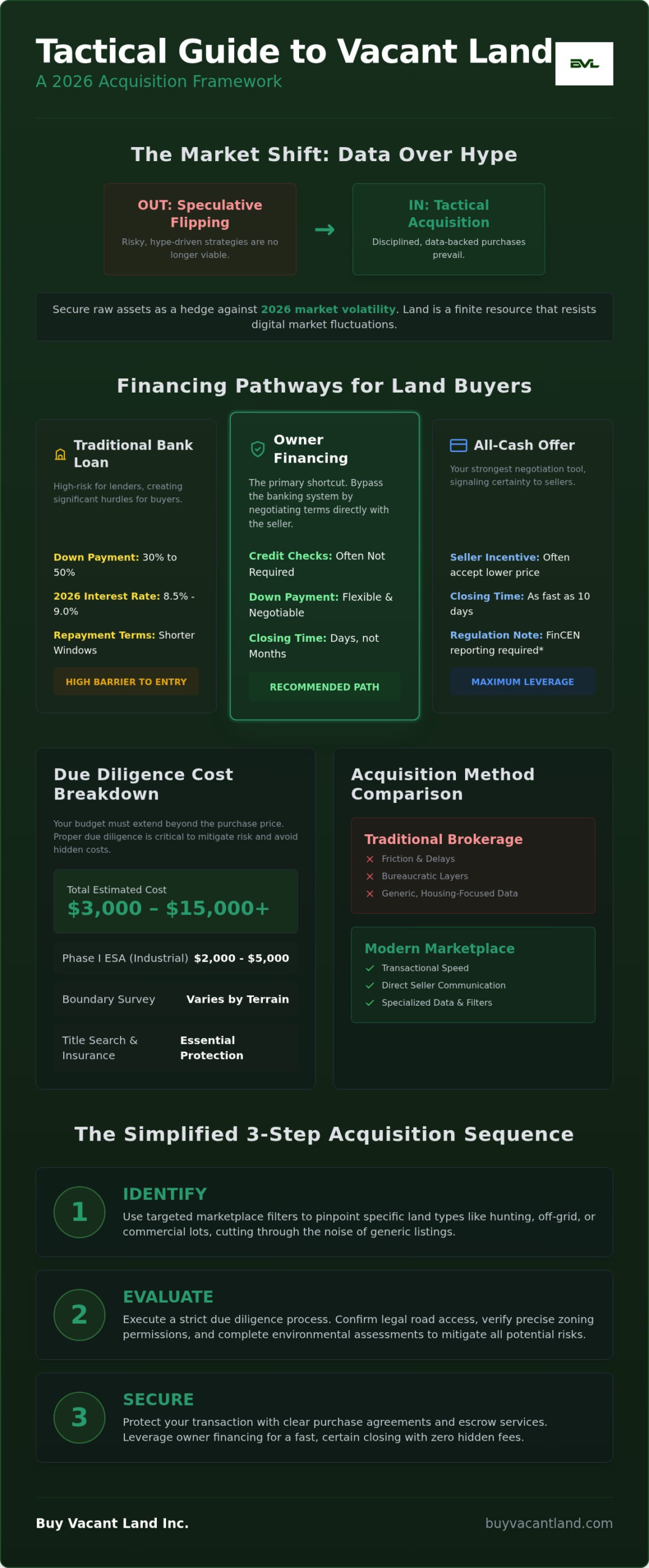
The era of speculative land flipping is over. 2026 belongs to the tactical buyer who values hard data over hype. Successful vacant land acquisition now requires a disciplined approach to navigate new FinCEN reporting rules for all-cash deals and shifting IRS Opportunity Zone requirements. You likely feel the frustration of unclear zoning restrictions and the sting of hidden development costs. It’s exhausting to deal with slow, traditional real estate processes that don’t account for the unique hurdles of raw acreage.
You can cut through the red tape and secure high-quality parcels with a streamlined strategy. This tactical guide provides a no-nonsense framework to master the process of identifying, evaluating, and securing raw land. You’ll learn how to find off-market deals and marketplace opportunities while avoiding the common pitfalls of undeveloped property. We cover the essential due diligence steps; from environmental assessments to navigating current 8.5% interest rates. Follow this clear roadmap to purchase your next property with absolute confidence, speed, and zero hidden service fees through our simplified, three-step acquisition sequence.
Key Takeaways
- Implement a tactical framework for vacant land acquisition to secure raw assets as a hedge against 2026 market volatility.
- Bypass traditional banking hurdles by leveraging owner-financing options for faster, more efficient property procurement.
- Streamline your search using targeted marketplace filters to pinpoint specific land types like hunting, off-grid, or commercial lots.
- Mitigate risk through a strict due diligence process that confirms legal road access and precise zoning permissions.
- Protect your transaction with clear purchase agreements and escrow services to ensure a secure and certain closing.
What is Vacant Land Acquisition in 2026?
Vacant land acquisition is the strategic procurement of undeveloped real estate. In 2026, this isn’t just about buying dirt; it’s about securing a tangible asset that resists the volatility of digital markets and currency fluctuations. Land remains a primary tool for inflation hedging because its supply is fixed while demand for residential and recreational space continues to climb. You’re buying a finite resource that doesn’t depreciate like a vehicle or require the constant maintenance of a house.
You must distinguish between two primary categories: raw land and improved lots. Raw land lacks basic utilities like water, sewer, or electricity. It offers the lowest entry price but requires more effort to develop. Improved lots are shovel-ready parcels with infrastructure already in place. These cost more upfront but eliminate the headache of utility installation. While private acquisition is the focus here, buyers should understand the legal landscape, including concepts like Eminent domain, which defines how government entities can acquire private property for public use. Understanding these legal frameworks ensures you remain a protected and informed owner.
The Strategic Value of Raw Land
Raw land offers a low-cost entry point into real estate. You don’t have to worry about leaky roofs, broken HVAC systems, or tenant complaints. Carrying costs like property taxes and maintenance are significantly lower than improved properties. This makes it an ideal vehicle for land banking. Land banking is a long-term wealth preservation strategy where you hold undeveloped property in the path of future growth to capture maximum appreciation.
This asset class is incredibly versatile. You can hold it for agricultural use, lease it to hunters, or wait for the right moment to start a residential development project. The goal is simple: buy low, hold with minimal overhead, and sell when the market catches up to your location. It’s a pragmatic way to build equity without the stress of managing physical structures.
Marketplace vs. Traditional Brokerage
The traditional real estate model is failing land buyers. General MLS sites focus on homes and rentals, leaving land as an afterthought. This creates friction and delays. Modern vacant land acquisition has shifted toward direct-to-consumer marketplaces like BuyVacantLand.com. These platforms remove the middleman and prioritize speed. Marketplaces offer several critical advantages:
- Direct Communication: Speak directly with sellers to get fast answers on property history and terms.
- Specialized Data: Access filters for terrain, vegetation, and off-grid suitability that generic sites ignore.
- Transactional Speed: Skip the bureaucratic layers of traditional brokerages that slow down simple land transfers.
Using a specialized platform ensures you have the data needed to make a confident, equitable financial proposal without the noise of the residential housing market. It’s about efficiency and getting to the closing table faster.
Financing and Budgeting for Your Land Purchase
Banks don’t like raw land. It’s a high-risk asset for traditional lenders because it lacks immediate collateral value like a house. Expect to pay 30% to 50% down when seeking a bank loan. Interest rates in August 2026 hover around 8.5% for 5-year fixed loans and up to 9.00% for 10-year terms. Traditional lenders also demand shorter repayment windows. This creates a significant cash flow burden for most buyers.
You win by using cash or alternative financing. An all-cash offer is your strongest negotiation tool. It removes the financing contingency and signals certainty to the seller. Sellers often accept a lower price in exchange for a guaranteed, 10-day close. Note that as of March 1, 2026, new FinCEN rules require reporting for certain all-cash residential land transactions involving LLCs or trusts. If cash isn’t an option, you need a different tactic to finalize your vacant land acquisition, such as exploring private lending or entity solutions from Pure Business Capital.
The Power of Owner Financed Land
Owner financed land is the primary shortcut for modern buyers. It bypasses the banking system entirely. You negotiate terms directly with the seller. This often means no credit checks and flexible down payments that fit your specific budget. Closings happen in days, not months. Most land contracts or deeds of trust are straightforward. You pay the seller in installments until the balance is clear. It’s a pragmatic solution for securing property without the red tape of a mortgage broker. If you want to see these deals in action, browse our owner-financed listings today.
Calculating Total Cost of Acquisition
Your budget must go beyond the purchase price. Proper due diligence in 2026 costs between $3,000 and $15,000. This depends on the parcel size and complexity. A Phase I Environmental Site Assessment (ESA) is mandatory for industrial land and costs between $2,000 and $5,000. You also need to account for surveys. Boundary surveys are essential for verifying acreage, and costs vary significantly based on terrain and vegetation density. Dense forest or steep mountains increase the surveyor’s time and your final bill.
Smart buyers use strategies for acquiring vacant properties that prioritize title clarity and cost-efficiency. Don’t let hidden fees derail your vacant land acquisition. You must budget for title insurance to protect against past ownership disputes. County recording fees are also your responsibility. These fees vary by state but are necessary to finalize the deed transfer. Map out every dollar before you sign the contract to ensure a smooth, stress-free transaction.
Sourcing High-Potential Vacant Lots
Successful sourcing begins with strict criteria. You must define your target location, terrain type, and intended use before looking at a single listing. Location dictates appreciation potential. Terrain dictates construction costs. Intended use, whether for a residential lot or hunting land, dictates the necessary zoning. Don’t browse aimlessly; have a specific profile for the property you want to acquire.
Focus your hunt on “path of progress” areas. These are regions where municipal infrastructure is expanding. Look for new highway exits, sewer extensions, or commercial permits in county planning documents. Securing property in these zones is the most effective way to accelerate your vacant land acquisition strategy. You want to buy where the city is going, not where it has already been for twenty years.
Use technology to save time and fuel. Satellite imagery and GIS mapping allow for remote sourcing and initial vetting. You can identify drainage issues, slope gradients, and neighboring land use from your desk. Check for flood zones and wetlands through FEMA maps before you ever drive to the site. This prevents wasted trips to unsuitable parcels and keeps your search efficient.
Using Marketplaces for Efficient Discovery
Don’t waste time on general real estate sites. They aren’t built for raw acreage. A specialized vacant land listing marketplace provides the filters you actually need. You can isolate cheap land for sale, off-grid lots, or farms in seconds. Set up automated alerts for target counties to beat other buyers to the punch. For Sale By Owner (FSBO) listings are particularly valuable because they often lack the retail markup found in developer-led projects. You get a direct line to the owner, which speeds up the entire transaction and simplifies the negotiation process.
Analyzing Property Comps Nationally
Determining fair market value requires a regional lens. Prices vary wildly across the United States. For example, while the national average for farmland was $4,350 per acre in 2025, Texas statewide prices climbed to $5,246 by early 2026. Price per acre varies significantly based on road access and utility proximity. A remote parcel might be a bargain at $2,000 per acre, but a lot with city water and paved access could easily command $60,000 in the same county.
Use historical sales data to determine if a lot is priced fairly. Most county tax assessors provide online databases showing recent deed transfers. Don’t rely solely on asking prices; look at what people actually paid. Compare similar parcels within a five-mile radius to establish a baseline. This data-driven approach ensures your vacant land acquisition is based on reality rather than seller optimism. It’s the only way to guarantee an equitable financial proposal.
The Due Diligence Framework: Mitigating Risk
Due diligence is where your vacant land acquisition succeeds or fails. You must verify legal access immediately. A property is useless if it’s landlocked without a recorded, deeded easement. Don’t take a seller’s word for it. Check the county records yourself. If the road is private, confirm who maintains it and what the cost-sharing agreement looks like. Access is the absolute foundation of property value.
Utilities are often your largest hidden expense. Bringing power to a remote site can cost thousands of dollars per pole. If municipal water isn’t available, you’ll need to drill a well, which offers no guarantee of hitting a viable aquifer. You also need a soil percolation (perc) test. If the soil doesn’t drain, you can’t install a standard septic system. This single failure can turn a high-potential residential lot into an expensive, unusable garden. Verify these physical constraints before you release your earnest money.
Zoning and Legal Restrictions
Zoning dictates your property’s future utility. Unrestricted land offers the most freedom, but “residential” or “agricultural” designations come with strict limitations. Contact the county planning department for a formal use verification. Ask about minimum square footage for builds and if RVs or tiny homes are permitted. You must also check for Covenants, Conditions, and Restrictions (CC&Rs) or HOA rules that often override county zoning. If you’re wondering how do you buy land with existing liens or back taxes, the answer is simple: clear them at closing. Ensure the title company deducts these debts from the seller’s proceeds so you receive a clean title.
Physical Property Inspection
A professional survey is non-negotiable. It is the most important document in your vacant land acquisition file. It confirms the exact acreage and reveals potential encroachments from neighbors. Topography also plays a critical role in your budget. A steep slope looks beautiful but often doubles your foundation and site preparation costs. Use GIS maps to check for flood zones and wetlands before you commit to a purchase. If you’re ready to start your search with confidence, view our verified land listings to find parcels with clear descriptions and high-quality data.
Closing the Deal and Finalizing Acquisition
Closing is the final hurdle in your vacant land acquisition. It is the moment where ownership officially shifts and your capital is deployed. You need a clear, enforceable contract to protect your investment. Don’t rely on verbal agreements or handshake deals. A written land purchase agreement is the only way to ensure both parties meet their obligations without confusion or delay.
You must choose the right deed for the transaction. A Warranty Deed is the gold standard for buyers. It guarantees the seller has the legal right to sell the land and that no hidden liens exist. A Quitclaim Deed is faster but offers zero protection. It simply transfers whatever interest the seller has, even if that interest is flawed or non-existent. Use a Warranty Deed whenever possible to secure your asset for the long term.
Escrow and title companies are your primary safeguards. They act as neutral third parties to manage the exchange. The escrow officer holds your funds until all contract conditions are met. The title company researches the property history to ensure no one else can claim ownership. Once the funds clear and the deed is signed, you must record the transaction. File the deed with the County Clerk or Recorder of Deeds immediately. This public record is your legal proof of ownership and protects you against future claims.
The Purchase Agreement Essentials
Your contract needs teeth. Include specific contingency periods for due diligence and soil testing. If the perc test fails or you discover an easement issue, you need a clear path to exit the deal and recover your earnest money. Specify exactly who pays for closing costs and title insurance. These costs shouldn’t be a surprise at the closing table. Ensure the language clearly states your ownership of mineral and timber rights. Some sellers try to retain these to profit from the land after you buy it. Demand that all subsurface and surface rights transfer to you at the point of sale.
Efficient Closing Strategies
Traditional real estate closings take months. Tactical land buyers don’t have that kind of time. Specialized platforms allow land deals to close in days, not weeks. You can finalize your vacant land acquisition from your home using mobile notaries and digital document signing services. Remote closing is the modern standard for off-grid and rural properties. You don’t need to fly across the country to sign a stack of papers. Coordinate with a title company to send a notary to your door. This efficiency ensures you secure the property before a competitor can make a higher offer. Speed is your greatest advantage. Ready to start? Browse vacant land listings now.
Secure Your Asset with Confidence
Successful vacant land acquisition in 2026 requires a shift from speculative guessing to tactical execution. You now have the framework to navigate high interest rates and complex due diligence requirements. Remember that your profit is made at the purchase. By prioritizing owner-financed deals and verifying legal access before closing, you eliminate the traditional stressors of property ownership. You’ve learned how to bypass slow banking hurdles and secure raw land that serves as a powerful hedge against inflation.
Your search for the perfect parcel doesn’t have to be a multi-month ordeal. Use a specialized marketplace to cut through the noise of the residential market. BuyVacantLand.com provides an exclusive focus on raw land with national coverage across the United States. You communicate directly with sellers to eliminate unnecessary broker markups and speed up your transaction. This streamlined path ensures you receive an equitable financial proposal without hidden service fees. Stop waiting for the perfect market and start building your portfolio today. Find Your Next Investment on BuyVacantLand.com. Your future property is ready for discovery.
Frequently Asked Questions
What is the first step in vacant land acquisition?
Define your criteria first. You must know your intended use, whether it is for a residential lot or hunting land, before searching. This prevents wasting time on unsuitable parcels. Once you have a goal, use a specialized marketplace to filter for land that meets your specific needs. Start with a clear objective to ensure an efficient and successful transaction.
Can I get a mortgage for vacant land?
Yes, but expect a difficult process compared to a standard home loan. Banks view raw land as high risk because there is no immediate collateral. You must provide a 30% to 50% down payment. Interest rates are typically higher, hovering around 8.5% to 9.00% in 2026. Many buyers choose owner financing to bypass these strict bank requirements and close the deal faster.
What does ‘unrestricted land’ actually mean?
Unrestricted land generally means the property has no zoning limitations or HOA rules. You have the freedom to use the land for various purposes, from building a tiny home to starting a farm. However, you must still follow state and federal laws. Always verify with the county planning department to confirm that unrestricted truly means zero local building constraints or usage permits.
How do I know if I can build on a vacant lot?
Conduct a physical property inspection and a perc test immediately. A perc test determines if the soil can support a septic system. Without this, you cannot build a residence in most jurisdictions. You also need to confirm utility access and road easements. Contact the local building department to review setbacks and minimum square footage requirements before you finalize your vacant land acquisition.
Is a survey required for land acquisition?
A professional survey is highly recommended for every deal. It is the only way to verify exact boundaries and acreage. A survey reveals encroachments, such as a neighbor’s fence or a shared driveway, that could lead to legal disputes. Don’t rely on old tax maps or verbal descriptions. Spend the money upfront to secure a precise legal description of your property.
What are the common hidden costs of buying raw land?
Hidden costs include clearing vegetation, drilling a well, and bringing power to the site. You must also budget for title insurance, county recording fees, and environmental assessments. These expenses can range from $3,000 to $15,000 depending on the property’s complexity. Property taxes are usually low for raw land, but utility installation can quickly exceed your initial purchase price. Plan for these infrastructure costs from the start.
How do I find out who owns a vacant piece of land?
Visit the county tax assessor’s website or the recorder of deeds office. Most counties provide searchable online databases where you can look up property owners by parcel number or address. If the data is not online, visit the county courthouse in person. Specialized land marketplaces also provide direct seller contact information. This simplifies the discovery process and removes the need for exhaustive public records searches.
Is buying land a good investment in 2026?
Land remains a stable inflation hedge in 2026. It is a finite resource with low carrying costs compared to improved real estate. High-quality parcels with clear access and water sources see steady appreciation. Successful vacant land acquisition depends on buying in the path of progress where infrastructure is expanding. It offers long-term wealth preservation and versatility for development, recreation, or agricultural use.




Join The Discussion