
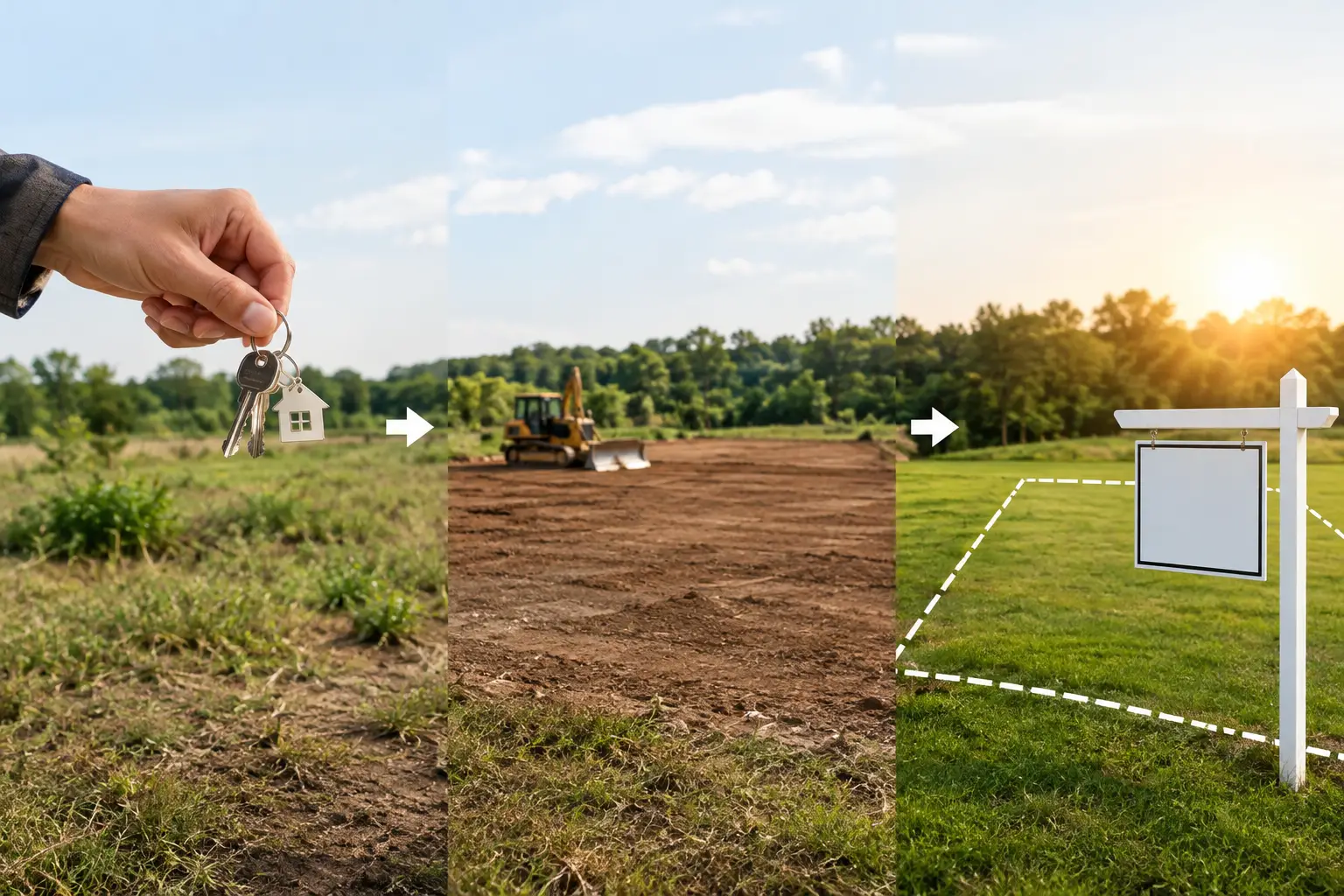
A $9,500 rural parcel can look like an easy win when nearby listings ask $25,000. But a vacant land flipping example only becomes profitable when the parcel has a real buyer, clean access, a usable legal description, and costs that leave room for a resale. The purchase price matters. The details behind it matter more.
Land flipping is the practice of buying a vacant parcel below its market-supported resale value, then selling it for a profit. Sometimes the investor adds value through better marketing, a clearer property file, minor cleanup, or flexible owner financing. Sometimes the opportunity is simply finding a motivated seller before a retail buyer finds the property.
This practical example walks through the numbers, the research, and the decision points that separate a promising deal from a cheap piece of land that sits.
A Vacant Land Flipping Example With Real Numbers
Assume an investor finds a 2.3-acre parcel in a rural county about 25 minutes from a growing small city. The property is wooded, fairly level, and zoned for a single-family home or manufactured home. It is not waterfront, but it is close to a state forest and several popular recreation areas.
The owner inherited the property years ago, lives out of state, and no longer wants to pay the annual taxes. The parcel was listed for $14,900. After confirming the basics, the investor offers $9,000 cash, with the seller paying no commissions and closing within 21 days. The seller accepts.
The investor’s projected costs look like this:
- Purchase price: $9,000
- Closing, recording, and title-related costs: $1,050
- Delinquent taxes paid at closing: $420
- Brush clearing and a basic entrance cut: $900
- Photos, signage, and listing costs: $330
- Carrying costs for four months: $300
The all-in basis is $12,000. That number, not the $9,000 purchase price, is the starting point for the resale decision.
After closing, the investor lists the property at $21,900. This is not based on wishful thinking or a neighbor’s oversized asking price. It is based on recent sales of comparable 1.5- to 3-acre parcels with legal road access, similar zoning, and similar distance to utilities. A few active listings are higher, but closed sales show that properly marketed lots in this range are actually trading between $18,500 and $22,500.
After 47 days on the market, a buyer agrees to pay $19,500. The seller covers $700 in closing costs. The investor’s net proceeds are $18,800, creating a $6,800 pre-tax profit on a $12,000 all-in investment.
That is a solid result, but it is not automatic. The deal worked because the investor confirmed that the property was usable and priced the resale for the buyer market, not just for other investors.
Why This Land Flip Worked
The first advantage was location with a defined use case. This was not remote acreage with no obvious purpose. A buyer could use the land for a future homesite, a manufactured home, a weekend base near public recreation, or a long-term hold. More potential uses generally create a larger pool of buyers, provided local rules allow them.
The second advantage was legal, recorded access. The parcel fronted a maintained county road. That sounds basic, yet access is one of the biggest dividing lines in vacant land value. A property reached only by an unrecorded trail, through a neighbor’s land, or by a questionable easement may be far harder to finance, build on, or resell.
The third advantage was a realistic exit price. The investor did not assume every active listing represented market value. Sellers can ask any price. Closed comparable sales, current competition, and local demand tell a more useful story.
Finally, the investor improved how the property was presented. The entrance was visible from the road, the brush was trimmed back, and the listing included clear photos, a parcel map, acreage, zoning information, road details, and nearby points of interest. Those steps did not transform the land physically, but they reduced uncertainty for buyers.
The Due Diligence Behind the Offer
A land investor should never make an offer based solely on aerial images and a low asking price. The best flips are often decided before the contract is signed.
Start by matching the assessor parcel number, legal description, acreage, and owner name across county records. A mismatch can signal a listing error, a boundary question, or an estate issue that needs to be resolved before closing. Review property taxes and confirm whether there are delinquent amounts, special assessments, liens, or other obligations that could affect the transaction.
Next, verify access on the ground and in the records. County road maps, plats, title work, and a site visit all help answer different questions. Seeing tire tracks on a path is not the same as confirming legal access. If an easement is involved, read it carefully. Some easements are limited, poorly described, or impractical for a future homesite.
Zoning and land-use rules deserve the same attention. Ask the county planning department what is allowed under the current designation. Confirm minimum lot size, setbacks, manufactured-home rules, RV restrictions, floodplain status, and whether the parcel can receive a building permit. If a buyer would need a septic system, local health department requirements can materially affect value.
Utilities should be described accurately. “Power nearby” can mean a line is across the street, half a mile away, or available only at substantial extension cost. Water may require a well, and soil conditions can determine whether septic is feasible. You do not have to solve every future building question to flip land, but you should not market assumptions as facts.
When the Same Numbers Would Not Be a Good Deal
Now change a few facts. Suppose the $9,000 parcel has no documented access, sits in a flood-prone area, and cannot support a septic system. A low purchase price does not cure those problems. The investor may still be able to resell it to an adjoining owner, a recreation buyer, or someone seeking a speculative hold, but the buyer pool is much smaller.
Or suppose comparable sales support only $14,000, not $19,500. With a $12,000 all-in basis, there is too little room for negotiation, unexpected closing costs, and the time required to sell. A deal can show a paper profit and still be a poor use of capital.
This is why experienced investors work backward from a conservative resale value. If you believe a parcel can reasonably sell for $20,000, do not assume you can safely pay $15,000 just because the spread looks positive. Estimate selling expenses, cleanup, taxes, holding time, and a price reduction if demand is slower than expected. Then build in enough margin to make the risk worthwhile.
Building a Resale Plan Before You Buy
Before submitting an offer, identify the most likely buyer. A one-acre lot outside a commuter town may appeal to a future homeowner. Five wooded acres near a lake may appeal to a recreational buyer. An inexpensive desert parcel may appeal to a long-term investor or off-grid buyer. The marketing language, photos, pricing, and financing approach should follow that buyer profile.
Owner financing can widen the audience for appropriately priced land. In the example above, the investor could offer terms such as a $3,900 down payment with the remaining balance paid monthly. That may create a faster response from buyers who want land but do not want to use a bank loan for a modest purchase. It also changes the investment: the seller receives income over time and retains responsibility for servicing the note, tracking payments, and handling default risk.
Cash pricing remains simpler. For a first flip, a clean cash resale can be easier to manage and can free capital for the next opportunity. The right strategy depends on your cash needs, buyer demand, and comfort with ongoing administration.
How to Find Better Land Flip Opportunities
The strongest opportunities often come from sellers with a clear reason to sell, not from land that has already been heavily marketed at retail pricing. Look for inherited parcels, owners who live far away, lots with years of unpaid taxes, and properties that no longer fit the owner’s plans. Respectful, straightforward communication matters. A fair offer with a simple closing process can solve a real problem for the seller.
When reviewing available land, compare parcels by intended use rather than acreage alone. Two five-acre properties can have dramatically different values if one has paved-road frontage, flexible zoning, power at the boundary, and nearby homes while the other has difficult access and no practical building path.
A land-focused marketplace such as BuyVacantLand.com can also help investors study the competition by property type, state, price range, and buyer appeal. Use the listings to understand how sellers position similar parcels, then verify pricing with local sold data and county records.
The goal is not to buy the cheapest land you can find. It is to buy land with a clear story, a defensible value, and enough room for the next owner to see the opportunity. When those pieces line up before closing, a flip becomes a calculated land investment instead of a gamble on a map.



Join The Discussion