
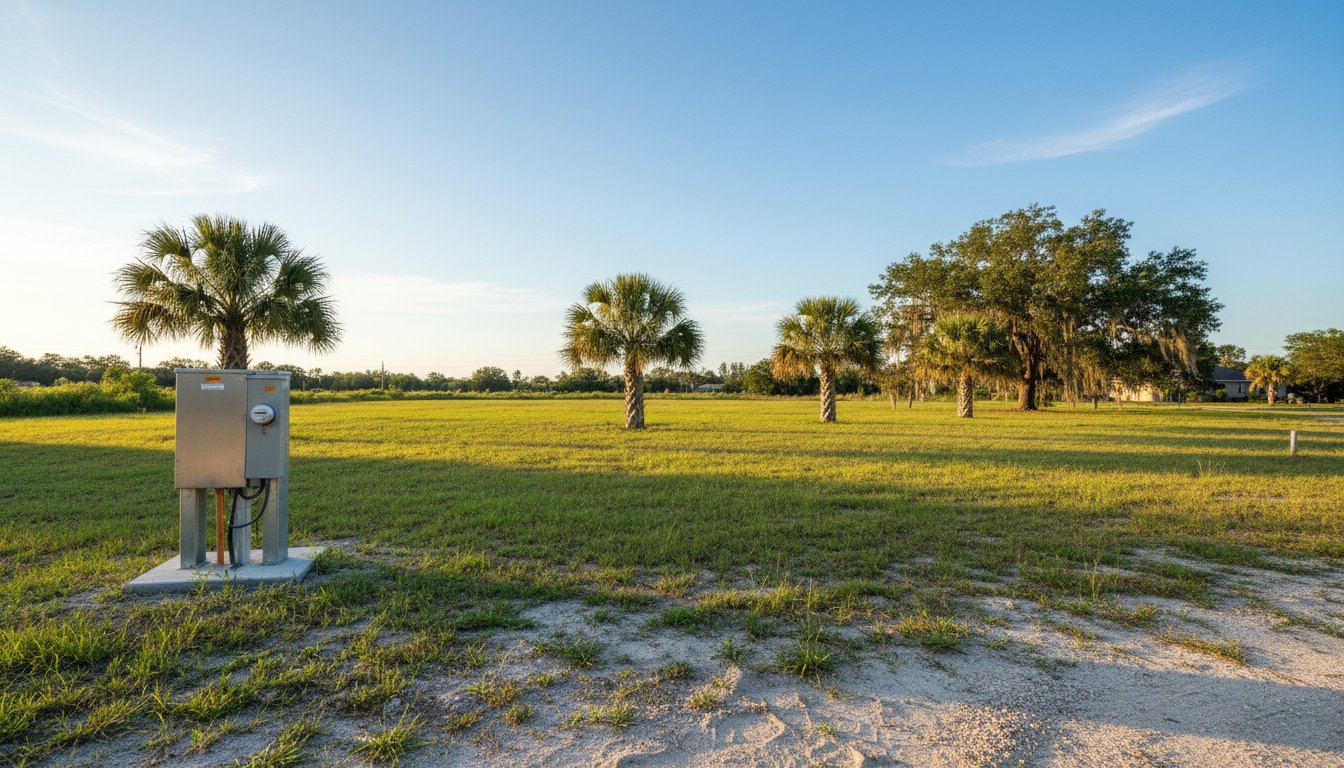
A single missing utility connection can increase your total construction budget by $30,000 before you even break ground. You want a lot that is ready for a foundation, not a financial money pit. Searching for land for sale with utilities should be a straightforward process. However, hidden hookup fees and complex zoning requirements often turn a dream build into a stressful nightmare. You already know that raw land is a gamble that most buyers can’t afford to take. You need a build-ready lot that guarantees a fast and predictable development path.
This 2026 guide shows you exactly how to identify, verify, and value serviced land to avoid these costly surprises. Industry data from 2024 indicates that a serviced lot can save a developer over 120 days in the permitting and site preparation phase. We will teach you how to confirm every connection and understand the true value difference between septic and sewer systems. You will learn a clear, three-step process to ensure your land is truly build-ready. Stop wasting time on useless property and secure a lot that is ready for your vision today.
Key Takeaways
- Define the “Build-Ready” spectrum to accurately distinguish between raw land and fully improved parcels.
- Master the “Core Four” utility requirements to ensure your site meets 2026 residential standards for water, power, waste, and communications.
- Avoid the “at the street” trap by calculating the true cost of connecting land for sale with utilities to your specific build site.
- Follow a strict three-step verification process with the county and utility providers to confirm infrastructure before you buy.
- Use specialized search filters to find parcels that guarantee a faster, simpler path to construction without hidden development fees.
What Does Land for Sale with Utilities Actually Mean?
Buying land for sale with utilities means you are purchasing speed and certainty. It refers to vacant parcels where essential services are already on the property or sitting right at the property line. You don’t have to guess if you can build. The infrastructure is ready for your foundation today. In the 2026 market, these lots are the gold standard for residential development.
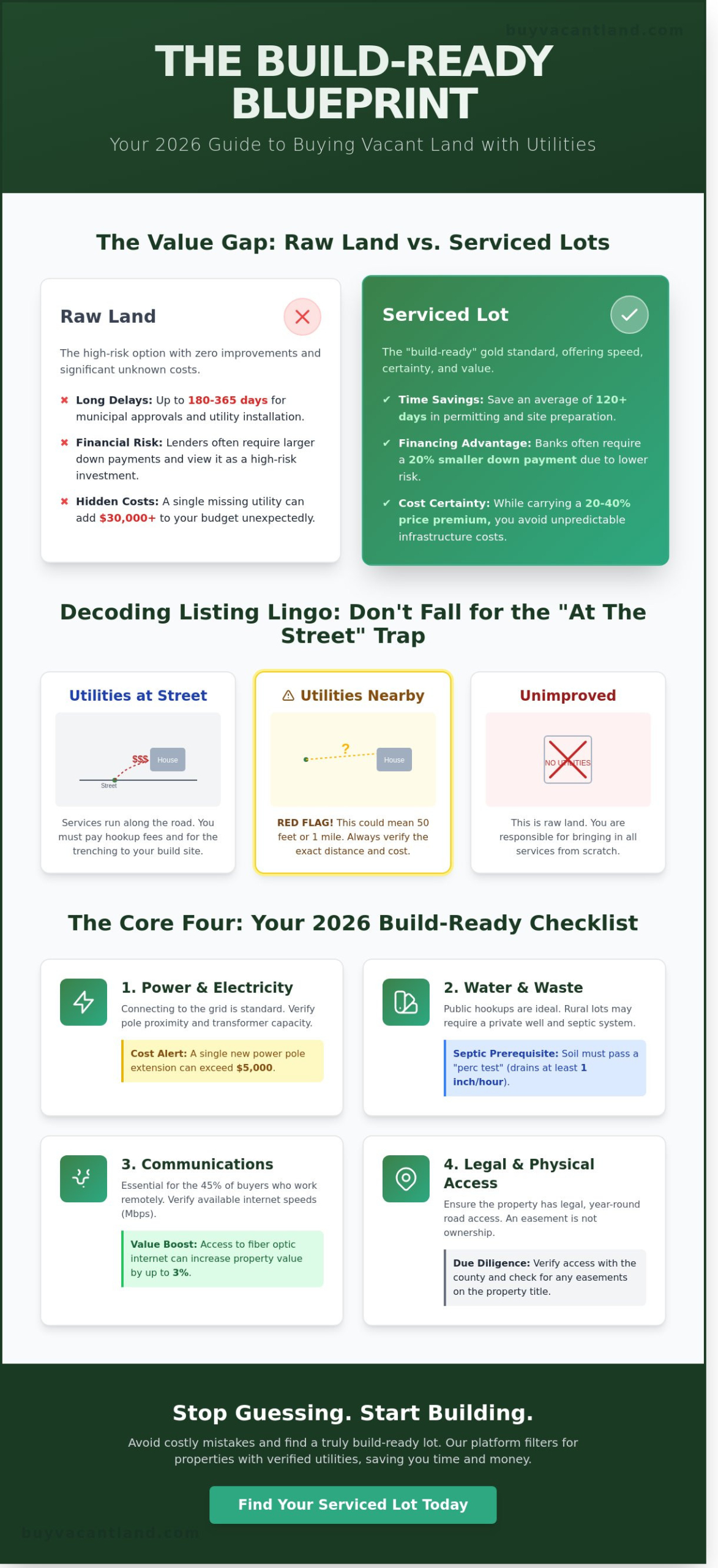
The build-ready spectrum separates land into three distinct categories. Raw land has zero improvements and no service access. Improved lots have utilities nearby but require connection fees. Fully developed parcels are pad-ready with all taps installed. Utilities are the primary driver of vacant land value in 2026 because they eliminate the biggest hurdle in construction: the unknown cost of municipal infrastructure.
Lenders view utilities as a form of collateral security. A lot with water and power is a lower risk than a scrub brush field with no service access. Most banks require a 20% smaller down payment for serviced lots compared to raw land. If you want to secure a construction loan, having utilities at the property line is usually a mandatory requirement for approval.
The Value Gap: Raw Land vs. Serviced Lots
When you choose a serviced lot, you pay a 20% to 40% premium over raw land prices. This price hike reflects the “time cost” of development. Installing new lines can take 180 to 365 days for municipal approvals alone. You skip the red tape by buying build-ready. You can check regional price shifts in our guide on how much is an acre of land to see how these premiums apply to your specific zip code.
Common Utility Terminology You Will See in Listings
Deciphering listing descriptions requires a sharp eye for specific industry phrases. Not all “available” utilities are ready for immediate use. Look for these three common terms in real estate listings:
- Utilities at Street: The lines run along the public road. You must pay the city or county to tap into them and run lines to your build site.
- Utilities Nearby: This is a red flag. It could mean services are 50 feet away or half a mile away. Always verify the exact distance.
- Unimproved: This property lacks a 100% connection to any public utility like water, sewer, or electricity.
Understand the difference between public systems and private ones before you sign a contract. A private system means you’re responsible for a well or septic tank. A public system means you pay a monthly bill to a provider. Public systems generally offer higher resale value and lower maintenance stress for the average homeowner.
The Core Four: Essential Utilities for Every Vacant Lot
Every buildable lot needs a strategy for water, power, waste, and communication. These systems dictate your construction budget and your move-in timeline. In 2026, residential utility access follows strict national standards for safety and efficiency. Your zoning determines your specific requirements. Residential lots usually demand municipal hookups to meet local building codes. Agricultural lots often rely on private, decentralized systems. Perform your due diligence when buying land to ensure these services are reachable. Finding land for sale with utilities saves you months of permit headaches and prevents thousands in unexpected infrastructure costs.
Power and Electricity Access
Connecting to the local power grid is the standard for most buyers. If a lot lacks a nearby pole, you pay for the line extension. Costs vary by region, but a single pole extension in 2026 can exceed $5,000 depending on the utility provider’s proximity. Always ask about “transformer capacity.” If the local transformer is already at 100% load, you must pay for a hardware upgrade before you can draw power. Modern 2026 builds also prioritize solar readiness. Even if you stay on the grid, your electrical panel should support future battery storage and rooftop arrays to maintain high resale value.
Water and Sewer Solutions
Municipal water hookups provide the most reliability. If they aren’t available, you’ll need a private well. This requires a drilling permit and a certified water quality test. Public sewer access is ideal for high-density areas, but rural lots require a septic system. You must pass a “perc test” to ensure the soil drains at a rate of at least 1 inch per hour. If you are looking at 1 acre land for sale, your septic layout is flexible. Smaller lots face tighter restrictions on where the tank and leach field can go relative to the property lines.
Modern Communications and Internet
Off-grid living no longer means being unconnected. High-speed fiber and broadband are now essential for the 45% of buyers who work remotely. Fiber optics increase property value by up to 3% according to 2025 real estate market data. Check cell signal strength as a “soft utility” during your site visit. If the signal is weak, you’ll need a signal booster or a satellite setup like Starlink. Reliable internet is a requirement for modern living. Verify the available megabits per second (Mbps) before you sign a contract. If the utility process feels too complex, you can sell your land for cash and skip the infrastructure costs entirely.
- Grid-tied Power: Check distance to the nearest transformer to avoid high extension fees.
- Water Source: Confirm if the lot requires a $15,000 well or a $2,000 municipal hookup.
- Waste Management: Ensure the soil passes a perc test before finalizing your purchase.
- Connectivity: Verify fiber availability to protect your long-term property value.
The Available Trap: Utilities at the Street vs. On-Site
Don’t let a vague listing description drain your bank account. The biggest mistake land buyers make is assuming “utilities available” means the lot is ready for a foundation. This single misconception often costs buyers between $5,000 and $50,000 in unexpected infrastructure fees. You must distinguish between utilities existing near the property and utilities being ready for hookup.
At the street means the municipal infrastructure exists in the public right-of-way. You don’t own it yet. To get water or power, you must pay a “tap fee” to the provider and hire a contractor to dig a trench to your build site. On-site means the work is finished. The meters are installed, or the stubs are already located within your property line. When you search for land for sale with utilities, always demand proof of physical meters or utility stubs on the lot itself.
Watch for these red flags in listing descriptions:
- “Utilities nearby” usually means they are hundreds of feet away.
- “Power at the road” means you pay for the drop and the poles.
- “Buyer to verify” is often code for “the seller knows it’s expensive to connect.”
The Real Cost of Utility Extensions
Extending lines from the street to your home site is a major capital expense. According to 2024 industry data from HomeAdvisor, running a new power line costs between $25 and $50 per linear foot. If your home site is 300 feet from the road, you are looking at a $15,000 bill just for electricity. Water lines average $30 to $60 per foot. These prices assume flat, clear ground. If your land has rocky terrain or requires a road crossing, these costs can double instantly.
You must also budget for the Impact Fee. This is a one-time tax charged by municipalities to connect new homes to the existing grid. In high-growth areas, these fees range from $1,500 to over $20,000 per lot. Verify these costs with the local building department before you sign a contract. Searching for land for sale with utilities that are already on-site saves you from these volatile expenses. If you want to narrow your search to nearby options, our guide on vacant land for sale near me shows you how to locate build-ready parcels in your local market without the guesswork.
Easements and Access Rights
Physical proximity doesn’t guarantee access. If the nearest power pole is on your neighbor’s property, you cannot touch it without their permission. You need a signed, recorded easement to bring that power to your lot. Always check a professional property survey for “P.U.E.” (Public Utility Easement) markings before buying. A utility easement is a legal right for providers to access and use a specific portion of your land for infrastructure maintenance and installation. If your neighbor refuses to grant an easement, your “build-ready” lot might stay dark forever. Verify the access rights during your due diligence period to keep your project on track.
Due Diligence Checklist: How to Verify Utilities Before Buying
Listing descriptions are marketing tools. They are not legal guarantees. If you see land for sale with utilities, verify the claim immediately. Don’t rely on a real estate agent’s word. Infrastructure is expensive. A mistake here costs you $25,000 or more in unexpected connection fees. Use a strict three-step verification process to protect your investment. First, call the county. Second, call the utility provider. Third, check the deed for easements. This sequence identifies problems before you lose your earnest money.
A professional land survey is your most powerful tool during due diligence. It identifies physical infrastructure like transformers, water meters, and sewer cleanouts. Surveys also reveal hidden easements that might prevent you from building over a buried line. If the lot relies on shared infrastructure, use our guide on how to find out who owns a property to contact neighbors. Ask them about the reliability of shared wells or private road maintenance agreements. This direct approach prevents future legal disputes over line maintenance.
Questions to Ask the Local Planning Department
Contact the planning office directly. Ask if the lot sits within the current service district for city water and sewer. In 2025, approximately 14% of high-growth counties implemented moratoria on new hookups due to capacity limits. Ask if any such restrictions exist for your specific parcel. Request the exact dollar amount for impact fees. These are one-time charges for a single-family residential tap. These fees often change annually on July 1st. Get the current rate in writing.
Verifying with Utility Companies Directly
Demand a “Will Serve” letter. This document is a formal commitment from the utility company. It guarantees they can and will provide service to your lot. Ask for a written quote on the distance from the nearest service drop. If the nearest power pole is more than 100 feet away, your connection costs will rise significantly. For commercial lots, confirm the availability of three-phase power. Standard residential service won’t support heavy machinery. Get these facts during your 30-day feasibility period.
Stop guessing and start building. Browse our verified land for sale with utilities and secure your lot now.
Find Build-Ready Land for Sale with Utilities Today
Searching for land for sale with utilities doesn’t have to be a full-time job. BuyVacantLand.com cuts through the noise. We simplify the search for lots that already have the infrastructure you need. You won’t waste time on properties that require $30,000 in septic costs or years of waiting for a city water hookup. Our platform gives you the tools to find build-ready parcels in minutes.
Use our specialized filters to isolate properties labeled “Utilities Included” or “Build-Ready.” This precision saves you hours of scrolling through unusable desert or swamp land. Once you find a lot, you communicate directly with the seller. You can ask technical questions about transformer locations or sewer line depths instantly. Our marketplace focuses on total transparency. We help you avoid the common raw land headache by providing clear data upfront.
Why Buyers Choose Our National Marketplace
We built this platform for people who value their time. You pay zero commissions and zero hidden fees when browsing our listings. Traditional real estate sites clutter your screen with houses, rentals, and condos. We offer a focused environment exclusively for vacant land. Whether you need a small residential infill lot or 40 acres of rural acreage, you’ll find it here without the distraction of suburban townhomes.
- Zero Commissions: Keep your money for your construction budget.
- Zero Hidden Fees: What you see is what you pay.
- Land Focus: 100% of our listings are vacant lots.
Our streamlined process removes the red tape. You get direct access to owners who are ready to close. This efficiency is why thousands of buyers trust our marketplace every year. We turn a complex real estate transaction into a simple, three-step path to ownership. You identify the property, verify the utilities, and move toward a fast closing.
Take the Next Step Toward Property Ownership
Your dream build starts with the right foundation. Browse our national inventory of land for sale in florida and across the United States. New lots hit the market daily. If you don’t see the perfect land for sale with utilities today, sign up for our automated alerts. You’ll be the first to know when a build-ready property becomes available in your target zip code.
Ready to move fast? Get your fair cash offer or find your dream lot with a few clicks. We provide the reliability and speed you need to secure your future home site. Don’t wait for the market to get more crowded. Start your search now and experience the relief of a guaranteed, simple transaction. Your future property is waiting for you to take action.
Secure Your Build-Ready Lot Now
Buying land in 2026 requires a fast, tactical approach. You can’t afford to guess if a lot is ready for construction. The 2025 National Association of Realtors Land Market Report indicates that build-ready properties sell 30% faster than raw acreage. You must verify the Core Four utilities immediately. Don’t fall for the utilities at the street trap. This mistake often costs buyers between $10,000 and $30,000 in extension fees according to 2024 HomeAdvisor hookup cost data.
Finding land for sale with utilities shouldn’t be a struggle. We simplify the search. You get direct-to-seller listings. You pay zero buyer commissions. We maintain a specialized vacant land focus to save you time. Our platform removes the traditional real estate red tape. You get a clear path to ownership without middleman fees. Take the lead on your construction project and lock in a lot that’s actually ready for a foundation. Your new build starts with the right dirt. Secure your future site today.
Find build-ready land with utilities on our national marketplace today!
Frequently Asked Questions
Is it better to buy land with utilities already installed?
Yes, buying land with utilities already installed is the fastest way to start your project. It eliminates the 3 to 6 months of permit waiting times often reported by the National Association of Home Builders. You avoid the stress of coordinating with city departments. Choosing land for sale with utilities ensures your build stays on schedule and avoids hidden infrastructure costs.
How much does it cost to bring utilities to a vacant lot?
Costs typically range from $10,000 to over $30,000 depending on your distance from main lines. HomeAdvisor data shows that drilling a private well costs between $1,500 and $12,000. Extending electrical lines can cost $25 to $50 per linear foot. Calculate these expenses before you sign a contract to ensure the deal makes sense for your budget.
Can I build on land if it doesn’t have municipal sewer access?
You can build on land without city sewer by installing a private septic system. The EPA notes that 20 percent of U.S. households successfully use these onsite wastewater systems. You’ll need a percolation test to confirm the soil can handle the drainage. This test usually costs between $750 and $1,500 depending on your specific county requirements.
Does “utilities available” mean I can hook up for free?
No, “utilities available” simply means the main lines are close to the property boundary. You’re still responsible for tap fees and connection charges. These fees often range from $1,000 to $5,000 per utility. Always call the local provider to get the exact connection price. Don’t assume available means ready to use without a checkbook.
What is the cheapest way to get water on raw land?
Rainwater harvesting or a shallow driven well are the most cost-effective methods for remote lots. A basic 5,000-gallon cistern system costs roughly $3,000 to install. This is significantly less than the $15,000 average for deep rock drilling. Check local 2026 building codes first. Some jurisdictions require a minimum flow rate before they’ll issue a residential building permit.
How do I know if the electricity is close enough to my property?
Look for existing power poles within 100 feet of your property line. Most utility companies provide the first 100 feet of line extension for a flat service fee. Distances beyond this point incur heavy per-foot charges. Contact the local cooperative with the property’s GPS coordinates. They’ll provide a binding estimate for the drop line and transformer installation.
Do I need a survey to find where the utilities are located?
Yes, a professional boundary survey identifies exactly where utility easements and hookups sit. This prevents you from building over a gas line or water main. A standard survey costs between $400 and $1,000 according to 2024 market data. It’s a small price for the peace of mind that comes with knowing your land for sale with utilities is build-ready.
What happens if a lot is “unrestricted” but has no utilities?
Unrestricted land gives you total freedom but requires you to provide your own power and water. You’ll need to invest in off-grid solutions like solar or wind. A complete residential solar array averages $15,000 to $25,000 before federal tax credits. This path is great for privacy but requires more upfront capital than a lot with existing city connections.




Join The Discussion