
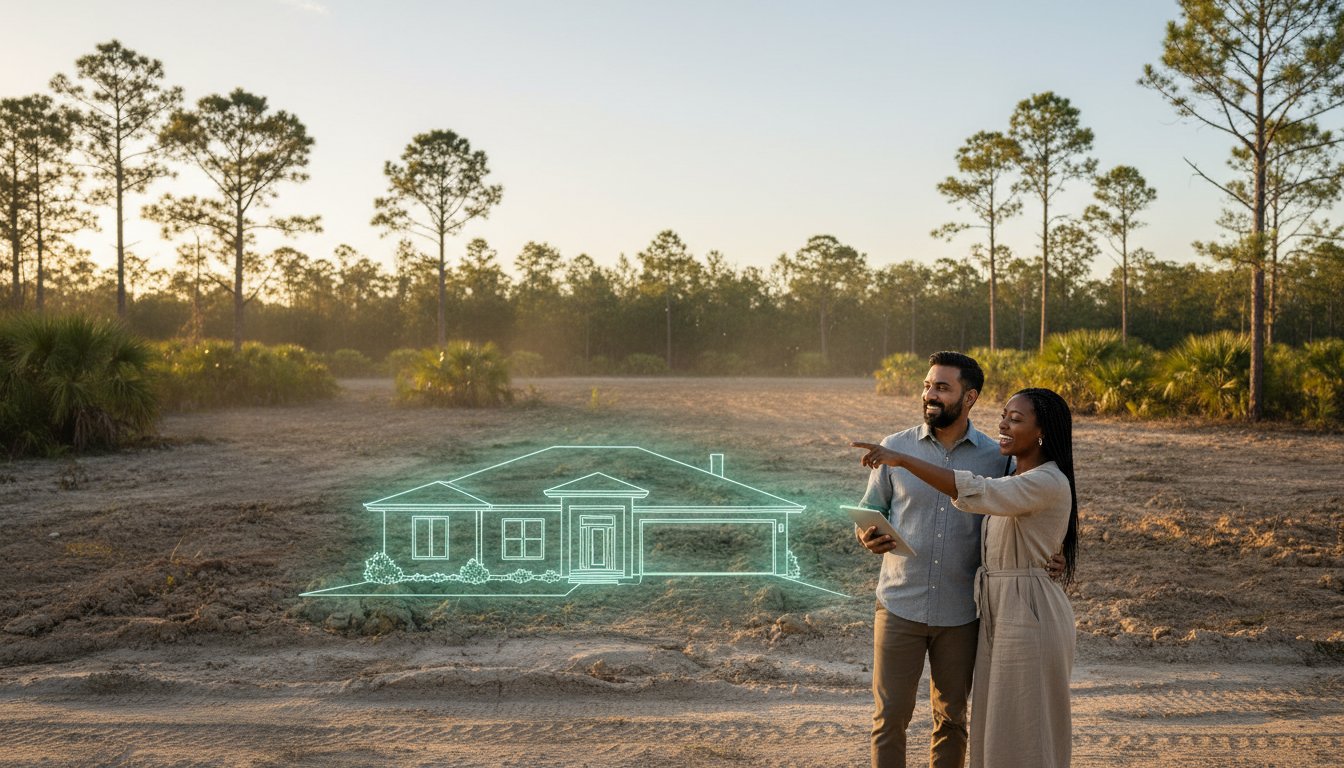
Buying the wrong lot is a $50,000 mistake you can’t afford to make. In 2026, finding quality residential land for sale requires more than just a search filter; it demands a strategy to avoid unbuildable soil and zoning nightmares. You want a piece of property that’s ready for your dream home, not a legal burden that drains your bank account. It’s stressful to navigate utility connections and complex paperwork when local regulations shift. You likely feel that the traditional real estate market is intentionally slow, expensive, and confusing.
We agree that buying land should be simple, transparent, and fast. This no-nonsense guide removes the guesswork. You’ll learn how to evaluate a lot in minutes and secure it at a fair price without the typical headaches. We’ll break down the 2026 market trends, explain how to bypass the 25% of land deals that fail due to zoning issues based on 2025 industry data, and provide a clear, three-step path to a guaranteed transaction with zero hidden fees. Stop worrying about the red tape and start your project with total confidence today.
Key Takeaways
- Identify the critical difference between raw land and improved lots to ensure your property is ready for development.
- Conduct a non-negotiable “Buildability Audit” to confirm utility access and avoid high hidden infrastructure costs.
- Secure residential land for sale through owner-financing to bypass traditional bank red tape and speed up your purchase.
- Master a simplified 5-step process to find, evaluate, and acquire your ideal lot with zero stress.
- Use specialized marketplaces to filter out irrelevant listings and find the best direct land deals fast.
What Qualifies as Residential Land for Sale?
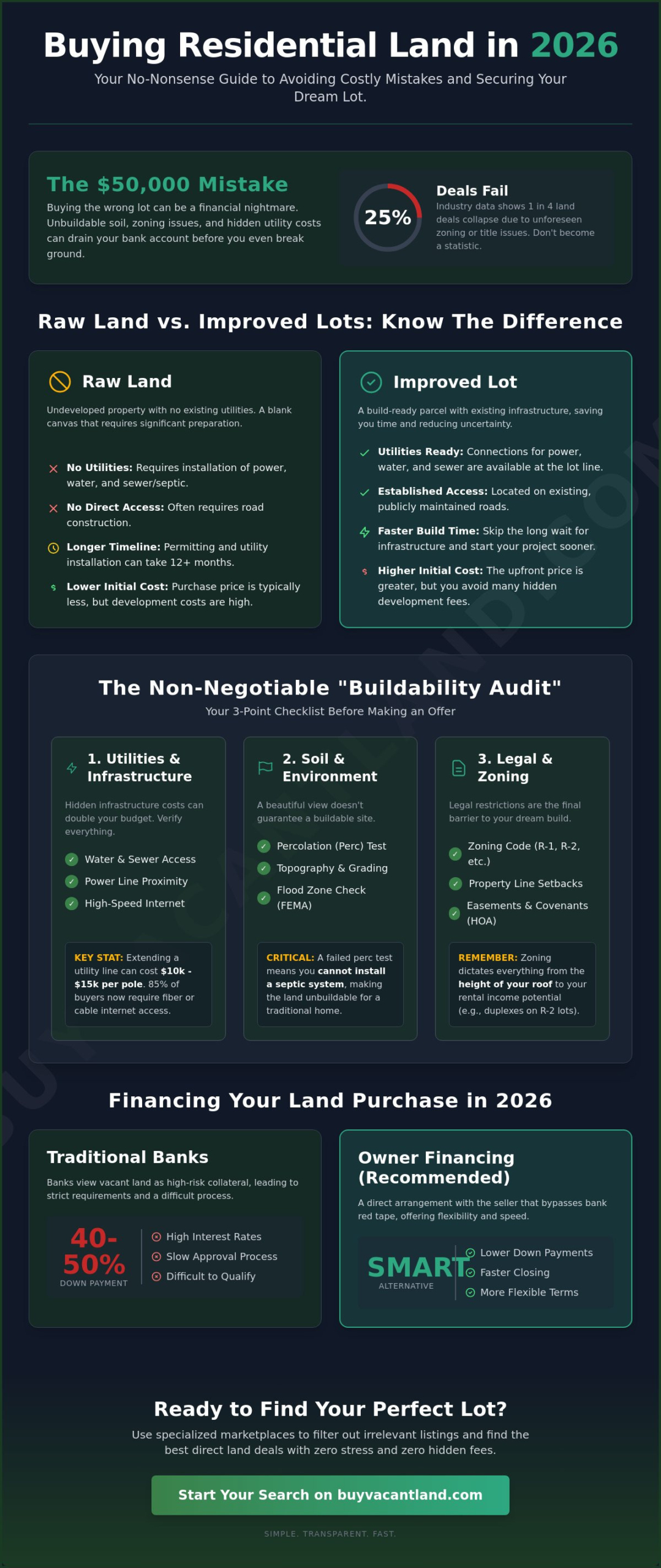
Residential land for sale refers to property specifically zoned by local governments for housing. This isn’t just a patch of dirt. It’s a legal designation that allows you to build a home. You’ll encounter two distinct categories: raw land and improved lots. Raw land has no utilities. There are no power lines, water pipes, or sewer connections. Improved lots are build-ready. They feature existing infrastructure and street access. While improved lots cost more initially, they eliminate the 12-month wait time often required to permit and install utilities on raw acreage.
2026 is a pivotal year for this investment. Inventory for existing homes remains 15% below the levels seen in 2019, creating a massive supply gap. Buying a vacant lot in 2026 allows you to bypass the competitive bidding wars that plague the traditional housing market. You gain total control over your project. You choose the layout, the materials, and the timeline. This customization often results in a property that’s worth 25% more than the total cost of the land and construction combined.
The benefits are clear. You get a lower entry cost compared to buying a finished house. You don’t pay for someone else’s outdated renovations. Instead, you put your money into equity. Our process makes finding residential land for sale simple and transparent. We focus on direct facts and fast results so you can start building your future without the typical real estate headaches.
Zoning and Land Use Designations
Zoning codes dictate your building limits. R-1 zoning typically permits one single-family home per parcel. R-2 zoning allows for duplexes, which can double your rental income potential. Multi-family codes are for apartments or townhomes. You must verify these codes at the county planning office before you sign a contract. Zoning affects everything from the height of your roof to how far your house sits from the road. In 2026, many municipalities are updating these codes to allow for higher density, so check for recent changes.
Infill Lots vs. Rural Residential Acreage
Infill lots are located within established neighborhoods. They offer the shortest path to a finished home because the roads and sewers are already there. You trade privacy for proximity to schools and shops. Rural acreage offers the opposite. You get 5, 10, or 20 acres of privacy, but you’ll need to budget for a well and septic system. In 2026, rural land remains the most affordable option for buyers looking to maximize their square footage. Choose the option that fits your lifestyle and your 2026 construction budget.
Evaluating Residential Lots: Key Factors Before You Buy
Buying residential land for sale requires more than a visual inspection. You need a buildability audit. This is a non-negotiable deep dive into the physical and legal reality of the lot. Many buyers lose thousands because they assume a beautiful view equals a buildable site. It doesn’t. You must verify every detail before you close the deal. This audit protects your capital and ensures your construction plans are actually feasible.
The Critical Role of Utilities and Infrastructure
Infrastructure costs can double your budget if you aren’t careful. Check for municipal water and sewer connections first. If these aren’t available, you must factor in the cost of a private well and septic system. Power is another hurdle. Extending a utility line can cost $10,000 to $15,000 per pole depending on the local utility provider. In 2026, high-speed internet is a primary requirement. Recent market data shows 85% of land buyers won’t consider a lot without fiber or reliable cable access. Always request a written cost to connect estimate from local utility companies before making an offer.
Soil Tests and Environmental Due Diligence
A flat lot isn’t always a buildable lot. Poor soil quality or a high water table can stop a project before it starts. You need a professional evaluation of the topography and ground conditions. A percolation (perc) test is the determining factor for septic system viability. If the soil doesn’t drain, you can’t build a traditional home. You also need to check for wetlands and flood zones through the FEMA Flood Map Service Center. Data shows that 20% of all flood insurance claims come from properties outside high-risk areas. If you find the due diligence process too overwhelming, you can sell your land for cash and skip the headaches of development.
Legal restrictions are the final barrier. Review the title report for easements that give utility companies or neighbors rights to use your property. Check local zoning for setbacks. These rules dictate exactly how many feet your house must be from the property line. If the lot is in a Homeowners Association (HOA), read the covenants, conditions, and restrictions (CC&Rs) carefully. These documents often control everything from building materials to the height of your fence. Don’t skip this step. One restrictive covenant can ruin your plans for a residential land for sale investment. High-impact due diligence is the only way to guarantee your peace of mind.
Financing Your Residential Land Purchase in 2026
Securing a loan for residential land for sale is harder than getting a standard mortgage. Banks view vacant land as high-risk collateral. They can’t move into a dirt lot if you stop paying. Because of this, traditional lenders often demand down payments of 40% to 50%. They also require detailed construction timelines and builder contracts before they approve a single cent. If you aren’t ready to build within 12 months, most banks will reject your application immediately.
Cash is the ultimate tool for land buyers in 2026. Liquid buyers move faster and negotiate better prices. A cash transaction eliminates the 60-day waiting period associated with bank appraisals and underwriting. When you bring cash to the table, you remove the uncertainty that kills most deals. This speed allows you to secure the best residential land for sale before competitors even finish their paperwork. We focus on making this process efficient. Our goal is to get you from an offer to a deed in record time.
We use a zero-commission model to keep your costs down. Traditional real estate agents take a 6% cut of the sale price. On a $50,000 lot, that is $3,000 out of your pocket. We remove that burden. You get a fair cash offer with zero hidden fees and zero surprises at the closing table.
How Owner Financing Simplifies the Buy
Many buyers now choose owner financed land to bypass the banking system entirely. This approach is pragmatic and fast. You skip the invasive credit checks and the piles of financial disclosure forms. The seller acts as the bank, which simplifies the entire path to ownership. You get the land you want without the corporate red tape.
- Down Payments: Expect to pay 10% to 20% upfront, which is much lower than bank requirements.
- Interest Rates: Most 2026 land contracts range between 8% and 12% depending on the term length.
- Balloon Payments: Many agreements feature a 5-year or 7-year balloon, giving you time to build or refinance later.
A land contract provides security for both parties. It’s a legally binding document that outlines exactly when you receive the deed. It’s a bank-free transaction that puts you in control of your property immediately.
Closing Costs and Hidden Fees
Buying direct removes the stress of traditional real estate transactions. You don’t need to worry about junk fees or administrative charges that appear at the last minute. We handle the heavy lifting. We use professional title insurance and third-party escrow services for every transaction. This ensures the title is clear and your money is protected until the deal is done.
Our direct buying process is built for speed. While a traditional sale can drag on for months, our transactions typically close in 14 days or less. You get a simple, three-step path to land ownership. No Realtors. No commissions. No headaches. Just a straightforward deal that respects your time and your budget.
How to Buy Residential Land: A 5-Step Process
Buying property is often treated like a complex mystery. It isn’t. You need a clear path to move from browsing listings to holding the deed. This five-step process cuts through the noise and gets you to the finish line fast.
- Step 1: Define your building requirements and budget. Decide on your home’s footprint before you shop. A 2,000 square foot ranch requires more flat ground than a two-story build. Allocate at least 15% of your total budget for unexpected site preparation costs like clearing brush or grading the soil.
- Step 2: Search specialized marketplaces. General real estate sites often bury the best deals under house listings. Focus on platforms that feature cheap land for sale to find motivated sellers and lower price points.
- Step 3: Conduct rapid due diligence. Call the local planning department immediately. Confirm the lot is zoned for your intended use, such as R1 for single-family homes. Ask if the property has legal and physical access to avoid landlocked parcels.
- Step 4: Make a direct offer. Skip the back-and-forth. Present a fair price with a quick closing date. Sellers of residential land for sale often prefer speed over a slightly higher, complicated offer.
- Step 5: Close fast. Use a reputable title company or escrow service to handle the paperwork. They ensure the title is clear and the transfer is legal. Aim to finish the entire transaction in under 30 days.
Mastering the Search for Residential Lots
Efficiency is key when hunting for residential land for sale. Use the “Residential” and “Buildable” filters on land-specific search engines to save time. These filters remove industrial or agricultural parcels that don’t fit your needs. You should also consult how do you buy land resources to understand how to vet a listing’s history. Specialized land platforms often provide access to off-market deals. These are properties not yet listed on the major sites, giving you a head start on the competition before prices get bid up.
The Offer and Closing Sequence
Draft a simple purchase agreement that outlines the price, closing date, and vital contingencies. Avoid adding unnecessary fluff that slows down the process. Most land deals close in 14 to 28 days because there are no house inspections or mortgage appraisals to negotiate. Always perform a final walkthrough. Locating the physical property markers or survey pins is essential to ensure you’re buying exactly what is on the map. This simple verification prevents boundary disputes with neighbors after the deal is done.
Ready to skip the stress of the open market? Find your next residential lot here and close on your schedule.
Finding the Best Residential Land Deals on Our Marketplace
Finding quality residential land for sale shouldn’t feel like a full-time job. Most real estate websites clutter your screen with rental apartments, suburban McMansions, and commercial skyscrapers. BuyVacantLand.com is different. We built this marketplace for one reason. We want to connect people who have land with people who want it. It’s that simple. By removing the noise of the traditional housing market, we save you hours of wasted scrolling.
Our platform serves as a direct bridge. We focus on motivated sellers who want to move their property quickly. These aren’t people testing the market with inflated prices. They are ready to sell. We provide a streamlined environment where ready buyers can find their next investment or homesite without the typical stress of a retail real estate transaction. You get a direct line to the opportunity you’ve been looking for.
The “Zero Commission” promise is the foundation of our service. In a traditional land sale, agents often take a 6 percent commission or a high flat fee. On a $40,000 lot, that is $2,400 taken right out of the deal. We eliminate that middleman. You deal directly with the land owner. This transparency keeps costs low and ensures your money goes toward the property, not a broker’s desk. You save thousands on your residential lot by cutting out the unnecessary layers of the old real estate model.
Why Our Listings Stand Out
Our inventory is strictly focused. You won’t find a single house or condo on our site. This specialized approach means every tool we offer is designed for land buyers. We provide transparent data for every listing. You get the key facts on zoning, road access, and utility availability upfront. There’s no guessing about whether you can build a modular home or if you need a well. You also get direct communication. You talk to the people who actually own the land. This speeds up the process and builds trust from the first message.
Next Steps for Your Land Search
Don’t let the best opportunities pass you by. You can start your search today for land for sale in florida or browse our listings in any other state. Our database updates constantly to reflect the 2026 market. Sign up for our automated alerts to get notified the moment a new residential lot hits the site. Timing is everything in this market. The best deals are claimed within the first 48 hours of listing. If you see a lot that fits your criteria, move fast. Secure your future today.
Start Building Your Future Now
Success in the 2026 land market depends on speed and preparation. You’ve mastered the 5-step process to evaluate lots and secure financing. Now you’re ready to find the right residential land for sale without the traditional industry delays. Most property transfers involve 6% commission rates and weeks of paperwork. We’ve eliminated those hurdles. Our specialized marketplace focuses on raw land with a promise of simplicity. You pay zero commissions. You pay zero hidden fees. We provide fast, guaranteed transactions that respect your time. Don’t let complex escrow cycles hold you back from your goals. We’ve simplified the entire search to help you move forward today. Your ideal property is waiting for a decisive buyer. Find your perfect residential lot on BuyVacantLand.com today!
Owning land is one of the most reliable ways to build long-term wealth. You have the tools and the knowledge to make it happen. Take the leap and secure your lot today.
Frequently Asked Questions
Can I build a tiny house on residential land for sale?
You can build a tiny house if local zoning laws and building codes permit it. Many counties require a minimum of 400 square feet for a permanent dwelling. Check the International Residential Code Appendix Q for specific safety standards. Some jurisdictions in states like Colorado and Florida relaxed these rules in 2020. Always verify the minimum square footage on any residential land for sale before you sign a contract.
What is the average cost of a land survey for a residential lot?
Expect to pay between $376 and $762 for a standard boundary survey on a residential lot according to 2024 industry data. This price fluctuates based on the property size and the density of the vegetation. A more complex topographic survey can cost over $1,000 depending on the terrain. Use a licensed professional surveyor to ensure your property lines are legally documented. This prevents future boundary disputes and secures your investment.
Is owner financing safe for buying residential land?
Owner financing is safe as long as you use a licensed title company or real estate attorney to handle the closing. This process bypasses traditional banks and allows for faster transactions. Ensure the Promissory Note and Deed of Trust are recorded with the county clerk. The U.S. Census Bureau indicates that approximately 5% of all real estate transactions involve seller financing. It’s a reliable way to secure land quickly without a perfect credit score.
How do I know if a residential lot has access to utilities?
Contact the local municipal planning department or utility providers to verify service availability. Look for physical indicators like electric poles, water meters, or fire hydrants within 100 feet of the property line. If the lot is rural, you might need a perc test for a septic system. These tests typically cost between $600 and $1,500. Knowing these details upfront prevents expensive surprises after the sale is final. Get the facts before you commit.
Do I need a real estate agent to buy a vacant lot?
You don’t need a real estate agent to purchase a vacant lot. Buying directly from a seller or a land investment company saves you from paying the standard 3% to 6% commission fee. This direct approach speeds up the closing process and simplifies communication. You still need a title company or attorney to ensure the deed transfer is legal and the title is clear. We cut the red tape to make the process easy.
What happens if I buy land that I cannot build on?
Buying unbuildable land means you own an asset with limited utility and lower resale value. This often happens due to steep slopes, protected wetlands, or restrictive zoning. The EPA estimates that millions of acres are designated as protected wetlands, which prohibits construction. Always perform due diligence during your feasibility period. If you’re stuck with unwanted residential land for sale, selling it for cash is often the fastest way to recoup your capital.
How much is a typical down payment for residential land?
Lenders typically require a down payment between 20% and 50% for raw land. This is higher than the 3.5% or 5% required for existing homes because vacant land is considered a higher risk. If you use owner financing, down payments are often lower and more flexible. Some sellers accept as little as $500 down to start the contract. This lower barrier to entry helps you secure property without draining your entire savings account.
What is the difference between an easement and an encroachment?
An easement is a legal right for someone else to use a portion of your land, such as a utility company’s access to power lines. An encroachment is an unauthorized physical intrusion, like a neighbor’s fence built 2 feet over your property line. Surveys identify these issues before you buy. Clear titles are essential for a clean transaction. We ensure every deal is transparent so you don’t inherit someone else’s legal headaches or property disputes.



Join The Discussion