

Your inherited land is currently a liability, not an asset. Every day that property sits idle, you’re losing money to property taxes and maintenance costs. The decision to sell inherited land shouldn’t be a multi-year legal battle or a constant drain on your bank account. You’re likely frustrated by confusing title transfers and disagreements with co-heirs while the bills keep piling up. We understand the burden of owning land you didn’t ask for and don’t intend to use.
This guide gives you the exact roadmap to navigate probate and minimize taxes using the 2026 federal estate tax exemption of $15 million. You’ll learn how to bypass the national average 5.70% commission and secure a fast sale with zero out-of-pocket costs. We’ll walk through the three steps to clear your title, leverage the 2026 stepped-up basis rules, and get your fair cash offer on a specialized marketplace without the typical real estate red tape.
Key Takeaways
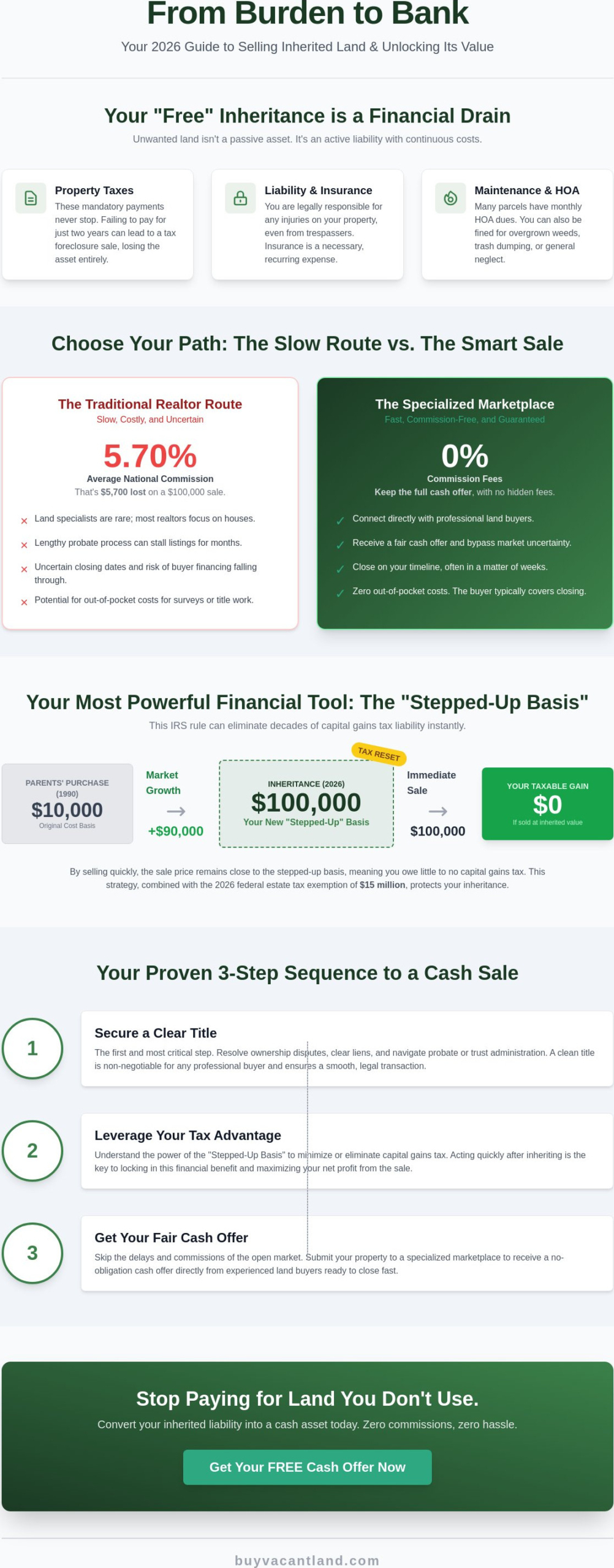
- Use the “Stepped-Up Basis” rule to eliminate capital gains tax liabilities and keep more of your inheritance.
- Avoid legal headaches by securing a clear title and resolving liens before you list the property for sale.
- Discover why specialized marketplaces help you sell inherited land faster than traditional realtors who focus on houses.
- Stop paying property tax bills on land you don’t use by converting your liability into cash with zero commission fees.
- Follow a proven three-step sequence to prepare documentation and close your sale with zero out-of-pocket costs.
The Reality of Inheriting Vacant Land in 2026
Inheriting land feels like a win until the first tax bill arrives. Most people view a land inheritance as a gift, but without a plan, it’s a financial drain. You don’t just get a deed; you get property tax statements, insurance requirements, and maintenance chores. If you don’t intend to build a home or start a farm, that acreage is a liability. You must sell inherited land before the holding costs consume your potential profit.
The national average real estate commission reached 5.70% in April 2026. On a $100,000 lot, you lose $5,700 the moment you sign a traditional listing. When you add in probate attorney fees and back taxes, your “free” land becomes very expensive. Speed is your best tool to protect your equity. Every month you wait is another month of “dead” holding costs that you can never recover.
Determining Legal Ownership and Title
How you received the property dictates how fast you can turn it into cash. If the land was held in a Living Trust, you can often bypass the court system entirely. This is the fastest path to a clean sale. If there was only a Will, you must navigate the probate process. This can be a lengthy and complex hurdle that takes months to resolve. The Executor or Personal Representative holds the legal authority to sign the closing documents, but they must follow strict court guidelines.
Things become complicated with heirs property. This situation occurs when land passes down informally without a clear will. You might find yourself sharing ownership with multiple siblings or distant cousins. Disagreements over the sale price or timing can stall the process for years. You need a clear title to get paid. No professional buyer will touch a lot with “cloudy” ownership or unresolved claims.
The Burden of Unwanted Acreage
Owning raw land isn’t a passive experience. You face three primary annual costs that eat into your inheritance:
- Property Taxes: These are mandatory and never stop. In many counties, failing to pay for just two years can lead to a tax foreclosure sale.
- Liability Insurance: You need coverage even for empty dirt. If a trespasser gets injured on your lot, you are legally responsible for their medical bills.
- HOA and Maintenance: Many parcels belong to associations with monthly dues. Even without an HOA, you may be fined for overgrown weeds or trash dumping.
Managing a vacant lot from a distance is nearly impossible. You can’t see if someone is timber-stealing or using your property as a private campsite. In 2026, the risk of adverse possession remains a threat. If an outsider occupies your land long enough without your permission, they could eventually claim legal ownership. Don’t let your inheritance become a source of stress. Convert the land into cash and walk away with peace of mind.
Navigating Taxes and Probate for Inherited Property
Tax season shouldn’t be a source of anxiety when you decide to sell inherited land. Many heirs assume they’ll owe a massive percentage of the sale price to the government. In reality, the 2026 tax code provides significant protections for inherited assets. You generally don’t pay federal income tax on the inheritance itself. Instead, you only worry about the growth in value that happens while you own it.
The federal estate tax exemption for 2026 is $15 million per individual. Unless the estate you’re dealing with exceeds this massive threshold, you won’t owe federal estate taxes. Most sellers only need to focus on capital gains. If you act quickly, you can often walk away with the full sale amount. Selling immediately is the most efficient way to keep your taxable income from inherited property at zero.
What is Stepped-Up Basis?
Stepped-up basis is the resetting of an asset’s cost basis for tax purposes upon inheritance. This is your most powerful financial tool. Your cost basis is adjusted to the fair market value of the land at the exact time of the original owner’s death. This adjustment wipes out decades of accumulated capital gains tax liability instantly.
Imagine your parents bought a parcel for $10,000 in 1990. By the time you inherit it in 2026, the land is worth $100,000. If you sell it for $100,000 today, your taxable gain is $0. You don’t pay tax on the $90,000 of growth that happened before you owned it. You only pay taxes if the value increases beyond that $100,000 mark before you close the deal. You can request a fair cash offer today to lock in your value before the market shifts.
Capital Gains and the “Two-Year” Rule
Capital gains tax rates on inherited property in 2026 are 0%, 15%, or 20%. Your specific rate depends on your total taxable income for the year. Unlike a primary residence, vacant land does not qualify for the $250,000 tax exclusion. You can’t live on raw land to avoid the tax. This makes it even more important to sell fast.
Holding the land for more than one year classifies your profit as a long-term gain. While these rates are lower than ordinary income tax, they still represent a loss of cash. The smartest move is to sell inherited land as soon as probate allows. This ensures the sale price stays close to your stepped-up basis. Consult with a tax professional by January 31, 2027, to finalize your 2026 return and confirm your specific liability.
Why Selling Raw Land Differs from Residential Real Estate
Traditional realtors spend their time talking about kitchens and bathrooms. Your inherited land has neither. Most residential agents don’t understand how to value or market a vacant lot. They’ll try to apply the same strategies they use for suburban homes, but those methods fail when there are no walls or roofs to show. To sell inherited land effectively, you must treat it as a distinct asset class with its own set of rules.
A “Home Buyer” wants a move-in ready sanctuary near good schools. A “Land Buyer” is a different persona entirely. They’re often developers, investors, or off-grid enthusiasts looking for specific features like soil quality, drainage, and road access. These buyers don’t browse the local MLS. They congregate on specialized marketplaces that highlight the technical details of the dirt itself. If you list with a standard agent, your property will likely sit untouched while you continue to pay property taxes.
The Challenge of Valuing Undeveloped Lots
Finding “comps” for raw acreage is significantly harder than finding them for a three-bedroom ranch. In the first quarter of 2026, the median price per acre for land listings in the U.S. was $62,365. However, that number fluctuates wildly based on local zoning and utility access. A lot with a capped well and a cleared building site is worth far more than a landlocked parcel with no legal access. You can’t rely on a simple neighborhood average to set your price.
Legal status also dictates value. Before you can even set a price, you must ensure the probate court process has officially transferred the title to your name. Without a clear deed, professional buyers won’t even make an offer. You need a valuation that accounts for the “buildability” of the land, not just its size. This requires looking at county zoning maps and topographical data rather than just recent sale prices of nearby houses.
Marketplace Reach: Finding the Right Buyer
Specialized marketplaces attract cash buyers who are ready to move quickly. These investors aren’t waiting for a 30-year mortgage approval. They understand the inherent value of the land and have the capital to close the deal in days, not months. This speed is essential when you’re trying to avoid the 23.6% decrease in national land inventory seen since 2019. Buyers are more deliberate in 2026, but they act fast when they find documented, high-quality parcels.
Creative options can also help you move property in a stabilized market. Offering “Owner Financing” is a powerful way to expand your pool of potential buyers. This strategy allows you to act as the bank, collecting interest and securing a faster sale. For a deeper look at how this works, read our guide on Owner Financed Land: The Complete 2026 Guide to Bank-Free Buying. By using a specialized platform, you connect directly with these motivated buyers and skip the traditional 5.70% commission fees.
How to Prepare Your Inherited Parcel for a Fast Sale
Preparation for land isn’t cosmetic. You don’t need to paint walls or fix leaky faucets. To sell inherited land quickly, you must prepare the legal and technical foundation of the property. Buyers in 2026 are more deliberate and focused on documentation than ever before. If your paperwork is messy, your sale will stall. Follow these four steps to get your parcel ready for a guaranteed transaction.
First, secure a clear title. Resolve any outstanding property tax liens or inheritance disputes immediately. Second, gather your essential documents. This includes a professional survey, zoning maps, and recent tax bills. Third, perform a “boots on the ground” inspection. You need to know exactly what you are selling. Finally, price the land for a cash transaction. While land prices increased 76.6% between 2019 and 2026, a high list price on a vacant lot often leads to months of waiting and ongoing tax bills. Aim for a price that reflects the current 2026 market stability.
Due Diligence for Land Sellers
You must verify legal access before listing. Landlocked parcels are significantly harder to sell and often require a legal easement. Check for environmental constraints like protected wetlands or steep slopes that prevent building. These factors dictate the land’s value more than the total acreage. Confirm if utilities like power, water, or septic are available at the lot line. Providing this data upfront builds trust with investors and speeds up the escrow process.
Marketing Your Land for Maximum Exposure
High-quality photos are mandatory. Use a drone to show the terrain and property boundaries from above. Your description should be direct and benefit-driven. Instead of “five acres of dirt,” use “Ready for your off-grid cabin with road access.” Highlighting the potential use of the land attracts the right buyer persona immediately. Land buyers in 2026 act quickly once they have the facts, so don’t hide the details.
Professional land buyers look for transparency and speed. They want to know the “Fair Cash Offer” potential so they can close without the red tape of traditional bank financing. Skip the long wait and the 5.70% agent commission. You can get your fair cash offer today and turn your inherited burden into a liquid asset in as little as 14 days.
List Your Inherited Land on a Specialized Marketplace
Traditional real estate agents aren’t land experts. Most don’t know how to market a lot that lacks a roof and four walls. When you list with a traditional brokerage, you lose approximately 5.70% of your sale price to commissions. That’s money you should keep. If your goal is to sell inherited land quickly, you need a specialized marketplace that targets developers and investors directly. These buyers don’t care about kitchens or curb appeal; they care about zoning, access, and potential.
BuyVacantLand.com removes the middleman. We connect you with a national audience of buyers who understand the value of raw acreage. You don’t have to wait months for a residential buyer to get a mortgage. Our platform attracts cash buyers who are ready to move now. It’s the most pragmatic solution for heirs who want to end the cycle of property tax bills and maintenance costs. We’ve streamlined the process so you can move from listing to closing without the typical residential red tape.
Zero Commission, Zero Stress
We operate on a model built for speed and transparency. Traditional brokerages are slow and expensive. We focus on simplicity. You manage your offers through a streamlined platform without the pressure of a sales agent. This national reach is critical in a market where inventory has dropped 23.6% since 2019. You aren’t limited to local buyers who might not have the cash on hand. By reaching a broader audience, you increase your chances of a fast, clean sale with zero commissions, zero fees, and zero closing costs.
Take Action Today
Stop letting property taxes drain your bank account. Every day you wait, your inheritance shrinks as holding costs pile up. We’ve simplified the entire process into three clear steps. Submit your property details, review your offers, and close the transaction with zero out-of-pocket costs. It’s time to convert that unwanted dirt into a liquid asset. Position your land where the right buyers are already looking. Get your fair cash offer today. You can List your vacant land on our national marketplace today and walk away with the peace of mind you deserve.
Turn Your Inherited Liability Into Cash Today
You now have the roadmap to stop the financial drain of unwanted acreage. Holding onto this property means losing money every month to taxes and maintenance. The 2026 tax rules, specifically the stepped-up basis, provide a narrow window to sell inherited land with minimal liability. Don’t let a traditional agent take 5.70% of your equity for a listing that doesn’t fit their expertise. You’ve learned how to clear your title and prepare the technical documents needed for a professional transaction.
Our platform is built exclusively for vacant land and provides national reach to cash buyers. We eliminate the stress of the traditional market with zero commission listings and a focus on speed. You can bypass the long wait of the MLS and connect directly with investors who value your dirt. It’s time to stop paying for land you don’t use and start enjoying the relief of a guaranteed sale. Get your fair cash offer and list your land today. You’ve done the research; now take the final step to secure your profit.
Frequently Asked Questions
Do I have to pay taxes when I sell inherited land?
You only pay taxes on the profit earned after the date of the original owner’s death. The IRS grants you a stepped-up basis to the fair market value at the time of inheritance. If you sell the property quickly for its appraised value, your taxable gain is often zero. For the 2026 tax year, any applicable long-term capital gains are taxed at 0%, 15%, or 20% depending on your total income.
How long does it take to sell inherited land through probate?
The probate process typically takes between six and 18 months to complete. This timeline depends on the complexity of the estate and the specific laws in your state. If the property was held in a Living Trust, you can bypass the courts entirely and sell within weeks. Without a trust, you must wait for the court to issue Letters Testamentary before you can legally sign a deed.
Can I sell inherited land if my siblings do not want to?
You can force a sale by filing a partition action in court. This legal move requires the property to be sold and the proceeds to be divided among all heirs according to their ownership percentage. While effective, this process involves court costs and legal fees that reduce your final payout. Most heirs find it more pragmatic to reach a buyout agreement to avoid the expense of a forced judicial sale.
What documents do I need to sell land I inherited?
You need the death certificate, the current deed, and court-certified probate documents. These papers prove you have the legal authority to sell inherited land on behalf of the deceased. If the property is held in a trust, you’ll need the Trust Agreement and a Certificate of Trust. Providing a recent survey and the most recent property tax bill will also help speed up the buyer’s due diligence process.
Is it better to sell inherited land “as-is” or improve it first?
Selling “as-is” is the most efficient choice for raw land. Unlike houses, cosmetic improvements on vacant lots rarely return the cost of the investment. Buyers in 2026 are looking for buildable terrain and clear documentation rather than cleared brush or temporary fencing. Focus your energy on resolving title issues and gathering permits, which adds more actual value to the transaction than physical labor.
How do I find the value of inherited land if there are no recent sales?
Start with the 2026 national median price of $62,365 per acre and adjust for local factors. Value is driven by “highest and best use,” such as residential development or agricultural production. If local comps are missing, look at county zoning maps and utility access. A parcel with road frontage and power at the lot line commands a significant premium over landlocked or off-grid acreage.
What happens if the inherited land has back taxes owed?
Back taxes are settled at the closing table using the proceeds from the sale. You don’t need to pay these debts out-of-pocket to start the listing process. The title company will verify the exact amount owed to the county and deduct it from your final check. This ensures the buyer receives a clear title while allowing you to exit the property without any upfront financial burden.
Can I sell inherited land without a realtor?
You can sell inherited land without a realtor by using a specialized marketplace. This allows you to skip the national average 5.70% commission and work directly with cash buyers. Specialized platforms connect you with investors who understand land technicalities and don’t require traditional bank financing. This direct method is the fastest way to close a deal with zero commissions and zero hidden fees.




Join The Discussion