

Most buyers looking for off-grid land for sale end up purchasing a scenic view that is legally uninhabitable. That is a costly mistake. You want independence and a break from rising utility costs, but the fear of buying a parcel without water rights or building permissions is a real barrier. You need a property that actually works, not a legal headache that drains your savings.
This guide eliminates the guesswork. You will learn how to find affordable raw land and evaluate it like a professional. We cover the 2026 logistics of solar and septic systems, including the fact that the 30 percent federal tax credit for homeowner-owned solar expired in late 2025. We also detail how to find owner-financed parcels to bypass the 8 percent to 9 percent interest rates currently standard for land loans.
We provide a clear path to self-sufficiency. First, we identify the specific zoning hurdles you must clear. Second, we break down the actual costs for essential infrastructure like wells and waste management. Finally, we show you how to close the deal without traditional real estate commissions or procedural delays. Let’s get started.
Key Takeaways
- Define modern off-grid requirements to include high-speed satellite internet for a functional remote lifestyle.
- Prioritize water, power, and waste infrastructure to avoid purchasing unusable parcels.
- Navigate complex county zoning laws to find unrestricted land suitable for alternative dwellings like tiny homes or RVs.
- Streamline your search for off-grid land for sale by using specialized platforms that filter out traditional home listings.
- Secure your property efficiently by connecting directly with land owners through a dedicated vacant land marketplace.
What is Off-Grid Land for Sale?
Off-grid land for sale refers to property that operates independently of municipal services. This means no connection to the public electrical grid, city water lines, or central sewer systems. Understanding what ‘off-the-grid’ means is essential for setting realistic expectations before you buy. In 2026, this definition has evolved to include modern comforts. High-speed satellite internet now allows residents to remain fully connected while living miles from the nearest power line. You can secure total privacy without sacrificing your career or communication.
You will find two main types of parcels on the market. Raw undeveloped land is a blank slate with no existing improvements. Improved off-grid lots might already feature a drilled well, a cleared building site, or a basic solar setup. Choosing improved land often saves time and reduces immediate infrastructure costs. Both options offer significant benefits that traditional real estate cannot match. You enjoy lower property taxes, total privacy, and permanent freedom from monthly utility bills. You own the land and the resources that power it.
The Difference Between Off-Grid and Remote Land
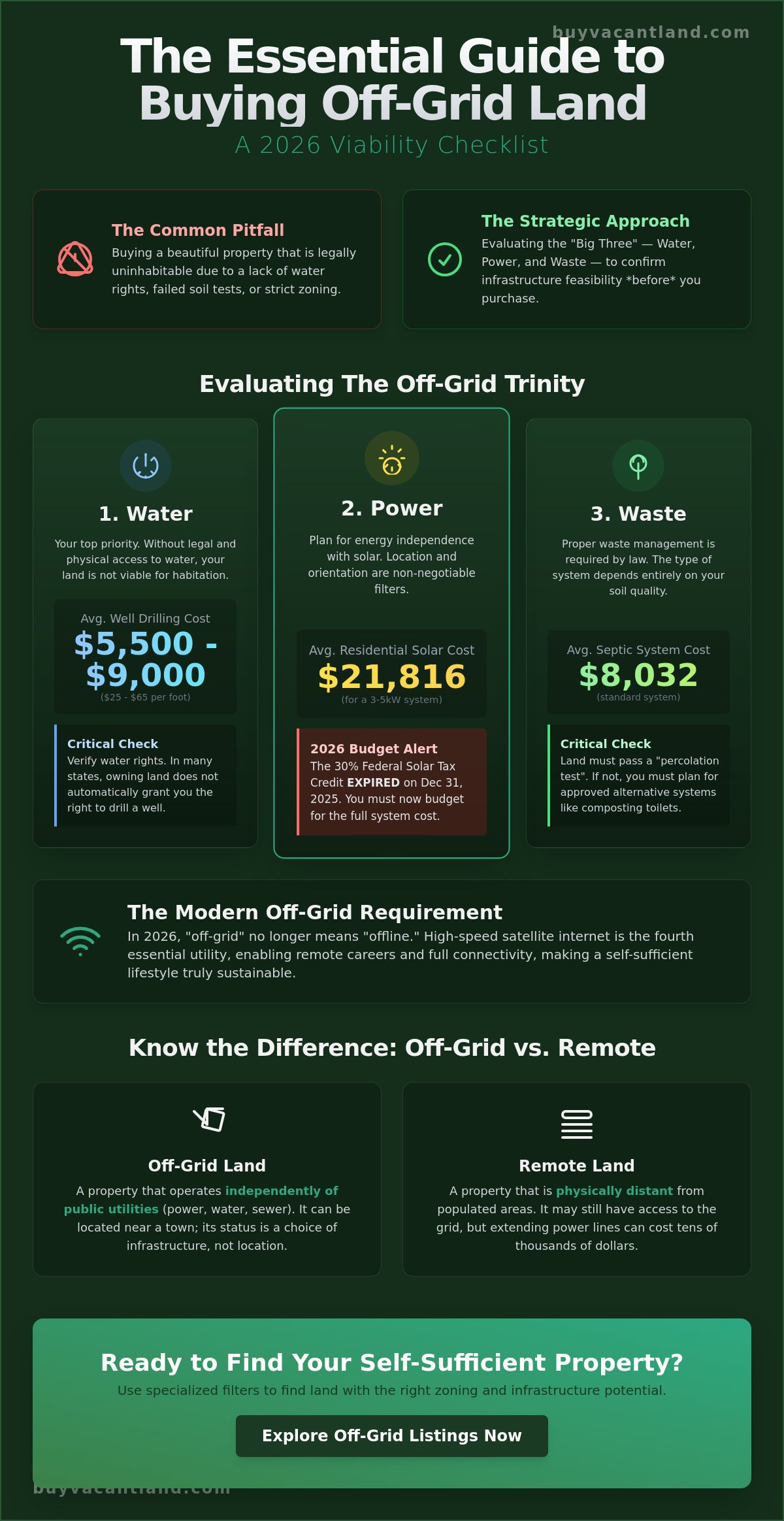
Searching for off-grid land for sale requires a clear understanding of location versus utility status. Remote land is physically distant from population centers, yet it may still have access to power lines. Conversely, you can find off-grid land near a small town if the owner chooses to disconnect. This distinction is vital for your building budget. Bringing power to a remote lot can cost tens of thousands of dollars for every pole required. Choosing a parcel specifically designed for off-grid use lets you invest that money into solar arrays or lithium-ion battery storage instead.
Why Demand for Self-Sufficient Property is Peaking in 2026
The drive for energy independence has never been higher. U.S. electricity consumption is projected to hit record levels in 2026, and people want to escape the rising costs of the national grid. Food security is another major driver for this move. Large, unencumbered parcels allow for greenhouses and livestock that suburban lots cannot accommodate. The shift toward remote work has also removed the need for a daily commute. This makes cheap land for sale a viable alternative to overpriced urban housing. You get more space, more freedom, and a lower cost of living.
Evaluating the Big Three: Water, Power, and Waste
Buying off-grid land for sale is a technical challenge, not just a real estate transaction. You must verify the feasibility of infrastructure before you commit your capital. Infrastructure defines your daily life and your property’s long-term value. If you cannot secure water or manage waste, the land is effectively useless for permanent habitation. Successful buyers use a strict feasibility framework to evaluate every potential parcel.
Water is your absolute priority. In 2026, the national average to drill a residential well ranges from 5,500 to 9,000 dollars. You should budget between 25 and 65 dollars per foot of depth. If drilling is not viable due to depth or water quality, you must plan for cisterns and water hauling. Waste management follows closely in importance. A standard septic system costs an average of 8,032 dollars. If the soil fails a percolation test, you may need to pivot to composting toilets and graywater systems. These alternative methods are often more cost-effective but require specific county approvals.
Power and communication are the final pillars. Modern off-grid power systems typically rely on solar arrays paired with lithium-ion battery storage. A full residential solar installation in 2026 averages around 21,816 dollars. To remain productive, you need reliable data. High-speed satellite internet like Starlink and cellular boosters have made remote work possible from almost any location. You can view off-grid listings that already feature these critical connectivity advantages.
Water Rights and Discovery
Owning the surface land does not guarantee access to the water beneath it. Riparian rights in 2026 ensure you have legal access to surface water flowing through or adjacent to your parcel, but these rights vary by state. In Colorado, for example, you generally need at least 35 acres to qualify for a domestic well permit without an existing water source. Always check state water records and permit history before signing a contract. A parcel without legal water access is a liability, not an asset.
Sustainable Energy Systems
Energy independence requires precise planning. A small off-grid cabin typically needs a 3kW to 5kW solar system to handle basic appliances and lighting. Southern exposure is a non-negotiable search filter for solar-reliant lots. Without clear sun access, your system will fail to charge your battery bank during winter months. You must also decide between a backup generator and an oversized battery bank. While a generator provides certainty during storms, a larger lithium-ion bank reduces your long-term reliance on fuel. Remember that the 30 percent federal tax credit for homeowner-owned solar expired on December 31, 2025. You must now account for the full system cost in your 2026 budget.
Navigating Zoning Laws and Building Codes
Zoning laws determine if your off-grid dream is legal or a liability. Many buyers find off-grid land for sale only to realize the local county forbids living in an RV or a tiny home. You must research state-by-state off-grid living laws before you wire any funds. In 2026, Arizona continues to follow the International Residential Code (IRC). Counties like Cochise mandate a minimum dwelling size of 296 square feet. If you plan to build a smaller structure, you will face immediate enforcement actions. You need to know these numbers before you buy.
Unrestricted land is the gold standard for self-sufficient living. These parcels typically exist in rural counties where residential building code enforcement is non-existent. Parts of Texas still offer this level of freedom. However, never assume that “remote” means “unregulated.” Even distant desert lots can be subject to strict Homeowners Association (HOA) covenants. These private rules can ban solar panels, specific fencing, or even the type of livestock you intend to raise. Always demand a copy of the CC&Rs (Covenants, Conditions, and Restrictions) during your due diligence period. A cheap lot with an aggressive HOA is not a bargain.
Understanding Land Use Designations
Your property’s zoning category dictates your daily life. Agricultural (Ag) zoning often allows for livestock and farm structures, but it may have strict rules about secondary dwellings or “accessory dwelling units.” Residential zoning is more common but carries the most red tape regarding construction materials and utility hookups. Look for “Open Use” or “Unclassified” designations. These categories provide the maximum flexibility for off-grid builders in 2026. You must also verify the presence of wetlands or flood zones. Federal regulations can halt all construction on these protected areas. A parcel in a flood zone is often unbuildable and carries massive insurance costs.
Easements and Legal Access
Never buy landlocked property. Without legal access, you cannot reach your land without trespassing on neighbors. This is a high-risk investment that often leads to expensive litigation. Ensure you have a deeded easement recorded with the county. A “handshake” agreement with a neighbor is worthless if that neighboring property changes hands. You also need to verify road maintenance responsibilities. In winter months, many rural roads are not plowed by the county. If you don’t own a plow or a heavy-duty 4×4, you will be stranded. Confirm who maintains the path to your gate before you sign the deed.
How to Buy Off-Grid Land Safely in 2026
Securing off-grid land for sale in 2026 demands a disciplined approach. You cannot rely on traditional real estate agents who specialize in suburban homes. They often lack the technical knowledge required for raw land transactions. You need a logical, five-step sequence to move from a search query to a recorded deed. This process ensures you don’t waste capital on a parcel that cannot support your lifestyle.
Your first step is to define your “must-haves.” Determine your minimum acreage and preferred climate before you start looking. Proximity to supplies is critical for long-term survival; living two hours from the nearest hardware store can be a logistical nightmare. Second, use specialized marketplaces. Platforms like BuyVacantLand.com allow you to filter specifically for raw land, removing the clutter of developed houses. Third, conduct a remote “desktop” inspection. Use satellite imagery to check for existing road access and analyze topographic maps to identify steep slopes that might prevent building. Fourth, perform a physical site visit. You must walk the property lines yourself. Check for natural drainage patterns and verify your cell signal strength. Finally, verify the title. Ensure the seller actually owns the land and check for back taxes or hidden liens that could become your legal debt.
Due Diligence Checklist for Raw Land
Your closing process must include specific technical verifications. Always order a soil percolation test before you finalize the deal. This test confirms if the ground can support a septic system. If markers are missing, hire a professional surveyor to verify boundaries. You don’t want to accidentally build a cabin on a neighbor’s lot. Ensure the how do you buy land process includes a comprehensive title search to eliminate legal risks before any money changes hands.
Financing Your Off-Grid Escape
Traditional banks rarely offer loans for raw, off-grid land. Lenders view undeveloped property as high-risk assets. In 2026, raw land loans typically require down payments between 20 percent and 50 percent. This creates a significant barrier for many buyers. You can bypass these hurdles by seeking owner financed land. This arrangement allows you to make payments directly to the seller without a bank’s interference. BuyVacantLand.com connects you with sellers who offer these flexible terms. You can browse available owner-financed lots and secure your property without the stress of a traditional mortgage.
Find Your Off-Grid Property on BuyVacantLand.com
Searching for off-grid land for sale should not be a frustrating chore. Most real estate websites prioritize houses, condos, and rental properties. This “home-clutter” forces you to scroll through thousands of irrelevant listings to find one undeveloped parcel. BuyVacantLand.com solves this problem. We are a specialized marketplace dedicated exclusively to vacant land. You won’t find a single kitchen remodel or suburban driveway here. We focus on raw, undeveloped property for buyers who value independence and efficiency.
The platform is designed for a fast, logical search experience. You can filter your results by specific land types to match your goals. Whether you need hunting land, farms and ranches, or residential lots for a future cabin, the interface is straightforward. We categorize listings so you can find exactly what you need without wasted clicks. This streamlined approach saves you time and reduces the stress of property hunting. Sellers also benefit from this focus. When you list your vacant land on our site, you reach a targeted national audience specifically looking for dirt, not houses.
Why Choose a Specialized Land Marketplace?
Success in the land market depends on direct access. Our marketplace facilitates communication between land owners and buyers. This direct link often leads to better deals and clearer information about the property’s history. You can find “unlisted” opportunities that never hit traditional databases. One of the greatest advantages is access to owner-financed land. As discussed in previous sections, traditional bank loans for raw land are difficult to secure in 2026. Our platform highlights sellers who offer bank-free financing. This allows you to secure your off-grid escape with a simple, equitable financial proposal. This is a marketplace built by land experts for people who understand the value of raw earth.
Start Your Search Today
Don’t let complex hurdles stop your progress. You can browse thousands of acres across the United States right now. The path to self-sufficiency starts with the right parcel. If you have land to sell, our listing process is fast and transparent. We cut through the traditional procedural delays found in the real estate industry. You can put your property in front of motivated buyers in minutes. Take the final step toward your goal of independence. View our current off-grid land for sale here and find the foundation for your remote lifestyle. Your perfect property is waiting.
Secure Your Off-Grid Future Today
You now have the framework to evaluate remote property without the typical industry hurdles. You understand that water rights and solar feasibility define a parcel’s value. You also know how to bypass complex zoning laws by targeting unrestricted land. These steps protect your capital and ensure your self-sufficient lifestyle is legally sound. Don’t leave your independence to chance.
Finding the right off-grid land for sale requires a specialized tool. Traditional sites waste your time with residential listings and high commissions. Our direct-to-seller marketplace offers an exclusive focus on vacant land with national coverage across the US. We provide a simplified path to ownership that cuts through procedural delays. We eliminate the noise so you can focus on the land.
Take action now to secure your future. Browse Off-Grid Land for Sale Now and connect directly with sellers who understand your goals. Your ideal property is available today.
Frequently Asked Questions
Can I legally live off-grid in the United States?
Yes, off-grid living is legal in all 50 states, but local county regulations dictate the specifics of your lifestyle. Most jurisdictions allow you to generate your own power and collect rainwater. However, you must comply with local health department rules regarding waste disposal and minimum dwelling sizes. Always verify the specific land-use laws in your target county before you finalize a purchase.
How much does it cost to drill a well on off-grid land?
Drilling a residential water well in 2026 typically costs between 3,000 and 15,000 dollars. The national average for this service is approximately 5,500 to 9,000 dollars. You should expect to pay between 25 and 65 dollars per foot of depth. These prices fluctuate based on the local geology and the depth required to reach a reliable aquifer.
What is the best state to buy off-grid land for sale?
The best state depends on your need for solar gain, water access, and building freedom. Search for off-grid land for sale in states like Missouri or Tennessee for high rainfall and lower land costs. If you prefer solar power, the Southwest offers the best energy potential. You should prioritize states that have favorable water rights and minimal county-level building interference.
Is it possible to get a mortgage for off-grid property?
Obtaining a traditional mortgage for raw off-grid land for sale is extremely difficult because banks view undeveloped parcels as high-risk assets. Most lenders require a down payment between 20 percent and 50 percent and charge higher interest rates. You will find more success using owner financing. This method allows you to negotiate terms directly with the seller and bypass rigid bank requirements.
How do I know if a piece of land is landlocked?
You can identify a landlocked property by reviewing the deed and county plat maps for a recorded easement. A legal easement ensures you have a permanent right to cross adjacent properties to reach your land. If no road frontage or deeded access exists, the property is landlocked. Never rely on verbal promises from neighbors; only a recorded document provides legal protection.
What does “unrestricted land” actually mean?
Unrestricted land refers to property located in a county that has not adopted residential building codes or zoning limitations. You have the freedom to build alternative structures or live in temporary dwellings like RVs. While you gain maximum independence, you must still follow state-level environmental laws for water and waste. This designation is most common in very rural or unincorporated areas.
Do I need a permit to build an off-grid cabin?
Most counties require a building permit for any structure used as a permanent residence. Codes typically mandate inspections for structural integrity and safe waste management. Even if you are building in a remote area, you should contact the local building department to confirm permit needs. Some jurisdictions offer exemptions for very small structures or “owner-builder” projects.
Can I use a composting toilet on my property?
You can use a composting toilet if your local health department approves alternative waste systems. Many rural counties permit these systems as long as they meet specific sanitation certifications. However, some areas still require a traditional septic tank to be installed on the property as a backup. Always confirm these requirements with the local authorities before you design your waste management system.




Join The Discussion