
National land inventory has contracted by 23.6 percent since 2019, yet the median price for raw land in 2026 remains $22,682 per acre. You likely feel the pressure of this tightening market. It’s easy to feel overwhelmed by thousands of listings or terrified of buying a property with no utility. You want a high ROI, but you don’t want a money pit. Master the exact framework for how to find undervalued land to move past the uncertainty. Real value isn’t hidden; it’s simply misunderstood by the general market.
This guide delivers a clear strategy to identify, verify, and secure parcels priced well below market value. You’ll gain the confidence to pull the trigger on a purchase with a verified evaluation checklist. We’ll break down the steps to calculate intrinsic value and capitalize on current tax laws like the permanent 100 percent bonus depreciation. Follow this logical path to eliminate procedural hurdles and maximize your land investment returns today. It’s time to stop searching and start securing assets with speed and certainty.
Key Takeaways
- Define the “Value Gap” to separate a property’s current price from its highest and best use potential.
- Master how to find undervalued land by auditing legal utility and physical fundamentals to avoid costly mistakes.
- Capitalize on “bad listings” where poor marketing creates deep discounts for savvy investors.
- Leverage Days on Market (DOM) and automated alerts to secure aggressive offers on high-potential parcels.
- Streamline your acquisition using specialized platforms that offer residential lots and undeveloped land with clear, direct terms.
What is Undervalued Land? Intrinsic Value vs. Market Price
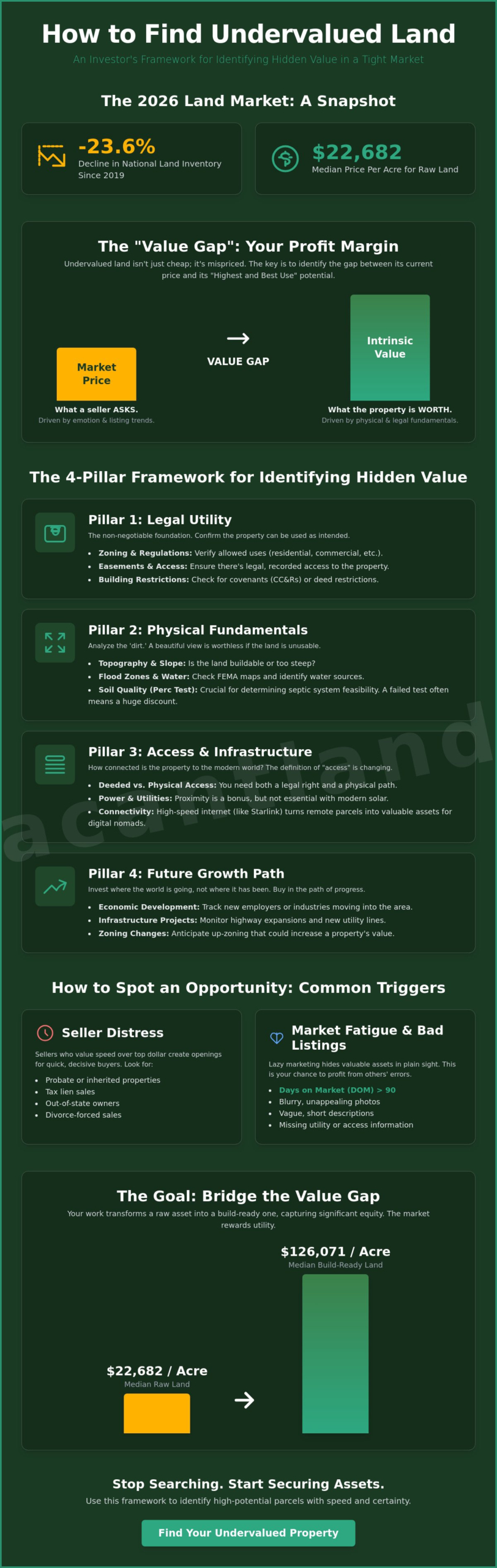
Undervalued land is property where the asking price sits significantly lower than its highest and best use potential. It’s a specific financial opportunity. Many investors confuse “cheap” with “undervalued.” Cheap land is often useless dirt with no legal access or utility. Undervalued land is a mispriced asset with a clear path to appreciation. Knowing how to find undervalued land requires looking past the sticker price to see the “Value Gap.”
This Value Gap is the profit margin between a property’s raw state and its build-ready state. In 2026, demand is shifting. Digital nomads and off-grid enthusiasts are hunting for remote parcels with high connectivity potential. These buyers don’t need city sewers. They need privacy and solar exposure. If you find a parcel that meets these needs but is priced as “useless” acreage, you’ve found a deal. You’re buying future utility at yesterday’s prices.
The Difference Between Price and Value
Market price is driven by emotion and listing trends. It’s what a seller hopes to get. Intrinsic value is driven by physical and legal fundamentals like soil, water, and zoning. Intrinsic value is the property’s baseline utility regardless of market hype. For instance, understanding land value tax principles helps investors see how location and community infrastructure drive worth. Focus on the dirt. The 2025 U.S. average farm real estate value was $4,350 per acre. Use these benchmarks to identify when a listing is truly mispriced.
Why Land Becomes Undervalued in 2026
Property doesn’t become a bargain by accident. It happens because of friction. Seller distress is a primary driver. Probate cases, tax liens, or divorces force quick sales. These sellers value speed over top-dollar returns. They want a swift transaction. This creates an opening for the pragmatic investor who can close quickly without drama.
Market fatigue is another factor. Properties sitting for over 90 days often suffer from “Bad Listing” syndrome. Poor photos and vague descriptions scare off the average person. Information asymmetry also gives you the edge. You might know a local zoning change is coming. If the seller doesn’t, they’ll price the land as raw acreage. Learning how to find undervalued land means identifying who is tired of holding the asset. Spot the gap and act fast.
The 4-Pillar Framework for Identifying Hidden Land Value
Valuation isn’t a guessing game. It’s a formula. Most investors lose money because they buy based on a “gut feeling” or a pretty photo. To master how to find undervalued land, you must strip away the emotion and look at the raw data. This framework identifies properties with fixable flaws that the general market ignores. You want the parcels that look difficult but are actually simple to solve with the right information. This process creates a swift path to high ROI by focusing on four specific pillars of value.
Pillar 1 & 2: The Technical Foundation
Pillar 1 is Legal Utility. You must look at zoning, easements, and building restrictions. Use the county GIS (Geographic Information System) map to find hidden details. A property might be listed as “unbuildable” simply because it lacks a recorded easement. If you can secure that access, the value skyrockets. Pillar 2 covers Physical Fundamentals. This includes topography, flood zones, and soil quality. A soil percolation (perc) test is your most important tool here. If a property doesn’t perc for a traditional septic system, the price drops. However, in 2026, advanced aerobic systems can often solve this issue. You can find these mispriced residential lots and turn a “useless” parcel into a buildable site for a fraction of the market cost.
Pillar 3 & 4: Infrastructure and Growth
Pillar 3 is Access and Infrastructure. Deeded access is a legal right, while physical access is a cleared path. You need both. Proximity to power is less critical in 2026 than it was five years ago. High-efficiency solar and Starlink connectivity have changed the game. “Off-grid” no longer means “disconnected.” This shift allows you to buy remote land at raw prices while selling it to the growing digital nomad market. Pillar 4 is the Future Growth Path. Identify the path of progress by tracking national infrastructure projects and highway expansions. In early 2026, the median price for raw land was $22,682 per acre, while build-ready land hit $126,071. Your goal is to buy in Pillar 4’s path and move the property toward Pillar 1’s utility. This transition is where the most significant equity is built. Focus on the data, ignore the noise, and execute your purchase with certainty.
Analyzing Listing Gaps: Spotting Deals Others Miss
Public listings are a gold mine of human error. You don’t need to drive thousands of miles to find a deal. You need to analyze digital data. Mastering how to find undervalued land starts with identifying human error in public listings. Most investors wait for an “off-market” miracle. You can find your margin today by looking at “mismanaged” public data. These are properties hidden in plain sight because the listing agent failed to present them correctly.
The “Bad Listing” opportunity is real and profitable. Residential agents often treat land as an afterthought. They use one blurry photo taken from a car window. They write a two-sentence description with no mention of utility access. This laziness is your profit. When a listing looks terrible, it scares off the average buyer. This lack of competition allows you to secure the asset at a lower price point. You aren’t buying a bad property; you’re buying a bad advertisement. For those new to the market, learning how do you buy land is the first step before hunting for these specific gaps.
Red Flags vs. Green Flags in Online Listings
You must filter listings with surgical precision. A major red flag is the phrase “Buyer to verify all info.” This usually indicates a known legal or physical hurdle the agent doesn’t want to handle. Conversely, green flags like “Inherited property,” “Must sell,” or “Liquidation” signal high seller motivation. Use Google Earth to spot value that the listing photos missed. Look for natural clearings, existing driveways, or proximity to new developments that the agent failed to highlight. The 2026 median price for raw land is $22,682 per acre, but a “bad” listing might sit well below this benchmark simply due to poor visibility.
The ‘Misclassified’ Property Strategy
Search filters are only as good as the person entering the data. You can find incredible deals by looking for misclassified properties. Search for residential lots listed under the “agricultural” category. Many agents click the wrong box during data entry. This mistake keeps the property off the radar of residential developers. You should also look for incorrect acreage data. An agent might list a 10-acre parcel as 1 acre in the title by mistake. These errors create a massive advantage for the diligent researcher. Exploit these listing gaps to secure high-value land with zero competition. Move fast when you spot these errors. Speed is your greatest asset in a market where inventory has contracted by 23.6 percent since 2019.
Tactical Search Strategies for the National Market
Efficiency is the difference between a successful investor and a hobbyist. You don’t have time to browse thousands of listings manually. National inventory has contracted by 23.6 percent since 2019. This means competition is fierce for the remaining parcels. To master how to find undervalued land, you must build a system that delivers deals to your inbox. Stop searching and start filtering. Use automation to identify price drops and new inventory before the general market reacts.
Your search should target specific high-utility categories. Focus on hunting land, off-grid parcels, or cheap land for sale in emerging markets. Look for “Wholesale” indicators in listing descriptions. These are often properties priced for quick cash flips by sellers who value speed over maximum profit. You can find these opportunities by browsing our current inventory of undeveloped vacant land today.
Automating Your Deal Flow
Set up automated alerts based on “Price per Acre” thresholds rather than total price. This allows you to spot massive parcels that are mispriced relative to their size. To calculate price-per-acre, divide the total asking price by the number of acres to normalize different lot sizes. Filter your searches for “Owner Financing” to increase your purchasing power without traditional bank hurdles. In early 2026, land prices per acre fell by 0.5 percent from the previous year. This slight softening creates a window for aggressive, automated bidding on properties that have sat for more than 60 days.
Negotiating the Undervalued Deal
Success in negotiation comes from being a straight shooter. Deliver a direct, no-contingency cash offer to solve the seller’s problem immediately. Use the physical flaws you identified earlier, such as heavy brush or lack of utilities, to justify a lower price point. Don’t argue about emotion; argue about the cost of utility. If a parcel requires $10,000 in clearing to be usable, deduct that from your offer based on the “intrinsic value” calculation. Your goal is to close the gap between the asking price and the baseline utility value. Move with urgency. A swift, assured transaction is often more valuable to a distressed seller than a higher price with a long closing window. Execute your offer, solve their burden, and secure your equity.
Securing Undervalued Land on BuyVacantLand.com
General real estate sites waste your time. They clutter your search with houses, rentals, and retail properties. To master how to find undervalued land, you need a specialized tool that filters out the noise. BuyVacantLand.com focuses exclusively on vacant parcels. This focus allows you to evaluate opportunities with speed and precision. You aren’t just browsing; you’re executing a strategy. Our platform eliminates the distractions that slow down professional investors.
Our marketplace connects motivated sellers directly with savvy buyers. This direct link removes traditional procedural hurdles that often kill deals. You can find everything from industrial lots to remote farms and ranches. If you want to increase your purchasing power, navigate our 2026 listings for owner financed land. This bank-free approach allows you to secure assets without the friction of a 5.875 percent direct farm ownership loan. Move fast to capitalize on the current market softening.
Why Our Marketplace is Built for Investors
Efficiency is our core value proposition. We focus strictly on raw land and undeveloped parcels. This means you won’t get distracted by residential noise or rental listings. Our listings provide the transparency you need for a rapid “4-Pillar” evaluation. You can verify topography and access before you ever contact the seller. This streamlined process is essential in a market where national inventory has contracted by 23.6 percent since 2019. We provide the data so you can provide the decision.
Start Your Search Now
Move from searcher to landowner today. First, use our national search filters to set your price-per-acre thresholds. Second, target land-specialized sellers who understand the value of a swift, no-contingency offer. Third, review the legal and physical utility of the parcel using our detailed data. Dealing with specialized sellers ensures you aren’t explaining land basics to a residential agent. It’s time to stop analyzing and start acquiring. Browse our current vacant land listings to secure your next high-ROI asset with absolute certainty.
Secure Your Market Advantage Today
You now possess the exact framework to identify high-ROI opportunities in a contracting market. By applying the 4-Pillar framework and auditing digital listing gaps, you can bypass the competition. You don’t need to wait for off-market deals when mispriced assets are sitting in plain sight. Success in 2026 requires moving past the “buying frenzy” mindset and focusing on baseline utility. Mastering how to find undervalued land is a repeatable process that rewards the diligent researcher.
Our platform streamlines this journey by offering exclusively vacant land listings across the United States. You get a direct connection to land owners and sellers without the noise of residential real estate. This transparency allows you to execute your evaluation checklist with speed and certainty. It’s time to stop searching and start securing your financial future. Find your next undervalued land deal on our national marketplace today. Your next great investment is waiting for a decisive buyer.
Frequently Asked Questions
How do I know if land is priced below market value?
Compare the asking price to recent “sold” comparables for similar acreage and utility in the same county. Look for a price-per-acre that sits below the local median for that specific land type. If the land has similar utility to build-ready lots but is priced as raw land, you have found an undervalued asset. Use local tax assessment data as a secondary baseline for value.
What is the best way to find the owner of a vacant lot?
Access the county’s online tax assessor database or GIS map to find the recorded owner. Search by the property’s parcel identification number (PIN) or address to see the owner’s name and mailing address. You can also use specialized marketplaces that provide direct seller contact information. This removes the need for manual research and speeds up your acquisition process.
Can I buy undervalued land with no money down?
Yes, by targeting properties offered with owner financing. Many sellers are willing to accept a small down payment or flexible monthly terms to move the property quickly. This strategy allows you to secure the asset without traditional bank loans or high credit requirements. It is a pragmatic way to scale your portfolio while keeping your cash liquid for improvements.
Is it risky to buy land without seeing it in person?
Risk is managed through data verification rather than physical presence. Use high-resolution satellite imagery and county GIS data to verify topography and access. If you perform a thorough 4-Pillar evaluation, you can identify how to find undervalued land and close the deal with confidence from anywhere. Professional investors rely on data because it is more objective than a visual walkthrough.
What are the hidden costs of buying cheap land?
Hidden costs usually involve clearing, road construction, and utility installation. You must also account for back taxes, title insurance, and recording fees. Always perform a feasibility study to ensure the cost of bringing the land to its highest use doesn’t exceed your projected ROI. Budgeting for these items upfront prevents your “deal” from becoming a financial burden.
How do zoning changes affect land value in 2026?
Zoning changes can instantly double a property’s value by increasing its legal utility. In 2026, many rural areas are rezoning for higher density or off-grid clusters to address housing shortages. Spotting these shifts early allows you to buy agricultural land and hold it for a residential value spike. Always check the minutes of local planning and zoning meetings for upcoming changes.
What is the difference between deeded access and physical access?
Deeded access is the legal right to cross another’s property to reach your land. Physical access is the actual existence of a road or trail you can drive on. You need both to ensure the land is usable. A property with deeded access but no road is often undervalued because buyers find the construction cost intimidating. This is an opportunity for you to add value through simple infrastructure.
How long does it typically take to find a truly undervalued deal?
A dedicated investor using automated alerts can find a deal within 30 days. The timeline depends on your local market knowledge and your ability to act fast when a “bad listing” hits the market. Consistency is key. Set up your filters, review your alerts daily, and be ready to submit a direct offer immediately. Speed is the primary advantage in a competitive market.




Join The Discussion