

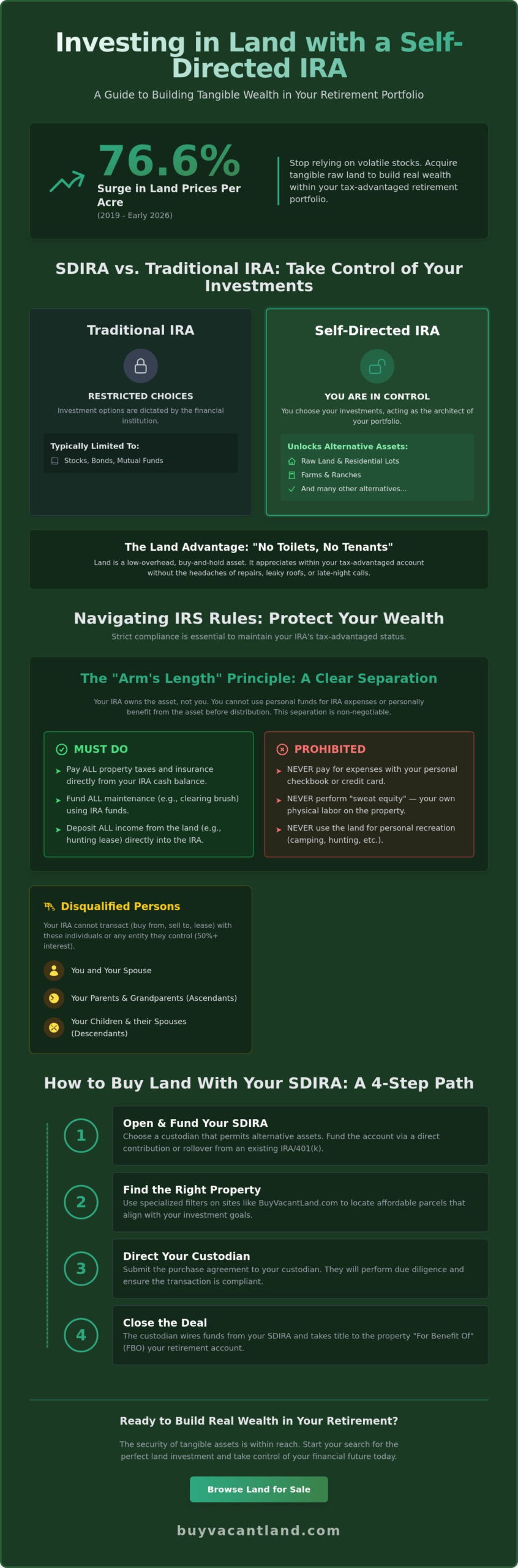
Did you know that land prices per acre surged 76.6% between 2019 and early 2026? Most investors watch these gains from the sidelines because they think their retirement savings are locked in stocks and bonds. You do not have to settle for paper assets. Using a self-directed IRA to buy land allows you to diversify into tangible, raw acreage without losing your tax advantages.
It is stressful to feel like your financial future is out of your control. You want the security of real estate but worry about complex IRS rules or accidentally triggering a prohibited transaction. We understand that confusion. This guide simplifies the process and removes the guesswork. You will learn how to select a custodian, handle expenses correctly, and avoid the “sweat equity” traps that can disqualify an account. We provide a clear, logical path to help you secure your portion of the $324 billion self-directed IRA market with total confidence and efficiency.
Key Takeaways
- Stop relying on volatile stocks. Acquire tangible raw land to build real wealth within your retirement portfolio.
- Protect your tax status. Learn to identify disqualified persons and avoid prohibited transactions that trigger IRS audits.
- Master the three-party execution model. Using a self-directed IRA to buy land is simple when you follow our step-by-step path from account setup to closing.
- Find the right deal fast. Use specialized filters on BuyVacantLand.com to locate affordable residential lots and off-grid parcels.
- Stay compliant for the long haul. Understand your responsibilities for annual valuations and ensuring all property costs stay inside the IRA.
The Strategy: Why Use a Self-Directed IRA for Land Investment?
Traditional retirement accounts often feel like a black box. You contribute money and hope the stock market performs. A Self-Directed IRA (SDIRA) changes the rules. It is a specialized Individual Retirement Account (IRA) that permits alternative investments. Using a self-directed IRA to buy land is a tactical move for those who want physical assets. You aren’t buying a ticker symbol. You are buying dirt. The process of using a self-directed IRA to buy land is straightforward once you understand the custodial role. It allows you to move away from paper assets and into something you can touch.
SDIRA vs. Traditional IRA: Key Differences
Traditional IRAs are restrictive. Banks and brokerages limit you to stocks, bonds, and mutual funds. They want you in their products. SDIRAs remove these barriers. You can hold farms, ranches, and residential lots. The primary difference is control. In a standard account, the institution dictates your options. With an SDIRA, you are the architect of your portfolio. You identify the property and direct the custodian to execute the purchase. This autonomy is why 58.5% of self-directed investors now focus on real estate. It is a shift from passive hoping to active asset selection.
The Long-Term ROI of Undeveloped Land
Undeveloped land is a low-overhead powerhouse. You avoid the service fees and management costs associated with rental buildings. There are no surprise repairs to drain your account. Between 2019 and early 2026, national land prices per acre climbed 76.6%. This is not speculative luck. It is the result of shrinking supply and rising demand for space. Many investors use their funds to acquire cheap land for sale in emerging markets to maximize their diversification. Land is a fundamental ‘buy and hold’ retirement play that builds wealth through steady, tangible appreciation.
IRS Rules and Prohibited Transactions You Must Avoid
IRS rules are rigid. You must follow them exactly to protect your retirement. The most critical rule for using a self-directed IRA to buy land is that the account owns the asset. You do not own it personally. Your name should never appear on the deed as the buyer. Instead, the deed must name the custodian for the benefit of (FBO) your specific account. If you treat the land like personal property, the IRS will disqualify the entire IRA. This leads to an immediate taxable distribution of the full account balance. You will lose your tax-sheltered status and face heavy penalties.
The ‘Arm’s Length’ Transaction Principle
Compliance requires total separation between your personal finances and the IRA. You cannot pay property taxes with your personal checkbook. You cannot use your own money to build a fence or clear brush. This is called “sweat equity” and the IRS forbids it. Every penny for maintenance, insurance, and taxes must come from the IRA cash balance. Conversely, if you lease the land for hunting or timber, that income must go directly to the custodian. You never touch the cash personally. This “arm’s length” distance ensures the transaction remains a pure investment.
Disqualified Persons Checklist
The IRS identifies specific individuals who cannot interact with your IRA-owned land. These are “disqualified persons.” You cannot buy land from your father. You cannot sell land to your daughter. You cannot lease the property to a business you control. Use this checklist to stay compliant:
- You and your spouse: No personal use or transactions.
- Lineal ascendants: Your parents and grandparents.
- Lineal descendants: Your children and their spouses.
- Controlled entities: Any corporation or partnership where you hold a 50% or greater interest.
Third-party management is the safest route for any land activity. Hire a professional to handle physical work or leasing. This keeps the transaction clean and protects your wealth.
Personal use is the most common trap for investors. You cannot spend a weekend camping on the property. You cannot hunt on the land. Even a single afternoon of personal recreation can trigger a prohibited transaction. The parcel must remain a dedicated investment asset until you take a distribution. Once you understand these boundaries, you can safely browse undeveloped vacant land for your portfolio. The rules require discipline, but they provide the framework for massive long-term growth. Stay focused on the financial proposal and let the custodian handle the administrative hurdles.
How to Execute a Land Purchase with Your SDIRA
Executing a land purchase requires precision. You must follow a specific sequence to maintain total compliance. The process of using a self-directed IRA to buy land starts with selecting a qualified custodian. These specialized firms handle the administrative heavy lifting. They ensure your transaction meets every IRS requirement. You don’t sign the purchase agreement personally. Your custodian does. This professional oversight eliminates the stress of potential audits and keeps your retirement funds secure.
Funding Your SDIRA Account
Move your capital efficiently. Most investors fund their accounts through direct rollovers from existing 401(k)s or traditional IRAs. This transfer is not a taxable event. For the 2026 tax year, standard contribution limits are $7,500 for those under 50. If you are 50 or older, the limit is $8,600. SEP IRA contributions can reach the lesser of 25% of compensation or $72,000. Always maintain a cash buffer within the account. You cannot pay property taxes with personal funds; you must keep liquid cash ready for annual expenses and maintenance costs.
Identifying a parcel is the next step in the sequence. Use a specialized marketplace like BuyVacantLand.com to find property that fits your strategy. You can browse off-grid land, commercial vacant lots, or residential parcels. The 2026 market is disciplined. Buyers now focus on property fundamentals like clear access and documented boundaries. Once you select a parcel, you submit a Direction of Investment (DOI) form to your custodian. Your custodian then sends the funds directly to the title company or escrow agent. This ensures you never touch the money. Using a self-directed IRA to buy land requires this strict separation to protect your tax-deferred status.
Closing the Deal: Title and Vesting
The deed must be perfect. If your name appears as the owner, the IRS considers it a full distribution. Correct vesting typically looks like this: ‘XYZ Trust Company, Custodian FBO [Your Name] IRA’. Your custodian signs every closing document. They review the title work to ensure the property is unencumbered. Because the IRA is the legal buyer, the custodian must approve the final settlement statement. They use the cash in your account to pay for the purchase price and all associated closing costs. If you are new to the process, review our guide on how do you buy land to understand the standard closing timeline. This structured approach creates a sense of momentum that pushes you toward the final closing without distraction.
The role of the custodian is central during the final steps. They receive the recorded deed and hold it on behalf of your account. By following this multi-step path, you move from a paper-based portfolio to a tangible land owner in a matter of weeks. It is a reliable, no-nonsense way to diversify your wealth into high-quality acreage.
Financial Analysis: Risks and Maintenance of IRA Land
Investing in land requires a long-term perspective. Unlike stocks, you cannot sell a parcel in seconds. Liquidity is a primary concern. Real estate takes time to market and close. You must plan for this delay. Using a self-directed IRA to buy land also introduces specific reporting duties. Each year, you must provide a Fair Market Value (FMV) to your custodian. This valuation informs the IRS of your account’s worth. It is a non-negotiable administrative task. If you use leverage to buy land, be aware of Unrelated Business Income Tax (UBIT). This tax applies to the portion of income generated by debt-financed assets. It is a complex area that requires professional tax advice.
Managing Property Expenses
Low carry costs make raw land an attractive IRA asset. You don’t have the high maintenance of a rental home. There are no utility bills or emergency repairs. This simplicity allows your capital to grow without constant depletion. Success depends on your ability to keep the IRA’s liquid reserves healthy. If you are ready to diversify, view our current listings of undeveloped vacant land to find your next investment.
Exit Strategies for Retirement
You have two primary ways to access your wealth at retirement. First, you can sell the land. The proceeds stay in the IRA. This keeps the funds tax-advantaged. You then take cash distributions as needed. Second, you can take an “in-kind” distribution. This means the custodian transfers the deed from the IRA’s name into your personal name. An in-kind distribution is a taxable event based on the current fair market value of the land. You will owe income tax on that value in the year of the transfer. This is a pragmatic way to move a legacy asset into your personal holdings once you reach the age of 59 and a half. Planning your exit early ensures a smooth transition of your hard-earned assets.
Finding SDIRA-Eligible Properties on BuyVacantLand.com
A funded account is only half of the strategy. You need a tangible asset to generate returns. Many investors stall after opening an account because they cannot find suitable property. Our marketplace solves this problem. We specialize in vacant land parcels that fit the SDIRA model perfectly. You can filter for raw land, residential lots, and hunting land in seconds. This speed is vital. Using a self-directed IRA to buy land requires finding sellers who understand the process. We connect you directly with land owners. This direct communication facilitates custodian-ready contracts and eliminates traditional procedural hurdles.
Diversification is your primary goal. Using a self-directed IRA to buy land is most effective when you target cheap land for sale across different regions. Buying multiple affordable parcels reduces your risk compared to putting all your capital into one expensive property. Our platform allows you to browse off-grid land, farms, and ranches that meet your specific budget. You get the relief of a swift transaction and the peace of mind that comes from owning a physical resource. The 2026 land market favors those who act with precision and clear intent.
What to Look for in an IRA Land Investment
Success requires a pragmatic approach to selection. Focus on low-tax jurisdictions. High property taxes create a constant cash drain on your IRA reserves. Look for parcels in growth corridors where long-term appreciation is likely. Undeveloped vacant land is the ideal choice. It carries minimal liability and requires almost no maintenance. You want an asset that grows quietly in the background while you focus on your broader retirement goals. Avoid properties with complex zoning issues or environmental burdens that could complicate your annual fair market value reporting.
Streamlining the Transaction
We provide the data your custodian needs. Our detailed listings include the essential facts for administrative due diligence. This transparency speeds up the approval process. If you encounter “Owner Financed” listings, keep one rule in mind. SDIRAs require non-recourse debt structures. You cannot personally guarantee a loan for an IRA-owned property. Most IRA investors prefer to use 100% cash to avoid the complexities of UBIT. Our platform makes it easy to find these cash-ready deals. You can browse industrial land, commercial vacant lots, or simple residential parcels with ease. Start your search on BuyVacantLand.com today and secure your financial future with tangible acreage.
Secure Your Tangible Retirement Future
You now have a definitive roadmap for your 2026 investment strategy. Using a self-directed IRA to buy land is a tactical shift from volatile paper assets to physical acreage. Success requires three specific actions. You must follow IRS compliance rules. You must select a qualified custodian. Finally, you must maintain a cash buffer for property expenses. This approach turns your retirement account into a powerful tool for wealth preservation. It’s a reliable way to exit the cycle of market uncertainty.
Don’t wait for the next market correction to diversify. Our specialized vacant land marketplace offers direct seller connections and a vast national inventory of raw and undeveloped land. We simplify the search process so you can focus on building your legacy. Browse our national land listings for your SDIRA investment. Take the first step toward a more secure, tangible portfolio today. Your financial future deserves the stability of real property. It is time to act with precision and purpose.
Frequently Asked Questions
Can I use my self-directed IRA to buy land for a personal vacation home?
No. You cannot use IRA-owned land for any personal benefit. This includes building a vacation home, camping, or hunting on the property. The IRS requires the land to be a pure investment asset. Any personal use constitutes a prohibited transaction. This error triggers immediate taxes and penalties on the entire account balance. You must wait until you take a formal distribution at retirement age to use the land for personal reasons.
How much money do I need in my IRA to start buying vacant land?
You need enough capital to cover the full purchase price plus a liquid cash buffer. Median land prices in early 2026 reached $62,365 per acre nationally. However, using a self-directed IRA to buy land is possible with much less capital if you target affordable residential lots or off-grid parcels. Always keep at least 10% of the property value in cash within the account. This funds property taxes and insurance without risking a compliance violation.
Can I buy land from my father or my own business using my SDIRA?
No. You are strictly forbidden from transacting with disqualified persons. This group includes your parents, children, spouse, and any business entity you control. The IRS views these interactions as self-dealing. Even if you pay a fair market price, the transaction is illegal under Section 4975 of the Internal Revenue Code. Your IRA must purchase land from an unrelated third party to remain compliant and protect your tax-sheltered status.
What happens if I accidentally pay property taxes from my personal bank account?
You risk the total disqualification of your retirement account. The IRS views personal payments for IRA expenses as an illegal contribution or a prohibited transaction. If an audit discovers this mistake, the entire account is treated as a distribution. You will owe income tax on the full value and a 10% early withdrawal penalty if you are under age 59 and a half. Always direct your custodian to pay taxes from IRA funds.
Do I need a special type of custodian to buy raw land?
Yes. Standard brokerages typically limit you to stocks and bonds. You must open an account with a specialized self-directed IRA custodian. These firms are equipped to hold non-traditional assets like farms, ranches, and industrial lots. They handle the administrative requirements and ensure the deed is titled correctly. This specialized service is why demand for SDIRAs grew by 60% in 2025 as investors sought more control over their portfolios.
Can my IRA take out a mortgage to buy a larger parcel of land?
Yes, but the loan must be non-recourse. You cannot personally guarantee the debt with your own credit or assets. If the IRA defaults, the lender can only seize the land itself. Using a self-directed IRA to buy land with leverage may also trigger Unrelated Business Income Tax (UBIT). This tax applies to the portion of income generated by the debt. Consult a tax professional to calculate how leverage affects your long-term returns.




Join The Discussion