

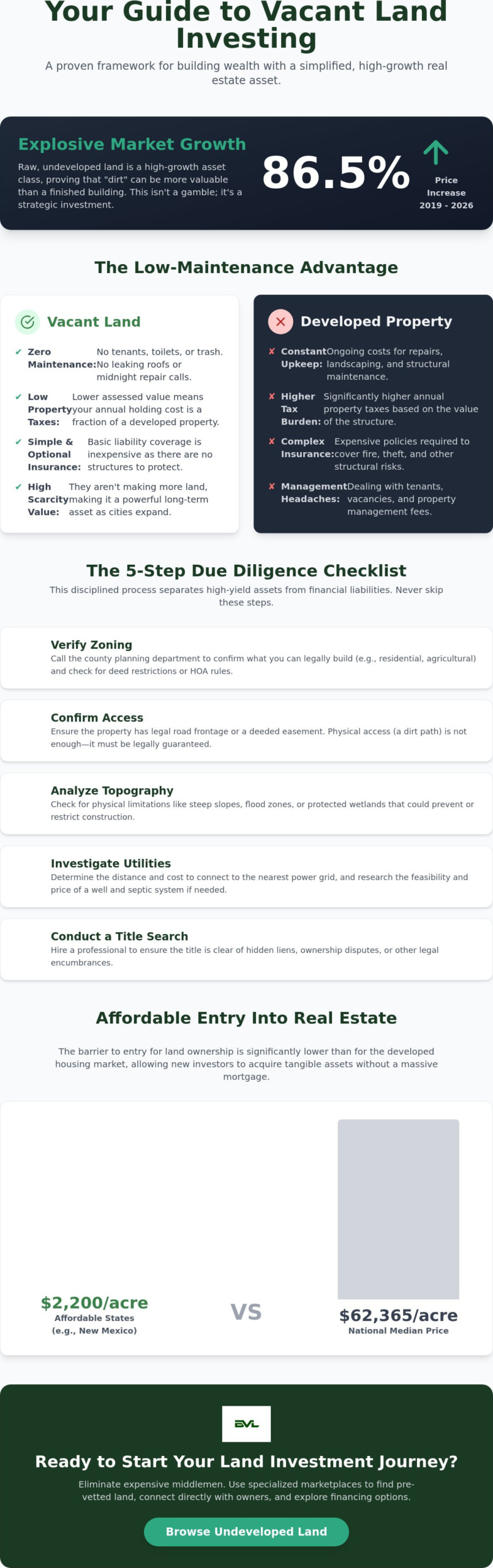
Raw, undeveloped land saw an 86.5% price explosion between 2019 and 2026. This massive growth proves that dirt is often more valuable than a finished building. Most people avoid this asset because they fear buying a useless swamp or getting stuck in a zoning nightmare. It’s true that the process feels different from buying a house. You need to understand that vacant land investment for beginners doesn’t have to be a gamble. You can build wealth without the headaches of tenants or leaking roofs. Stop guessing and start following a proven path.
This guide provides a direct, step-by-step framework to master the fundamentals of land investing. You’ll learn how to value raw parcels accurately and perform due diligence like a professional. We’ll show you how to find affordable land without paying high service fees or getting lost in legal jargon. We start with the basics of land valuation and move quickly into a repeatable checklist for your first purchase. This is your blueprint for a swift, assured transaction.
Key Takeaways
- Treat raw land as a high-growth asset class that eliminates the stress of building maintenance and property management.
- Follow a strict 5-step due diligence sequence to confirm zoning and legal access before you commit to a purchase.
- Identify the total cost of acquisition and local property tax structures to ensure your investment remains profitable.
- Simplify vacant land investment for beginners by choosing between easy-entry residential lots or high-potential off-grid parcels.
- Eliminate expensive middlemen by using specialized marketplaces to connect directly with owners and find financing options.
Understanding Vacant Land as a Strategic Asset Class
Vacant land is raw real estate. It has no buildings, no plumbing, and no electrical systems. For many, this sounds like a liability. For savvy investors, it’s the ultimate simplified asset. This guide to vacant land investment for beginners focuses on the practical reality of 2026. Land prices saw a 76.6% increase between 2019 and 2026. While the market dipped slightly by 0.5% in early 2026, the long-term trajectory remains strong. You aren’t dealing with the “three Ts”: tenants, toilets, and trash. You own a piece of the earth that requires zero midnight repair calls.
Buying land is significantly more affordable than entering the developed housing market. In states like New Mexico, you can find land for as low as $2,200 per acre. Compare that to the national median price per acre of $62,365. This low barrier to entry allows first-time buyers to secure a tangible asset without a massive mortgage. Understanding rural land sales helps you see that these transactions are often faster and cleaner than residential deals. You avoid the complex inspections and appraisals that slow down traditional home purchases.
The Advantages of Low-Maintenance Ownership
Ownership of raw land eliminates the stress of traditional property management. You have zero building maintenance costs. There are no roofs to replace or furnaces to service. Insurance requirements are minimal because there is no structure to protect from fire or theft. Property taxes on raw land are also a major benefit. The national average effective property tax rate is approximately 0.99% in 2026. Because the assessed value of raw land is lower than a house, your annual carrying cost is often just a few hundred dollars. This efficiency creates a stress-free path to ownership. It’s a “set it and forget it” asset that grows in value while you sleep.
- Zero Maintenance: No landscaping, cleaning, or structural repairs.
- Low Taxes: Minimal annual holding costs compared to developed lots.
- Simple Insurance: Basic liability coverage is inexpensive and often optional.
Market Appreciation and Scarcity
The 5-Step Due Diligence Sequence for New Investors
Due diligence is the difference between a high-yield asset and a financial liability. Many first-time buyers skip these steps and end up with land they can’t use. Success in vacant land investment for beginners requires a disciplined, repeatable process. You must move quickly but never ignore the facts. Follow this five-step sequence before you sign any contract.
- Verify Zoning: Call the county planning department immediately to confirm what you can actually build.
- Confirm Access: Ensure the property has a legal right-of-way and a physical path for vehicles.
- Analyze Topography: Check for steep slopes or protected wetlands that prevent construction.
- Investigate Utilities: Determine the distance to the nearest power pole and the cost of a well or septic system.
- Conduct a Title Search: Hire a professional to ensure there are no hidden liens or ownership disputes.
The market in 2026 is becoming more discerning. Buyers now prioritize high-quality land with documented boundaries and clear utility access. If a deal looks too good to be true, it’s often because one of these five steps failed. You can find pre-vetted opportunities by browsing undeveloped vacant land on specialized platforms that focus on transparency.
Zoning and Legal Permissions
Zoning dictates the utility of your land. Residential zoning allows for homes, while agricultural zoning might permit farms or livestock. Don’t assume you can change these rules later. In 2026, many states are passing zoning reforms to allow for Accessory Dwelling Units (ADUs). This Guide to Investing in Vacant Land highlights how understanding these local shifts can maximize your ROI. Always check for deed restrictions or Homeowners Association (HOA) rules. These private contracts can be even stricter than county laws. They might dictate the minimum square footage of a house or prohibit parking an RV on the lot.
Access and Infrastructure
Legal access is not the same as physical access. You might see a dirt path leading to the parcel, but that doesn’t mean you have the legal right to use it. “Road frontage” means the land touches a public road. A “legal easement” means you have written permission to cross someone else’s property. Without one of these, your land is landlocked and nearly impossible to sell. Infrastructure costs also vary wildly. If the property needs a septic system, you must conduct a soil percolation (perc) test. This test determines if the ground can absorb liquid waste. If the soil fails, you cannot build a traditional home. Always calculate these costs before making an offer.
Analyzing Costs and Avoiding Common Financial Pitfalls
Don’t let a low sticker price blind you to the reality of ownership. Success in vacant land investment for beginners depends on calculating the total cost of acquisition before you move forward. The listing price is only the first number in your budget. You must account for taxes, insurance, and closing fees to protect your profit margins. Land doesn’t have tenants to cover your monthly expenses. This means every dollar spent comes directly out of your pocket until you decide to sell or develop. Efficiency is your best tool for keeping these costs under control.
Ownership isn’t free. Even if you pay cash for a parcel, you’ll face ongoing holding costs that can erode your returns if ignored. Smart investors look for ways to minimize these burdens through direct transactions. Using a specialized marketplace allows you to communicate directly with sellers, which often eliminates the high service fees associated with traditional brokerage firms. This streamlined approach ensures your capital goes toward the asset itself rather than the process of buying it.
Property Taxes and Holding Costs
Property taxes are your primary recurring expense. Rates vary significantly depending on the location of the parcel. In 2026, New Jersey has the highest effective property tax rate at 2.23%. Hawaii offers the lowest at just 0.27%. The national average effective rate sits at approximately 0.99%. You can often reduce this liability by looking for land with agricultural exemptions. These “ag” exemptions apply to land used for farming, timber, or livestock and can slash your tax bill by a significant percentage. You should also budget for physical maintenance. This includes clearing brush for fire safety or maintaining fences to prevent trespassing. Use a thorough process of due diligence for buying land to estimate these carrying costs accurately.
Closing Costs and Transaction Fees
Closing costs are the final hurdle in any transaction. These typically include title insurance, escrow fees, and county recording fees. Title insurance is non-negotiable for a safe investment. It protects you from hidden liens or previous ownership disputes that could cost you the entire property. Recording fees are paid to the local government to officially document your deed. Traditional realtor-led deals often come with commission structures that don’t make sense for low-cost land. Direct marketplaces remove this bloat. For a deeper look at the specific steps required to finalize your purchase, read our comprehensive guide on how do you buy land. This direct path provides an equitable financial proposal and gets you to the finish line faster.
Selecting Your Property Type: From Residential Lots to Off-Grid Land
Your investment strategy must dictate the type of land you buy. Not all dirt is equal. For those starting with vacant land investment for beginners, the goal is to match the parcel to your financial objective. Residential lots are the most common entry point. They sit in or near established neighborhoods and offer the highest liquidity. You can sell these parcels quickly because the end-user is often a family looking to build a home. In 2026, suburban expansion is driving demand for these smaller, manageable lots. They are simple to understand and easy to value.
Off-grid land offers a different path. This type of property appeals to the growing “prepper” market and recreational users seeking privacy. These parcels are often unrestricted, meaning you face fewer building codes and zero HOA oversight. If you want larger acreage for a lower price, farms and ranches are the solution. These properties can generate agricultural income through leasing to local farmers or timber harvesting. Hunting land is another seasonal powerhouse. You can buy a large tract and lease it to hunters to cover your annual taxes and holding costs. Remote, undeveloped acreage is increasing in value as more people seek an escape from high-density urban environments.
Evaluating Residential vs. Industrial Lots
Residential lots are the safest bet for a first-time buyer. They offer faster resale potential because the market of homebuyers is vast. You can find many of these cheap land for sale opportunities in states like New Mexico or Nevada, where entry costs remain low. Industrial land is a different beast. It requires complex environmental due diligence to check for soil contamination or hazardous waste from previous uses. For a beginner, the high cost of these Phase I environmental reports often outweighs the potential profit. Stick to residential or recreational land to keep your transaction simple and your risk low.
The Rise of Off-Grid and Recreational Land
Unrestricted land is a massive niche in 2026. Buyers are tired of restrictive covenants that prevent them from parking an RV or building a tiny home. This freedom drives significant ROI for investors who can find parcels without deed restrictions. You can also generate immediate cash flow by leasing recreational land for hunting or camping. In many rural counties, the demand for seasonal leases exceeds the supply of available land. This creates a reliable way to offset your holding costs while the property appreciates. Selecting the right category is the first step toward a successful deal. You can browse all these categories and find owner financed land to simplify your first purchase even further.
How to Secure Your First Parcel on a Focused Marketplace
Traditional real estate agents often treat land as an afterthought. They focus on high-commission home sales and lack the technical knowledge required for raw acreage. Mastering vacant land investment for beginners requires a different approach. You need a specialized marketplace that caters specifically to land buyers. These platforms allow you to bypass the gatekeepers and negotiate directly with the person who holds the deed. You save time. You eliminate unnecessary service fees. This direct connection ensures a faster path to ownership and a more transparent transaction.
Efficiency is the core of a successful land deal. Using a focused platform allows you to filter through thousands of listings in minutes. You can target specific attributes like road access, utility availability, or terrain type. This streamlined search process removes the stress of asset acquisition. You don’t have to wait for an agent to call you back with basic details. All the information is at your fingertips. You can move from discovery to a signed agreement with speed and certainty.
Finding the Right Listing
Filters are your most powerful tool. Start by narrowing your search to “Cheap Land” or “Residential Lots” based on the strategy you selected in earlier sections. In 2026, financing raw land through traditional banks is challenging. Interest rates for raw land loans can reach 8.25% for a 3/1 ARM with a 40% down payment. Smart beginners look for sellers who offer flexible terms. You can learn how to bypass bank hurdles by reading our guide on owner financed land. This bank-free path simplifies your entry into the market and keeps your initial capital requirements low.
Analyze listing descriptions for specific keywords. Look for “unrestricted,” “legal access,” or “surveyed.” These terms indicate a higher-quality parcel with fewer hidden hurdles. Communicate directly with owners through the marketplace messaging system. Ask for the parcel identification number (APN) and any existing soil reports. Direct dialogue removes the confusion of third-party interpretation. You get the facts straight from the source, which allows you to make an informed decision quickly.
Closing the Transaction Swiftly
Finalize your deal with a clear, equitable financial proposal. Use digital tools to verify the property before you travel. Google Earth and local GIS mapping allow you to view boundaries and topographical features remotely. This digital due diligence saves you hundreds of dollars in travel costs. Once you agree on a price, ensure you have a written purchase agreement. This document must outline the purchase price, the closing date, and any contingencies like a successful title search. It’s a simple step that provides massive peace of mind.
Always use a professional escrow service or a title company to handle the transfer of funds. They act as a neutral third party to ensure the deed is recorded correctly and the seller receives their payment. This protects your investment and guarantees a clean transfer of ownership. The entire process is designed to be direct and efficient. You don’t need a complex legal team to buy a simple piece of dirt. Follow the steps. Verify the facts. Secure your future. Browse our vacant land listings today and find the parcel that fits your 2026 investment goals.
Take Action on Your 2026 Land Strategy
Our marketplace focuses exclusively on vacant land listings. We provide a direct connection between land owners and buyers to ensure a transparent transaction. There are no hidden service fees for discovery. You can move from browsing to a signed agreement with total confidence and speed. It’s time to stop researching and start owning. Start your investment journey by browsing our national land listings. Your first parcel is just a few clicks away. Secure your piece of the earth today.
Frequently Asked Questions
Is vacant land a safe investment for beginners in 2026?
Yes, because land is a finite resource with zero building maintenance requirements. Land prices exploded by 76.6% between 2019 and 2026. Beginners find it safer than residential rentals because there are no structures to repair or tenants to manage. Success depends on following a strict due diligence process to avoid landlocked or unusable parcels. It is a tangible asset that provides a reliable hedge against inflation.
How much money do I need to start investing in land?
You can start with a few thousand dollars depending on the location. In New Mexico, average prices are as low as $2,200 per acre. However, the national median price per acre is $62,365 in 2026. Many sellers on specialized marketplaces offer owner financing. This allows you to secure a parcel with a small down payment. This flexibility makes vacant land investment for beginners highly accessible compared to the expensive housing market.
Can I get a bank loan to buy raw, undeveloped land?
Yes, but bank loans for raw land are more difficult to secure than traditional mortgages. Lenders typically require a down payment between 20% and 50%. Interest rates are also higher, often ranging from 4% to 10% based on your credit profile. For example, a raw land loan in June 2026 carries an 8.25% interest rate with a 40% down payment. Many investors choose owner financing to avoid these strict bank requirements.
What are the biggest risks when buying vacant land?
The primary risks include buying landlocked property or land with severe building restrictions. You might purchase a lot only to discover it is a protected wetland or has no legal easement for access. Zoning changes can also impact your planned use. Avoid these pitfalls by conducting a thorough title search and verifying utility availability before closing. Never buy a parcel without confirming physical and legal access first.
How do I make money from a piece of empty land?
You can generate profit through long-term appreciation, parcel flipping, or leasing. Many investors buy raw land and wait for suburban expansion to drive up the value. Others lease their acreage for hunting, farming, or cellular towers to cover holding costs. In 2026, zoning reforms for Accessory Dwelling Units (ADUs) are creating new opportunities. You can add value to smaller residential lots by taking advantage of these increased development rights.
Do I need a real estate agent to buy land from an online marketplace?
No, you can buy directly from land owners and sellers on specialized marketplaces. This approach eliminates expensive agent commissions and hidden service fees. You communicate directly with the seller to negotiate an equitable financial proposal. Digital tools like GIS mapping and Google Earth allow you to perform your own remote due diligence. Direct transactions are faster and more transparent than traditional realtor-led deals.
How much are property taxes on a typical vacant lot?
Property taxes on raw land are generally much lower than developed real estate. The national average effective rate is approximately 0.99% in 2026. Your specific bill depends on the state. New Jersey has the highest rate at 2.23%, while Hawaii is the lowest at 0.27%. Because raw land has a lower assessed value than a house, your annual carrying cost remains minimal. This efficiency makes it an ideal asset for beginners.
What does “unrestricted land” mean for an investor?
Unrestricted land has very few deed restrictions or zoning limitations on how you use the property. This is a growing niche in vacant land investment for beginners. It allows you to park an RV, build a tiny home, or use the land for off-grid living without HOA interference. While unrestricted does not mean a total absence of laws, it offers the maximum flexibility for development or recreational use compared to suburban lots.




Join The Discussion