
Is that “cheap” five-acre lot actually a bargain, or is it a six-figure liability in disguise? Most buyers focus on the purchase price, but the true cost to develop raw land in 2026 depends more on the soil and the street than the sales contract. With construction materials like lumber up 40% and steel up 35% this year, guessing your budget is a recipe for financial disaster. You need an accurate way to estimate expenses before you sign a contract.
You want to build your project without getting buried by unpredictable utility fees and zoning hurdles. It’s frustrating to watch a project stall because a septic system suddenly costs $20,000 instead of $5,000. This guide provides a no-nonsense, line-item breakdown of every expense from clearing and grading to impact fees. You’ll learn the exact sequence of development and strategies to avoid overpaying for site prep. We’ll show you how to transform raw acreage into a build-ready site with total financial certainty.
Key Takeaways
- Establish a realistic 2026 financial baseline to ensure your undeveloped property remains a profitable investment.
- Analyze the total cost to develop raw land by comparing the price of municipal utility hookups against private well and septic systems.
- Estimate site preparation expenses accurately by evaluating the specific density of vegetation and the required grading for your foundation.
- Identify hidden soft costs like impact fees and professional surveyor rates that can consume up to 20% of your total budget.
- Learn why strategic land selection, such as choosing infill lots, can save you thousands in infrastructure extensions.
Understanding the True Cost to Develop Raw Land in 2026
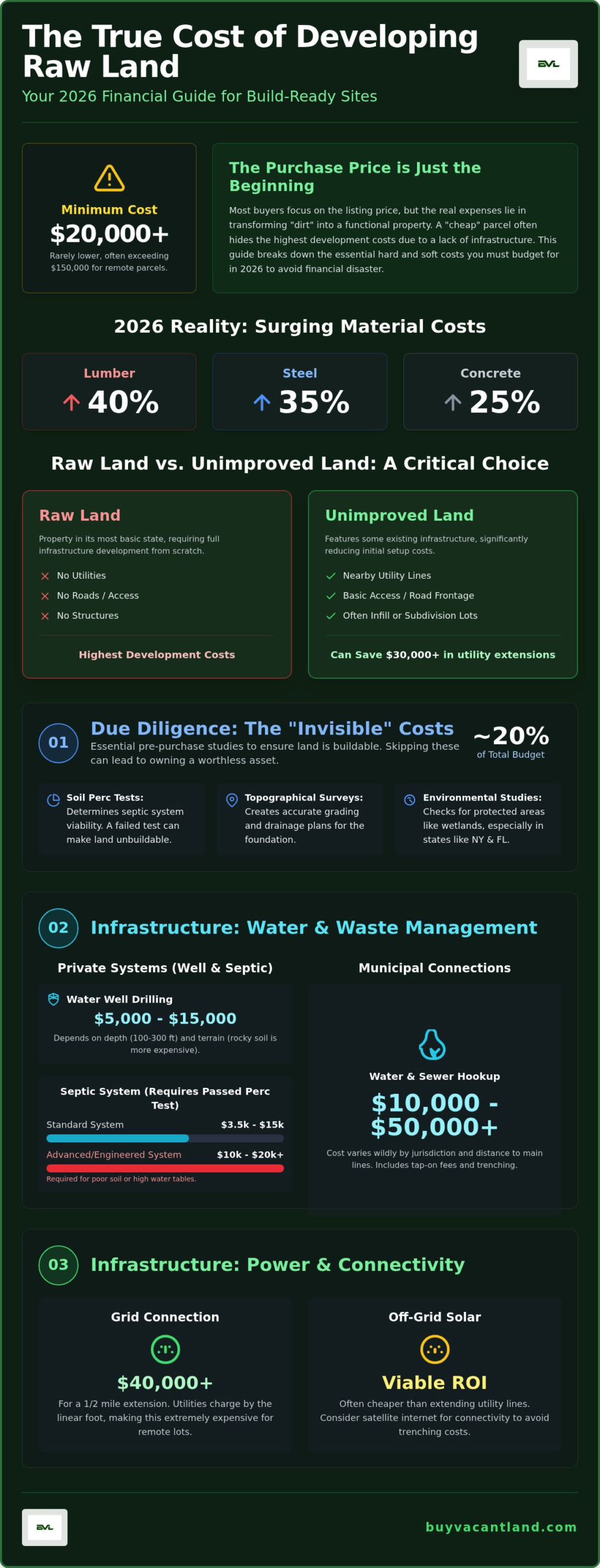
Raw land is property in its most basic state. It has no utilities, no roads, and no structures. In 2026, the total cost to develop raw land is rarely lower than $20,000. For remote parcels, that figure can easily exceed $150,000. You aren’t just buying dirt. You’re buying a complex engineering project. Understanding the true cost to develop raw land prevents you from overpaying for a project that will never see a foundation.
The purchase price is often a trap. A “cheap” parcel usually carries the highest development fees because it lacks basic infrastructure. You must distinguish between hard costs and soft costs. Hard costs include physical labor like moving dirt and clearing timber. Soft costs include “invisible” expenses like permits, engineering plans, and architectural drawings. Calculate these figures early to avoid a financial shortfall mid-project.
Raw Land vs. Unimproved Land: Why the Difference Matters
The distinction between raw and unimproved land will make or break your budget. Unimproved land often features some basic access or nearby utility lines. Raw land requires full infrastructure from scratch. This includes everything from drilling a well to carving out a driveway. Understanding how do you buy land involves more than picking a location. It requires a clear assessment of what the site lacks. Starting with unimproved land can save you $30,000 in utility extensions alone.
The Invisible Costs: Due Diligence and Feasibility
You must spend money before you own the property. Feasibility studies are your insurance policy. The Land development process starts with soil tests and surveys. A failed soil percolation test means you can’t install a septic system. This makes the land unbuildable for residential use. In 2026, a standard septic system costs between $3,500 and $15,000. Advanced aerobic systems required for poor soil can exceed $20,000. You need to know which one your land requires before you close the deal.
Budget for these specific 2026 realities:
- Soil Perc Tests: Essential for septic design and site viability.
- Topographical Surveys: Needed for accurate grading and drainage plans.
- Environmental Studies: New 2026 regulations in New York and Florida require wetland delineations.
- Material Surcharges: Lumber is up 40% and concrete is up 25% this year.
Being wrong about these costs is expensive. If you skip due diligence, you risk owning an asset you can never build on. Material price hikes are also a factor. These increases affect your hard costs immediately. Get written quotes from local contractors to lock in pricing for 2026.
Infrastructure and Utility Connection Expenses
Infrastructure is the most volatile variable in your budget. The cost to develop raw land fluctuates based on your proximity to existing service lines. Connecting to public utilities can range from $10,000 to over $50,000. If your site is half a mile from the nearest power pole, your budget will explode. You must verify these distances before you commit to a purchase. Every foot of wire and pipe adds up quickly. Infrastructure is not a place to guess.
Water and Waste: Well and Septic vs. City Connections
City water isn’t always the cheapest route. Municipal tap-on fees vary by jurisdiction and can be surprisingly high. However, private systems carry their own risks and maintenance requirements. A residential water well typically costs between $5,000 and $15,000. This depends on drilling depths of 100 to 300 feet. Rocky terrain can push the price per foot from $25 to $65 or more. You also need to budget $500 to $5,000 for the pump and plumbing. Quality testing is also mandatory to ensure the water is potable.
Waste management requires a percolation (perc) test. This test measures how quickly the soil absorbs water. If the soil fails, you cannot use a conventional septic system. A standard system costs between $3,500 and $15,000. If you need an advanced aerobic or engineered mound system, expect to pay $10,000 to over $20,000. These systems are mandatory in areas with poor drainage or high water tables. Never buy land without a successful perc test on file.
Power and Connectivity: The Grid vs. Off-Grid
Power companies charge by the linear foot to extend their lines. This often requires new poles, transformers, and clearing a right-of-way through the property. Underground wiring is more expensive than overhead but offers better protection from the elements. If the grid is too far away, consider off-grid land solutions as a viable financial alternative.
A robust solar array can provide a significant ROI compared to extending a utility line for $40,000. Don’t forget high-speed internet. Bringing fiber-optic cables to a rural lot is a massive undertaking. Many developers now rely on satellite-based internet to avoid high trenching costs. If you require a physical connection, expect to pay for every foot of trenching and conduit required to reach your build site. You can bypass many of these expensive hurdles by choosing the right property from the start. Browse available land listings that already have utility access to keep your development budget under control.
Site Preparation and Earthwork Costs
Earthwork is the first physical step in your project. It’s also where many budgets fail. The cost to develop raw land includes more than just moving dirt. You must account for mobilization fees. Contractors charge significant sums just to move bulldozers and excavators to your site. If your parcel is remote, these delivery fees can cost thousands before the first tree falls. Stop guessing about these expenses. Get firm quotes that include equipment transport and fuel surcharges.
Land Clearing and Debris Removal
Clearing costs range from $1,400 to $6,200 for light brush. Heavily wooded lots often exceed $15,000 per acre. Mechanical clearing with a forestry mulcher is fast but expensive. Hand clearing preserves the landscape but takes weeks of labor. You also face the hidden cost of stump removal. Leaving stumps to rot creates sinkholes under your future structures. Hauling debris off-site adds trucking fees and landfill surcharges. If your property has abandoned vehicles that need to be cleared, you can find out more about specialized removal services. Check local 2026 regulations before burning vegetation. Many jurisdictions now ban open burning due to air quality laws.
Driveway and Access Road Construction
You can’t build without a road. Construction equipment and emergency vehicles require stable, heavy-duty access. A private driveway can cost between $10,000 and $100,000 depending on length and terrain. Gravel is the most cost-effective base for new builds. Asphalt or concrete should wait until heavy construction ends to avoid damage from heavy trucks.
- Culverts: You must install pipes to manage water crossings at the driveway entrance.
- Wide-Radius Turns: Fire departments require specific widths and turn radii for their trucks.
- Drainage: Grade the road with a crown to prevent washouts during heavy rain.
Grading and leveling create your “building pad.” This is the flat area where your foundation sits. Site preparation and grading typically range from $4,000 to $40,000 per acre in 2026. This process must direct water away from the structure. Poor drainage leads to foundation cracks and basement flooding. Invest in professional grading now. It’s cheaper than fixing a flooded basement later. Every dollar spent on proper earthwork protects the long-term value of your property. This is the foundation of your entire cost to develop raw land budget.
Soft Costs: Permits, Zoning, and Professional Fees
The cost to develop raw land extends far beyond heavy machinery. Soft costs are the administrative and professional fees that make your project legal. In 2026, permits and professional services typically represent 10% to 20% of your total development budget. You cannot skip these steps. Cutting corners on engineering leads to failed inspections and costly rework. Hire your professional team early to secure your investment.
You need three primary experts: a licensed surveyor, a civil engineer, and an architect. A boundary survey is your first priority. This prevents legal disputes with neighbors by establishing exact property lines. If you build six inches over a line, you may be forced to tear down your structure. Don’t rely on old fences or verbal agreements. Physical markers and a recorded plat are the only protections that hold up in court. This is about certainty, not just compliance.
Surveys and Soil Engineering
Engineering ensures your land can actually support your vision. A topographic survey maps the “lay of the land.” This allows your engineer to design proper drainage and foundation placement. Geotechnical reports are equally critical. These tests determine if the soil is stable or if it contains expansive clay that could crack your foundation. Staking the property is the final step. Physical stakes show contractors exactly where to clear and where to dig. This small investment prevents massive errors during the earthwork phase.
The Permitting Gauntlet
Permit fees are a moving target. The average building permit in 2026 costs around $1,688, but complex projects can reach $8,500. You must distinguish between land use permits and building permits. Land use permits authorize the type of development. Building permits authorize the actual construction. Zoning variances add another layer of expense. If you want to use the land in a way not currently allowed, you’ll pay for public hearings and legal filings. These processes take time and money.
Impact fees are the “hidden tax” of land development. Municipalities charge these to offset the strain on local infrastructure. In 2026, impact fees range from $1,000 to $25,000 per lot. New 2026 regulations, like the SEQRA amendments in New York, now require deeper environmental reviews for projects impacting local communities. Stormwater management plans are also a mandatory part of the 2026 permitting process. These plans prove you won’t flood your neighbor’s property. You can simplify this entire process by choosing land that’s already zoned for your specific needs. Search for pre-zoned residential and commercial lots to avoid the headache of complex zoning variances and high impact fees.
Strategic Land Selection to Minimize Development Costs
Your purchase price is only the entry fee. The true cost to develop raw land is determined by the physical and legal state of the parcel. Buying cheap land for sale is often a financial trap if you ignore infrastructure requirements. A $10,000 lot that needs $60,000 in utility extensions is more expensive than a $40,000 lot with utilities at the curb. Focus on “infill” lots. These properties sit within established neighborhoods. They already have road access and nearby utility hookups. Choosing a lot with existing power and water access slashes the total cost to develop raw land by thousands of dollars.
Negotiate with sellers using facts. If your due diligence reveals a $15,000 clearing bill or a $20,000 engineered septic requirement, use these numbers to lower the purchase price. Most sellers aren’t aware of the 2026 construction material surcharges. Show them the quotes for culverts and gravel. Turn every development hurdle into a bargaining chip. This pragmatic approach preserves your capital for the actual build.
Evaluating Land Before You Buy
Create a feasibility checklist for every lot. Topography is your biggest cost driver. Flat land is almost always cheaper to build on because it requires minimal grading and no expensive retaining walls. Analyze the building envelope for existing easements. Utility companies or municipalities may have rights to parts of your land. This can restrict where you place your foundation. Check for:
- Utility Proximity: Distance to the nearest transformer and water main.
- Soil Type: Known drainage issues or rocky terrain that complicates digging.
- Access: Existing paved road frontage vs. a required 500-foot gravel driveway.
- Zoning: Current setbacks and height restrictions that impact your design.
Finding Value on BuyVacantLand.com
Our marketplace simplifies the discovery of high-value parcels. You can filter for residential lots, industrial land, or off-grid acreage across the United States. Look for owner financed land to keep your cash liquid. This allows you to deploy your capital into site preparation and infrastructure immediately. We focus exclusively on vacant land to save you time. You won’t sift through houses or rental listings here. You get direct access to raw property. Ready to start? Browse our national land listings today and find a lot that fits your 2026 budget.
Secure Your Development Future Today
Managing the cost to develop raw land requires a shift from guessing to precision. You now understand how infrastructure distances and soil quality dictate your final bill. Success in 2026 depends on accounting for rising material prices and non-negotiable soft costs like impact fees. These aren’t just expenses; they’re the foundation of a viable project. Don’t let unpredictable connection fees or zoning hurdles stall your progress.
The most effective way to control your budget is to start with the right parcel. Choose land with existing utility access or favorable topography to save thousands on site preparation. Find your next development project on BuyVacantLand.com. As the #1 marketplace dedicated exclusively to vacant land, we offer national listings for every budget and use case. Our platform provides a direct connection between land owners and buyers to ensure a swift, assured transaction. Take the first step toward your build-ready site with total financial certainty.
Frequently Asked Questions
Is it cheaper to buy raw land or a developed lot?
Developed lots have a higher purchase price but lower immediate infrastructure expenses. Raw land is cheaper upfront but requires heavy investment in utilities and roads. The total cost to develop raw land often exceeds the price of a developed lot once you factor in 2026 construction material surcharges for steel and concrete.
What is the first step in developing raw land?
Conduct a feasibility study and a boundary survey before spending a dollar on clearing. You must verify property lines and confirm the soil can support a septic system through a percolation test. This due diligence ensures you don’t waste capital on land that is legally or physically unbuildable.
How much does it cost to clear an acre of land in 2026?
Clearing costs range from $1,400 to $6,200 for light brush, but heavily wooded lots can exceed $15,000 per acre. These figures include mechanical mulching and debris removal. Remember that mobilization fees for heavy machinery will add several thousand dollars to your initial quote regardless of the acreage.
Can I develop raw land myself to save money?
You can manage the project, but most tasks require licensed professionals and heavy equipment. While you might clear light brush yourself, you cannot legally install septic systems or connect to the power grid without certified contractors. Attempting complex earthwork without experience often leads to drainage failures that increase the total cost to develop raw land later.
How long does the land development process usually take?
Expect the process to take six to twelve months from the initial survey to a build-ready site. Permitting represents a significant portion of this timeline. New 2026 environmental regulations in states like Florida and New York have extended review periods for projects affecting wetlands or disadvantaged communities.
What are impact fees and why do I have to pay them?
Impact fees are one-time charges assessed by local governments to fund the infrastructure needed for new residents. These fees cover the strain on schools, roads, and emergency services. In 2026, these costs range from $1,000 to $25,000 depending on the specific municipal schedule and the project’s complexity.
Does raw land require a specific type of insurance during development?
Yes, you should carry general liability insurance and builder’s risk insurance as soon as site work begins. This protects you from financial loss due to accidents on the property or theft of construction materials. Most lenders require this coverage as a non-negotiable condition of your construction loan.
How much should I budget for a septic system on a new lot?
Budget between $3,500 and $15,000 for a conventional septic system in 2026. If your soil test requires an aerobic or advanced treatment system, your costs will likely range from $10,000 to over $20,000. These prices fluctuate based on soil conditions and the distance from the house to the leach field.



Join The Discussion