
Most people searching for off grid land for sale spend months focused on the wrong things. They chase scenic views and acreage numbers while completely overlooking the questions that actually determine whether a parcel is livable: Does it have legal water access? Can you build on it? Will a bank even touch it? Buy the wrong piece of land, and that dream of self-sufficiency turns into an expensive, landlocked headache fast.
You already know raw land is different. No utilities, no guarantees, and a due diligence process that most real estate agents aren’t equipped to walk you through. That instinct to slow down and do your homework? It’s the right one.
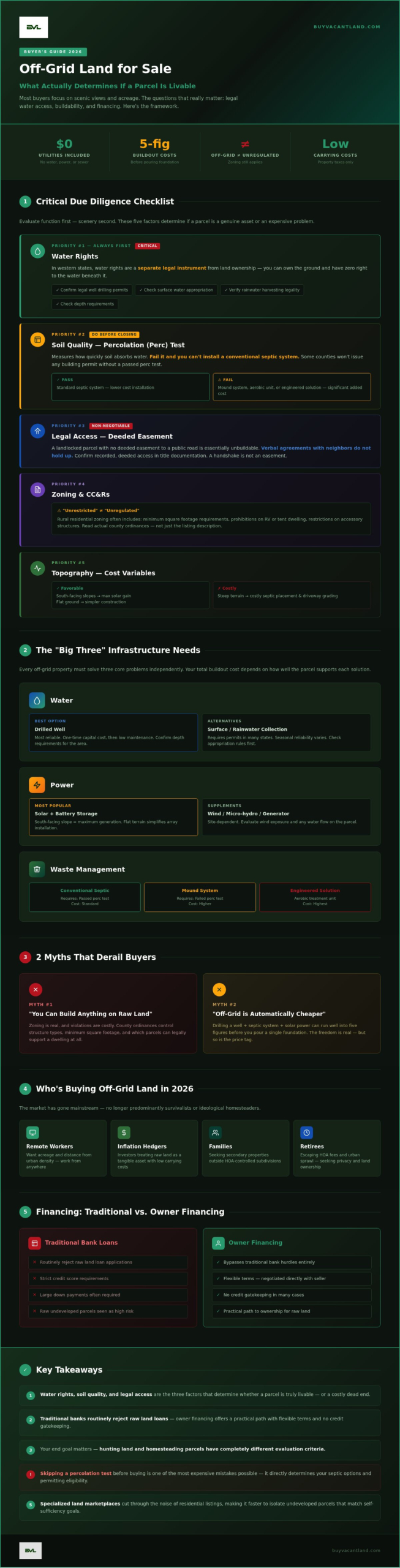
This guide gives you a practical, no-nonsense framework for finding and securing the right parcel. You’ll get a clear due diligence checklist covering water rights, zoning, and access, a breakdown of owner-financing options that bypass traditional bank hurdles, and the specific criteria that separate a productive off-grid property from a costly mistake. Let’s get into it.
Key Takeaways
- Not all off grid land for sale is created equal—water rights, soil quality, and legal access are the three factors that determine whether a parcel is truly livable or a costly dead end.
- Traditional banks routinely reject raw land loans, but owner financing offers a practical path to ownership with flexible terms and no credit gatekeeping.
- The type of off-grid property you need depends entirely on your end goal—hunting land and homesteading parcels have completely different evaluation criteria.
- Skipping a percolation test before buying undeveloped land is one of the most expensive mistakes a buyer can make—it directly determines your septic system options.
- Specialized land marketplaces cut through the noise of residential listings, making it faster to isolate undeveloped parcels that match your self-sufficiency goals.
The Reality of Buying Off-Grid Land for Sale in 2026
Off-grid land is exactly what the name implies: property with no connection to public utilities. No municipal water line. No sewer hookup. No grid power running to the meter. What you buy is raw ground, and everything else, water, power, waste management, is your problem to solve. That clarity matters before you spend a single hour browsing listings.
2026 is shaping up to be a genuine inflection point for land buyers. Urban housing costs have pushed a growing segment of the population toward a different calculus entirely: own the ground outright, build what you need, and stop paying for infrastructure you don’t control. This isn’t fringe thinking anymore. It’s a practical response to a housing market that’s priced out a wide swath of working Americans.
The buyer profile has shifted accordingly. The people searching for off grid land for sale today aren’t predominantly survivalists or ideological homesteaders. They’re remote workers who want acreage, investors hedging against inflation, families looking for a secondary property, and retirees who want out of HOA-controlled subdivisions. The market has gone mainstream, and that’s changed how land is priced, marketed, and sold.
One thing hasn’t changed, though. Off-grid does not mean unregulated. That’s a costly assumption. County zoning ordinances, building codes, and setback requirements apply whether or not a parcel has utilities. Some rural counties have surprisingly strict rules about structure types, minimum square footage, and even which parcels can legally support a dwelling at all.
Why Investors Are Moving Toward Raw Land
Raw land is a tangible asset that doesn’t depreciate the way a structure does. It has low carrying costs, typically just property taxes, and it doesn’t require maintenance. In a volatile economy, that combination is genuinely attractive. Add in the growing premium on privacy and distance from urban density, and undeveloped parcels in desirable rural corridors have become a serious asset class, not just a lifestyle purchase.
Common Misconceptions About Off-Grid Living
Two myths derail buyers consistently. First, the belief that you can build anything on raw land. You can’t. Zoning is real, and violations are costly. Second, the assumption that off-grid is automatically cheaper than conventional housing. Drilling a well, installing a septic system, and setting up solar power can collectively run well into five figures before you pour a single foundation. Set realistic expectations early. The freedom is real, but it has a price tag attached.
Critical Due Diligence: Evaluating Raw Land for Self-Sufficiency
Most buyers get this backwards. They fall for a parcel’s aesthetics, then scramble to figure out if it actually works. Flip that process. Evaluate function first, scenery second. The five factors below determine whether a piece of off grid land for sale is a genuine asset or an expensive problem waiting to happen.
Water rights come first. Always. Before anything else, confirm whether you can legally access water on the property. In western states, water rights are a separate legal instrument from land ownership. You can own the ground and have zero right to the water beneath it. Even in eastern states with more permissive riparian rights, check whether the county permits new well drilling and what depth requirements apply. Surface water use, including streams and ponds, often requires a separate appropriation permit. Rainwater harvesting is legal in most states but restricted in others. Verify all of it before you make an offer.
Soil quality determines your septic options. A percolation test, commonly called a perc test, measures how quickly soil absorbs water. Fail it, and you can’t install a conventional septic system. That doesn’t automatically kill the deal, but it does mean more expensive alternatives: mound systems, aerobic treatment units, or engineered solutions that add significant cost. Some counties require a passed perc test before they’ll issue any building permit at all. Get this done during your due diligence window, not after closing.
Legal access is non-negotiable. A landlocked parcel with no deeded easement to a public road is essentially unbuildable for practical purposes. Verbal agreements with neighbors don’t hold up. Confirm that recorded, deeded access exists in the title documentation. If the only access runs across a third party’s land, you need a written easement, not a handshake.
Zoning and any covenants, conditions, and restrictions (CC&Rs) deserve equal attention. “Unrestricted” land sounds appealing, but it’s not the same as “unregulated.” Rural residential zoning often carries minimum square footage requirements, prohibitions on RV or tent dwelling, and restrictions on accessory structures. Read the actual county ordinances, not just the listing description.
Finally, assess topography for practical function. South-facing slopes maximize solar gain in the northern hemisphere. Flat ground simplifies construction and reduces foundation costs. Steep terrain complicates septic placement and driveway grading. These aren’t aesthetic preferences; they’re cost variables.
The “Big Three” Infrastructure Needs
Every off-grid property must solve three core problems independently. How well a parcel supports each solution directly determines your total buildout cost.
- Water: A drilled well is the most reliable long-term source, but drilling costs vary significantly by depth and geology. Cisterns fed by rainwater collection work in high-precipitation areas but require large storage capacity for dry seasons. Confirm local regulations on rainwater harvesting before counting on it as a primary supply.
- Waste: Conventional septic systems require a passed perc test and adequate setbacks from wells and property lines. Composting toilets are legal in most jurisdictions but often require a county permit and may still need a greywater system for sink and shower drainage. Outhouses are prohibited in most counties. Don’t assume.
- Power: Evaluate solar potential by checking the parcel’s average peak sun hours for its geographic location. Tree canopy, ridge shadows, and north-facing slopes all reduce solar viability. Wind potential requires local data, not guesswork. Some rural parcels sit in corridors with consistent wind resources; others don’t.
Legal and Environmental Checks
Order a professional survey if the boundaries aren’t recently established and recorded. Fence lines and listing maps are not legal documents. Environmental encumbrances, including wetlands designations, conservation easements, and flood zone classifications, can severely restrict what you’re permitted to build and where. Pull the FEMA flood map for any parcel near low-lying terrain. Check for recorded easements that grant utility companies, neighboring landowners, or government entities access across the property. These don’t disappear at closing.
Doing this work upfront takes time. It also prevents the far more costly experience of discovering a fatal flaw after you’ve taken title. Searching a focused platform like BuyVacantLand.com helps narrow your options to undeveloped parcels from the start, so you’re running due diligence on land that’s actually built for off-grid use, not retrofitting a residential listing that doesn’t fit your goals.
Off-Grid Land Categories: Finding the Right Fit
Not every piece of off grid land for sale serves the same purpose. A hunter needs completely different terrain than a homesteader. A prepper’s checklist looks nothing like an investor’s. Buying the wrong category of land for your intended use isn’t just a lifestyle mismatch; it’s a financial one. Get clear on your use-case first, then evaluate parcels through that specific lens.
Hunting and recreational land lives and dies by wildlife habitat quality. Dense cover, water sources, and established game corridors matter far more than soil quality or southern exposure. Seasonal access is acceptable here; most buyers aren’t living on it year-round. Focus your evaluation on timber density, proximity to public land that expands your effective range, and whether the parcel has existing food plot potential. Access roads that turn to mud in November are a real problem, so check them in the wet season, not July.
Homesteading parcels demand the opposite priorities. Year-round road access isn’t optional. Arable soil, reliable water, and a growing season long enough to support a productive garden are the baseline requirements. Flat to gently rolling terrain reduces labor and equipment costs significantly. If you’re planning livestock, confirm that the county allows it and that the parcel has enough acreage to meet any minimum grazing requirements.
Remote survival retreats prioritize a different set of variables entirely: natural concealment, defensible positioning, and deep-well potential in areas with reliable aquifer access. These buyers typically want distance from population centers and multiple ingress routes. Topography that provides natural screening from roads is a genuine asset here, not just a scenic preference.
Investment lots are a pure numbers play. The strategy is simple: buy cheap land in rural corridors showing early signs of development pressure, hold it with minimal carrying costs, and sell when demand catches up. Low price per acre, clear title, and legal road access are the only non-negotiable criteria.
Acreage Needs by Use-Case
- 1 to 5 acres: Workable for a small cabin, intensive raised-bed gardening, and a basic off-grid setup. Limited privacy buffer and no room for livestock beyond small animals like chickens or rabbits.
- 10 to 40 acres: The practical minimum for meaningful self-sufficiency. Supports livestock, a woodlot for fuel, and enough distance from neighbors to matter. This range covers the majority of serious homesteading buyers.
- 40-plus acres: Opens the door to large-scale food production, serious hunting, and genuine privacy. At this size, the land itself becomes a resource, not just a building site.
Climate and Regional Considerations
Geography dictates your off-grid technology stack more than any other single factor. Arid regions across the Southwest offer exceptional solar potential, with high annual peak sun hours that make photovoltaic systems highly efficient. The tradeoff is severe: water scarcity is a genuine survival constraint, not an inconvenience. Deep wells, rainwater cisterns, and strict water budgeting aren’t optional in these climates.
Forested regions in the Pacific Northwest, Appalachia, and the upper Midwest flip that equation. Rainfall is abundant, streams are reliable, and firewood is a renewable heating resource. But consistent cloud cover and dense tree canopy reduce solar viability significantly. Buyers in these regions often combine micro-hydro or wind with modest solar arrays rather than relying on solar alone.
The practical takeaway: don’t evaluate a parcel’s infrastructure potential in isolation from its regional climate. A setup that’s ideal in New Mexico is a poor fit for western Oregon. Platforms like BuyVacantLand.com list parcels nationally, which makes it straightforward to filter by region and match your target climate to your intended off-grid approach before you start running detailed due diligence.
Financial Strategies for Purchasing Undeveloped Off-Grid Property
Traditional banks don’t like raw land. That’s not an opinion; it’s a structural reality. Undeveloped parcels have no improvements to appraise, no comparable sales in many rural markets, and no income stream to underwrite. Most conventional lenders require a minimum 20 to 50 percent down payment on raw land, charge higher interest rates than residential mortgages, and often reject applications outright if the parcel lacks road access or a perc test. If you’re searching for off grid land for sale and expecting to finance it the same way you’d buy a house, reset that expectation now.
Two paths actually work: owner financing and cash. Both bypass the bank entirely. Both give you leverage that a conventional mortgage applicant simply doesn’t have.
Cash is the fastest path to a discount. Sellers of cheap rural land often carry parcels for years without a serious buyer. Show up with a cash offer and a short closing window, and you have negotiating power that’s genuinely rare in that market. A clean, no-contingency cash offer routinely closes at 10 to 30 percent below asking price on undeveloped lots. The seller eliminates financing risk, and you capture that value immediately.
The land contract versus deed of trust distinction matters here. In a land contract arrangement, the seller retains legal title until you’ve paid in full. You get equitable title and possession, but the deed doesn’t transfer until the final payment. A deed of trust works differently: title transfers at closing, but a trustee holds a security interest until the loan is satisfied. Land contracts carry more risk for the buyer if a seller defaults or has title issues. Know which structure you’re signing before you commit.
Mastering Owner Financed Land Deals
Owner financed land typically comes with terms that look nothing like a bank loan: down payments as low as 10 to 15 percent, interest rates negotiated directly with the seller, and no credit check gatekeeping the deal. Repayment periods commonly run three to ten years. Monthly payments on a modestly priced rural parcel can be genuinely affordable.
Protect yourself even in private deals. Run a title search before you sign anything. Confirm the seller holds clear title with no liens, back taxes, or recorded encumbrances. And the moment closing happens, record the deed at the county courthouse immediately. An unrecorded deed leaves you exposed. It’s a straightforward step that most buyers skip, and it’s the single most important thing you can do to protect your ownership position.
Hidden Costs of Buying Raw Land
The purchase price is the starting line, not the finish. Budget for these additional costs before you commit:
- Property taxes: Undeveloped rural parcels typically carry very low annual tax bills, often well under a few hundred dollars per year depending on county and acreage. Confirm the current assessed value and tax rate before closing.
- Closing costs and title insurance: Even in simple private transactions, a title search, title insurance policy, and county recording fees add up. Title insurance protects against claims that surface after closing. Don’t skip it to save money upfront.
- Survey fees: If the boundaries aren’t recently surveyed and recorded, budget for a professional survey. Boundary disputes on rural land are common and expensive to resolve after the fact.
- Initial site work: Road clearing, gate installation, and basic access improvements are often the first costs a new owner faces. These vary widely by terrain and parcel condition, but they’re real and should factor into your total acquisition budget.
Finding off grid land for sale with owner financing already in place removes the single biggest hurdle most buyers face. Browse owner-financed land listings on BuyVacantLand.com to find undeveloped parcels where the seller has already structured a path to ownership that doesn’t require a bank’s approval.
How to Secure Your Off-Grid Plot on BuyVacantLand.com
Generic real estate platforms bury undeveloped parcels under thousands of residential listings. You end up filtering through homes, condos, and improved lots just to find raw ground. BuyVacantLand.com skips all of that. The entire marketplace is built around vacant land, which means every listing you’re looking at is already the right category. That’s not a small thing. It cuts your search time significantly and keeps you focused on parcels that actually match off-grid use cases.
The Streamlined Search Process
Start with the filters. Narrow by acreage, price range, and financing type to surface parcels that fit your budget and ownership timeline. If you’re working with limited capital, filtering by owner financing immediately isolates deals where the seller has already removed the bank from the equation. For buyers hunting cheap land for sale in rural corridors, this filter combination is the fastest path to affordable, actionable listings.
Save your searches. New off grid land for sale hits the marketplace regularly, and setting up alerts means you’re notified the moment a parcel matching your criteria goes live. You don’t have to check back manually or risk losing a good deal to a buyer who saw it first. When you’ve shortlisted several parcels, compare them directly using the listing data available: price per acre, county, stated access, and any disclosed infrastructure details. Side-by-side comparison prevents the common mistake of fixating on one parcel simply because you saw it first.
Read listing descriptions carefully. Sellers on a specialized platform like this are more likely to disclose water source information, road access status, and financing terms upfront than a general MLS listing would. When details are missing or vague, contact the seller directly. Ask specifically about well depth or water source, recorded road access, and whether owner financing is available if it isn’t already listed. Most sellers respond faster than a traditional agent would, because there’s no intermediary slowing the communication down.
Closing the Deal with Confidence
Before you sign anything, get boots on the ground. Walk the parcel. Confirm the access road is passable in the current season. Identify where a well and septic system would realistically go. Check for any obvious drainage issues or encroachments that don’t show up in photos. No listing description substitutes for a physical visit.
For the full transaction roadmap, including title searches, deed recording, and closing steps, the 2026 beginner’s guide to buying land covers every stage in detail. Buying direct from sellers through a marketplace also eliminates buyer’s agent commissions that can add thousands to your total cost on a transaction where every dollar matters.
The parcel you’re looking for exists. The process of finding it doesn’t have to be complicated. Start your search for off-grid land today and put the filters to work.
Your Off-Grid Land Search Starts Here
The framework is straightforward. Water rights, legal access, and soil quality determine whether off grid land for sale is a genuine opportunity or an expensive mistake. Your financing strategy, whether cash or owner financing, determines how fast you can move. And your use case, homesteading, hunting, investment, shapes every evaluation decision that follows.
What slows most buyers down isn’t the land itself. It’s wading through residential listings on platforms that weren’t built for raw land buyers. BuyVacantLand.com cuts that problem entirely. It’s a direct-to-seller marketplace focused exclusively on vacant land, with a national database of undeveloped parcels and owner-financed listings already built in. No homes cluttering your search results. No agent commissions eating into your budget. Just raw land, filtered to match what you’re actually looking for.
The right parcel is out there. The process doesn’t have to be complicated. Find your perfect off-grid land parcel today and put the search filters to work.
Frequently Asked Questions About Off-Grid Land for Sale
Is it legal to live off-grid in the United States?
Yes, living off-grid is legal in the United States, but the specifics vary significantly by county and state. There’s no federal law against it. What trips people up is local zoning. Some counties prohibit full-time dwelling in structures that don’t meet minimum square footage requirements, and others restrict RV or tent living entirely. Always verify county ordinances before you buy, not after.
The practical approach is to call the county planning department directly and ask two questions: what structures are permitted on the parcel, and is full-time off-grid habitation allowed? You’ll get a straight answer faster than reading through dense zoning code yourself.
What is the cheapest state to buy off-grid land?
States in the rural South and Mountain West consistently offer the lowest price per acre for undeveloped land. New Mexico, West Virginia, Tennessee, Arkansas, and parts of Texas routinely surface in searches for affordable off grid land for sale. These states combine low population density with large inventories of undeveloped rural parcels, which keeps prices down.
Don’t optimize for price alone. A cheap parcel in an arid region may require an expensive deep well. A low-cost lot in a flood-prone area carries hidden costs that dwarf the purchase price. Match the state to your intended use case first, then find the most affordable parcel within that region.
How much does it cost to put a well on off-grid land?
Well drilling costs vary too much by location and geology to give a reliable single figure. Depth is the primary cost driver, and required depths range from under 100 feet in some regions to over 600 feet in others. Local well drilling contractors are your best source for realistic estimates because they know the aquifer depths in that specific county. Get at least two quotes before you budget.
Factor in the pump, pressure tank, and any required water testing on top of the drilling cost. Some counties also require a licensed driller and a permit before work begins. Confirm both requirements with the county before you close on any parcel where a well is your primary water plan.
Can I get a mortgage for off-grid land?
Traditional mortgage lenders typically won’t finance raw, undeveloped land. Most require the parcel to have road access, a perc test, and sometimes existing utilities before they’ll underwrite a loan. Down payment requirements for raw land loans at conventional banks commonly run between 20 and 50 percent, and interest rates are higher than residential mortgages. Many applications get rejected outright.
Owner financing is the practical alternative. It bypasses bank approval entirely, with terms negotiated directly between buyer and seller. Down payments can be as low as 10 to 15 percent, and there’s no credit check gatekeeping the deal. Searching specifically for owner-financed listings on a platform like BuyVacantLand.com puts you in front of sellers who’ve already structured a bank-free path to ownership.
What does “unrestricted land” actually mean?
Unrestricted land means the parcel has no private deed restrictions, homeowner association rules, or recorded covenants limiting how you use it. It doesn’t mean unregulated. County zoning ordinances, state environmental laws, and building codes all still apply regardless of whether a parcel is marketed as unrestricted. The label refers to private contractual limits, not government regulations.
Always pull the county zoning classification for any parcel described as unrestricted and read what that classification actually permits. Agricultural zoning, rural residential zoning, and unzoned parcels each carry different rules. The listing description is a marketing tool. The county’s official records are the legal reality.
How do I find out if a property has deeded access?
The definitive answer lives in the county recorder’s office. Request a copy of the deed and any recorded easements for the parcel. A title search, which a title company or real estate attorney can run, will surface all recorded documents tied to that parcel including access easements, utility easements, and any encumbrances. Don’t rely on the seller’s verbal assurance or a listing description that says “access via dirt road.”
If access runs across a neighboring property, confirm there’s a written, recorded easement granting that right. An easement that isn’t recorded at the county courthouse is essentially unenforceable. This is one of the most important title checks you’ll do, and it should happen before you make any offer, not during a rushed closing process.
Do I need a permit for a solar system on off-grid land?
In most counties, yes. Solar installations above a certain wattage threshold typically require a building permit, and some jurisdictions require an electrical inspection even for off-grid systems not connected to the utility grid. Requirements vary widely. Some rural counties have minimal oversight; others apply the same permitting process they’d use for a grid-tied residential system.
Contact the county building department before you install anything. Ask specifically about off-grid solar permits, setback requirements for ground-mounted arrays, and whether an inspection is required. Unpermitted installations can complicate future sales and, in some counties, result in fines or mandatory removal. A quick call upfront prevents a much bigger problem later.
What is a percolation test and why do I need one?
A percolation test, called a perc test, measures how quickly your soil absorbs water. A licensed inspector digs test holes and times how fast water drains through the soil at a standardized rate. The result determines whether your parcel can support a conventional septic system. Fail the test and you’re looking at more expensive alternatives like mound systems or engineered solutions, or in some counties, no building permit at all.
Run the perc test during your due diligence period, before closing. Make passing it a contingency in your purchase agreement if possible. Discovering a failed perc test after you’ve taken title leaves you holding a parcel with severely limited buildout options and no recourse against the seller. It’s a straightforward test that prevents one of the most common and costly mistakes in raw land buying.


Join The Discussion