
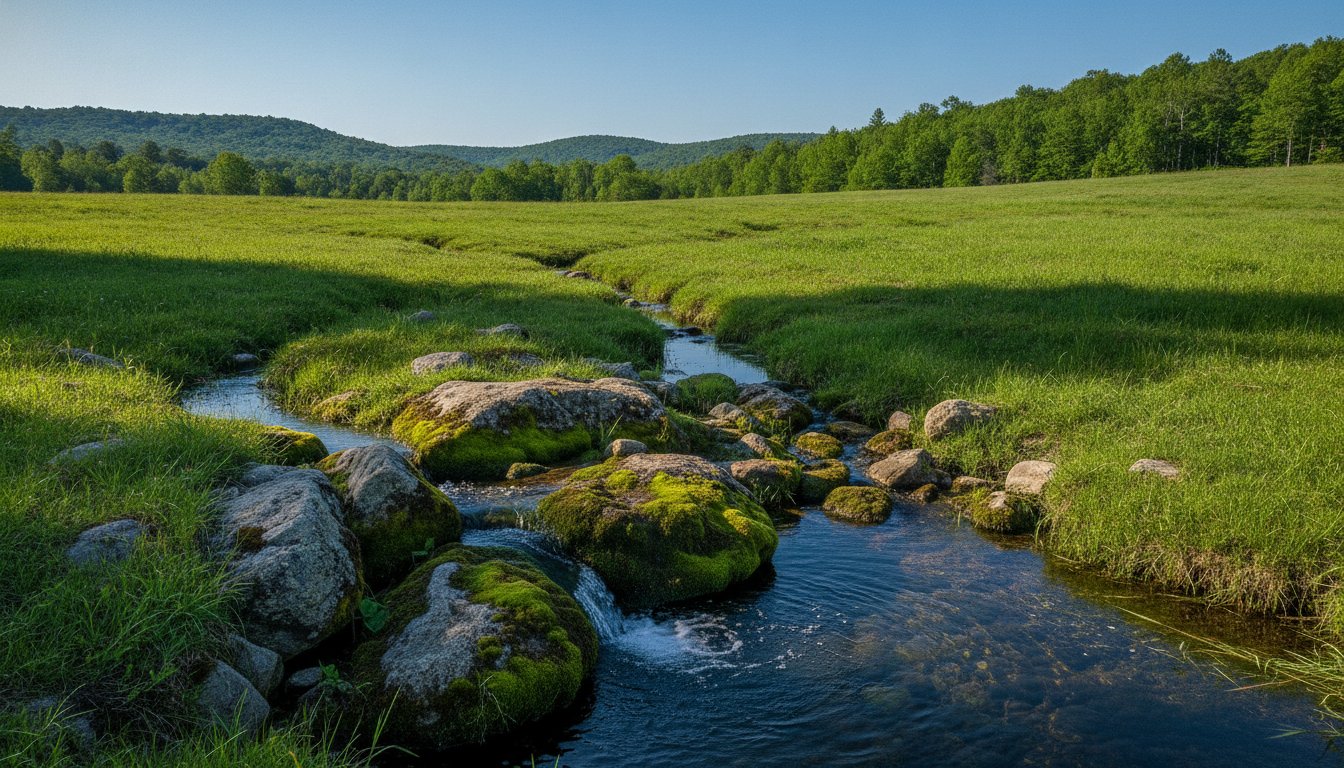
Your land is only as valuable as the water it holds. In 2026, finding a property with a natural spring for sale is more than a lifestyle choice; it’s a strategic move for total water independence. You want the security of a year-round flow, but you likely worry about seasonal droughts or complex legal hurdles. You’re right to be cautious. With 3,728 spring properties currently listed across the country, the difference between a viable asset and a dry hole comes down to technical verification.
This guide eliminates the confusion. You’ll learn how to identify high-value parcels, verify flow rates, and navigate the latest 2026 water laws. We provide the specific data you need to ensure your spring meets the two-gallons-per-minute threshold required for a household. We also break down recent legislative shifts in states like Idaho and Utah that impact your ownership rights. We offer a direct, three-step framework to evaluate land features and secure your off-grid future. Stop guessing about your water source. Get the facts you need to make a fast, assured investment today.
Key Takeaways
- Achieve total water independence by identifying the most reliable natural spring sources for 2026.
- Learn the difference between gravity and artesian springs to guarantee a consistent, year-round supply.
- Avoid legal disputes by mastering the critical differences between Riparian and Prior Appropriation water rights.
- Use specialized marketplace filters to find a property with a natural spring for sale that meets your specific needs.
- Protect your water quality by following a streamlined process for building a professional spring box.
Why Buy Property with a Natural Spring for Sale in 2026?
A natural spring is a self-sustaining point where groundwater discharges to the surface. It happens when an aquifer fills to the point that water overflows onto the land. In technical terms, a Spring (hydrology) represents a verified connection to a reliable underground reservoir. Finding a property with a natural spring for sale in 2026 is the most efficient way to secure your future. The demand for water security has shifted from a luxury to a necessity. You aren’t just buying land; you’re buying a permanent resource.
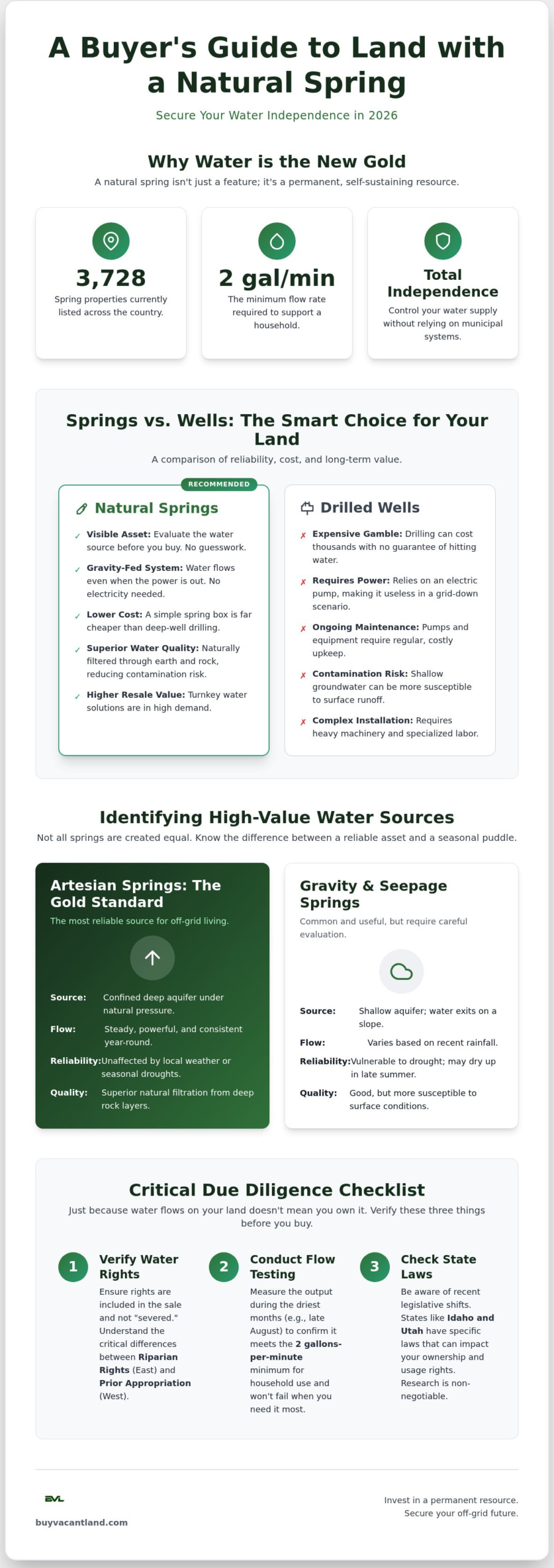
Owning a spring eliminates the financial burden of deep-well drilling. Wells are expensive gambles that often require drilling hundreds of feet without a guarantee of success. A spring is a visible, active asset you can evaluate before you buy. It supports a healthy ecological cycle, keeping your soil moist and your local wildlife thriving. This natural water cycle creates a resilient environment that withstands seasonal changes better than parched, undeveloped lots. It’s a direct solution for those who value efficiency and land health.
The Tangible Value of Water Independence
Water independence means you’re in control. You don’t rely on municipal systems that can fail or hike prices. Most spring systems use gravity to move water. This means your taps stay on even when the power grid goes down. For those interested in sustainable agriculture or livestock, a consistent water source is non-negotiable. It ensures your animals stay hydrated and your crops grow without high utility bills. A property with a natural spring for sale also commands a higher resale price. Buyers in 2026 look for turnkey water solutions. They want land that’s ready for use on day one without the stress of utility delays.
Springs vs. Wells: Which is Better for Your Land?
The choice between a spring and a well comes down to reliability and cost. Developing a spring box is a pragmatic investment. It protects the water source from debris while providing easy access for your plumbing. Wells require heavy machinery, electricity, and ongoing pump maintenance. Springs are simpler. They offer natural filtration through layers of earth and rock, which often results in higher water quality than shallow groundwater. You avoid the risk of surface contamination that plagues many traditional wells. When you secure a property with a natural spring for sale, you choose a system that works with the land. It’s a faster, cleaner, and more reliable path to off-grid living.
Identifying Different Types of Natural Springs
Not all water sources are equal. You must distinguish between a reliable asset and a seasonal puddle before you commit. Understanding How natural springs are formed allows you to predict long-term performance and avoid costly mistakes. Springs are categorized by their geological origin and how consistently they flow. Perennial springs offer water year-round, while ephemeral springs are seasonal and often dry up when you need them most. If you spot a “seepage” area with saturated soil and distinct vegetation but no active flow, you’ve found a shallow water table. These areas are prone to contamination and rarely support a full household. Look for active discharge points rather than just damp earth to ensure you’re getting a functional water source.
Artesian Springs: The Gold Standard
Target artesian springs for the most reliable off-grid water source. These occur when water is trapped in a confined aquifer under natural pressure, forcing it to the surface through cracks in the rock. This natural pressure ensures a steady, powerful flow regardless of local weather patterns or surface droughts. You can identify these on topographical maps by looking for discharge points located at lower elevations relative to the surrounding landscape. When you evaluate a property with a natural spring for sale, prioritize artesian sources for maximum security. They offer the cleanest water because deep rock layers provide superior natural filtration. These springs often maintain a constant temperature year-round, which is a key indicator of a deep-seated, reliable water source.
Gravity and Seepage Springs
Sloped terrain often hides gravity springs. Water travels downward through porous soil until it hits an impermeable layer like clay or solid rock, forcing it to exit the slope. These are easier to develop but more vulnerable to local drought conditions. A gravity spring depends on recent rainfall to recharge the shallow aquifer it draws from. Look for specific signs of health: distinct flow channels, year-round soil saturation, and water-loving plants like ferns or watercress. If the flow stops in late August, the spring is likely too shallow for permanent use. You can browse high-potential off-grid land listings to compare these features in real-time. Always verify the flow during the driest months before finalizing any property with a natural spring for sale.
Critical Due Diligence: Water Rights and Flow Testing
Finding a property with a natural spring for sale is only the first step. You must verify the “Golden Rule” of water ownership: just because water flows across your land doesn’t mean you own the rights to use it. In 2026, legal frameworks are tighter than ever. You need to identify if the water rights are included in the sale or if they’ve been “severed” and sold to a third party. Failing to verify this can leave you with a scenic feature you aren’t legally allowed to touch. Water rights are a separate deeded interest in land, meaning they require their own specific title search during your due diligence period.
Understanding Your Legal Right to the Water
The rules change depending on your location. Eastern regions typically follow Riparian Rights, where you share water naturally with neighbors whose land touches the source. Western regions use Prior Appropriation, governed by the “first in time, first in right” principle. Recent 2026 updates have increased the complexity of these laws. Several jurisdictions modified domestic use requirements on February 17, 2026, while others passed new frameworks for livestock watering claims on August 18, 2026. Always check for active groundwater moratoriums in high-demand regions, such as the five-year ban issued on March 23, 2026, in certain western basins. These regulations dictate your ability to develop the source for household use.
Testing for Flow and Potability
Never rely on a spring’s appearance during a wet season. You must test the flow during the driest month of the year to see its true minimum capacity. Use a simple “bucket test” to measure Gallons Per Minute (GPM). Place a five-gallon bucket under the discharge and time how long it takes to fill. A flow rate of at least two gallons per minute is the verified standard to support a single-family household. If the flow drops below this, you’ll need significant storage tanks to meet daily demand.
Potability is equally critical. Professional lab testing for a comprehensive panel of contaminants typically costs between $199 and $400 in 2026. You must screen for bacteria, nitrates, and heavy minerals. Check for upstream contamination sources like industrial sites or large-scale livestock operations. Regular Spring water testing and maintenance ensures your supply stays safe for long-term consumption. Don’t skip this step. A contaminated source turns a high-value property with a natural spring for sale into a liability. Secure your investment by getting hard data before you close the deal.
How to Find Spring Properties on a Land Marketplace
Finding a property with a natural spring for sale requires a targeted search strategy. General real estate apps are built for houses; they often bury critical land features in long descriptions. You need a specialized approach. Start by using high-impact keyword filters like “artesian,” “spring-fed,” and “live water.” These terms help you bypass thousands of dry parcels and focus on land with verified water assets. Efficiency is the goal. Targeted filters save you hours of manual scrolling and put you ahead of other buyers.
Verify the listing data with topographical maps and satellite imagery. Look for “blue line” indicators on USGS maps, which often signal perennial or intermittent water sources. Pay close attention to elevation drops. Springs typically emerge where a hillside meets a flatter area. In arid regions, use satellite views to spot localized clusters of green vegetation. If a specific area stays green while the surrounding land is brown during the summer, you’ve likely found a year-round spring. This visual evidence provides a layer of certainty before you schedule a site visit.
Decoding Land Listing Descriptions
You must read between the lines of every description. A “seasonal creek” is not the same as a year-round spring. Seasonal water often disappears when you need it most. Watch for red flags like “potential for water” or “nearby springs.” These phrases usually mean the property itself lacks a verified discharge point. If you’re unsure about the process, review our guide on how do you buy land to avoid common pitfalls. Ask the seller for the specific GPM flow rate and whether the water rights are deeded. Get these answers in writing before you spend time or money on a physical inspection.
Leveraging National Marketplaces
Specialized platforms like BuyVacantLand.com offer a distinct advantage for raw land buyers. These sites allow you to filter for “off-grid” and “undeveloped” parcels that general apps overlook. You can often find high-value cheap land for sale by looking for properties that need development. Set up automated alerts for your specific criteria. In the competitive 2026 market, the best water-rich lots sell quickly. Being the first to see a new listing gives you the best chance to secure a property with a natural spring for sale. Use our platform to search available spring properties and start your due diligence immediately.
Developing Your Spring for Off-Grid Living
Securing a property with a natural spring for sale is just the beginning. To turn that raw water source into a functional utility, you must develop it correctly. A spring box is your first line of defense. It protects the discharge point from animals, debris, and surface runoff. In 2026, the typical cost to develop a natural spring ranges from $1,500 to $4,000. If you require a comprehensive system with a collection field and a header tank, expect to invest between $1,900 and $7,900. These systems pay for themselves quickly when compared to the rising costs of municipal water.
Gravity-fed systems are the most efficient way to move water. They require no electricity and have fewer mechanical parts to fail. Use the natural elevation of your land to push water from the spring box into your storage cistern. A cistern acts as a buffer, ensuring you have a steady supply even during peak usage hours. If your spring is at a lower elevation than your home, you will need a solar-powered pump and a pressure tank. Always verify local permitting requirements before you begin construction. As of 2026, many regions require permits for installing large-scale water systems or drilling wells to ensure compliance with EPA standards.
Building a Sustainable Spring Box
Use food-grade materials for your spring box to prevent chemical leaching. Polyethylene tanks or pre-cast concrete are the standard choices. You must protect the “eye” of the spring, which is the exact point where water exits the ground. Avoid compacting the soil around this area with heavy machinery. Install a screened overflow pipe to allow excess water to exit the box without creating backpressure. This prevents the spring from finding a new path of least resistance and disappearing. Add a sediment trap to catch fine particles before they enter your main plumbing lines.
Finalizing Your Land Acquisition
The closing process is your last chance to protect your investment. Ensure that all water rights are explicitly detailed in the final closing documents. Don’t rely on verbal promises from a seller. Your final checklist must include a professional survey to mark the spring’s location and a clean title search that confirms the water rights are intact. Verify your water testing results one last time to ensure the source is free from bacteria and nitrates. Once these steps are complete, you can move forward with confidence. You can Browse our latest listings for land with natural water sources to find your ideal off-grid parcel today.
Secure Your Water Independence Today
Securing a property with a natural spring for sale is the most direct path to off-grid resilience. You’ve learned how to distinguish between seasonal seepage and reliable artesian flows. You now understand that verifying deeded water rights is just as critical as the physical flow rate. These steps remove the guesswork from your land acquisition. By focusing on technical due diligence and proper spring box development, you ensure a lifetime of clean, gravity-fed water without the high costs of deep-well drilling.
BuyVacantLand.com is a specialized national marketplace designed specifically for raw land buyers. We provide a direct connection to land owners and offer specialized filters for undeveloped land features. Our platform allows you to bypass the noise of traditional real estate apps and find high-value, off-grid parcels with ease. Our national reach ensures you have access to the best water-rich land available. Find your off-grid property with a natural spring today. Your self-sufficient lifestyle is within reach and ready for action.
Frequently Asked Questions
Is a natural spring better than a well for off-grid living?
A natural spring is often superior because it eliminates the need for expensive drilling and electric pumps. Most springs use gravity to move water, ensuring your taps stay on during power outages. Unlike wells, which can cost thousands to drill with no guaranteed results, a spring is a visible asset. You can evaluate the flow before you buy. This makes a property with a natural spring for sale a more predictable investment for long-term self-sufficiency.
How do I know if a spring will run all year long?
You must verify the spring’s flow during the driest month of the year, typically late summer or early autumn. This reveals the minimum capacity of the aquifer. Look for perennial indicators like established flow channels and year-round vegetation. If a spring is ephemeral, it only flows during wet seasons and won’t support a permanent homestead. Always perform a bucket test to ensure the discharge meets your daily household requirements.
Do I automatically own the water if a spring is on my property?
You don’t automatically own the water just because it’s on your land. Water rights are often a separate deeded interest. Depending on your location, you’ll deal with Riparian rights or Prior Appropriation laws. In 2026, many jurisdictions have updated their domestic use and livestock watering regulations. Several regions modified these requirements on February 17, 2026, while others finalized new frameworks on August 18, 2026. You must perform a specific title search to confirm the water rights are included in your purchase.
Can I drink water directly from a natural spring?
Never drink directly from a spring without professional lab testing. Natural water sources are vulnerable to bacteria, nitrates, and heavy minerals from upstream contamination. Even clear water can harbor pathogens like Giardia or E. coli. In 2026, a comprehensive potability test typically costs between $199 and $400. Protect your health by installing a filtration system and a professional spring box to keep surface runoff and animals away from your supply. This ensures your property with a natural spring for sale remains a safe asset.
What is the difference between an artesian spring and a regular spring?
The primary difference is pressure. An artesian spring occurs when water is trapped in a confined aquifer under natural pressure, forcing it to the surface. These are highly reliable and often flow at a constant rate regardless of local rainfall. Regular gravity or seepage springs rely on elevation changes and are more prone to seasonal fluctuations. Artesian sources generally offer superior water quality because the water undergoes deep natural filtration through rock layers.
How much flow (GPM) do I need for a small farm?
A household requires at least two gallons per minute (GPM) for basic needs. For a small farm with livestock or irrigation, you’ll need significantly more. A single cow can drink 30 gallons a day, and irrigation demands vary by crop type and soil. If your spring flows at a lower rate, you must install large storage cisterns to collect water overnight. This allows you to meet high-demand periods without depleting your source or stressing the spring.
Are there special permits required to build a spring box?
Yes, most jurisdictions require permits to develop a natural water source for domestic use. These regulations ensure your system meets EPA standards and doesn’t negatively impact the local water table or downstream neighbors. In 2026, you may need a building permit for the spring box structure and a plumbing permit for the distribution lines. Always check with your local Department of Water Resources to avoid fines and ensure your property with a natural spring for sale is legally compliant.
Does a natural spring increase property taxes?
A natural spring can increase property taxes if it significantly raises the land’s assessed value. Tax assessors view reliable water sources as a major improvement, similar to a paved road or a utility hookup. While the spring itself is a natural feature, the infrastructure you build to develop it, such as cisterns and pump houses, adds taxable value. However, the long-term savings on municipal water bills usually far outweigh the minor increase in annual property taxes.


Join The Discussion