
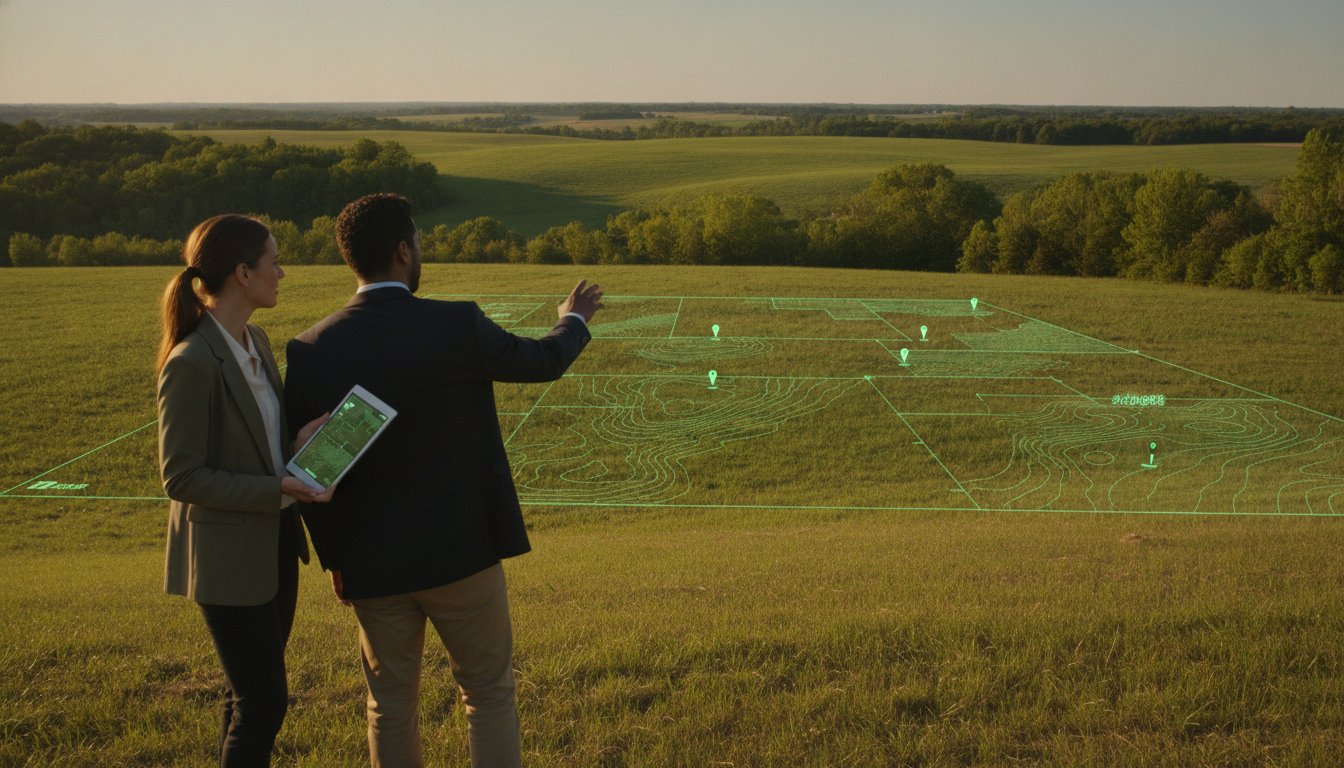
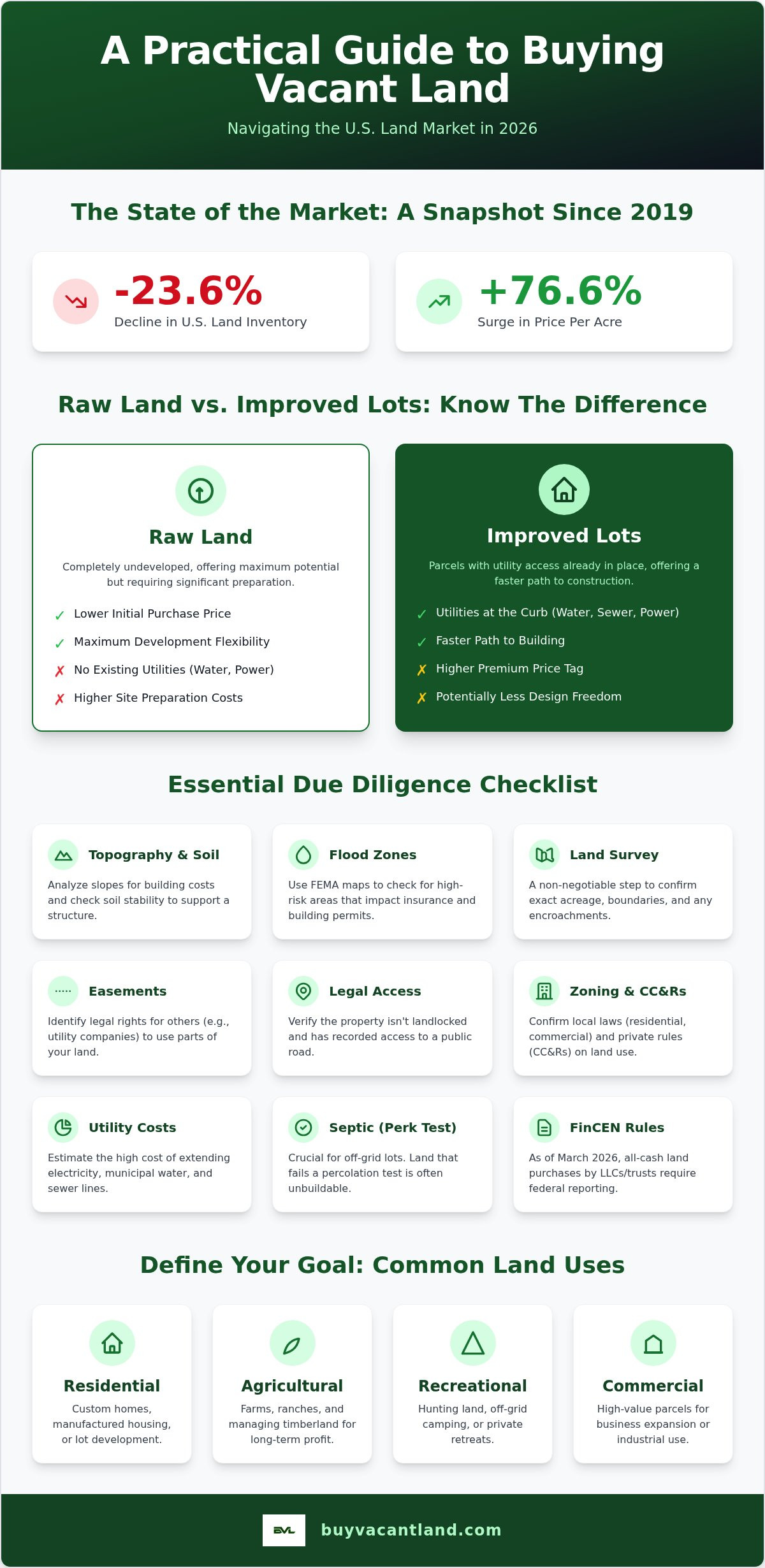
U.S. land inventory has dropped by 23.6 percent since 2019, while prices per acre have surged by over 76 percent. Finding a high-value vacant lot in this competitive 2026 market requires more than just luck. Most buyers waste hours sifting through residential home listings only to find parcels with hidden utility costs or restrictive zoning. You need a direct path to raw land without the noise of traditional real estate websites that prioritize houses over dirt.
You likely feel that the process of acquiring undeveloped land is unnecessarily complex and opaque. It’s true that wading through local regulations and the new FinCEN reporting rules can feel like a full-time job. This guide changes that. You’ll master the essentials of vacant lot acquisition and sales with a pragmatic approach to the national market. We’ll show you how to identify high-value parcels, understand the steps to a clean transaction, and use specialized platforms designed specifically for land. This is your roadmap to a swift, assured transaction without the usual procedural hurdles.
Key Takeaways
- Distinguish between raw land and improved parcels to accurately assess the development potential of a vacant lot.
- Perform essential due diligence on topography and soil types to prevent hidden costs before you commit to a purchase.
- Analyze current market demand to decide if land banking or immediate development fits your financial goals.
- Save time by searching specialized listing platforms that exclude residential homes and focus entirely on undeveloped land.
- Follow a streamlined, numbered sequence to move from defining your use goals to closing a clean transaction.
What is a Vacant Lot? Understanding Undeveloped Land in 2026
A vacant lot is a defined tract of land without any permanent buildings or structures. In the 2026 real estate market, these parcels are distinct financial assets. Local governments track every parcel through public records using an Assessor’s Parcel Number (APN) or a legal metes and bounds description. This documentation ensures clear ownership and defines the physical limits of your property. Transparency is higher than ever. As of March 1, 2026, federal regulations mandate reporting for all-cash purchases of residential land by LLCs and trusts to combat fraud.
Holding land is a proven hedge against inflation. Between 2019 and 2026, the price per acre of land increased by 76.6 percent. While currency loses value, tangible earth remains a finite resource. Current market data shows that U.S. land inventory has decreased by 23.6 percent since 2019. This scarcity drives demand. You aren’t just buying dirt; you’re securing a position in a tightening national market.
Raw Land vs. Improved Lots: Know the Difference
Distinguishing between raw and improved land is the first step toward a smart purchase. Raw land is completely undeveloped. It lacks utility hookups, road access, or cleared sites. While the initial purchase price is lower, your preparation costs will be higher. You’ll need to account for well drilling, septic installation, and power line extensions. These are the “hidden” costs that often derail unprepared buyers.
- Raw Land: No utilities, maximum potential, lower entry cost.
- Improved Lots: Water, sewer, and electricity are already at the curb.
When you see advertisements for “cheap land,” they almost always refer to raw, off-grid parcels. These require significant sweat equity or capital to become buildable. Improved lots offer a faster path to construction but carry a premium price tag because the infrastructure is already in place.
Common Uses for Vacant Land Parcels
Defining your goal early prevents wasted time. A vacant lot can serve multiple purposes depending on its zoning and location. Most buyers fall into one of three categories:
- Residential: Building custom homes, placing manufactured housing, or developing residential lots.
- Agricultural: Establishing farms, ranches, or managing timberland for long-term profit.
- Recreational: Using the land for hunting land, off-grid camping, or private retreats.
Industrial and commercial vacant lots are also high-value options for business expansion, such as developing a managed parking area. For those looking to monetize their property, scannable parking signs for sale provide a simple way to handle reservations and payments automatically. Identifying your specific use case allows you to filter through listings with precision. Don’t browse general sites that clutter your screen with houses. Focus only on the land that meets your criteria.
Essential Due Diligence: Evaluating a Vacant Lot Before Purchase
Due diligence is your only protection when buying a vacant lot. Unlike a house, you can’t walk through a land parcel to see its flaws. Most issues are hidden in the soil or buried in legal records. You must verify the physical and legal reality of the land before signing any contract. Failure to do so leads to expensive mistakes that can’t be undone. Smart buyers treat this phase as a rigorous audit of the asset’s potential.
Start with the physical landscape. Topography dictates your construction budget. A steep slope might offer a view, but it requires costly retaining walls and specialized foundations. Soil type is equally critical. You need stable ground that can support a structure without shifting. Finally, check the flood zones. If a vacant lot sits in a high-risk area, your insurance premiums will skyrocket, or you might be barred from building entirely. Use FEMA maps to get the facts early.
Never rely on a seller’s word about property lines. A professional land survey is a non-negotiable requirement. It confirms the exact acreage and identifies encroachments from neighbors. You also need to check for easements. These legal rights allow others to use portions of your land for utilities or access. An easement in the wrong place can permanently block your building plans. If you’re looking for a simpler way to find vetted opportunities, you can browse undeveloped land listings that provide clear data from the start.
Zoning Laws and Land Use Restrictions
Local zoning codes are the law. They determine if a lot is residential, commercial, or industrial. Don’t assume you can build a workshop on a residential lot just because it’s “your land.” You must also review CC&Rs (Covenants, Conditions, and Restrictions). These private rules often govern aesthetics, such as minimum square footage or exterior materials. Check the setback requirements too. These rules dictate how far your building must be from the property lines, which significantly reduces your actual buildable footprint.
Utilities and Access: The Hidden Costs of Raw Land
Legal access is the most vital factor for any property. If a lot doesn’t touch a public road or have a recorded easement, it’s landlocked. You won’t get a building permit for land you can’t legally reach. Once access is confirmed, look at utilities. Bringing electricity or municipal water to a remote parcel is expensive. You might pay thousands for every utility pole required to reach your site. If municipal sewer isn’t available, you’ll need a septic system. This requires a successful perk test to prove the soil can handle wastewater. If the land fails this test, it’s effectively unbuildable.
Buying vs. Selling Vacant Lots: Market Dynamics and Strategy
The 2026 market has shifted toward disciplined, targeted activity. Demand for a vacant lot remains high because national inventory has dropped by nearly 24 percent since 2019. Individual builders want control; investors want a hedge against inflation. You must choose between two primary strategies: land banking or active development. Land banking is a passive hold strategy. You buy in the path of national growth and wait for appreciation. Active development involves immediate construction to maximize asset value. Both paths require a clear understanding of utility availability. Pricing your land accurately depends on recent comparable sales and the quality of existing infrastructure.
Why Buyers Seek Vacant Land in 2026
Buyers are moving away from cluttered residential listings. They want autonomy. The drive for off-grid living and homesteading fuels demand for rural parcels. Others focus on pure investment. They secure land in areas where national development is projected to expand. Building from the ground up offers total customization. You don’t deal with the limits of a previous owner’s renovation choices. You start with a clean slate and build exactly what you need without compromise.
Why Sellers List Vacant Lots on Specialized Marketplaces
Holding an unused asset is a financial burden. Property taxes accumulate annually without providing a return on your capital. Sellers list on specialized platforms to offload these burdens fast. General real estate sites often bury land listings under thousands of home search results. By using a land-only marketplace, you reach a targeted audience of cash buyers. These buyers look specifically for a vacant lot and off-grid opportunities that traditional agents might ignore.
- Tax Relief: Stop paying annual fees for land you don’t use.
- Targeted Reach: Connect with buyers who aren’t looking for houses or rentals.
- Swift Transactions: Avoid the procedural hurdles found in traditional residential sales.
Specialized platforms like BuyVacantLand.com streamline the entire process. They eliminate the noise of the housing market. This focus ensures your listing gets in front of motivated buyers who understand the value of raw land. It’s the most efficient way to turn an idle asset into liquid capital.
How to Find and Secure the Best Vacant Lot Deals
Securing a high-value vacant lot in the 2026 market requires a systematic approach. You cannot rely on the same tools used for residential home searches. National land inventory has tightened; prices are up. You need a method that prioritizes speed and accuracy. Follow these four steps to find and secure the best deals without the usual procedural delays.
Step 1: Define your land use goals. You must know if the land is for a custom home, a recreational retreat, or a long-term investment. Each category has different requirements for zoning and access. Step 2: Search specialized land-only listing sites. Avoid the home-clutter on traditional real estate platforms. Use marketplaces that provide technical data like soil types and topography maps. Step 3: Analyze the price per acre. Compare the listing price to surrounding parcels. In 2026, the national average for raw rural land is between $1,500 and $2,500 per acre. If the price is higher, verify the added value like existing wells or road frontage. Step 4: Secure your financing. Prioritize cash or owner-financed options. These methods are the most efficient way to close a transaction in today’s market.
Navigating Specialized Land Marketplaces
Use specific keywords to narrow your search results immediately. Terms like “unrestricted land” help you find parcels with fewer building codes and more freedom. You can use platforms like Lands of America to view a broad national inventory of undeveloped property. Set up automated alerts for specific categories like “hunting land” or “farms.” This ensures you act the moment a new deal appears. Speed is your greatest advantage when inventory is low.
Financing Your Lot: Owner Financing vs. Cash Deals
Traditional banks are often hesitant to lend on undeveloped land. They view raw parcels as high-risk assets and frequently demand down payments of 20 to 50 percent. This creates a significant barrier for many buyers. Owner financed land offers a pragmatic alternative. It bypasses bank-imposed credit hurdles and complex loan applications. You deal directly with the seller. Cash deals remain the most direct path to ownership. They eliminate lender-required appraisals and speed up the final transaction. A cash offer often allows you to negotiate a better price on a vacant lot because the seller faces zero financing risk.
Start your search today by browsing our latest undeveloped land listings to find a parcel that fits your budget.
Buy Vacant Land: The National Marketplace for Undeveloped Property
BuyVacantLand.com provides a focused environment for land transactions. We exclude homes and rental properties to ensure a streamlined user experience. This specialization eliminates the noise found on general real estate sites. You won’t waste time scrolling through suburban houses to find a vacant lot. Our platform connects motivated sellers directly with buyers who value raw land. We provide national coverage across the United States. Our listings include diverse land types, from industrial lots and commercial parcels to residential lots and off-grid acreage. This is the efficient alternative to cluttered search engines.
The 2026 market demands speed and reliability. Traditional real estate sites treat land as a secondary category. We treat it as the primary asset. This focus allows us to offer a higher level of transparency and approachability. Whether you are searching for hunting land or farms and ranches, you get direct access to the data that matters. We cut through traditional procedural hurdles to facilitate a swift, assured transaction for every user.
Why Specialized Listing Platforms Beat General Sites
General real estate websites are built for residential housing. They prioritize square footage, bedroom counts, and kitchen upgrades. These metrics are useless for land buyers. BuyVacantLand.com uses simplified data fields relevant to your search. You’ll find information on access, zoning, and topography without digging through irrelevant descriptions. This focus creates a faster connection between parties. Sellers reach a targeted audience that already understands the value of a vacant lot as a financial asset. Buyers get a clean interface that leads to an equitable financial proposal without the distraction of home listings.
- Targeted Audience: Your listing is seen only by people specifically looking for land.
- Simplified Data: No irrelevant fields for “number of bathrooms” or “garage style.”
- Efficiency: Faster connections lead to quicker closings and less stress.
Getting Started: List or Find Your Lot Today
Sellers can create a high-converting listing in minutes. Focus on clear landscape photos and accurate descriptions of legal access. Include the parcel number and any known utility details to build immediate trust. Buyers should use our specialized filters to narrow their search by land use. If you’re looking for cheap land for sale, prioritize off-grid parcels or owner-financed opportunities. These often provide the most accessible entry point into the national market. Browse our national inventory today and secure your next asset with confidence.
Secure Your Position in the 2026 Land Market
Success in today’s market requires a shift in perspective. Rigorous due diligence prevents hidden utility costs and zoning traps. You’ve learned that land-specific data is more valuable than general real estate fluff. Finding or selling a vacant lot is a strategic move that demands a specialized approach. You now have the roadmap to navigate these complexities with confidence and speed.
Don’t let the noise of the housing market slow your progress. Use tools designed for your specific goals. Our platform offers national reach across all 50 states and a direct connection between motivated buyers and sellers. We focus exclusively on raw land to provide the relief and peace of mind that come from a swift, assured transaction. We cut through the procedural hurdles that typically stall land deals.
List your property or find your next land investment today on BuyVacantLand.com. Take the next step toward your goals with a dedicated ally that values your time. Your future property is waiting.
Frequently Asked Questions
What is the difference between a vacant lot and raw land?
A vacant lot is a specific parcel within a developed area, often with basic infrastructure or survey markers in place. Raw land is completely undisturbed property without utility connections or road access. While both are undeveloped, a vacant lot typically sits in a residential or commercial zone. Raw land often requires significant clearing and grading before any construction can begin. This distinction affects your total development budget and timeline.
Is buying a vacant lot a good investment in 2026?
Yes, land remains a stable asset as a hedge against inflation and currency volatility. Demand is driven by a shift toward custom builds and off-grid homesteading. Since land is a finite resource, securing a high-value parcel in a growing national market offers long-term equity potential. You avoid the maintenance costs and depreciation associated with physical structures. It is a passive hold strategy that benefits from national development trends and increasing scarcity. Similar principles of scarcity and strategic acquisition apply to digital real estate, where the DnsLister Blog helps domain name hunters identify high-value assets.
Locate the property’s Assessor’s Parcel Number (APN) through the local county tax assessor’s website. This public record provides the current owner’s name and mailing address. You can also visit the county recorder’s office to view the most recent deed. If you want to save time, use a specialized land marketplace that provides owner information or direct contact details. This transparency ensures you deal with the actual title holder from the start of the process.
Can I get a loan for a vacant lot?
Yes, though land loans are distinct from residential mortgages. Lenders require a higher down payment, often between 20 and 50 percent, because raw land is viewed as a higher risk. In 2026, interest rates for these loans generally range from 4 to 12 percent depending on the property type. Many buyers bypass traditional banks by seeking owner-financed deals. This approach simplifies the approval process and eliminates strict credit score requirements and complex bank applications.
What are the typical closing costs for a vacant land sale?
Closing costs for land usually range from 2 to 5 percent of the purchase price. These fees cover title insurance, escrow services, and deed recording. You should also budget for a professional land survey and any necessary environmental tests. Unlike home sales, you don’t pay for building inspections or appraisal management fees. This reduced cost structure makes land transactions significantly more efficient and transparent for both buyers and sellers looking for a clean deal.
What does “unrestricted land” actually mean?
Unrestricted land refers to property that is not subject to private CC&Rs or homeowner association rules. You have more freedom to use the land for manufactured homes, tiny houses, or off-grid living. However, you must still follow county-level zoning laws and health department regulations for septic systems. Always verify that no hidden deed restrictions exist. This type of land is highly sought after by those seeking maximum autonomy and minimal governmental oversight on their property.
Do I need a survey before buying a vacant lot?
Yes, a professional survey is essential to confirm legal boundaries and identify potential encroachments. It ensures you aren’t paying for acreage that belongs to a neighbor. The survey also highlights the location of any recorded easements that could block your building plans. Skipping this step is a high-risk gamble that can lead to permanent legal disputes. A clean survey provides the peace of mind needed for a swift transaction on any vacant lot.
How do I sell my vacant land fast without a realtor?
List your property on a specialized land marketplace to reach a national audience of cash buyers. Traditional realtors often focus on homes and lack the expertise to market raw dirt effectively. Provide clear photos, the APN, and details about utility access to build immediate trust. By selling directly, you eliminate high commission fees and maintain control over the transaction. Focus on high-impact descriptors to attract motivated buyers looking for a quick, equitable financial proposal.



Join The Discussion