

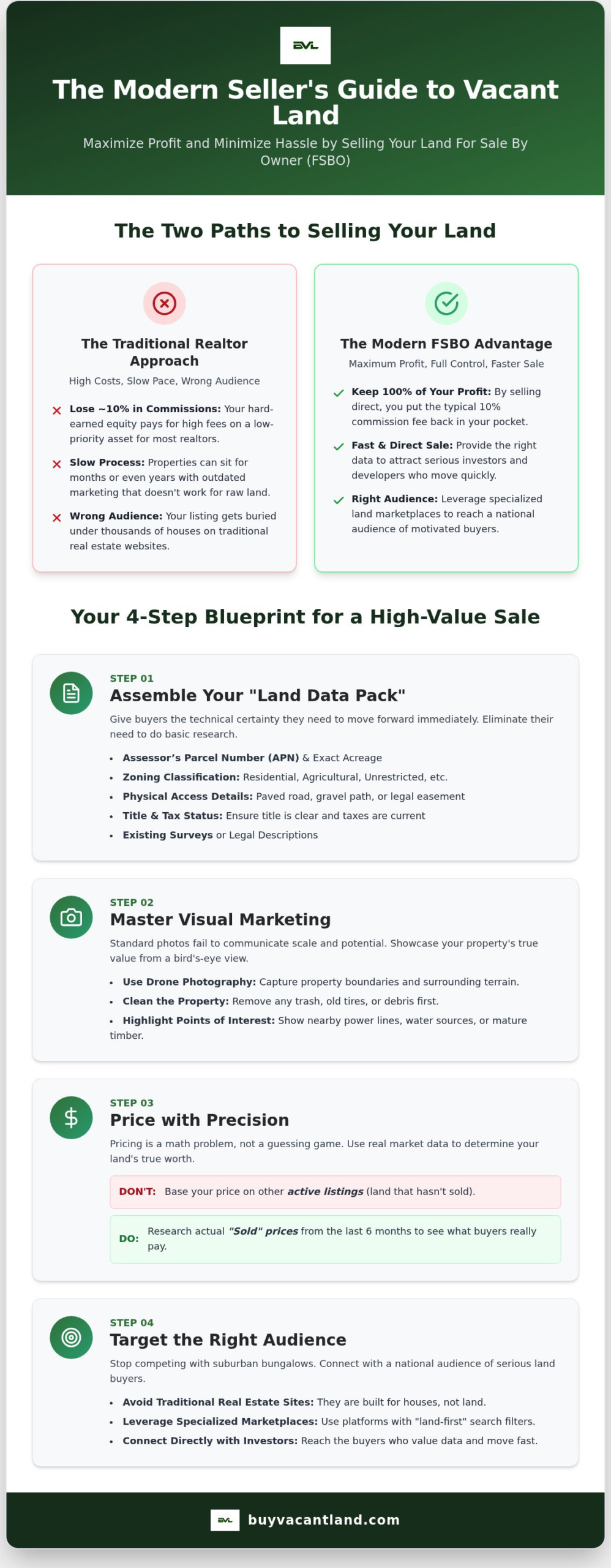
Why hand over 10% of your hard-earned equity to a realtor who might let your property sit for years? You’ve worked hard to own your property, so it’s frustrating when the traditional market treats raw land like an afterthought. Learning how to sell vacant land on your own terms is the fastest way to secure a win. You don’t need a middleman to find the right buyer. You need a better strategy that prioritizes your profit over someone else’s commission. We’ve seen too many sellers lose money to unnecessary fees and outdated marketing methods that simply don’t work for undeveloped parcels.
We understand the headache of confusing legal paperwork and the stress of waiting for a closing date that never comes. This guide changes that. You’ll master the step-by-step process of selling your raw land quickly and for top dollar without paying high realtor commissions. We’re providing a straightforward checklist for a FSBO sale that ensures a higher net profit and a quick closing process. We’ll show you how to prepare your deed, market to the right audience, and bypass the hurdles that keep most properties stuck in limbo for months. Let’s get your land sold now.
Key Takeaways
- Master how to sell vacant land by targeting specific buyer types like investors and developers who prioritize zoning utility.
- Build a professional Land Data Pack to give buyers the technical certainty they need to move forward immediately.
- Optimize your asking price by analyzing actual market data and the impact of existing infrastructure on your land’s value.
- Simplify your closing with a direct purchase agreement and professional title services to avoid unnecessary transactional hurdles.
- Leverage specialized marketplaces to reach a national audience of buyers specifically looking for raw land.
The Reality of Selling Vacant Land in 2026
Selling land isn’t like selling a house. You don’t need a staging expert or a fresh coat of paint. You need data. A deep understanding real property involves more than just looking at a dirt lot. It’s about the bundle of rights and the potential for development. In 2026, the strategy for how to sell vacant land centers on transparency and speed. Most buyers aren’t looking for a backyard; they’re looking for an asset. They want to know about zoning, access, and utilities. If you treat your land like a residential home, you’ll fail.
Investors and developers move fast when they see value. They’ll walk away from a listing that lacks technical detail. The market for raw land is traditionally slower than the housing market, but specialized platforms are changing that pace. These tools allow you to reach a national audience instantly. By cutting out the middleman, you remove the friction that usually delays a sale. Selling “For Sale By Owner” (FSBO) has become the standard for maximizing profit. It gives you total control over the transaction and the timeline.
Why Land Buyers Aren’t Looking on Traditional Sites
Traditional real estate platforms are built for kitchens and curb appeal. They prioritize houses and rentals because that’s where the volume is. Your land listing often gets buried under thousands of residential “fixer-uppers” that clog the search results. Buyers specifically seeking off-grid land or commercial lots don’t want to scroll through suburban bungalows. Specialized marketplaces eliminate this noise. They use “land-first” search filters that let buyers find exactly what they need. This targeted approach connects you with serious investors, not window shoppers looking for a dream home.
The Cost of the “Traditional” Realtor Approach
Hiring a realtor for a land sale is often a bad financial move. Most agents focus on high-commission home sales. Because land prices are typically lower than house prices, many agents charge 10% or higher to make the work worth their time. This commission eats your equity. When you add administrative fees and listing costs, your net profit shrinks significantly. Choosing a direct seller’s path puts that 10% back in your pocket. It allows you to provide an equitable financial proposal directly to the buyer without losing money to service fees. You keep the profit you’ve earned.
Preparing Your Land for a High-Value Sale
Speed and certainty are the primary drivers of a successful land transaction. Professional sellers don’t guess about their property’s details. They provide hard facts from the start. Assemble a comprehensive “Land Data Pack” before you ever post a listing. This packet provides the technical proof that your land is worth the asking price. Start with the Assessor’s Parcel Number (APN) and the exact acreage. These details allow serious buyers to verify county records and tax history instantly. Without this data, your listing is just another piece of digital noise.
Zoning is your next priority. You must determine if the lot is residential, agricultural, or unrestricted. A buyer looking for a commercial site won’t waste time on a residential lot. Be precise. Document the physical access clearly to avoid future disputes. Is there a paved road, a gravel path, or just a legal easement? Clear, deeded access significantly increases property value. Mastering how to sell vacant land requires you to eliminate the buyer’s need to perform their own basic research. Give them the answers before they ask the questions.
Visual Marketing: Beyond Simple Photos
Standard ground-level photos are insufficient for raw acreage. They fail to communicate the scale and potential of the property. Use drone photography to capture the property boundaries and the surrounding terrain from a bird’s-eye view. Buyers need to see the “lay of the land” to understand drainage and building sites. Clear away any trash, old tires, or debris before the drone takes flight. You are selling a “clean slate” for their future project. Highlight specific points of interest like nearby water sources, mature timber, or power lines. Visual proof of utility proximity can justify a much higher price point than a vague description.
The Documentation Checklist for Sellers
Administrative delays kill deals. Check your property tax status today. Ensure all payments are current to prevent late-stage hurdles at the title company. A “clear and marketable” title is non-negotiable for a fast closing. If there are old liens or clouds on the title, resolve them now. Provide any existing survey records or legal descriptions you have on file. An old survey is better than no survey because it reduces the buyer’s perceived risk and upfront cost. This transparency creates a smoother path to an equitable financial proposal. Understanding how to sell vacant land efficiently means being prepared for every question. When your data is ready, you can list your vacant land for sale on a platform that values technical accuracy. Buyers trust prepared sellers.
Pricing and Marketing Strategies That Work
Pricing is a math problem, not a guessing game. Many sellers fail because they base their asking price on other active listings. This is a mistake. Active listings represent land that has not sold yet. To understand how to sell vacant land for its true worth, you must research “Sold” prices. Look at actual transactions from the last six months. These figures represent what buyers are actually willing to pay in the current market. Don’t let an aspirational neighbor’s unsold lot dictate your strategy.
Utility availability is the single biggest value driver. A lot with power and water connections can often command double the price of a completely raw parcel. If your land has these features, lead with them in every headline. If it doesn’t, obtain a quote for bringing utilities to the property line. Providing this information removes a massive hurdle for the buyer. Use a “Tiered Listing” approach to test the market. Start at your ideal retail price. Reduce it by a set percentage every 30 days until you hit the “sweet spot” where inquiries spike.
How to Determine Your Land’s Value
Success requires granular research. Compare your lot to others with identical terrain and road access. A steep hillside lot is not comparable to a flat meadow. Visit your local county assessor’s website to find recent raw land deeds. These records are public and provide the most accurate data points available. You can also increase your pool of potential buyers by offering owner financed land. This strategy allows you to sell at a premium price by acting as the bank. It’s a powerful selling feature for buyers who can’t secure traditional loans for raw dirt.
Realtor vs. Marketplace vs. Cash Buyer
You have three primary paths to a sale. Each has a different impact on your bottom line. Choose the one that aligns with your profit goals:
- Realtors: They offer broad reach but charge high commissions. Most agents lack specific land expertise. They often treat your listing as a low priority compared to house sales.
- Cash Buyers: These companies offer an instant sale and a quick closing. The trade-off is significant. You’ll typically lose 30 to 50% of your property’s market value in exchange for the convenience.
- Specialized Marketplaces: This is the most efficient path for 2026. These platforms offer low listing costs and a targeted audience of land-only buyers. You retain your equity and sell at retail prices.
Your marketing description must be punchy. Don’t just list the acreage. Focus on “Potential Use Cases.” Describe exactly what a buyer can do with the dirt. Whether it’s a “perfect off-grid homestead” or a “prime industrial storage site,” painting a clear picture of the utility drives faster offers. Be the solution to their search.
Navigating the Legal and Closing Process
The closing phase is where your preparation pays off. You don’t need a massive legal team to handle the paperwork. Start by drafting a simple Purchase and Sale Agreement. This document outlines the price, the closing date, and any contingencies. Once both parties sign, open escrow with a reputable title company or a real estate attorney. They act as a neutral third party to hold funds and clear the title. This is a fundamental step in learning how to sell vacant land safely. Using a professional intermediary ensures the buyer’s money is real and your title is ready for transfer.
Coordinate the deed transfer with precision. You’ll likely use a Warranty Deed or a Quitclaim Deed. A Warranty Deed offers the highest protection by guaranteeing the title is clear. A Quitclaim Deed simply transfers whatever interest you have without guarantees. Most retail buyers will insist on a Warranty Deed. Never sign the final deed until you verify the wire transfer of funds into escrow. Confirmation from your bank or the title officer is the only proof that matters. Don’t rely on a screenshot of a transfer. Wait for the funds to clear.
Closing Costs: Who Pays What?
Standard practice dictates that the seller pays for title insurance and state transfer taxes. These costs are the price of doing business. However, everything is negotiable. In a “hot” market with high demand, you can request that the buyer covers all closing costs. This increases your net profit instantly. Avoid hidden fees by requesting a “Settlement Statement” at least three days before closing. This document lists every dollar moving in the transaction. Review it for junk fees or incorrect prorations before you sign anything.
The Final Steps to a Successful Transfer
Execution requires attention to detail. Notarize the deed according to your specific state requirements. Some states require witnesses in addition to a notary. Once signed, ensure the county recorder receives the original physical document. The title company usually handles this, but you must confirm it happened. Keep digital copies of every signed agreement and the final settlement statement for your tax records. Proper documentation prevents future legal headaches. Ready to start the process? You can list your vacant land for sale today and connect with buyers who understand the value of a clean, direct transaction.
Listing on BuyVacantLand.com: Your Direct Path to Buyers
You need a platform that understands the technical requirements of a land sale. Traditional real estate sites are cluttered with houses and rentals. This residential noise distracts buyers and buries your property under irrelevant results. BuyVacantLand.com provides a direct path to a national audience of dedicated land buyers. You don’t have to compete with suburban bungalows for attention. Our marketplace is built specifically for raw acreage and off-grid parcels. This specialization is the key to how to sell vacant land without the typical delays of a general marketplace.
Efficiency means keeping your money. One of the biggest burdens of a traditional sale is the high commission cost. Realtors often take 10% of your equity just for listing the property on a local database. On our platform, you keep 100% of your sale price. There are no hidden agent fees or surprise transactional costs. We provide a simple, no-nonsense listing process designed for sellers who value their time. You control the transaction from start to finish. This transparency ensures an equitable financial proposal for both parties.
Leveraging a Specialized Marketplace
Buyers come to our platform with specific intent. They aren’t browsing for kitchen remodels. They are searching for cheap land for sale and long-term investment opportunities. Our filter options allow these buyers to find your specific land type instantly. Whether you own a farm or a commercial lot, the right audience is already here. Direct communication with buyers removes the middleman delay. You answer questions and negotiate terms without waiting for an agent to return a call.
Getting Started with Your Listing
The process is streamlined for speed. Upload your high-resolution drone photos and the property data you gathered in your Land Data Pack. Mastering how to sell vacant land is simpler when you have the right tools to present your property professionally. Setting your price is simple when you use our market insights to see what’s moving in the current economy. Manage your inquiries through our platform to keep your sale organized. Stay informed on broader trends by reviewing our guide to competitive regional markets to understand how buyer interest shifts. Your listing is your most powerful tool. Use it to close your deal now.
Take Control of Your Land Sale Today
You now have the exact blueprint for a successful, commission-free transaction. Selling land in 2026 is about technical accuracy and direct marketing. By gathering your technical data pack and pricing based on actual sold records, you eliminate the uncertainty that keeps properties on the market for years. You don’t need a middleman to manage your deed transfer or find a buyer. You’ve mastered the process of how to sell vacant land by prioritizing transparency and efficiency over traditional procedural hurdles.
The final step is moving your property in front of the right audience. Avoid the noise of residential sites and the burden of high realtor commissions. Our platform offers a specialized raw land audience and a direct buyer-to-seller connection that puts you in charge of your equity. List your vacant land for sale on our national marketplace today. You’ve done the work to prepare your asset. Now it’s time to secure your profit and move on to your next project with total peace of mind.
Frequently Asked Questions
Do I need a realtor to sell my vacant land?
You don’t need a realtor to sell your property. Many owners choose to sell independently to avoid high commissions that often reach 10% or more for raw land. By using a specialized marketplace, you connect directly with buyers looking for residential lots or off-grid parcels. This approach puts you in control of the timeline and the final profit. It’s the most efficient way to manage how to sell vacant land in the current market.
How long does it typically take to sell raw land?
The timeline depends on your pricing strategy and exposure. Raw land typically stays on the market longer than houses because the buyer pool is smaller. However, listing on a platform dedicated to land-only buyers significantly reduces this wait time. If you price your lot according to recent sold data rather than aspirational asking prices, you can often close a transaction within 90 days. Speed depends on your preparation and market reach.
What paperwork is required to sell land by owner?
You must prepare a Purchase and Sale Agreement to formalize the deal. You also need a legal deed, such as a Warranty Deed, to transfer ownership. Gather your Assessor’s Parcel Number (APN), latest tax bill, and any existing surveys. These documents provide the technical certainty buyers require. Having a complete data pack ready from the start prevents administrative delays during the escrow process and ensures a professional, transparent transaction for both parties.
How do I find the value of my vacant lot?
Start by researching actual sold prices for similar lots in your county. Don’t base your value on active listings, as those prices haven’t been proven yet. Look for parcels with similar acreage, zoning, and utility access. Access to power and water can significantly increase a lot’s worth. Check the county assessor’s public records to find hard transaction data. This research is a critical step in learning how to sell vacant land for top dollar.
What is the difference between a Warranty Deed and a Quitclaim Deed?
A Warranty Deed provides the buyer with a guarantee that the title is clear of liens or encumbrances. It offers the highest level of protection. A Quitclaim Deed only transfers the interest you currently hold without making any promises about the title’s history. Most retail buyers and title companies insist on a Warranty Deed. Using the correct deed ensures the transaction is legally sound and provides the buyer with necessary peace of mind.
Can I sell land that has back taxes owed on it?
You can sell land with delinquent taxes. These debts are usually settled at the closing table. The title company or closing attorney deducts the owed amount from your sale proceeds to pay the county directly. This ensures the buyer receives a clear title. It’s a common practice that allows you to liquidate an asset even if you’ve fallen behind on payments. Always disclose back taxes early to keep the transaction transparent.
Do I need a survey to sell my property?
A new survey is not always a legal requirement, but it is highly recommended. It defines exact boundaries and identifies any encroachments. Buyers feel more confident when they see a professional plat map or recent survey markers. If you have an old survey, provide it to the buyer immediately. This can save time and money. If no survey exists, a buyer might request one as a condition of the sale to ensure acreage accuracy.
What are the main costs when selling land FSBO?
Your main expenses include title insurance, transfer taxes, and escrow or attorney fees. You’ll also have a small cost for listing on a specialized marketplace. The biggest advantage of the FSBO path is the total absence of realtor commissions. By handling the sale yourself, you keep the 10% fee that agents typically charge for land. This results in a higher net profit and a more equitable financial proposal for you as the seller.



Join The Discussion