

Traditional banks don’t want to lend you money for raw land. In 2026, most institutional lenders still demand 35% to 50% down payments and impose rigid credit requirements that kill deals before they start. You’ve likely felt the frustration of finding the perfect property only to be sidelined by a slow, bureaucratic approval process that takes months. It’s a common burden for land buyers who want to move fast and secure assets without the headache.
This guide gives you a no-nonsense breakdown of the owner financing land pros and cons so you can bypass the bank and secure your property on your own terms. Seller financing offers a streamlined path to ownership with down payments often as low as 5% and closing times measured in days rather than months. You deserve a clear, equitable financial proposal without the hidden fees or the red tape of a traditional mortgage.
We’ll explore exactly how these mechanics work in the current market, including typical 2026 interest rates ranging from 6% to 12%. You’ll learn how to identify the risks before you sign a contract and discover the best platform to find these specific land deals right now. It’s time to simplify your path to land ownership.
Key Takeaways
- Understand how to turn the seller into your bank to bypass strict 2026 institutional lending hurdles.
- Evaluate the owner financing land pros and cons to determine if low down payments outweigh higher interest rates.
- Master a streamlined two-step process for negotiating purchase prices and defining clear amortization schedules.
- Protect your capital by performing mandatory title searches to verify legal ownership and uncover existing liens.
- Discover a national marketplace designed specifically to connect you with seller-financed vacant land deals.
What is Owner Financing for Vacant Land?
Traditional banks don’t like raw land. In 2026, most institutional lenders view undeveloped property as a high-risk liability because there is no structure to act as immediate collateral. This creates a massive hurdle for buyers who want to secure residential lots or off-grid land without having 50% of the purchase price sitting in cash. Owner financing removes this barrier by letting the seller act as the bank. Instead of a mortgage company, you deal directly with the property owner to negotiate terms, interest rates, and payment schedules.
The mechanics are straightforward. You provide a down payment and sign a legal agreement to pay the remaining balance over a set period. This arrangement, often referred to as What is Seller Financing?, bypasses the slow, expensive bureaucracy of traditional finance. It’s a pragmatic solution for buyers who value speed and for sellers who want to earn interest on their equity. Understanding the owner financing land pros and cons is essential before you commit to a contract, as this method prioritizes the asset over your credit score.
The Core Difference Between Banks and Sellers
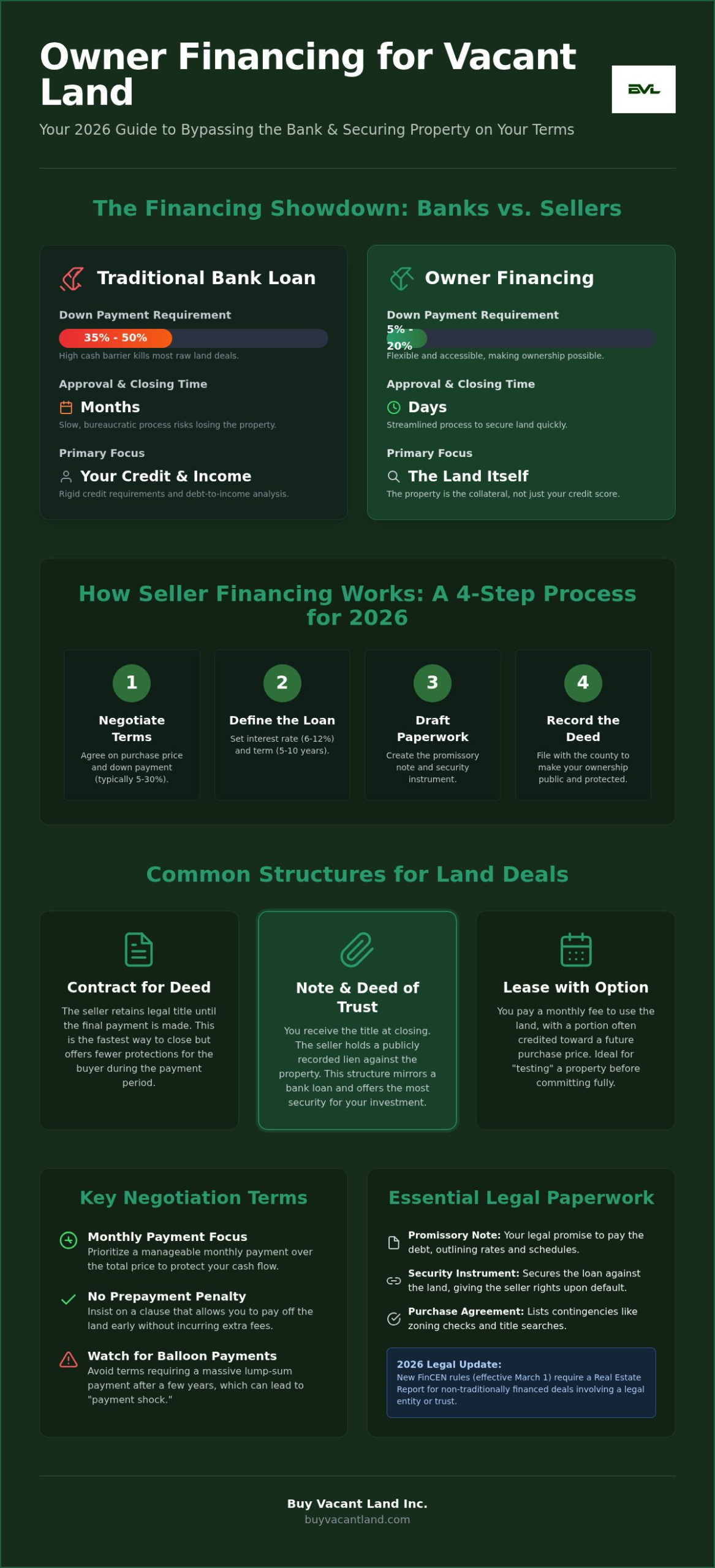
Banks are rigid. They typically demand 35% to 50% down for unimproved land and require a two-month approval process. Sellers are far more flexible. Many will accept down payments as low as 5% to 20% because they want to move the property quickly. While a bank focuses on your debt-to-income ratio and credit history, a seller focuses on the security of the land itself. If you default, the seller simply keeps the land and the payments made. This shift in perspective allows for closing times measured in days rather than months, providing a level of efficiency that traditional mortgages cannot match.
Common Structures for Land Deals
Most land transactions follow one of three primary paths. Choosing the right one depends on your need for legal protection and title control.
- Contract for Deed: The seller retains the legal title until you make the final payment. It’s the fastest way to close but offers fewer protections for the buyer if a dispute arises.
- Note and Deed of Trust: You receive the title to the land at closing. The seller holds a lien against the property, which is recorded publicly. This mirrors a traditional bank loan and provides the most security for your investment.
- Lease with Option to Purchase: You pay a monthly fee for the right to use the land, with a portion often going toward a future purchase price. It acts as a test drive for off-grid land or hunting parcels.
Each structure impacts the owner financing land pros and cons differently. Whether you’re looking for a quick handshake deal or a formal recorded lien, these options provide the flexibility needed to bypass bank-driven delays and secure your land today.
How the Seller Financing Process Works in 2026
The process moves fast because you bypass institutional gatekeepers. In 2026, a standard transaction follows a clear, four-step sequence. First, you negotiate the purchase price and down payment. While banks demand 35% or more, sellers often accept between 5% and 30% down. Second, you define the interest rate and amortization. Most land deals in 2026 carry rates between 6% and 12% with a 5 to 10-year term. Third, you draft the promissory note and security instrument. Finally, you record the deed at the county level to ensure your ownership is public and protected. This efficiency is a core part of the Owner Financing Pros and Cons debate; you trade higher interest for immediate access.
Speed is the primary advantage here. You don’t wait for weeks for an underwriter to review your tax returns. Instead, you focus on the equity in the land and your ability to meet the monthly obligation. This pragmatic approach is why many buyers are shifting toward these deals to avoid the rigid lending standards of 2026. Weighing the owner financing land pros and cons requires looking at both the immediate ease of entry and the long-term cost of the debt.
Negotiating Your Financing Terms
Prioritize your monthly payment over the total purchase price. A lower price is useless if the monthly debt service strangles your cash flow. Watch out for balloon payments. These require a massive lump sum payment after a few years. They can cause “payment shock” if you aren’t prepared to refinance or sell. Always insist on a no-penalty prepayment clause. This allows you to pay off the land early without extra fees if your financial situation improves. If you’re looking for flexible terms, you can browse owner financed land listings to see what sellers are currently offering.
The Legal Paperwork You Need
You need three primary documents to close safely. The Promissory Note is your legal promise to pay the debt. It outlines the interest rate, late fees, and payment schedule. The Security Instrument is the document that secures the loan against the land. It gives the seller the right to reclaim the property if you default. Finally, the Purchase Agreement lists your contingencies. Never skip zoning checks or soil tests. In 2026, remember that new FinCEN rules effective March 1 require a Real Estate Report for non-traditionally financed purchases if the buyer is a legal entity or trust. This ensures transparency and legal compliance for every party involved. Keeping these documents precise reduces the friction of the transaction and gets you on your land sooner.
Owner Financing Land Pros and Cons for Buyers and Sellers
Every financial decision involves a tradeoff between speed and cost. Evaluating the owner financing land pros and cons requires looking at both sides of the contract to ensure an equitable financial proposal. In 2026, buyers use this method to bypass the 35% to 50% down payments banks demand for raw land. Sellers use it to turn static property into a monthly revenue stream. It is a pragmatic exchange that solves the liquidity crisis currently facing the vacant land market. Before signing any documents, it is helpful to review the foundational definition of What is Owner Financing? to ground your expectations in the current market reality.
Banks prioritize institutional stability, while sellers prioritize property movement. This fundamental difference defines the entire transaction. While a bank might take 60 days to approve a loan for a residential lot, a seller can close in 72 hours. This efficiency alleviates the stress of asset ownership by providing a clear, multi-step path to completion without the middleman. However, both parties must understand the risks associated with bypassing traditional oversight.
The Buyer’s Perspective: Speed vs. Cost
Buyers gain immediate access to property without the “junk fees” of a mortgage originator. There are no loan application fees, no points, and often no credit checks. This is a massive advantage when securing cheap, off-grid parcels or hunting land that banks refuse to finance. The primary con is the interest rate. In 2026, seller-financed rates typically sit between 6% and 12%, which is higher than a standard 30-year home mortgage. You also don’t own the land “free and clear” until the final payment is recorded. If you want a bank-free path to ownership, researching owner financed land is your best first step toward a deal.
The Seller’s Perspective: Liquidity vs. Passive Income
Sellers benefit by opening their listing to a much larger pool of potential buyers. Most people can afford a $500 monthly payment but cannot afford $50,000 in cash. This increased demand often allows the seller to achieve a higher sale price. However, the risk is real. If a buyer defaults, the seller must navigate the legal cost of foreclosure or forfeiture to reclaim the title. There are also specific tax implications to consider. The IRS treats interest as ordinary income, while the principal may be taxed as capital gains. If you need to sell land quickly, offering financing is the most reliable way to create an attractive offer that generates long-term passive income.
Essential Due Diligence: How to Protect Your Investment
Speed doesn’t excuse sloppy research. While the 2026 market allows you to close deals in days, you must still follow the golden rule: never skip a title search. Even a “handshake” deal with a friendly neighbor requires professional verification. If you don’t verify the legal chain of ownership, you risk paying for property the seller doesn’t actually own or land that is buried under old tax liens. Understanding the owner financing land pros and cons means recognizing that you are responsible for your own protection without a bank’s legal department acting as a buffer.
Zoning and restrictions are equally critical. You must confirm the land can be used for your intended purpose before you send a down payment. If you plan to build an off-grid cabin but the county requires a minimum 2,000 square foot home with city sewer connections, that “cheap” lot becomes a financial burden. Always call the county planning department to verify the land use codes yourself. This pragmatic step ensures your investment aligns with your goals from day one.
Title Searches and Insurance
The “chain of title” is a history of every person who has owned the property. For off-grid land or residential lots, this history can be messy. You need to know if the seller still owes a bank for the property. Many traditional mortgages contain a “Due on Sale” clause. This allows the bank to demand the full balance immediately if the seller transfers the property to you without their permission. Title insurance is the ultimate safety net for land buyers. It protects your equity against future claims or undiscovered liens that could otherwise strip you of your ownership rights.
Physical Land Inspections
Don’t buy land sight unseen. You need to check for utility access, existing easements, and road maintenance agreements. An easement might give a utility company or a neighbor the right to drive straight through the middle of your future build site. A recent survey is mandatory to confirm boundaries; don’t rely on old fence lines or “roughly an acre” descriptions. For those planning to build, soil tests or “perc tests” determine if the ground can support a septic system. If the soil fails, you cannot legally build a residence. To avoid these pitfalls, you can find vetted land listings that provide clear property details upfront.
Finally, use a third-party servicing company to track your payments. These companies act as a neutral bookkeeper for both parties. They provide an annual interest statement for your taxes and ensure there is a clear record of every dollar paid toward the principal. This eliminates the “he-said, she-said” disputes that can occur in private financing and gives you peace of mind as you build equity in your land.
Find Owner Financed Land on a National Marketplace
Generic real estate websites waste your time. They focus on residential homes and rental properties, forcing you to sift through thousands of irrelevant listings to find a single acre of raw land. When you’re weighing the owner financing land pros and cons, you need a platform that prioritizes land-specific data. BuyVacantLand.com is a specialized national marketplace designed to connect buyers directly with sellers who offer bank-free deals. This focus eliminates the procedural hurdles of traditional real estate sites and gets you closer to your goal faster.
Efficiency is the core of our service. You can filter your search by property type, whether you need residential lots, off-grid land, or hunting land. This targeted approach ensures you only see properties that match your specific investment criteria. By connecting directly with the owner, you cut out the middleman and avoid the unnecessary service fees that plague conventional transactions. It’s a streamlined, transparent process built for the modern land buyer in 2026.
Using a Focused Land Marketplace
Skip the noise of the housing market. We don’t list homes or rentals; we only list vacant land. This specialization allows for a more reliable search experience. Our platform offers national reach across the United States, giving you access to undeveloped property from coast to coast. You deal with owners who already understand the owner financing land pros and cons and are ready to negotiate equitable financial proposals. This direct communication line is the most efficient way to secure a deal that fits your budget.
Your Next Steps to Land Ownership
Start by creating a shortlist of properties that meet your physical requirements and financial limits. Don’t just look at the total price; run the numbers on the monthly payments to ensure they align with your cash flow. Compare interest rates and down payment requirements across different listings to find the most competitive terms available. Once you identify a parcel that works, reach out to the seller immediately to begin the multi-step path to ownership. Browse our current owner-financed land listings today and take control of your property search.
Take Control of Your Land Investment Today
Bank-free ownership is no longer a last resort; it’s a strategic choice for efficiency. By mastering the owner financing land pros and cons, you position yourself to close deals in days rather than months. You avoid the 35% to 50% down payments and rigid credit checks that stall traditional transactions in 2026. This pragmatic approach provides the relief and peace of mind that come from a swift, assured transition into property ownership without the stress of institutional red tape.
The right deal is waiting for you on a platform that values your time. Our national marketplace focuses exclusively on raw land, connecting you directly with sellers who offer equitable financial proposals. You skip the home and rental clutter found on generic sites. You also eliminate unnecessary middleman fees and service charges. It’s time to secure your future on your own terms and build equity in an asset you control. Success in 2026 requires moving faster than the bureaucracy.
Start browsing owner-financed land listings nationwide to find your perfect parcel today. Your path to land ownership is simplified and ready for action.
Frequently Asked Questions
Is owner financing safe for land buyers?
Owner financing is safe if you treat it with the same legal scrutiny as a bank loan. You must perform a professional title search to ensure the seller has the legal right to sell. Recording the deed or security instrument at the county office protects your interest publicly. Using a third-party servicing company adds a layer of transparency to your payments. Always insist on a written contract to avoid the risks of a handshake deal.
What is a typical down payment for owner-financed land in 2026?
In 2026, most sellers accept down payments between 5% and 30% of the total purchase price. This is significantly lower than the 35% to 50% down payments typically required by traditional banks for raw land. Lower entry costs allow you to secure property without exhausting your cash reserves. Every deal is negotiable, but these percentages represent the standard range for residential lots and off-grid parcels across the national market.
Can I build on owner-financed land before it’s paid off?
You can typically build on the land before the final payment, but your contract must explicitly allow it. Some sellers include clauses that restrict major improvements or timber clearing until you reach a certain equity threshold. You must also ensure you have the legal right to pull permits while the seller still holds a lien or the title. Always verify these build rights during the negotiation phase to avoid legal stalls later.
What happens if I default on an owner-financed land contract?
If you default, the seller can reclaim the property through foreclosure or a forfeiture process. In a contract for deed, the seller often keeps the land and all previous payments made toward the principal. If the deal uses a deed of trust, the seller must follow state-specific foreclosure laws to recover the asset. Understanding the owner financing land pros and cons means acknowledging this risk to your equity if payments stop unexpectedly.
Do I need a lawyer for seller-financed land deals?
You should always have a real estate attorney review your promissory note and security instrument. While the process is faster than a bank loan, a lawyer ensures your contract is legally sound and protects your interests. They verify that the document includes essential clauses, such as no-penalty prepayments and clear default terms. Spending a small amount on legal review now prevents expensive litigation or the loss of property in the future.
How do interest rates for owner financing compare to bank loans?
Interest rates for owner financing in 2026 generally range from 6% to 12%. These rates are typically 1% to 3% higher than traditional bank loans for land. You trade a higher interest rate for the convenience of lower down payments and the lack of strict credit requirements. For many buyers, the speed of closing and the ability to bypass bank bureaucracy justify the additional cost over the life of the loan.
Can I pay off my land contract early?
You can pay off your land contract early if your agreement includes a no prepayment penalty clause. Most pragmatic sellers allow early payoffs because it gives them their full principal faster. Always verify this specific term before signing the promissory note. Paying the balance ahead of schedule saves you thousands in interest and gives you clear, unencumbered ownership of your property years sooner than the original amortization schedule.
Does owner financing show up on my credit report?
Most private sellers do not report your payments to credit bureaus like Experian or Equifax. This means your land loan won’t help or hurt your credit score unless the seller uses a specialized third-party servicing company that offers credit reporting. If you want to build credit through your land purchase, you must ask the seller to use a service that reports monthly payments. Otherwise, the transaction remains private between you and the seller.




Join The Discussion