

You didn’t just inherit a piece of dirt; you inherited a tax-free financial reset that most investors would pay a fortune to secure. Many people assume they’ll lose a huge chunk of their inheritance to the government, but the reality is often the opposite. It’s normal to feel overwhelmed by the paperwork or worry about IRS penalties when dealing with an unwanted asset. You want a clean break and a fair price without the stress of managing property you never asked for.
This guide shows you exactly how to handle taxes on selling inherited land in 2026. You’ll learn how the stepped-up basis wipes away years of capital gains and why the $15 million federal estate tax exemption means most sellers won’t owe a dime on the transfer. We’ll break down the specific capital gains brackets and state-level rules so you can sell your residential lot or off-grid parcel with total confidence. We’ll simplify the complex IRS codes into a clear path so you can turn that land into cash quickly and efficiently.
Key Takeaways
- Use the stepped-up basis to reset your property value to the current market rate and avoid paying taxes on decades of appreciation.
- Calculate your precise taxes on selling inherited land by subtracting the fair market value at the time of death from your eventual sale price.
- Benefit from the 2026 federal estate tax exemption of $15 million, which ensures most inherited land sales remain tax-free at the federal level.
- Identify strategic ways to defer or minimize liability, including 1031 exchanges or timing your sale during a lower-income year.
- List your property on a specialized marketplace to connect with high-intent buyers and turn your inherited asset into cash immediately.
Understanding Stepped-Up Basis on Inherited Land
Inheriting land usually comes with a mix of emotional weight and financial confusion. You need to know the numbers before you make a move. The most important concept you’ll encounter is the “stepped-up basis.” This stepped-up basis explained essentially means the IRS resets the property’s value. It moves from what the original owner paid to what the land is worth on the day they passed away. It’s a clean slate for your tax obligations.
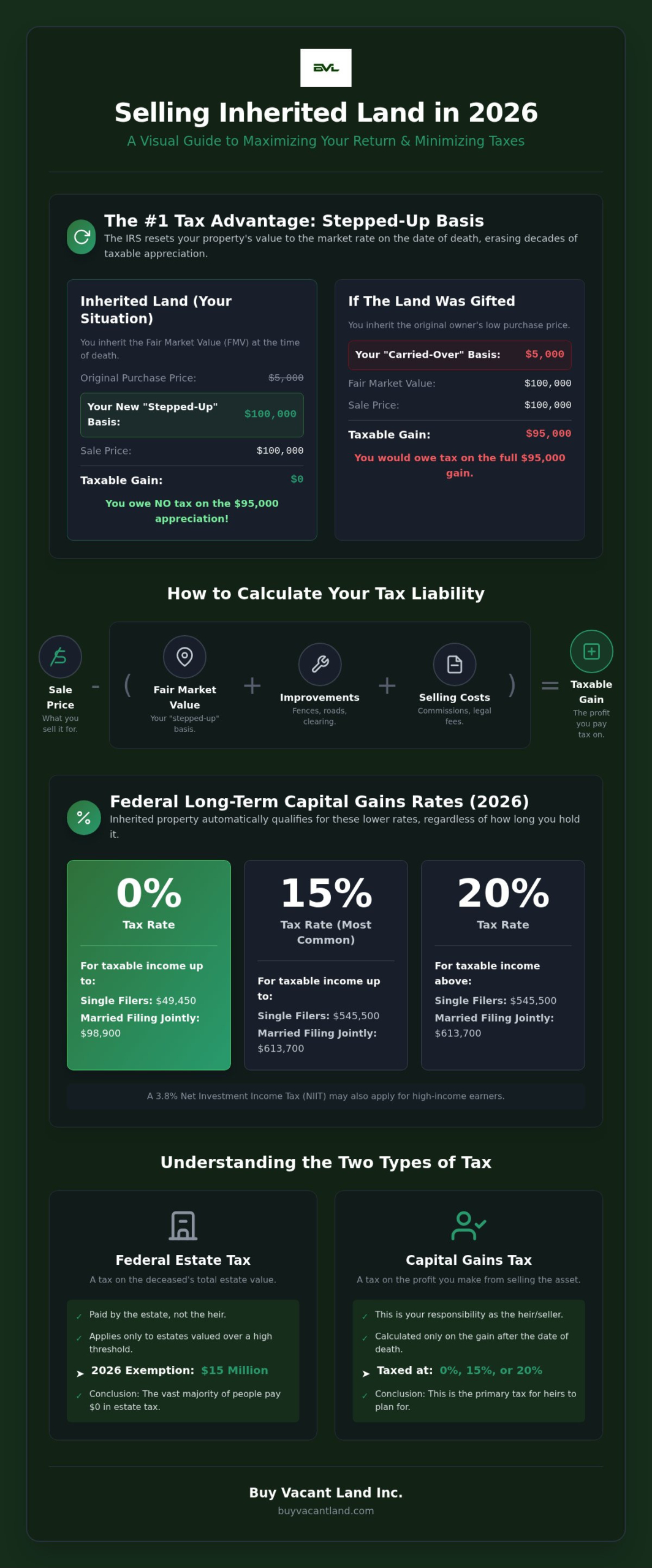
Think about the math. If your parents bought a residential lot for $5,000 decades ago and it’s now worth $100,000, you don’t owe taxes on that $95,000 gain. Your new “cost” is $100,000. This benefit applies to all types of undeveloped property, including farms, ranches, and off-grid acreage. It is the primary reason why taxes on selling inherited land are often much lower than people expect. You only pay for the appreciation that happens while the land is in your name.
How the IRS Views Inherited Property
The IRS treats the date of death as a hard line in the sand. This date determines the Fair Market Value (FMV) used for all future tax calculations. It’s a massive advantage over “gifted” property. If a relative gives you land while they’re still living, you inherit their original purchase price as your basis. If you wait to inherit the property through an estate, you get the market value reset. This single difference can save you a fortune in capital gains liability. The IRS automatically considers inherited assets as long-term holdings, which qualifies you for lower tax rates immediately.
Documenting the Value for Future Sale
Accuracy requires documentation. Hire a professional appraiser to value the land as of the date of death. They will analyze comparable sales in the area to justify the FMV. This isn’t just a suggestion; it’s your defense against an IRS audit. Keep these records organized and accessible. When you’re ready to move on, using a vacant land listing marketplace makes the selling process fast and efficient. Your appraisal proves your starting point. This ensures you only pay taxes on selling inherited land for the value added during your specific period of ownership.
Federal Capital Gains Taxes on Land Sales
Calculating your tax bill is straightforward. Subtract the stepped-up basis from your final sale price. If you inherited a farm valued at $200,000 and sell it for $210,000, you only owe tax on the $10,000 profit. This is why getting an accurate appraisal early is critical. It defines your starting point for taxes on selling inherited land and prevents overpayment to the IRS.
The IRS gives you an automatic win here. Inherited land is treated as a long-term asset. It doesn’t matter if you sell it two weeks after the funeral. You qualify for long-term capital gains rates immediately. This prevents the high tax hit of short-term rates, which can reach 37% for other types of assets. You get the benefit of the deceased owner’s holding period added to your own.
For 2026, the federal long-term capital gains rates are 0%, 15%, or 20%. The 0% rate applies to single filers earning up to $49,450 or married couples up to $98,900. Most sellers fall into the 15% bracket, which covers single filers up to $545,500 and married couples up to $613,700. If your income exceeds these limits, the 20% rate applies. High earners with a modified adjusted gross income over $200,000 for individuals or $250,000 for couples may also owe a 3.8% Net Investment Income Tax (NIIT).
Long-Term Capital Gains Benefits
You don’t need to wait a year to sell your property. The law assumes you’ve held the property long enough to qualify for the best rates. Lower rates mean more cash stays in your pocket after the sale. When you file your taxes, report the transaction on IRS Form 1040, Schedule D. This form tracks your capital gains and losses for the year. If you want to move quickly, you can list your land today and capitalize on these favorable 2026 rates.
Estate Tax vs. Inheritance Tax
Don’t confuse the tax on the sale with the tax on the estate. The federal estate tax only hits estates valued over $15 million in 2026. Most people won’t pay this. The estate tax is paid by the estate before you receive the land. Your responsibility is the capital gains tax on the profit you make after inheriting it. It’s a pragmatic distinction that removes most of the tax fear for average land sellers. You only focus on the growth in value that occurs under your watch. This clarity helps you manage taxes on selling inherited land without unnecessary stress.
How to Calculate Your Tax Liability
Determining your tax bill doesn’t have to be a guessing game. You follow a strict mathematical formula to find the truth. First, identify the Fair Market Value (FMV) on the day the previous owner passed away. This figure serves as your baseline. It is the amount you “paid” for the property in the eyes of the IRS. Second, track every improvement made since that date. Brush clearing, fence installation, and road construction all count. These capital improvements increase your basis and shield your profits from the IRS.
Third, gather your transaction records. Commissions, marketing costs, and legal fees are all deductible. Fourth, perform the final calculation. Subtract your adjusted basis (FMV plus improvements plus selling costs) from the final sale price. The resulting number is your taxable gain. Following these steps ensures you don’t pay a penny more in taxes on selling inherited land than legally required.
Adjusting Your Basis with Selling Costs
Many sellers overlook the small expenses that add up at the closing table. You can deduct survey fees and title insurance from your total gain. These closing costs for land sales act as a direct buffer against tax liability. If you spend $3,000 on a boundary survey and $8,000 on marketplace commissions, that is $11,000 of profit the government can’t touch. Keep every invoice from your land surveyor and title company. This documentation is your proof if the IRS asks questions later. Pragmatic record-keeping leads to significant tax savings.
Real-World Calculation Example
Let’s look at a 10-acre parcel inherited in 2026. The professional appraisal sets the FMV at $150,000. You spend $5,000 on road work and $10,000 on commissions and closing fees. Your adjusted basis is $165,000. Capital gains are the difference between the sale price and the stepped-up basis.
If you sell the property for $165,000 shortly after inheriting it, your taxable gain is zero. You walk away with the full cash value. However, if you hold the land for five years and the market pushes the price to $200,000, you’ll owe capital gains tax on the $35,000 difference. Holding land for appreciation can increase your net worth, but it also increases your eventual taxes on selling inherited land. Decide whether the potential growth outweighs the immediate tax-free liquidity of a quick sale.
Strategies to Minimize Taxes When Selling
You have inherited a valuable asset, but you must protect your profit from unnecessary erosion. Strategic planning allows you to legally reduce or defer your tax bill. One effective method involves offsetting gains with capital losses. If you sold stocks or other real estate at a loss this year, those losses cancel out the profits from your land sale. This simple balancing act directly lowers your total taxes on selling inherited land.
Charitable donations offer another path for high-income earners. Donating a portion of the acreage to a qualified non-profit can provide a deduction that offsets the gain on the remaining portion. This move requires a specific appraisal, but the tax savings often justify the effort. You turn a potential tax liability into a community benefit while keeping more of your cash.
The Power of the 1031 Exchange
The 1031 exchange is the ultimate tool for land investors. It allows you to defer all capital gains taxes by reinvesting your sale proceeds into a “like-kind” property. You can swap raw hunting land for residential lots or commercial parcels. The rules are strict. You must identify a replacement property within 45 days of your sale and close within 180 days. This strategy is ideal if you want to grow your real estate portfolio without losing 15% or 20% of your capital to the IRS immediately. It keeps your money working for you.
Timing Your Sale for Maximum Efficiency
Your 2026 income level dictates your capital gains rate. If you expect a lower income year due to retirement or a career change, wait to close the sale until that window opens. A lower total income can drop your capital gains rate from 15% down to 0%. Conversely, selling immediately after inheritance is often the most pragmatic move. If you sell the land for its appraised fair market value shortly after the owner’s death, your taxable gain is zero. You bypass the tax headache entirely by liquidating before the land appreciates further. Consult a tax professional to align these moves with your specific 2026 financial goals. When you are ready to move forward, list your land for sale on a specialized marketplace to find buyers quickly.
Listing and Selling Your Inherited Land
Selling land is a business transaction. Treat it like one. You have already identified your stepped-up basis and calculated your potential tax liability. Now you must execute the sale quickly to avoid ongoing maintenance costs or property tax bills. Transitioning from a burdened owner to a successful seller requires a strategic shift in focus. You aren’t just selling dirt; you are selling a specific opportunity to a specific buyer. Speed and clarity are your best tools for a clean exit.
General real estate sites often fail land sellers. They prioritize homes and rental properties, leaving land listings buried at the bottom of search results. Choosing a specialized platform for undeveloped vacant land ensures your property is seen by people actually looking for raw acreage. This targeted visibility is the fastest way to turn your inheritance into liquid cash.
Marketing Different Land Categories
Precise marketing attracts high-intent buyers. If you inherited hunting land, highlight the wildlife density and water sources. For off-grid lots, emphasize the privacy and solar potential. Industrial parcels require data on road access and utility proximity. Use high-quality photos that show the terrain clearly. Provide GPS coordinates and boundary descriptions so buyers can inspect the property without your physical presence. Reaching a national audience of buyers increases competition. This allows you to secure a price that matches the fair market value you established for your taxes on selling inherited land.
Finalizing the Transaction with Ease
Set your price with confidence. Use the stepped-up basis as your anchor. If you list the land at or near the 2026 appraised value, you effectively eliminate your federal capital gains burden. This pragmatic pricing strategy attracts serious cash buyers who want a straightforward deal. Listing on BuyVacantLand.com simplifies the process further. You manage the transaction directly and avoid unnecessary middleman fees that drain your profit. This direct path mirrors the efficiency of the tax rules you’ve already mastered. It is the final step in a streamlined sequence that replaces the stress of ownership with the peace of mind of a fair financial proposal. Move forward today and capitalize on the value your family left behind.
Turn Your Inherited Asset Into Immediate Cash
Managing an unwanted inheritance doesn’t have to be a source of stress or confusion. You now understand how the stepped-up basis resets your property value and why taxes on selling inherited land are often minimal or non-existent in 2026. By documenting the fair market value early and accounting for every improvement, you protect your financial interests while fulfilling your duties to the estate. Selling quickly at the appraised value is often the most pragmatic way to secure a tax-free liquidation and avoid ongoing maintenance costs.
Don’t let raw acreage sit idle while property taxes and liability concerns accumulate. You can list your inherited land on our national marketplace today to connect directly with motivated buyers. We provide a specialized raw land marketplace and never allow listing fees for homes or rentals to clutter the experience. This direct connection ensures a swift transaction without unnecessary procedural hurdles. You have the tools to move from a burdened owner to a successful seller in just a few simple steps. Take control of your financial future and transform that land into an equitable cash proposal today.
Frequently Asked Questions
Do I pay taxes on land I inherited but haven’t sold yet?
No, the IRS does not tax the act of inheriting land at the federal level. You only face income tax obligations when you eventually sell the property and realize a gain. However, you are immediately responsible for local property taxes and any applicable maintenance costs. If the total estate exceeds $15 million in 2026, the estate itself may owe federal estate tax before the land transfers to your name.
How is the cost basis determined for inherited land sold years later?
Your cost basis starts with the fair market value on the day the previous owner died. This is known as the stepped-up basis. If you sell years later, you add the cost of capital improvements, such as new fencing or road access, to this initial value. Subtracting this adjusted basis from your final sale price determines your total taxes on selling inherited land. Keep all receipts to prove these additions.
Can I sell inherited land to a family member at a discount without tax issues?
You can sell to a relative at any price, but the IRS views the discount as a gift. If you sell land worth $100,000 for $50,000, you have made a $50,000 gift. You must report this on a gift tax return if it exceeds the 2026 annual exclusion limit. While this doesn’t usually result in immediate taxes for most people, it reduces your lifetime gift and estate tax exemption. Documentation is essential.
What happens if I sell the inherited land for less than the appraised value?
Selling below the appraised fair market value results in a capital loss. You can use this loss to offset other capital gains from stocks or real estate sales in the same tax year. If your losses exceed your gains, you can typically deduct up to $3,000 against your ordinary income. This provides a pragmatic way to lower your overall tax burden while liquidating an unwanted asset quickly and efficiently.
Is there a federal inheritance tax on vacant land in 2026?
There is no federal inheritance tax in the United States. The federal government imposes an estate tax, which is paid by the deceased person’s estate before assets reach the heirs. In 2026, this tax only applies to estates valued over $15 million. While the federal government stays out of your inheritance, five states currently levy their own inheritance taxes. Check local regulations in Kentucky, Maryland, Nebraska, New Jersey, or Pennsylvania.
Do I need to report the inheritance of land on my tax return if I don’t sell it?
No, you do not need to report the receipt of inherited land on your federal income tax return. The IRS does not consider an inheritance to be taxable income. You only report the property when you sell it or if it generates rental income. Until a sale occurs, your main financial obligations are property taxes and local assessments. Documentation of the fair market value at the time of inheritance remains essential for future reporting.
How do state taxes differ from federal taxes when selling inherited property?
State tax laws vary significantly and often have lower exemption thresholds than federal laws. While the federal estate tax exemption is $15 million, some states tax estates valued as low as $1 million. Twelve states and the District of Columbia impose their own estate taxes in 2026. Additionally, your state may tax capital gains at a different rate than the federal brackets. Always verify the specific rules in the state where the land is located.
Can I use the primary residence exclusion on inherited land?
No, raw land does not qualify for the Section 121 primary residence exclusion. This tax break requires you to have owned and lived in a physical home on the property for at least two of the five years before the sale. Since the IRS defines vacant land as an investment or personal asset rather than a dwelling, you cannot shield the profit. You must rely on the stepped-up basis to minimize your taxes on selling inherited land.




Join The Discussion