
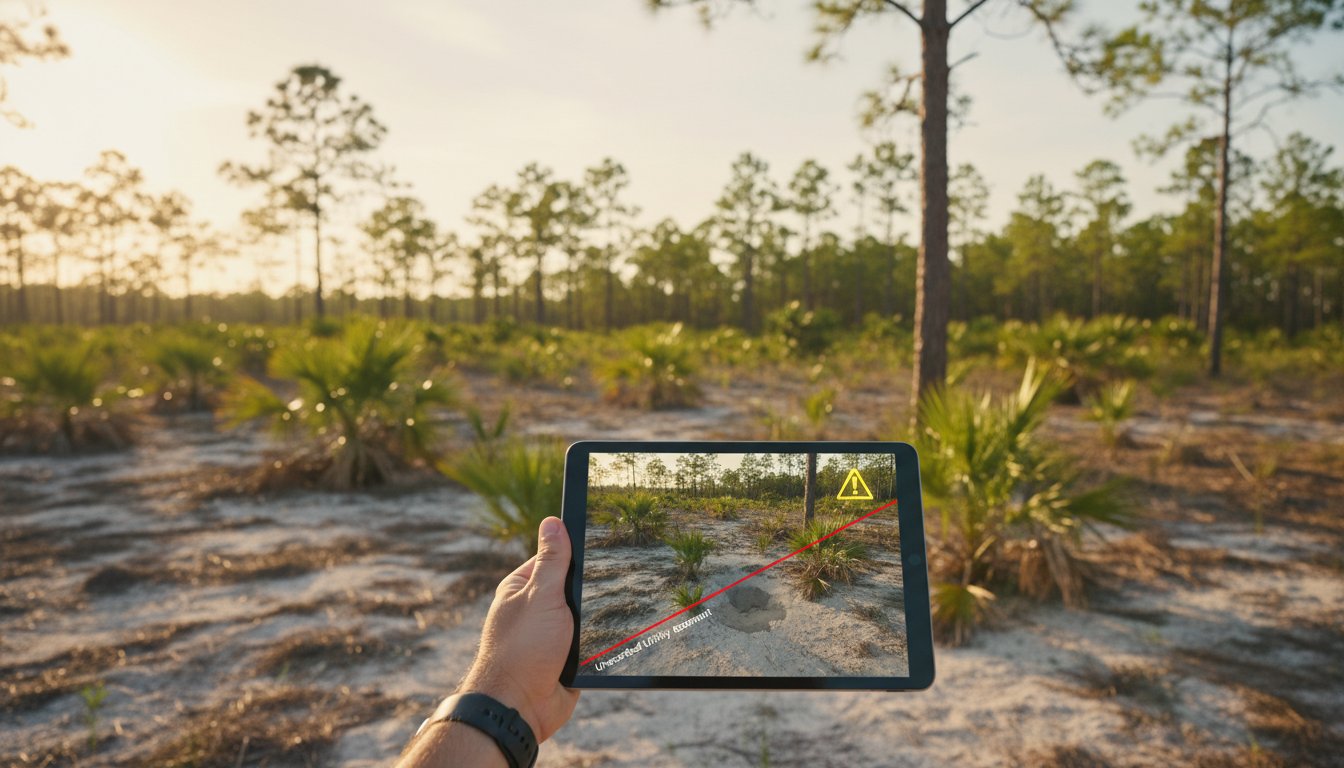
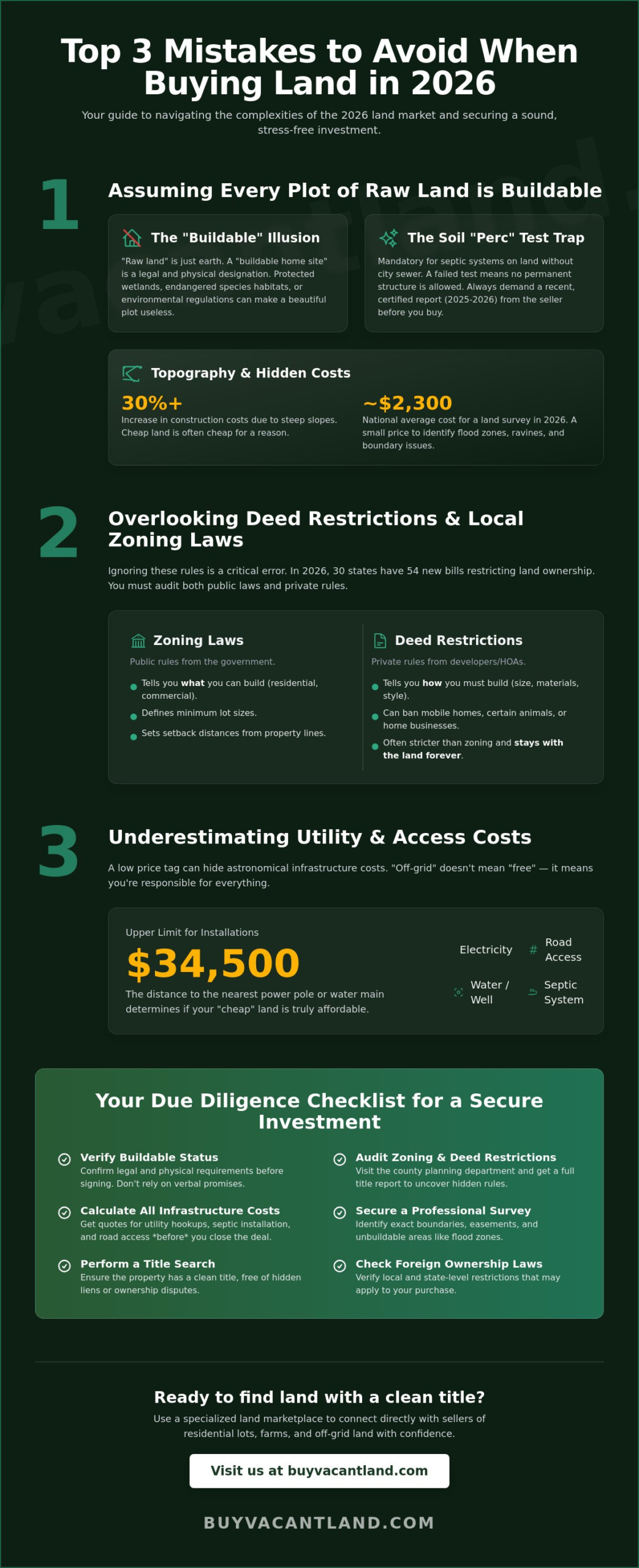
Your dream property becomes a financial nightmare the moment you realize it’s unbuildable. In the 2026 market, documentation is everything. If a right of way or utility easement isn’t recorded at the county office, it doesn’t exist. Many buyers fall into expensive traps because they overlook the critical mistakes to avoid when buying land. You likely feel overwhelmed by complex zoning laws or the new FinCEN reporting rules that started March 1, 2026. It’s normal to feel anxious about hidden costs like the $34,500 upper limit for utility installations.
We know you want a sound investment without the traditional real estate headaches. This guide shows you how to identify hidden land traps and secure a clean property title with total confidence. You’ll learn exactly how to navigate the 2026 landscape. We cover everything from managing $2,300 average survey costs to checking local foreign ownership restrictions. This article provides a clear due diligence checklist and a streamlined path to ownership. Get the facts you need to buy your vacant lot with zero stress.
Key Takeaways
- Verify that “raw land” meets all physical and legal construction requirements. Not every parcel is a buildable home site.
- Learn the top mistakes to avoid when buying land by auditing zoning laws and deed restrictions before signing a contract.
- Calculate utility and access costs upfront. Distance to the nearest power pole determines if your “cheap” land is actually affordable.
- Secure your investment with a professional survey and title search. These steps identify hidden liens and boundary disputes before you pay.
- Use a specialized land marketplace to find clean property titles. Connect directly with sellers of residential lots, farms, and off-grid land.
Mistake 1: Assuming Every Plot of Raw Land is Buildable
Don’t assume a beautiful view equals a building permit. Buildable land is a parcel that meets every legal and physical requirement for construction. It’s a binary reality. It either works or it doesn’t. Raw land is simply earth. It hasn’t been improved. A home site is a legal designation. You must verify the status of what is a land lot before you wire any funds. Protected wetlands or endangered species habitats can stop a project in its tracks. In 2026, environmental regulations are stricter than ever. One of the biggest mistakes to avoid when buying land is trusting a seller’s verbal promise that you can build.
Unrestricted land is a common marketing term. It sounds like freedom. In reality, it often means the county provides zero services. You might have no road maintenance or no utility access. It’s a pitfall for the unwary. You want a sound investment, not a permanent liability. Specialized marketplaces like BuyVacantLand.com help you filter through these details so you don’t buy a useless lot.
The Soil Percolation (Perc) Test Trap
A perc test is the measurement of water absorption rates in soil for septic suitability. If you’re looking at off-grid land or residential lots without city sewer, this test is mandatory. Buying without a successful test is a total gamble. You could end up with a very expensive campsite that can never hold a permanent structure. Soil quality varies by foot; a pass on a neighbor’s lot means nothing for yours. Understanding these mistakes to avoid when buying land will save you from the perc test trap. Ensure the seller provides a recent, certified report from 2025 or 2026 before proceeding.
Topography and Environmental Constraints
Cheap land is often cheap for a reason. Steep slopes increase construction costs by 30% or more. You’ll spend your budget on retaining walls instead of your home. Flood zones are another deal-breaker. Consult FEMA flood maps as a non-negotiable first step. Identifying unbuildable areas on a survey map saves you thousands. The national average cost of a land survey in 2026 is approximately $2,300. This is a small price to pay for the peace of mind that your land is actually usable. If 80% of your ten-acre lot is a ravine, you only bought two usable acres. Stick to the facts and get everything in writing.
Mistake 2: Overlooking Deed Restrictions and Local Zoning Laws
Zoning tells you what you can build. Deed restrictions tell you how you build it. You might have ten acres but zero room for a house. Local laws and private covenants determine your property’s true value. Ignoring these details is one of the top mistakes to avoid when buying land. As of May 2026, legal complexities are rising across the country. 30 states have now passed 54 bills restricting specific types of land ownership. You must check the county recorder’s office and local statutes for every parcel before you commit.
Restrictive covenants often include minimum square footage requirements. If you want a tiny home but the deed requires 2,000 square feet, your plan is dead. Mobile home bans are also common. Even if the land is rural, a previous owner might have banned manufactured housing decades ago. These rules stay with the land forever. They don’t disappear when the property changes hands. Always read the full title report to find these hidden traps. If you want a simpler path, browse our vacant land listings to find properties with clear details.
Setback requirements are silent killers of building plans. These rules dictate how far your structure must be from property lines, roads, or septic tanks. A small lot can become unbuildable if the setbacks overlap in the center. Don’t guess where the house goes. Calculate your buildable footprint based on current 2026 county codes. If the setbacks leave you with only a 10-foot wide strip, the land is effectively useless for a standard home.
Zoning vs. Deed Restrictions
Zoning is public law managed by the government. Deed restrictions are private rules created by developers or previous owners. If the county says you can build a barn but the HOA says no, the HOA usually wins. Private restrictions are often more aggressive than public laws. They control everything from exterior paint colors to where you park your boat. For a deeper dive into the buying process, read How Do You Buy Land? The Complete 2026 Beginner’s Guide.
Questions to Ask the Planning Department
Visit the local planning office in person. Don’t rely on old websites that haven’t been updated since 2024. Ask these specific questions to protect your investment:
- Is this property zoned for residential, agricultural, or mixed-use?
- What are the minimum lot size requirements for a building permit?
- Are there any planned road expansions or public works projects nearby?
- What are the exact setback requirements for the front, side, and rear?
Mistake 3: Underestimating the Cost of Utilities and Physical Access
Raw land is only as valuable as its connection to the world. Don’t let a low price tag blind you to infrastructure costs. Many buyers think off-grid living is a simple way to save money. In reality, it’s often more expensive than connecting to a city grid. Total utility installation costs in 2026 range from $9,000 to $34,500 on average. This is one of the most expensive mistakes to avoid when buying land. If you’re 500 feet from the nearest power pole, you face a massive bill before you even break ground.
Running electricity from a road to a house site costs between $5 and $25 per linear foot. If your project requires a new transformer, expect to pay between $3,000 and $7,000 extra. These numbers are the market reality for May 2026. You must map out every foot of wire and pipe before you commit your cash. High-quality off-grid land listings should already disclose these distances. If they don’t, you must do the legwork yourself. A sound investment requires knowing these numbers upfront.
The Reality of Utility Hookups
Utility extension costs can range from $15 to $50 per linear foot depending on terrain. This includes trenching, which currently costs between $400 and $1,200 per 100 linear feet. If you can’t connect to city water, a well and septic system will cost between $6,000 and $20,000. Municipal water connections are cheaper, ranging from $1,000 to $6,000. Always call the local utility companies before you sign a contract. Get a written estimate for your specific lot coordinates. Don’t rely on neighborhood averages because every parcel is unique.
Securing Permanent Legal Access
Physical access and legal access are not the same. You might see a dirt path leading to the property, but that doesn’t mean you have the legal right to drive on it. Landlocked parcels are a common trap. You can’t get a building permit or a mortgage without deeded access. A neighbor can legally block your path if you don’t have a recorded easement. This creates an immediate loss in property value and massive legal headaches.
Check the title for existing easements. An easement gives someone else the right to cross your property for utilities or travel. These rights are permanent. A private dirt track might wash out during a storm, leaving you stranded and responsible for repairs. A paved county road is a guaranteed asset that the government maintains. Verify your access at the county office to ensure your property stays reachable year-round. Knowing these mistakes to avoid when buying land keeps your project on track and under budget.
Mistake 4: Skipping Professional Surveys and Title Searches
A visual inspection is a guess. You can’t see a property line with your eyes. You need a licensed professional to find the pins and mark the corners. Skipping this step is one of the most dangerous mistakes to avoid when buying land. In April 2026, the national average cost of a land survey reached $2,300. While a basic residential boundary survey for a one-acre plot averages $500 to $1,000, larger parcels like 50 acres can cost $25,000. Pay the fee now or pay a lawyer later. Documentation is the only thing that holds up in court.
Title searches are mandatory for any serious buyer. They identify liens, back taxes, and ownership disputes that don’t appear on a map. Clouded titles are frequent with family-owned or inherited land. One missing signature from a distant heir can freeze your construction project for years. Verify that all property taxes are paid in full before you close the deal. Check for mechanic’s liens or unpaid utility assessments from 2025. You want a clean start with your new investment.
Boundary Disputes and Encroachments
Neighbor’s fences or sheds often cross legal lines. This becomes your legal problem the moment you sign the deed. A licensed surveyor uses GPS and LiDAR technology to mark your land with total precision. Don’t trust old fences or “what the neighbor said.” Acreage discrepancies are common in older rural deeds. A deed might claim ten acres, but a modern survey shows only nine. This “missing” acre changes your price per acre instantly. Protect your equity by knowing exactly what you own.
Financial Due Diligence
Understand the difference between deeds. A General Warranty Deed offers the highest level of protection. It guarantees the seller has the right to sell and the title is clear. A Quitclaim Deed offers the least protection. It only transfers whatever interest the seller has, which might be nothing at all. If you are looking at Owner Financed Land: The Complete 2026 Guide, be extra careful. Some sellers use owner financing to offload land with existing title issues or unpaid taxes. Always insist on a professional title search even in private, bank-free transactions. Don’t let a “handshake deal” ruin your financial future. Secure your investment by seeing a clean title on paper first.
Check out our owner financed land listings to find properties with verified details and clear titles.
Mistake 5: Failing to Use a Specialized Land Marketplace
Traditional real estate websites are built for houses. They focus on bedrooms, kitchens, and school districts. Land is an afterthought on those platforms. Using a generic site is one of the primary mistakes to avoid when buying land. You need specific data like soil types, elevation, and legal access. A house-hunting app won’t tell you if a lot is in a FEMA flood zone or if it has a recorded easement. You waste hours filtering through residential homes just to find one piece of dirt.
Specialized marketplaces like BuyVacantLand.com connect you directly with land sellers. This removes the friction of the traditional real estate machine. You save money by avoiding high-percentage realtor commissions that often inflate land prices. In May 2026, the market rewards buyers who move fast and work directly with the source. If you want to find the best deals, check out our Cheap Land for Sale: The Ultimate 2026 Guide. It breaks down how to find affordable lots across the country without the usual stress.
The Benefit of Direct Seller Listings
Direct communication is a massive advantage. You get faster negotiations and clearer answers. When you speak to the seller, you cut out the middleman who might not even know where the property pins are located. This direct path allows you to access “off-market” feeling deals. These properties often aren’t listed on the standard MLS, meaning less competition for you. You can also find owner-financed opportunities directly from the source. This is vital in 2026 as bank lending for raw land remains strict. Direct deals offer zero hidden fees and a simplified path to closing.
Streamlining the Discovery Process
Specialized filters save you days of research. You can search specifically for residential lots, off-grid land, or hunting property. BuyVacantLand.com provides a focused environment designed for the land buyer’s journey. We understand that buying a farm or a ranch is different than buying a suburban lot. Our platform highlights the technical details that matter, from terrain features to utility proximity. This transparency builds confidence that your investment is sound. Don’t settle for a generic search engine when you can use a tool built for land. Browse our national land listings and find your perfect lot today!
Secure Your Land Investment with Confidence
Documentation is the shield that protects your bank account. You’ve learned how to spot unbuildable lots and why zoning laws can override your vision. You’ve also seen the real cost of utility access and the mandatory nature of professional surveys. These are the critical mistakes to avoid when buying land that most people ignore until it’s too late. The 2026 market doesn’t forgive sloppy due diligence. You must verify every claim with the county recorder before you send a wire transfer.
BuyVacantLand.com is your shortcut to a clean, fast transaction. We offer a specialized US-wide marketplace that connects owners and buyers directly. You get total transparency with zero commissions and zero hidden fees. Our platform eliminates the traditional real estate red tape that causes unnecessary stress. It’s the most efficient way to secure residential lots, farms, or off-grid land in a disciplined market.
Get your fair cash offer or browse our latest listings today!
Your perfect property is within reach. Start your journey today with the peace of mind that comes from a guaranteed, simple process.
Frequently Asked Questions
What is the most common mistake when buying land?
Assuming a property is buildable just because it is for sale is the top error. One of the biggest mistakes to avoid when buying land is skipping the zoning and environmental check. Buyers often confuse “raw land” with a “home site.” You must verify local 2026 ordinances before you spend a dime. If the soil or the county says no, your investment is a total loss.
Can I build on land that hasn’t been surveyed?
You cannot safely build without a professional survey. Identifying property corners ensures your structure isn’t on a neighbor’s lot. Encroachments lead to expensive lawsuits and demolition orders. A 2026 boundary survey provides the legal map for your building permit. Don’t rely on old fences or tree lines. A licensed surveyor provides the only data the county will accept for construction.
How do I know if land has legal access?
Verify legal access by reviewing the property deed and title report at the county recorder’s office. Physical paths on the ground don’t guarantee the legal right to use them. Look for a recorded easement or direct frontage on a public road. A landlocked parcel has zero value if you can’t reach it legally. Check these records before closing to ensure you aren’t trapped by a neighbor’s gate.
What does it mean if a title is “clouded”?
A clouded title means there are unresolved legal claims on the property. This includes unpaid mechanic’s liens, tax debts, or missing signatures from heirs. You cannot get title insurance or a mortgage with a cloud. It prevents a clean transfer of ownership. Clearing a cloud often requires a “quiet title” action in court, which can take six months or longer to resolve in 2026.
Is buying land with cash safer than financing?
Cash transactions are faster and often lead to better deals. Banks are notoriously strict about vacant land loans in 2026, often requiring 50% down payments. Cash eliminates interest costs and bank-mandated appraisals. However, you must still conduct rigorous due diligence. Whether you pay cash or finance, skipping a title search is one of the worst mistakes to avoid when buying land.
What happens if I buy land and it fails a perc test?
A failed perc test means the soil won’t support a standard septic system. You might have to install an aerobic treatment unit or a mound system. These alternative systems can cost double the price of a traditional setup. In some cases, the county won’t allow any system at all. This makes the land unbuildable for residential use. Always make your purchase contract contingent on a successful test.
Do I need a lawyer to buy vacant land in the US?
You aren’t legally required to have a lawyer in every state, but it’s highly recommended for complex transactions. States like New York and South Carolina require an attorney for real estate closings. A lawyer reviews the contract and ensures the title transfer is valid. If you’re dealing with clouded titles or disputed easements, professional legal help is a mandatory expense. It protects your cash from bad contracts.
Are there hidden fees when buying land from a direct seller?
Direct sellers typically offer a more transparent process with fewer fees. You avoid the 6% realtor commission that usually inflates land prices. However, you must still cover standard closing costs like title insurance and recording fees. At BuyVacantLand.com, we emphasize a simplified path with zero hidden surprises. Always ask for a line-item breakdown of the final price before you sign the closing papers.



Join The Discussion