

Most landowners lose thousands of dollars simply because they fear the IRS more than they value their own profit. You want to sell your property, but the tax implications of selling land feel like a complex trap. It’s normal to feel stressed by the thought of hidden fees or confusing cost basis calculations. You worked hard for your land. You deserve to keep the equity you built.
We provide the direct facts you need to move forward with confidence. This guide delivers a clear breakdown of the 2026 federal capital gains rates, which range from 0% to 20% depending on your taxable income. You’ll learn how to use your original purchase price and improvements to lower your taxable gain. We also explain how to use capital losses to offset your bill by up to $3,000 this year. Any remaining loss can even be carried forward to future years.
Stop letting paperwork and tax anxiety stall your plans. We’ll show you how to estimate your liability and execute a fast, simple exit strategy. Get the numbers. Lower your bill. Get your cash.
Key Takeaways
- Distinguish between short-term and long-term capital gains to ensure you qualify for the lowest possible federal tax rates.
- Learn how to calculate your true cost basis to reduce the tax implications of selling land and maximize your final payout.
- Explore legal deferral strategies like 1031 exchanges that allow you to reinvest your proceeds without an immediate tax hit.
- Understand the specific IRS reporting requirements, including Form 1099-S, to avoid penalties and ensure a clean exit.
- Discover how a fast cash sale eliminates the ongoing burden of property taxes and maintenance fees immediately.
The Tax Reality: What Happens When You Sell Vacant Land?
Selling your land triggers a specific set of tax rules that differ from selling a house. The IRS treats your undeveloped acreage as a capital asset. This means every dollar you make over your original investment is subject to the Capital Gains Tax in the United States. Understanding the tax implications of selling land starts with your holding period. The government taxes you differently based on how long you held the deed. If you want to keep more of your proceeds, you must understand the math behind your sale before you sign the contract. You are liquidating an asset. The IRS wants its cut.
Short-Term vs. Long-Term Capital Gains
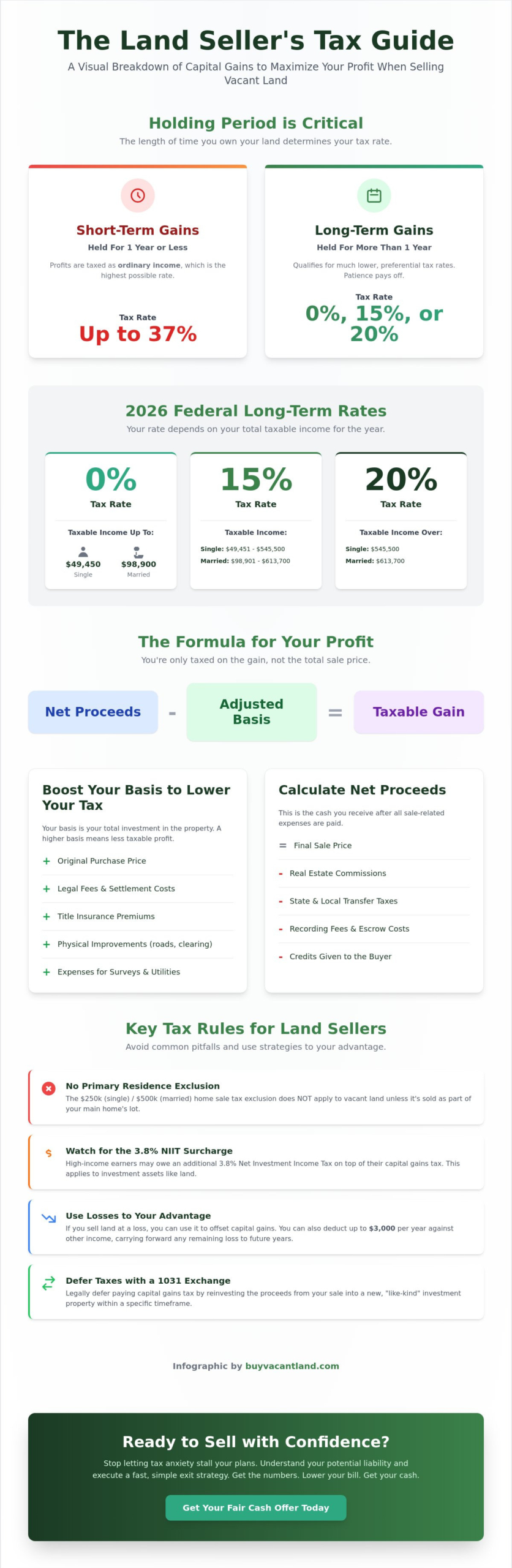
Short-term gains apply if you sell the land within 365 days of buying it. These gains are taxed as ordinary income. This rate can climb as high as 37% depending on your total annual earnings. It’s the most expensive way to exit a property. Long-term gains apply if you hold the land for more than one year. Your holding period officially begins on the day after you acquire the property. Patience pays off here. For 2026, long-term federal rates are 0%, 15%, or 20%.
- 0% Rate: Single filers earning up to $49,450 or married couples up to $98,900 pay nothing in federal capital gains.
- 15% Rate: Single filers earning $49,451 to $545,500 or married couples earning $98,901 to $613,700 fall into this middle tier.
- 20% Rate: High earners with income over $545,500 for individuals or $613,700 for married couples pay the maximum rate.
Why Vacant Land Taxes Differ from Residential Sales
Many owners assume they can use the primary residence exclusion. This is a costly mistake. Section 121 of the tax code allows individuals to exclude up to $250,000 in gains from a home sale, but this does not apply to vacant land. Unless your land is part of your primary home lot and sold at the same time, you’ll owe taxes on the profit. You cannot use the same tax breaks for an off-grid lot or a hunting ranch that you use for your family home.
You also need to watch for the Net Investment Income Tax (NIIT). This adds a 3.8% surcharge to your bill if your income exceeds certain thresholds. Residential sales often come with built-in safety nets that don’t exist for dirt. You are selling an investment asset. You need to calculate these costs now to avoid a surprise bill next April. The tax implications of selling land are manageable if you know the rules before you close the deal. Treat this as a business transaction to protect your equity.
Calculating Your Taxable Profit: Basis vs. Sales Proceeds
Calculating your taxable profit is a straightforward math problem. You don’t pay tax on the total sale price. You only pay on the profit realized from the transaction. To find this number, you must calculate two specific figures: your adjusted basis and your net sales proceeds. Getting these numbers right is the most effective way to manage the tax implications of selling land and keep more of your money.
Adjusting Your Cost Basis
Your cost basis starts with the original purchase price of the dirt. But it doesn’t end there. You can add several expenses to this number to lower your taxable gain. Think of your basis as your total “skin in the game.” The higher your basis, the lower your taxable profit will be.
Include these items in your calculation:
- Original purchase price of the property.
- Title insurance premiums paid when you bought the land.
- Legal fees and settlement costs from the original acquisition.
- Costs for physical improvements like land clearing or road construction.
- Expenses for surveying the property or installing utilities like water and power.
According to IRS Topic No. 409, these adjustments are vital for determining your capital gain or loss. If you spent $5,000 to bring power to the lot line, that money increases your basis. A higher basis means a smaller taxable profit. Keep every receipt for work done on the land. These records are your best defense against overpaying the IRS. They prove that your “investment” was higher than just the sticker price.
Calculating Net Proceeds from the Sale
Next, determine your net sales proceeds. This is not the price listed on your sales contract. It is the amount you actually receive after the sale expenses are paid. You can deduct several costs from the final sale price before you calculate your tax liability. This ensures you only pay for the actual profit you put in your pocket.
Typical deductions include:
- Real estate commissions or listing fees.
- State and local transfer taxes.
- Recording fees and escrow costs.
- Any credits you give to the buyer for closing costs.
The final formula is simple. Net Proceeds minus Adjusted Basis equals your Taxable Gain. If you sell a lot for $50,000 but your net proceeds are $45,000 and your adjusted basis is $30,000, your taxable gain is $15,000. You only owe the IRS for that $15,000 profit. Understanding these numbers gives you total control over your financial outcome. If you’re ready to see what your property is worth, you can list your land for sale and connect with buyers directly. Knowing your gain before you list helps you set the right price and plan for your next move.
Strategic Ways to Minimize Your Tax Liability
You don’t have to hand over your entire profit to the government. Smart planning lets you keep more cash in your pocket. The tax implications of selling land are manageable if you use the right legal strategies. You can defer, spread out, or even cancel your tax bill entirely. Your goal is to maximize your net proceeds and minimize what you owe. Use these strategies to protect your equity:
- Execute a 1031 exchange to reinvest in new land.
- Structure an installment sale to spread out payments over years.
- Harvest capital losses from other investments to offset gains.
- Donate the land to a 501(c)(3) for a charitable deduction.
The 1031 Exchange: Deferring the Bill
A 1031 exchange allows you to swap one investment property for another without paying immediate capital gains tax. The IRS considers all real estate “like-kind.” This means you can sell a hunting ranch and buy a residential lot or commercial parcel. You must follow two strict deadlines to qualify. You have 45 days from the date of your sale to identify a new property in writing. You then have 180 days from the sale date to close on that new property. Use our 2026 beginner’s guide on how to buy land to find your next exchange property. This strategy keeps your money working for you instead of sitting in a government account. It effectively pushes your tax bill into the future indefinitely.
Installment Sales and Tax Loss Harvesting
An installment sale is another pragmatic option. Instead of taking a lump sum of cash, you receive payments from the buyer over several years. This spreads your gain across multiple tax cycles. It is a powerful way to stay in a lower tax bracket. For example, if a large lump sum would push you into the 20% federal capital gains bracket, an installment sale might keep your income in the 15% or even 0% tier. You only pay tax on the portion of the profit you receive each year. It turns a large tax event into a series of smaller, manageable payments that fit your financial goals.
You should also look at your other investments. Tax loss harvesting involves selling underperforming assets to cancel out your land profits. If you have stocks or other real estate that lost value, sell them in the same year you sell your land. These capital losses offset your land gains dollar-for-dollar. If your total capital losses exceed your gains, you can deduct up to $3,000 against your ordinary income. Any remaining loss carries forward to future years. This is a reliable way to lower your overall tax liability. Always consult a CPA to verify your specific carryover limits for the current year. Finally, if you don’t need the cash, consider a charitable donation. Giving your land to a qualified 501(c)(3) organization can provide a tax deduction for the full fair market value. This eliminates the tax bill and supports a cause you value.
Federal Reporting and Compliance Requirements
Reporting your transaction is the final step in managing the tax implications of selling land. You cannot skip this part. The IRS receives data on your sale directly from the closing agent. Your job is to ensure your tax return matches the records they already have. Failure to report the sale correctly leads to audits, penalties, and unnecessary stress. You want a clean exit from your property. That requires precise documentation and timely filing.
The 1099-S Form: What to Expect
Form 1099-S is the primary document the IRS uses to track real estate profits. The title company, escrow agent, or settlement attorney is usually responsible for filing this form. It reports the gross proceeds of your sale. This number represents the total sale price before any commissions or closing costs are deducted. You’ll receive a copy of this form shortly after closing or during the following January. Review it immediately. If the reported gross proceeds don’t match your sales contract, you must request a correction from the agent. The IRS compares this specific number to what you report on your Form 1040. Any discrepancy will trigger an automated notice from the government.
State Tax Considerations
Federal taxes are only half of the story. You must also account for state-level obligations. Tax laws vary wildly depending on where your land is located. Some states like Texas, Florida, and Nevada have zero state-level capital gains tax. In these areas, you only worry about the federal bill. Other states like California or Oregon treat your profit as ordinary taxable income. This can add a significant percentage to your total tax burden.
You usually owe taxes to the state where the land sits. This is true even if you live in a different state. If you are a resident of a tax-free state but sell a parcel in a high-tax state, you’ll still have to file a non-resident return in that location. Plan for this expense now. Don’t let a state tax bill surprise you months after you’ve spent the proceeds. If you want to see what buyers are currently paying in your specific area, you can list your land for sale on our specialized marketplace to get a better sense of your potential net profit.
Finally, protect yourself from future audits. Keep every receipt and bank statement related to the improvements you made. Section 2 detailed how land clearing and utility installations increase your basis. If the IRS questions your math, these documents are your only defense. Store them in a safe place for at least seven years. A well-documented sale is a fast, permanent solution to your property ownership burdens. Get the paperwork right the first time and enjoy your liquid cash without looking over your shoulder.
Simplify Your Sale: Turning Land into Cash Quickly
Holding onto unwanted land is a choice to keep paying for something you don’t use. Every year you wait, you pay property taxes and liability insurance. These costs eat away at your eventual profit. The tax implications of selling land become more complex the longer you hold the asset. You want a clean break. You want liquid cash that you can put into better investments or use for your family’s needs. Converting your land into cash is the fastest way to stop the financial drain. Don’t let an unproductive asset dictate your financial future.
The Cost of Doing Nothing
Ownership isn’t free. Even if you don’t have a mortgage, you have recurring bills that never stop. Property taxes are a guaranteed expense. If the local government increases assessments, your “free” land gets more expensive every year. You also face the risk of market shifts. Waiting for a “better time” often means watching your equity vanish during a market downturn. You are essentially gambling with your net proceeds every month you wait to list.
Read our guide to selling land fast to stop the financial leak. Taking action now protects the value you’ve already built. It’s about efficiency and peace of mind. Every dollar you spend on taxes for land you don’t use is a dollar you could have invested elsewhere. Stop the cycle of recurring payments and turn that dirt into a liquid asset today.
The BuyVacantLand.com Advantage
Traditional real estate agents focus on houses and rental properties. They often don’t understand how to value residential lots, off-grid land, or hunting parcels. We built a specialized marketplace for owners who want a direct, pragmatic transaction. You don’t need a middleman taking a massive commission. You don’t need to wait months for a buyer to secure a bank loan that might fall through at the last minute. Our platform connects you with land-specific buyers who have cash ready to move. We specialize in everything from residential lots and farms to industrial land and off-grid parcels.
You deserve a simple process that values your time. We provide a streamlined path to turn your undeveloped land into a bank balance. Stop worrying about the tax implications of selling land and start focusing on your next move. Our system is designed for speed and reliability. You pay zero commissions and zero hidden fees when you list with us. This keeps your net proceeds high and your paperwork low. You can list your property in minutes and reach thousands of motivated buyers instantly. Take control of your financial future today. List your vacant land for sale today and get the cash you need without the stress.
Take Control of Your Proceeds and Move Forward
You now have the facts to handle the tax implications of selling land with confidence. Taxes are simply a math problem that you can solve with the right information. You know that 2026 long-term capital gains rates are manageable for most owners. You also know that your cost basis includes more than just the original sticker price. By tracking your improvements and closing costs, you’ve already found the most effective ways to lower your taxable profit.
Don’t let the fear of complex paperwork or IRS fees keep you stuck with an unproductive asset. You can stop the financial drain of annual property taxes and insurance today. Our specialized marketplace connects you directly to motivated buyers who specifically want raw acreage. We provide a streamlined platform with zero hidden listing fees to ensure you keep more of your equity. You don’t need a middleman to find a fair deal.
Get your land in front of cash buyers. List on BuyVacantLand.com now. Turn your dirt into liquid cash and enjoy the peace of mind that comes from a fast, simple transaction. It’s time to stop paying for land you don’t use and start focusing on your next investment.
Frequently Asked Questions
Do I have to pay taxes on land I inherited and then sold?
You usually pay very little tax on inherited land due to a “step-up in basis.” Your cost basis becomes the fair market value of the property on the date the previous owner died. If you sell it quickly for that same value, your taxable gain is zero. This is one of the most effective ways to manage the tax implications of selling land without losing your inheritance to the IRS.
How can I avoid capital gains tax on land without a 1031 exchange?
You can offset your gains by using tax loss harvesting. Sell other underperforming assets like stocks or bonds in the same year to cancel out the profit from your land sale. You can also donate the land to a qualified charity for a full market value deduction. These strategies provide immediate relief without the strict deadlines and complexity of a 1031 exchange or reinvestment requirement.
Is the tax rate different for selling commercial land vs. residential lots?
The federal tax rate is the same regardless of whether the land is zoned for commercial or residential use. Your bill depends entirely on your holding period and your total taxable income for the year. Long-term rates remain 0%, 15%, or 20% for both types of property. However, if the IRS classifies you as a “dealer” who flips land as a business, your profits are taxed as ordinary income.
Can I deduct property taxes I paid over the years from my sales profit?
You cannot deduct past property taxes from your final sales profit to reduce your capital gains. Property taxes are annual operating expenses that you should have deducted on your tax returns in the years you paid them. They do not increase your cost basis. Only capital improvements like installing a well or clearing timber can be added to your basis to lower your tax bill at closing.
What happens if I sell my land for a loss?
If you sell your land for less than your adjusted basis, you realize a capital loss. You can use this loss to offset other capital gains you had during the same year. If your losses exceed your gains, you can deduct up to $3,000 of the excess against your ordinary income. Any remaining loss carries forward to future years until it is fully used to offset future income.
What is the 3.8% Net Investment Income Tax and does it apply to me?
The NIIT is a surtax that applies to individuals with high investment income. You’ll likely owe this 3.8% tax if your modified adjusted gross income exceeds $200,000 for single filers or $250,000 for married couples filing jointly. It applies to the lesser of your net investment income or the amount your income exceeds these thresholds. This tax is an additional cost on top of your standard capital gains rate.
Do I need to pay taxes immediately after the closing?
You don’t usually pay the IRS the moment you sign the closing papers. You report the sale and pay the owed amount when you file your annual tax return the following April. However, if the gain is large, you might need to make an estimated tax payment to avoid underpayment penalties. Check with a tax professional to see if your specific tax implications of selling land require an immediate quarterly payment.
Are there special tax rules for selling land to a family member?
Selling land to a family member for less than its fair market value is considered a “gift” by the IRS. The difference between the sale price and the actual value counts toward your lifetime gift tax exclusion. The government monitors these transactions closely to prevent tax evasion. Ensure you have a professional appraisal to document the value and avoid potential audits or unexpected gift tax liabilities after the sale.




Join The Discussion