

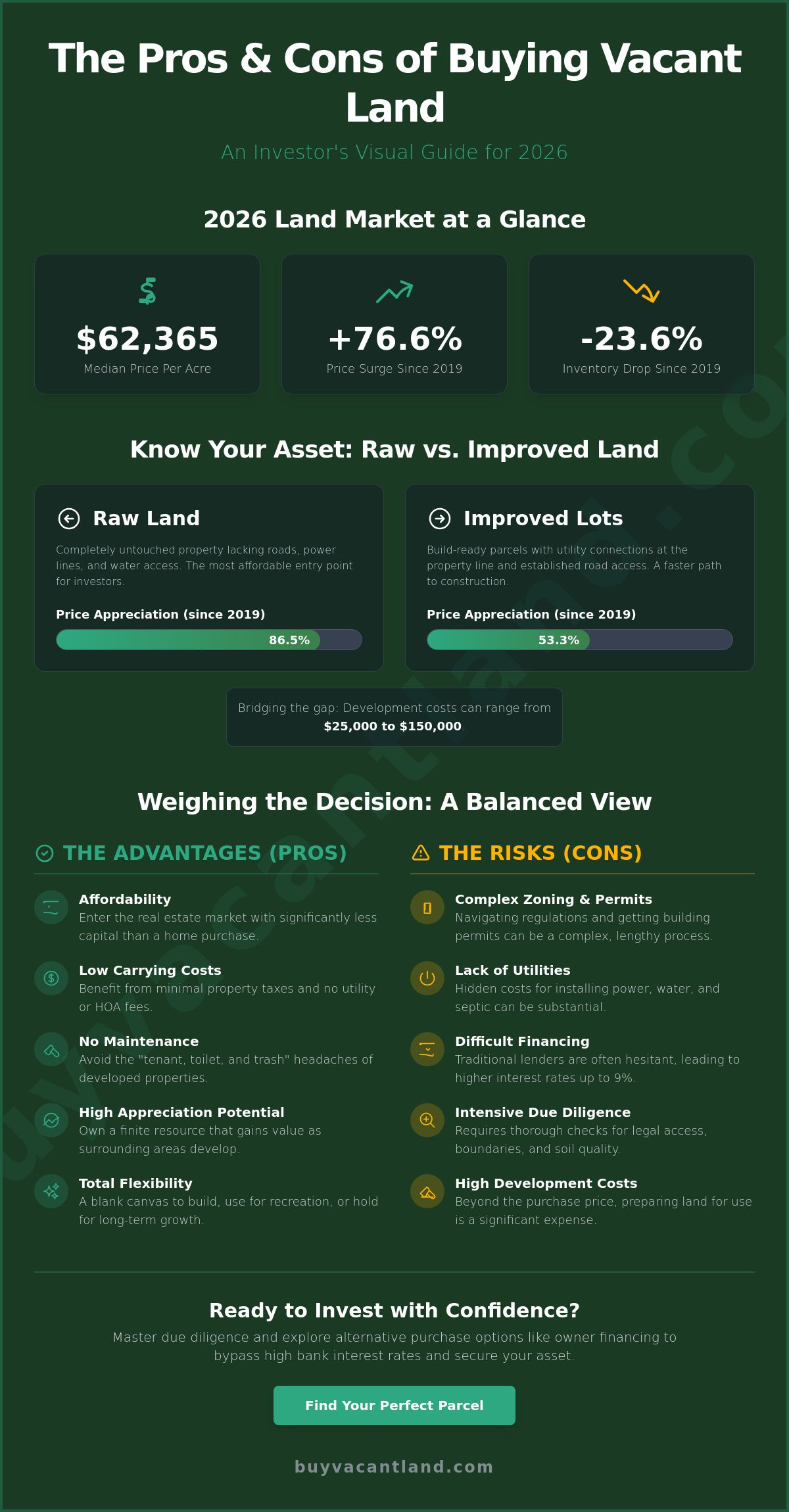
The median price per acre for vacant land in the U.S. surged 76.6% since 2019, reaching $62,365 in the first quarter of 2026. This rapid appreciation makes land a powerful asset, yet many investors stay on the sidelines. You likely recognize the potential of a blank canvas, but the fear of buying a “useless” lot with zoning traps or no utility access is a valid concern. Mastering the pros and cons of buying vacant land is the only way to turn that uncertainty into a calculated move. In a market where inventory has dropped by over 23%, you cannot afford to guess.
Securing land in 2026 involves higher hurdles, including interest rates for raw land that now reach up to 9%. This guide cuts through the confusion over permits and financing to give you a direct path to ownership. You will learn the essential advantages and hidden risks of land ownership to make a confident investment decision. We provide a clear list of pros and cons, a practical framework for evaluating any parcel, and a breakdown of current development costs. Stop worrying about hidden fees and start building your portfolio with speed and certainty.
Key Takeaways
- Distinguish between raw and improved land to calculate your immediate infrastructure budget.
- Evaluate the pros and cons of buying vacant land to weigh low maintenance costs against complex zoning hurdles.
- Use a verified due diligence checklist to confirm legal access and boundaries before signing any contract.
- Access bank-free purchase options like owner-financed land to secure your property faster and avoid high interest rates.
- Identify the hidden risks of utility installation to ensure your 2026 investment remains profitable.
What is Vacant Land? Defining Your 2026 Investment
Vacant land is a financial asset in its purest form. It is undeveloped property without existing buildings or active utility connections. In the 2026 real estate market, this asset class represents a unique opportunity for wealth building. Inventory levels have dropped by 23.6 percent since 2019, making every available acre more competitive. To understand what is a land lot in a professional context, you must look beyond the soil. You are buying the rights to future use, whether that is for a residential lot, a hunting tract, or a commercial site.
Analyzing the pros and cons of buying vacant land requires a clear definition of the asset. You aren’t just buying dirt; you are buying potential. The median price per acre for vacant land in the U.S. reached $62,365 in early 2026. This price reflects the diverse nature of land types, including farms, ranches, and industrial parcels. Each category carries different zoning rules and development paths. You must identify your specific goals before committing capital to a purchase.
Raw Land vs. Improved Lots
Raw land is completely untouched. It lacks roads, power lines, and water access. This is the most affordable entry point for investors. Raw land prices have surged by 86.5 percent since 2019, outpacing almost every other real estate category. The low entry cost is the primary draw, but the lack of infrastructure is a significant hurdle. You are responsible for every step of the development process.
Improved lots are build-ready parcels. These properties typically have utility connections at the property line and established road access. While more expensive, they offer a faster path to construction. Build-ready land prices increased by 53.3 percent over the same period. The price discrepancy between these two categories reflects the high cost of development, which can range from $25,000 to $150,000 depending on the site’s requirements.
Common Uses for Vacant Property
Most buyers choose vacant land for one of three reasons. First, custom home building allows you to create a residence tailored to your lifestyle. Second, recreational use is a major driver for sales of off-grid land and hunting tracts. These buyers want space for camping or outdoor sports without the restrictions of a suburban neighborhood. Finally, long-term investors buy and hold land to capture future appreciation. They wait for urban sprawl to increase the value of their acreage. If you want to bypass traditional bank hurdles for these purchases, consider owner financed land to secure your investment quickly.
The Strategic Advantages of Buying Vacant Land
Buying land is a pragmatic move for investors who value simplicity. It eliminates the immediate stress of structural maintenance. You own a tangible asset without the liability of a decaying building or high insurance premiums. When you weigh the pros and cons of buying vacant land, the low barrier to entry stands out as a primary benefit. It allows you to enter the real estate market with significantly less capital than a traditional home purchase requires.
The 2026 market favors those who secure assets now. Inventory for vacant land has dropped by 23.6 percent since 2019. This scarcity drives natural appreciation. You aren’t just buying dirt. You are securing a finite resource that others will need for future development. This creates a powerful position for the owner. You hold the leverage while the market expands around your property.
Affordability and Lower Carrying Costs
Land is the most accessible entry point into real estate today. You can find cheap land for sale that fits almost any budget. Unlike residential properties, land doesn’t require monthly utility payments or expensive homeowner association fees. Property taxes are also a major advantage. While the national average residential tax rate is approximately 0.99 percent, vacant land is often assessed at a much lower rate. This keeps your annual carrying costs at a minimum.
You also eliminate the “tenant, toilet, and trash” headaches. There are no leaking roofs to fix or delinquent renters to evict. Your investment sits quietly while you focus on other goals. This passive nature makes it an ideal choice for busy professionals. If you want to start building your portfolio without the operational burden, you can browse available land parcels to see how affordable ownership can be.
Investment Appreciation and Flexibility
The value of your land increases as local infrastructure develops. A new highway or a nearby shopping center can double your property value overnight. This blank canvas offers total flexibility. You can hold the land for long-term growth or pivot to development when the timing is right. Understanding due diligence for vacant land ensures you pick a lot with this high growth potential.
Land serves as a reliable hedge against inflation in 2026. National median land prices have already increased by 76.6 percent since early 2019. It is a hard asset that maintains value when currency fluctuates. You have the freedom to build a custom home, start a small farm, or simply wait for a developer to make an offer. This versatility is a core reason why the pros and cons of buying vacant land tilt toward the “pro” side for strategic investors.
The Cons: Navigating Challenges and Hidden Risks
Ownership of an asset that doesn’t produce immediate income requires a cold, hard look at the balance sheet. While the potential for growth is high, the risks are equally real. Understanding the pros and cons of buying vacant land means looking at the balance sheet with total honesty. Lenders often view raw land as a speculative gamble. This makes securing a traditional mortgage difficult. You should expect to provide a down payment between 20 percent and 50 percent to satisfy most banks. Interest rates for land loans in May 2026 reflect this risk, with 5-year fixed rates sitting around 8.50 percent.
Liquidity is another major factor to consider. Land often takes much longer to sell than a finished home. If you need to exit your investment quickly, you might find yourself stuck with a property that sits on the market for months. This asset class rewards patience, but it punishes those who lack a long-term capital strategy. You must have the financial runway to carry the property until the market reaches your target price.
The Infrastructure and Utility Hurdle
The sticker price of a lot is only your starting point. Bringing life to a property costs a significant amount of money. The national average cost to develop land in 2026 is approximately $35,000, but complex sites can reach $150,000 before you even pour a foundation. You must account for the reality of drilling a well, which often costs thousands depending on the depth of the water table. Installing a septic system requires a successful percolation test, and if the soil fails, your development plans could end immediately.
Extending power lines is another hidden expense. Utility companies often charge by the foot to run lines to your property. If your lot is deep in a rural area, these connection fees can exceed the original purchase price of the land. A “cheap” lot isn’t a bargain if it requires $100,000 in infrastructure just to make it habitable. Experienced investors often discuss the nuances of investing in vacant land to avoid these common traps.
Zoning, Easements, and Environmental Constraints
Zoning laws dictate exactly what you can do with your dirt. You might dream of a tiny home or a small farm, but local ordinances could prohibit both. Recent legislation, such as Washington’s HB 2418, has streamlined some permit processes, but local control remains the final word. You must also check for easements. An easement might grant a utility company or a neighbor the right to cross your property, which can limit where you are allowed to build.
Environmental risks can turn a prime lot into a “useless” one. Wetlands and flood zones carry strict federal protections that often prevent any construction. Soil quality also matters for more than just septic systems; it determines if the ground can support a heavy structure. Weighing the pros and cons of buying vacant land requires you to verify these constraints through professional inspections before you finalize your purchase.
Due Diligence Checklist: Evaluating a Potential Purchase
Systematic due diligence is your only defense against a “money pit” investment. You cannot rely on a seller’s description or a satellite image. You need a boots-on-the-ground verification process. This checklist ensures you don’t overlook the hidden risks that turn a cheap lot into a liability. Your goal is to move from uncertainty to a swift, assured transaction. Evaluating the pros and cons of buying vacant land requires this level of professional scrutiny before you wire any funds.
Confirming Legal and Physical Access
Start with legal access. It’s the foundation of property value. Legal access means you have a documented right to reach your land via a public road or a recorded easement. Physical access is a separate issue. You might have the legal right to enter, but the terrain might be impassable without a bulldozer. Landlocked parcels are a trap. They often require a court order to establish access, which is a slow and expensive process. Always verify road maintenance agreements if the property sits on a private drive. You don’t want to be solely responsible for grading a mile of gravel road after a storm.
Boundaries and title history are equally critical. Never close a deal without a professional land survey. Old markers move and fences are often placed incorrectly. A survey provides the certainty you need to build or fence your property without neighbor disputes. Simultaneously, check the title for liens or back taxes. You don’t want to inherit someone else’s financial debt. A clean title is the only way to ensure an equitable financial proposal. This step is vital when weighing the pros and cons of buying vacant land for long-term hold.
Environmental and Utility Testing
Environmental testing is mandatory for rural or off-grid land. The percolation (perc) test is your most important tool. It determines if the soil can absorb liquid from a septic system. If the land fails this test, you cannot build a residential structure in most jurisdictions. You should also consult the National Wetlands Inventory maps. Wetlands are federally protected. Building on them is often prohibited or requires mitigation permits that cost more than the land itself. Don’t buy “useless” land because you skipped a soil test.
Finally, check utility proximity. High-speed internet and power grid access are essential for 2026 resale value. If the nearest power pole is a half-mile away, your connection fees will be astronomical. If you plan on off-grid living, verify that local laws allow for solar or wind alternatives. Use this checklist to filter out high-risk properties quickly and move toward a confident purchase. When you’re ready to apply these standards to real listings, explore our marketplace for residential and off-grid land.
How to Safely Buy Vacant Land in Today’s Market
Efficiency defines the successful 2026 land investor. You don’t have time for the slow, bureaucratic hurdles of traditional residential real estate. Navigating the pros and cons of buying vacant land requires a modern approach that prioritizes speed and direct access. Traditional banks often reject land loans or demand massive down payments that tie up your liquidity. You can bypass these roadblocks entirely. Seek out owner financed land to secure your property without the rigid credit checks or high interest rates of a standard mortgage. This direct path keeps your capital available for development while moving your transaction forward with certainty.
Reviewing listings on a national scale allows you to find the best value outside of overpriced urban centers. You must look where the growth is headed rather than where it has already peaked. Use a direct approach to connect with sellers to eliminate the “middleman tax” and provide the peace of mind that comes from a swift, assured transaction. When you deal directly with a seller, you cut through the procedural noise that typically stalls real estate deals for weeks or months. This transparency is the hallmark of a professional 2026 investment strategy.
Leveraging Specialized Land Marketplaces
Generic real estate websites fail land buyers because they are designed to sell houses and apartments. They lack the filtering tools for acreage, soil types, and specific zoning. A dedicated lands of america listing platform provides the technical data you need to make an informed decision from your desk. You can filter for specific uses like hunting land, off-grid land, or residential lots. This targeted search saves hours of manual research and prevents you from touring properties that don’t meet your development criteria. Specialized marketplaces prioritize transparency and provide the high-impact descriptors required to evaluate a parcel’s true potential.
Simplifying the Transaction
You need to know how do you buy land without an expensive broker or unnecessary service fees. Direct-to-seller transactions are faster and more reliable than traditional paths. You deal with the person who knows the property’s history and boundaries. This creates a sense of momentum that pushes you toward the final deed without distraction. The path to ownership follows a strict logical progression:
- Identify your target land type on a specialized marketplace.
- Contact the seller directly to verify due diligence facts and access.
- Negotiate an equitable financial proposal that avoids common bank hurdles.
- Complete the paperwork and hold your deed with total certainty.
The pros and cons of buying vacant land are manageable when you use the right tools and skip outdated procedures. Speed and lack of cost are your primary advantages in the current market. Don’t wait for traditional lenders to catch up with the 2026 economy. Take a direct approach, use specialized platforms, and secure your investment today.
Take Control of Your Land Investment Strategy
Mastering the pros and cons of buying vacant land gives you a distinct advantage in a market where inventory is tightening. You now have the framework to evaluate any parcel with professional precision. Land value is defined by its potential. You must balance the benefit of low carrying costs against the reality of infrastructure expenses. Use your due diligence checklist to verify access and soil quality before you commit capital. This systematic approach ensures you avoid “useless” lots and secure high-growth assets with speed and certainty.
Your path to ownership should be simple and transparent. Our platform is exclusively focused on land parcels. We eliminate the noise of residential listings and the burden of hidden service fees for buyers. You get a direct connection to land owners and sellers for an equitable financial proposal. There’s no reason to wait for traditional banking hurdles to clear. Start your search now and build your portfolio with total confidence.
Browse thousands of vacant land listings on our national marketplace today!
Frequently Asked Questions
Is buying vacant land a good investment in 2026?
Buying land is a strong investment in 2026 due to limited supply and steady appreciation. National inventory has dropped 23.6 percent since 2019, which supports higher resale values. You should weigh the pros and cons of buying vacant land based on regional trends, such as the 5.9 percent price dip in the West. It remains a reliable hard asset for those seeking a long-term hedge against inflation.
Can I get a loan to buy raw land?
You can secure land loans, but lenders require higher down payments and charge higher interest rates. Expect to pay between 8.50 percent and 9.00 percent for fixed-rate terms as of May 2026. Most banks demand 20 percent to 50 percent down because they view raw land as a higher risk. Owner financing is often a faster alternative to bypass these strict institutional requirements.
What are the hidden costs of buying vacant land?
Development expenses are the most common hidden costs. The national average to develop a site is $35,000, but complex projects can reach $150,000. You must budget for percolation tests, well drilling, septic installation, and utility line extensions. These costs can quickly exceed the original purchase price of a cheap lot if you don’t perform thorough due diligence before the transaction.
Do I need a survey when buying land?
You absolutely need a professional survey before closing a deal. Relying on old markers or existing fences often leads to expensive legal boundary disputes. A survey confirms the exact acreage and identifies any encroaching structures from neighboring properties. It provides the legal certainty required to build or install fencing without future interference from local authorities or neighbors.
What is the difference between raw land and a vacant lot?
Raw land is completely untouched by infrastructure, while a vacant lot typically has road access and utility connections nearby. Raw land offers a lower entry price but requires a larger development budget. Understanding this distinction is a key part of evaluating the pros and cons of buying vacant land. Improved lots are build-ready and often command a significantly higher premium due to reduced risk.
How much are property taxes on vacant land?
Property taxes on vacant land are generally much lower than taxes on developed real estate. While the 2026 national average effective tax rate for residential property is 0.99 percent, empty parcels are assessed at a lower rate. You only pay for the value of the dirt, not the structures. This low carrying cost makes land an attractive option for passive investors who want to buy and hold.
Can I live in an RV on my vacant land?
RV living depends entirely on local zoning and county ordinances. Some rural areas allow temporary camping, but many jurisdictions prohibit permanent RV residency without a permitted septic system and power source. You must verify these rules with the local building department before you buy. Never assume you can live off-grid without checking the specific land use laws for your parcel first.
What does it mean if land is “unrestricted”?
Unrestricted land means the property has no private deed restrictions or Homeowners Association (HOA) rules. You have more freedom to use the land for mobile homes, farming, or off-grid living. You must still comply with state and county health and safety regulations. It is the most flexible type of ownership for buyers who want to avoid the procedural noise of restrictive covenants.




Join The Discussion