
Standard rental property math will fail you when evaluating a vacant lot. Most investors lose money on dirt because they use formulas designed for houses. If you are trying to learn how to calculate return on investment for land using a standard cap rate, you are already behind. You know that land is a finite asset with massive upside. However, the lack of monthly cash flow makes the math feel like guesswork. It is stressful to stare at a parcel and wonder if the holding costs will kill your profit.
Key Takeaways
- Learn why traditional real estate math fails for vacant land and how to adjust your formulas for zero rental income.
- Master how to calculate return on investment for land by accurately weighing carrying costs against your projected exit value.
- Identify the “silent killers” of land profit, including property taxes and liability insurance, to ensure your financial projections remain accurate.
- Discover how to multiply your returns through forced appreciation strategies like rezoning or installing essential utilities.
- Use specialized marketplace filters to find undervalued parcels that align with your specific profit goals and investment timeline.
Why Vacant Land ROI Differs from Traditional Real Estate
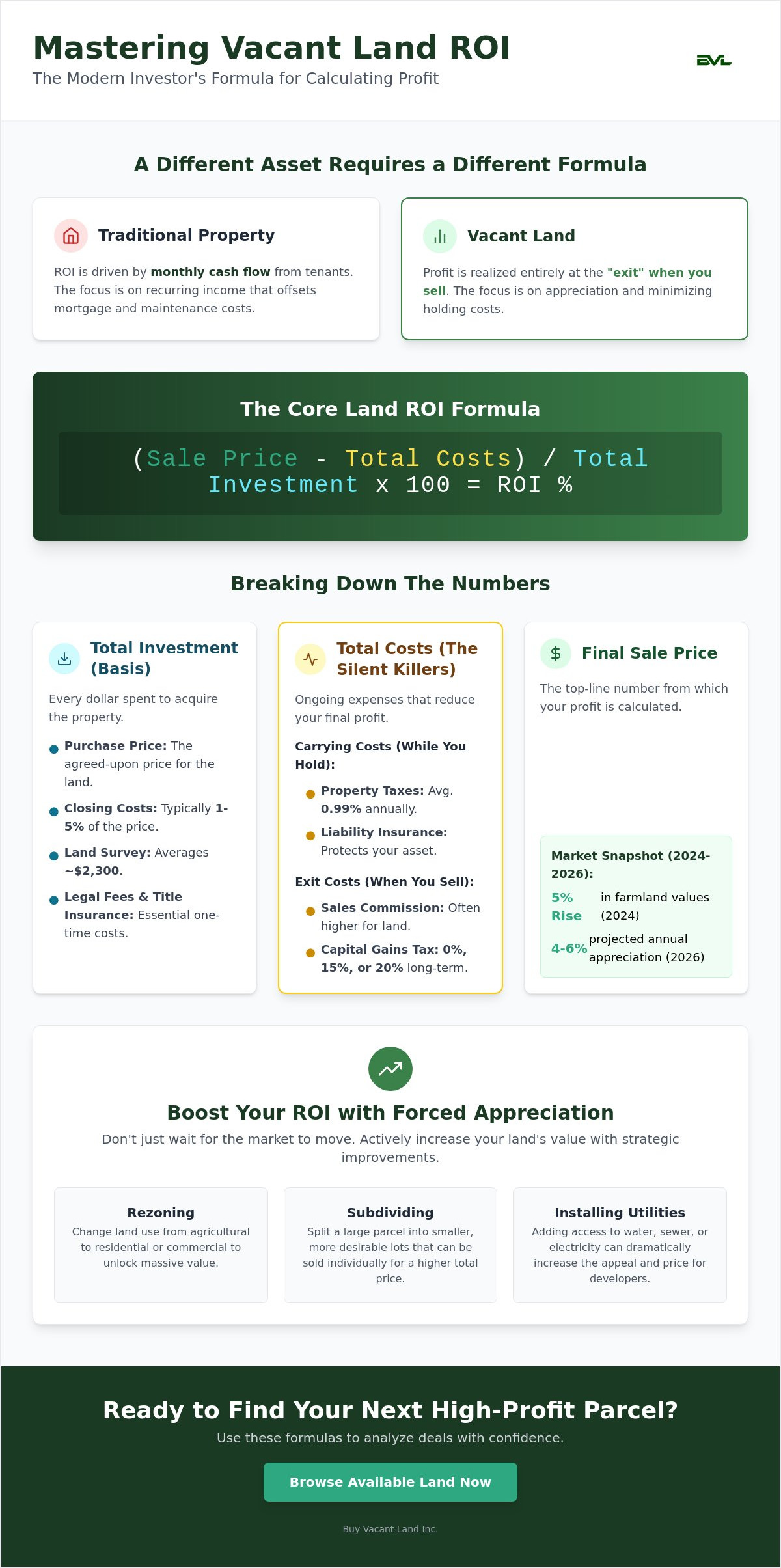
Traditional real estate investors obsess over monthly cash flow. If you buy a house, you want a tenant to pay the mortgage. If you buy vacant land, you are playing a different game. Land does not pay you dividends while you own it. Instead, your profit is realized entirely at the “exit” when you sell the parcel. Understanding how to calculate return on investment for land requires a shift in perspective. You must view the asset as a single transaction event rather than a recurring income stream. Every dollar you spend while holding the property is an investment that you must recover later.
In the simplest terms, Return on Investment (ROI) for land is the percentage of profit earned relative to your total investment cost. This cost is far more than just the purchase price. It includes closing fees, property taxes, and every dollar spent maintaining or improving the dirt. Because there is no rent to offset these expenses, your potential profit technically shrinks every day you own the land unless the market value appreciates faster than your carrying costs. You need a fast, reliable way to track these numbers to ensure your final check is as large as possible.
The Speculative vs. Practical Value of Dirt
Some investors buy land and wait for the market to move. This is speculative appreciation. Others buy for immediate utility, such as developing residential lots or industrial sites. Your ROI depends heavily on this strategy. For example, farmland values rose 5 percent in 2024. If you hold raw acreage, you are betting on the 4 to 6 percent annual appreciation projected for 2026. However, if you buy a parcel to rezone or subdivide, you are forcing value. Your time horizon is the critical variable here. A quick flip on a residential lot yields a much higher annual ROI than a ten year hold on remote hunting land.
The “No-Tenant” Advantage
The biggest benefit of vacant land is the total lack of physical structures. You will never deal with a leaking roof or a broken HVAC system. This eliminates the maintenance budget that usually eats into house-based ROI. Management is almost entirely passive. This simplicity creates a lower barrier to entry. You can acquire cheap land without the stress of property management or tenant disputes.
However, simplicity does not mean zero cost. You still face the burden of carrying costs. The 2026 national average effective property tax rate is approximately 0.99 percent. You must also account for liability insurance and potential survey costs, which average around $2,300. When you learn how to calculate return on investment for land, these numbers become the foundation of your math. You trade high maintenance for low, steady carrying costs. This makes land one of the most efficient ways to grow wealth without the headaches of traditional landlord duties.
The Core Formula for Calculating Land ROI
The formula for land profit is straightforward. You subtract your total costs from the final sale price. You then divide that number by your total investment and multiply by 100. This produces your ROI percentage. Mastering how to calculate return on investment for land starts with this core equation: [(Final Sale Price – Total Costs) / Total Investment] x 100. This number tells you exactly how much your capital grew. It is the only way to judge a deal objectively without emotional bias.
Your total investment includes every dollar spent from the moment you find the property until the day you sign the closing papers. This covers the purchase price, closing fees, improvements, and all carrying costs. The U.S. Department of Agriculture highlights the immense value of farm real estate, which makes up over 80 percent of farm sector assets. This proves that land is a heavy-hitting asset class that demands precise math. To compare land against stocks or bonds, you must also calculate your annualized ROI. This reveals your yearly growth rate. It prevents you from being blinded by a large total profit that took too long to achieve. Always use conservative exit price estimates. Markets fluctuate. A safety margin protects your bank account from unexpected downturns. If you are looking for deals with high profit potential, you can browse available land parcels to start your math.
Calculating Your Total Basis
Your basis is the foundation of your math. It includes the initial purchase price and all one-time acquisition fees. You must factor in legal fees, title insurance, and initial land surveys. In 2026, a standard land survey averages around $2,300. Closing costs typically range from 1 to 2 percent for cash deals or 2 to 5 percent if you use financing. Cost Basis is the total capital deployed before holding begins.
Determining Net Profit at Exit
Your final payout is never the full sale price. You must subtract the sales commission, which is often higher for land than for houses. You also need to account for capital gains taxes. For 2026, long-term rates are 0, 15, or 20 percent depending on your income level. Short-term gains are taxed at ordinary income rates. Factor in any seller-paid closing costs you agreed to cover. Subtracting these from the sale price gives you your true net profit. This is the only number that matters for your final ROI calculation.
Accounting for Carrying Costs: The Silent ROI Killer
Carrying costs are the silent killers of land profit. If you ignore them, your projected gains will vanish. Since raw land generates zero monthly income, every dollar spent on upkeep is a direct deduction from your bottom line. You must account for these expenses with total precision. Mastering how to calculate ROI requires a line-by-line breakdown of every recurring fee. This is the only way to ensure your equitable financial proposal remains profitable over the long term.
Property taxes are your most persistent burden. The national average effective property tax rate in 2026 is approximately 0.99 percent. However, this varies wildly by location. You might pay as little as 0.39 percent in Alabama or as much as 2.23 percent in New Jersey. You also need liability insurance. Even empty parcels carry risk. If someone gets injured on your property, you are liable. Factor in maintenance like brush clearing, fencing, and trash removal to keep the lot marketable. Finally, consider the opportunity cost. Your capital is tied up in a non-liquid asset. If you use financing, your interest rate likely sits between 4 and 10 percent in 2026. Your land must appreciate faster than your interest and tax rates combined just to break even. This is why knowing how to calculate return on investment for land is vital before you pull the trigger on a deal.
Taxes and Administrative Fees
Check current tax rates via county assessor records. Don’t guess. If you buy a residential lot in a planned community, look for mandatory HOA or POA fees. These can be hundreds of dollars per year. These fees often cover road maintenance or community amenities. They are non-negotiable. Conversely, look for agricultural land. Many states offer tax exemptions for active farming or timber use. These exemptions can slash your carrying costs and boost your final ROI significantly. It’s a simple way to preserve your profit margin without additional effort.
Physical Upkeep and Security
Local ordinances often require you to maintain your land. You might face fines for overgrown weeds or fire hazards. Budget for annual mowing or clearing. Security is another factor. Signs and fencing prevent illegal dumping and trespassing. These are small costs that prevent massive cleanup bills later. Dumping is a common issue for undeveloped parcels. Periodic surveying also protects your investment. A basic boundary survey prevents neighbors from encroaching on your dirt. Encroachment leads to expensive legal disputes that can stall a sale for months. Protect your boundaries to protect your profit.
How to Force Appreciation and Multiply Your Returns
Don’t just wait for the market to rise. Forced appreciation is the fastest way to multiply your capital. It involves taking active steps to increase the utility of the parcel. When you understand how to calculate return on investment for land, you see that a small spend on entitlements can lead to a massive exit price. For example, rezoning a parcel from agricultural use to residential use can exponentially increase its value. You are essentially changing the “highest and best use” of the dirt. This shift makes the land more attractive to developers and individual builders alike.
Subdivision is another powerful tool. You buy a large tract of undeveloped vacant land at a wholesale price. You then split it into smaller individual lots. Smaller lots sell at a higher price per acre because they are more accessible to the average buyer. This retail-flip strategy significantly boosts your total ROI. Bringing utilities to the property line also changes the game. A lot with water, power, and sewer access is “shovel-ready.” Buyers pay a premium for this convenience. You can find your next investment property on our marketplace and start planning these value-add steps today.
The Entitlement Process
Obtaining permits or changing land use designations is called entitlement. This process involves professional fees for engineers, architects, and land-use attorneys. While these costs add to your basis, they remove risk for the next buyer. “Paper Lot” development is a smart way to increase ROI without physical construction. You secure the approvals, but the next owner does the building. This strategy keeps your capital liquid while you capture the value jump. It is a no-nonsense way to grow wealth without the stress of managing a construction crew.
Improving Access and Utility
Physical improvements also drive value. Adding a gravel driveway or clearing a building pad makes the land feel usable. A successful “perc test” for septic systems is vital for rural land. Without it, the land might be unbuildable. Obtaining this test before selling removes a major hurdle for buyers. You should also consider the cost-to-benefit ratio of clearing timber or improving views. Selective clearing can turn a dense thicket into a desirable homesite. When you master how to calculate return on investment for land, you will know exactly how much each of these improvements adds to your final net profit. Every upgrade should be a calculated move toward a higher exit value.
Finding High-ROI Opportunities on BuyVacantLand.com
Mastering how to calculate return on investment for land is only useful if you have access to the right inventory. You need a source that cuts through the noise of the traditional housing market. BuyVacantLand.com is a specialized marketplace built for this exact purpose. We exclude homes and rental properties to focus entirely on empty parcels. This specialization saves you hours of wasted effort. You can quickly filter for specific categories like “Off Grid Land” or “Commercial Vacant Lots” to match your specific financial goals. Efficiency drives profit, and our platform is designed to get you to the closing table faster.
A general real estate website forces you to dig through thousands of residential listings to find a single lot. Our platform streamlines the search process. This allows you to compare multiple listings in a specific county within minutes. Establishing a “Market Comp” baseline is essential for accurate math. You cannot determine if a deal is equitable unless you see what similar dirt sells for in the same region. By focusing on a land-only marketplace, you gain a clearer picture of true market values without the distortion of building costs.
Leveraging Market Data for Accurate Projections
Use our detailed listing descriptions to identify properties with “Owner Financing.” This is a powerful tool to leverage your capital. It allows you to control a valuable asset with a smaller down payment, which can significantly increase your cash-on-cash ROI. You should also analyze price-per-acre trends across different US regions using our marketplace data. Focus on “Cheap Land” opportunities in areas where urbanization is expanding. These parcels often offer the highest percentage of potential appreciation because the entry cost is low. When you know how to calculate return on investment for land, these undervalued opportunities stand out immediately. You can move with speed and certainty while others are still guessing at the numbers.
Next Steps for Land Investors
Your path to a high-ROI deal starts with the right data and the right platform. Visit the BuyVacantLand.com homepage to start your search for your next parcel today. If you are new to the land game, read our How Do You Buy Land? The Complete 2026 Beginner’s Guide for acquisition tips and due diligence steps. We also invite sellers to list their land on our site to reach a targeted audience of ROI-focused buyers. Our system removes the usual procedural hurdles of traditional real estate. We connect you with serious investors who value a swift, assured transaction. Start your math now and secure your next equitable financial proposal.
Secure Your Next High-Profit Land Deal
You now have the tools to evaluate any parcel with absolute precision. You understand that land profit is realized at the exit. You know how to calculate return on investment for land by weighing every carrying cost against your forced appreciation strategy. Success in 2026 belongs to the investor who acts on data rather than emotion. By accounting for property taxes and professional fees upfront, you eliminate the guesswork that ruins most undeveloped investments. It is time to stop analyzing and start acquiring.
Stop wasting time on generic real estate sites that clutter your search with houses. Use a specialized marketplace built for raw land only. We provide national coverage across the United States and a direct connection between land owners and buyers. This transparency ensures you find the right lot to match your profit goals without unnecessary procedural hurdles. Browse high-potential land listings on BuyVacantLand.com and start your next project today. Your future portfolio starts with a single, well-calculated acre.
Frequently Asked Questions
What is a good ROI for a land investment?
A good ROI for land typically ranges between 10 and 20 percent annually for long-term holds. Speculative deals or forced appreciation projects like rezoning often aim for significantly higher returns. You should compare your potential deal against the 4 to 6 percent appreciation projected for 2026 to ensure you are outperforming the market baseline.
Does vacant land appreciate faster than houses?
Vacant land can appreciate faster than houses in high-growth corridors where supply is finite. While houses have depreciating structures that require constant maintenance, raw land value is driven entirely by scarcity and location. In emerging suburban rings, undeveloped parcels often see double-digit growth while existing homes plateau due to aging infrastructure and rising repair costs.
How do I factor in inflation when calculating land ROI?
Subtract the annual inflation rate from your nominal ROI to find your real return. Land is a hard asset that historically acts as a hedge against currency devaluation. If inflation is 3 percent and your land appreciates by 8 percent, your real growth is 5 percent. This calculation ensures you are building true wealth rather than just keeping pace with rising prices.
Are there tax benefits to holding vacant land that improve ROI?
Agricultural exemptions are the most significant tax benefit for land investors. Many states allow you to reduce property taxes by up to 90 percent if the land is used for active farming or timber. This drastically lowers your carrying costs. When you understand how to calculate return on investment for land, these tax savings become a core part of your final profit margin.
How does owner financing affect my return on investment?
Owner financing increases your cash-on-cash return by reducing the initial capital you need to deploy. It allows you to control a high-value asset for a fraction of the purchase price. This leverage amplifies your percentage of profit when you sell. It is a pragmatic way to scale your portfolio quickly without exhausting your liquid cash reserves.
What is the biggest risk to land ROI?
Zoning changes and environmental restrictions are the biggest risks to your projected ROI. A parcel that seems perfect today could become unbuildable if local ordinances change or new wetlands are identified. These events can stall a sale for years. Conduct thorough due diligence on local zoning maps before you commit to any equitable financial proposal.
Can I generate income from land while holding it to improve ROI?
You can generate interim income by leasing your land for grazing, hunting, or cellular towers. This cash flow offsets your property taxes and liability insurance. Even small amounts of revenue improve your final numbers. Learning how to calculate return on investment for land involves adding this holding income to your final exit profit for a complete financial picture.
How much should I budget for closing costs when calculating ROI?
Budget 1 to 2 percent of the purchase price for cash deals and up to 5 percent for financed transactions. These fees include title insurance, recording fees, and attorney costs. Accurate budgeting prevents these small expenses from eating into your expected profit. Always include these acquisition costs in your initial basis to keep your math reliable and honest.




Join The Discussion