

A single accident on your vacant lot can jeopardize your entire personal net worth if you hold the deed in your own name. You want to grow your land portfolio without the constant fear of personal lawsuits or complicated tax filings. It’s stressful to manage raw acreage when your personal assets are on the line. Understanding the buying land in an LLC pros and cons is the first step toward a professional, secure investment strategy for 2026.
This guide clears the confusion. You’ll learn if a legal shield is worth the setup costs and how to balance asset protection with tax efficiency. We’ll break down specific data, including the $132 average state filing fee and current 2026 interest rates like the 6.000% USDA Farm Ownership Loan. We also explore how owner financing bypasses the strict requirements banks often place on business entities. Discover if holding vacant land in an LLC is the right move for your liability protection, tax strategy, and investment growth. Get the facts you need to make a swift, assured decision for your next land acquisition.
Key Takeaways
- Establish your land as a separate legal entity to shield your personal net worth. This professional structure ensures your home and savings remain untouched by property-specific liabilities.
- Weigh the buying land in an LLC pros and cons to see how anonymity can protect your privacy. Keeping your name off public land records is a critical step for high-value asset management.
- Factor in the administrative costs of maintaining a business entity, such as annual franchise taxes and separate banking. Clean record-keeping is the key to preserving your legal shield.
- Secure land inventory through owner financing to avoid the rigid personal guarantees required by traditional lenders. This strategy provides a faster, more flexible path for LLCs to acquire raw acreage.
- Start your investment journey by filing Articles of Organization in your target state. Professional consultation ensures you maximize your 2026 tax benefits from the very first parcel.
Understanding the LLC Structure for Vacant Land Ownership
A Limited Liability Company (LLC) is a specific legal structure that separates your personal life from your business assets. It acts as a shield. When you purchase property through this entity, the law views the business as the owner. You are simply the manager or member. This distinction is the foundation of modern asset protection. In 2026, savvy investors prioritize these structures because they offer a level of security that individual ownership cannot match.
Individual ownership makes you personally liable for every accident or debt. If a payment is missed or a lawsuit occurs, your car, home, and savings are at risk. An LLC changes the math. It creates a separate entity with its own rights and responsibilities. Evaluating the buying land in an LLC pros and cons starts with this fundamental shift in risk management. You aren’t just buying dirt; you’re building a professional portfolio that protects your family’s future.
Why Raw Land Ownership Requires a Legal Buffer
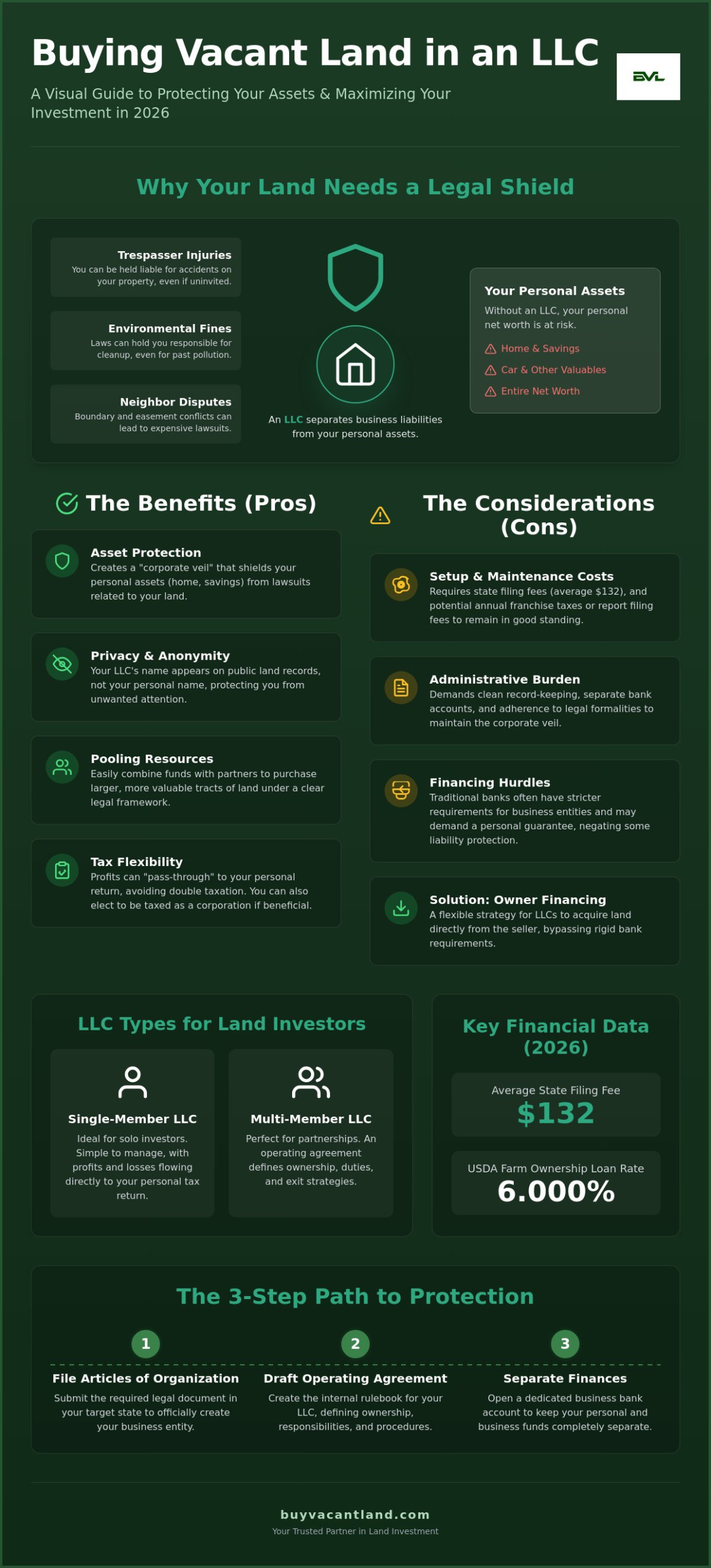
Many people assume vacant land is low risk because there are no buildings. This is a mistake. Raw acreage carries unique liabilities that can trigger massive financial burdens. Trespassers may injure themselves on your property. Environmental issues, such as old chemical runoff or protected species violations, can lead to aggressive government fines. These events are often out of your direct control.
- Trespassing: You are often liable for injuries even if the person wasn’t invited.
- Environmental Risks: Federal laws can hold owners responsible for cleaning up land they didn’t pollute.
- Neighbor Disputes: Boundary or easement conflicts can lead to expensive litigation.
An LLC keeps these problems contained. The corporate veil is the legal rule that protects your personal assets from being used to satisfy the business’s debts or legal judgments. Without this buffer, one bad day on a remote lot could wipe out your entire net worth.
Single-Member vs. Multi-Member LLCs for Land
Solo investors typically use a single-member LLC. It’s simple to manage and usually requires no extra tax filings. Profits and losses flow directly to your personal return. Multi-member LLCs are different. They allow you to partner with others to buy larger, more expensive tracts. This structure outlines exactly who owns what and who makes the decisions. It prevents partnership disputes from turning into legal nightmares. If you want to understand the full acquisition process, read How Do You Buy Land? The Complete 2026 Beginner’s Guide for a step-by-step breakdown.
The Benefits: Why Investors Buy Land Under a Business Entity
Buying land through a business entity offers immediate advantages for your financial security. It stops a single lawsuit from draining your personal bank account. This is the primary reason why investors analyze the buying land in an LLC pros and cons before making an offer. You gain a level of professional separation that individual deeds simply can’t provide. This shield ensures that your private life stays separate from your investment risks.
Tax flexibility is another major win for the 2026 investor. Most land LLCs use pass-through taxation. This means profits go directly to your personal return to avoid double taxation. However, you can also choose to be taxed as a corporation if it benefits your specific tax bracket. When forming a real estate LLC, you gain the power to decide how your money is treated by the IRS. It’s a pragmatic way to keep more of your investment growth.
Privacy and Anonymity in Land Deals
Privacy is a luxury in the digital age. When you buy land in your own name, your home address and purchase price become public records. Nosy neighbors or predatory litigators can find you with a simple search. An LLC replaces your name with a business title. You can name your entity something generic to keep your identity hidden from public view. It’s an efficient way to stay off the radar.
A Registered Agent adds another layer of defense. They receive legal documents on your behalf. This prevents process servers from showing up at your front door. High-net-worth collectors use this strategy to build massive portfolios without drawing unwanted attention. It provides peace of mind and keeps your personal life private. This professional approach allows successful land owners to enjoy the rewards of their investments, perhaps by visiting premier Los Angeles entertainment spots like The Vermont Hollywood, while keeping their financial details secure.
Pooling Resources for Larger Acreage
Buying large tracts of hunting land is expensive. An LLC makes it possible to pool capital with friends or family safely. You can combine funds to buy a 100-acre parcel that would be out of reach for a solo buyer. This structure allows for shared ownership without the typical messy legal hurdles of joint tenancy.
A well-drafted operating agreement is your best defense against future disputes. It defines who pays the property taxes and how much time each member spends on the land. It also outlines what happens if one person wants to sell their share. Selling your membership interest is much faster than selling a physical deed. It’s a clean transfer that keeps the land intact while providing you with liquidity. If you’re looking for a deal, you can find undeveloped land listings that fit your LLC’s budget right now.
The Drawbacks: Potential Risks and Costs of LLC Land Holdings
The protection of a business entity is not free. You must trade simplicity for security. An LLC requires active maintenance, extra capital, and strict record-keeping. If you fail to manage these details, your legal shield will fail when you need it most. Weighing the buying land in an LLC pros and cons means looking at the recurring financial burdens that individual owners don’t face. These costs can eat into your profit margins if you buy low-value parcels without a clear plan.
Sloppy bookkeeping is the fastest way to lose your assets. If you pay for property taxes with your personal credit card, you commingle funds. This mistake allows a court to pierce the corporate veil. It means a judge can ignore your LLC and allow creditors to seize your personal home or savings. You must maintain a separate business bank account for every transaction. You must also keep formal meeting minutes even if you are the only member. This administrative load is a significant trade-off for your peace of mind.
Insurance premiums also tend to be higher for business-owned land. Insurance companies often view entities as higher-risk targets for lawsuits. They assume a business has deeper pockets than an individual. To manage these costs, using a tool like Compare Property Insurance can help you evaluate different coverage options. You may find that a standard liability policy for a business costs more than a personal umbrella policy. You also need a CPA who specializes in real estate entities. Their expertise ensures you stay compliant with federal laws, but their professional fees add to your annual overhead.
The True Cost of Maintenance
State fees vary significantly across the country. In 2026, the average state filing fee to form an LLC is approximately $132. However, your location dictates your actual cost. Montana offers a low entry at $35 and Kentucky follows at $40. Conversely, Massachusetts charges a steep $500 just to get started. You also face recurring annual report fees that average $91 nationally. California investors face a minimum annual franchise tax of $800, while Delaware charges $300. For the first year, the average US investor spends roughly $224 on basic compliance alone.
Complexity in Title Transfers
Moving land you already own into an LLC can trigger unexpected expenses. Many states charge a transfer tax when you record a new deed. Title companies often charge higher closing fees for business entities because they must verify your operating agreement and authority to sign. If you are searching for Cheap Land for Sale: The Ultimate 2026 Guide to Affordable US Lots, always factor these closing costs into your total acquisition budget. A bargain lot can quickly become an expensive burden if you don’t account for entity-based transfer fees.
Financing and Legal Hurdles: Navigating LLC Land Purchases
Securing a bank loan for an LLC is significantly harder than buying land in your own name. Traditional lenders view business entities as higher risks. They worry about “shell companies” with no assets other than the land itself. To mitigate this risk, banks almost always require a personal guarantee. This means you are still personally responsible for the debt if the LLC defaults. You gain the legal shield for liability, but you don’t always get it for the mortgage. Understanding these financial realities is a vital part of weighing the buying land in an LLC pros and cons.
Interest rates for business-owned land are typically higher than residential rates. As of July 2026, a 20-year fixed-rate land purchase with 30% down and excellent credit carries an interest rate of 8.875%. If you opt for a 3/1 ARM on raw land with 40% down, you can expect rates around 8.250%. These figures are often higher than what an individual might secure for a primary residence or a small farm. However, specialized programs like the USDA Farm Service Agency (FSA) offer Direct Farm Ownership Loans at 6.000% for eligible agricultural producers. You must choose your lender carefully to keep your investment profitable.
The “Due on Sale” clause is a hidden trap for investors moving existing property into a new entity. Most mortgage contracts state that the full balance is due if the title changes hands. Transferring your deed to an LLC counts as a transfer. If your lender finds out, they can demand immediate payment of the entire loan. Always get written permission from your bank before moving a mortgaged parcel into an LLC structure. It’s an efficient way to avoid a sudden financial crisis.
Lending Restrictions for Business Entities
Many residential lenders refuse to fund LLCs entirely. They prefer the simplicity of individual borrowers. A business entity often needs a two-year track record of income before a bank will consider an application. If your LLC is brand new, you’ll likely need a down payment of 35% to 50%. You can bypass these rigid bank restrictions by seeking owner financed land. This strategy allows you to negotiate terms directly with the seller and avoid the traditional credit market altogether.
Insurance and Liability Specifics
Your personal umbrella insurance policy probably won’t cover land owned by a business. You need a dedicated General Liability Insurance policy for the LLC. This ensures your legal shield remains intact if someone is injured on the property. Insurance companies often require specific “vacant land” riders for business-owned acreage. These policies are pragmatic tools that provide the certainty you need to hold land long-term without stress. If you’re ready to start your portfolio, browse our national marketplace for raw land listings today.
How to Start Your Land Portfolio with an LLC Strategy
Stop planning and start executing. You’ve weighed the buying land in an LLC pros and cons. Now you need a clear path to your first deed. Follow this five-step sequence to launch your land business with zero wasted time. This process removes the friction of traditional property ownership and sets you up for professional growth in 2026.
Step 1: Consult with a real estate attorney and CPA. You need professionals to review your specific tax bracket and liability needs. They ensure your operating agreement is airtight. Step 2: File Articles of Organization in your target state. This is the official birth of your company. Expect to pay an average state filing fee of $132, though this ranges from $35 in Montana to $500 in Massachusetts. Step 3: Obtain an EIN from the IRS. This Employer Identification Number is free and acts as a social security number for your business. You cannot open a bank account without it.
Step 4: Open a dedicated business bank account for land transactions. Never use your personal account for business expenses. This step is non-negotiable for maintaining your legal shield. Step 5: Browse a specialized marketplace to find your first parcel. Once your entity is active, you’re ready to acquire inventory. Use your LLC name on all purchase agreements to ensure the property is shielded from day one. This logical progression replaces confusion with certainty.
Choosing the Right State for Your LLC
File your LLC in the state where the land is located. This is called a “Domestic LLC.” If you file in your home state but buy land elsewhere, you’ll likely have to pay “Foreign Qualification” fees in the land’s state. This doubles your paperwork and your costs. If you’re a land flipper looking for tax efficiency in 2026, look at states with no annual report fees. Arizona, Missouri, New Mexico, Ohio, and South Carolina currently offer this benefit. This pragmatic choice keeps your overhead low while you build equity.
Scaling Your Land Investment Business
Growth requires a strategy for managing multiple properties. A “Series LLC” allows you to hold several residential lots in separate “cells” under one master entity. If a lawsuit hits Lot A, Lot B remains protected. This is the professional path to becoming a developer. It also simplifies your exit strategy. Instead of selling a physical deed and paying high transfer taxes, you can sometimes sell the membership interest of the LLC itself. This is a faster, cleaner transaction for high-value deals. Find your next investment property on our national land marketplace today!
Secure Your Financial Future with a Professional Land Strategy
A business entity transforms a simple dirt purchase into a sophisticated financial asset. You’ve seen how an LLC shields your home from property-specific lawsuits and offers the flexibility of pass-through taxation. While the administrative burden and setup fees require attention, the peace of mind provided by a legal buffer is invaluable. Evaluating the buying land in an LLC pros and cons is the final hurdle before you start acquiring acreage with confidence. You now have the checklist to manage your risks and scale your portfolio efficiently.
Success in 2026 depends on finding high-value inventory that fits your new business structure. Our national land marketplace provides specialized raw land listings and direct seller connections to help you move fast. We cut through the traditional procedural hurdles to bring you the best undeveloped property across the country. Don’t let indecision stall your investment growth. Take the first step toward a secure, professional portfolio today. Your journey to land ownership should be swift and certain.
Start building your land portfolio—browse thousands of vacant lots now!
Frequently Asked Questions
Can I transfer land I already own into an LLC?
Yes. You can move land into an LLC by executing and recording a new deed with your county. This is a standard procedure for investors who want to shield their personal assets from property-specific liabilities. Always check your mortgage contract for a “Due on Sale” clause before the transfer. You must also account for local transfer taxes that apply when the title changes hands.
Do I need a separate LLC for every piece of land I buy?
You don’t need a separate entity for every parcel, but it provides better protection. If you hold five properties in one LLC, a lawsuit against one puts all five at risk. Many 2026 investors use a “Series LLC” to isolate liabilities for different residential lots under a single master entity. It’s an efficient way to scale your portfolio without paying multiple annual filing fees.
Does buying land in an LLC save money on taxes?
An LLC is usually a pass-through entity. It doesn’t lower your tax rate automatically. Profits and losses flow directly to your personal tax return. For 2026, long-term capital gains rates are 0%, 15%, or 20% depending on your income. The real benefit is flexibility. You can choose to be taxed as an S-Corp if your CPA determines it will reduce your self-employment tax burden.
Can an LLC get a mortgage for raw land?
Yes, but banks have stricter requirements for business entities. You should expect to provide a personal guarantee and a down payment of 30% to 40%. As of July 2026, raw land ARM rates are approximately 8.250%. Many buyers use owner financing to skip the bank entirely. It’s a faster, more certain path to acquisition for a new LLC with no established credit history.
What is the biggest risk of buying land in an LLC?
The primary risk is “piercing the corporate veil” through poor management. If you pay business bills with personal cash, you lose your legal protection. A judge can then allow creditors to seize your personal home and savings. You must maintain separate bank accounts and keep formal records. This administrative discipline is a key factor when weighing the buying land in an LLC pros and cons.
Is it more expensive to insure land owned by an LLC?
It’s often more expensive because you need a commercial general liability policy. Personal umbrella policies don’t cover business-owned acreage. Insurance companies often view entities as targets with deeper pockets. You’ll need specific “vacant land” riders to ensure your shield stays intact. Factor these higher premiums into your annual budget to maintain a realistic view of the buying land in an LLC pros and cons.
Do I need an attorney to buy land through an LLC?
You aren’t legally required to hire an attorney, but it’s a pragmatic choice. An attorney ensures your operating agreement is airtight and your deed transfer is recorded correctly. They also help you comply with federal Beneficial Ownership Information (BOI) reporting. Professional guidance prevents the small clerical errors that could jeopardize your entire legal shield. It’s a small price to pay for certainty.
How does an LLC affect the sale of vacant land later?
An LLC can make the sale faster through a membership interest transfer. You sell the business entity that owns the deed rather than the land itself. This can sometimes bypass expensive transfer taxes and simplify the closing process. It’s a clean exit strategy that appeals to professional investors. This structure turns your passive land holding into a professional, liquid business asset.




Join The Discussion