

Buying a vacant lot is not just buying a house without the walls; it is a high-stakes verification game where the wrong move leaves you with expensive dirt you cannot use. You likely feel the pressure of rising costs and shrinking inventory. National median lot values hit $59,000 recently, and builders are snatching up smaller parcels faster than ever. Learning how to buy a residential lot requires cutting through the noise of hidden utility costs and strict zoning laws that threaten your vision. You need a clear path to secure a property without the standard industry delays.
This guide simplifies the entire process for the 2026 market. You will learn to identify buildable land, verify essential permits, and navigate a lending environment where land loan rates often reach 10 percent. We break down the transition from raw land to a construction-ready site into a manageable, multi-step sequence. Stop worrying about bank rejections and start focusing on the relief of a closed deal. We show you how to find affordable options and secure your future home site with total confidence.
Key Takeaways
- Distinguish between improved and raw land to avoid unexpected infrastructure and development costs.
- Verify buildability by mastering the “Big Three”: zoning restrictions, utility availability, and legal road access.
- Discover how to buy a residential lot using owner financing to bypass high bank interest rates and strict credit requirements.
- Follow a streamlined 5-step strategy to filter out market noise and identify high-value parcels quickly.
- Eliminate traditional real estate hurdles by connecting directly with vacant land sellers on specialized marketplaces.
What is a Residential Lot and Why is it a Strategic Investment?
A residential lot is a specific parcel of land legally designated for housing construction. Understanding What is a Residential Lot involves looking past the surface to the underlying zoning codes. These codes dictate exactly what you can build and how you can use the property. Learning how to buy a residential lot starts with recognizing that not all land is created equal. You aren’t just buying dirt; you’re buying the legal right to develop a home site.
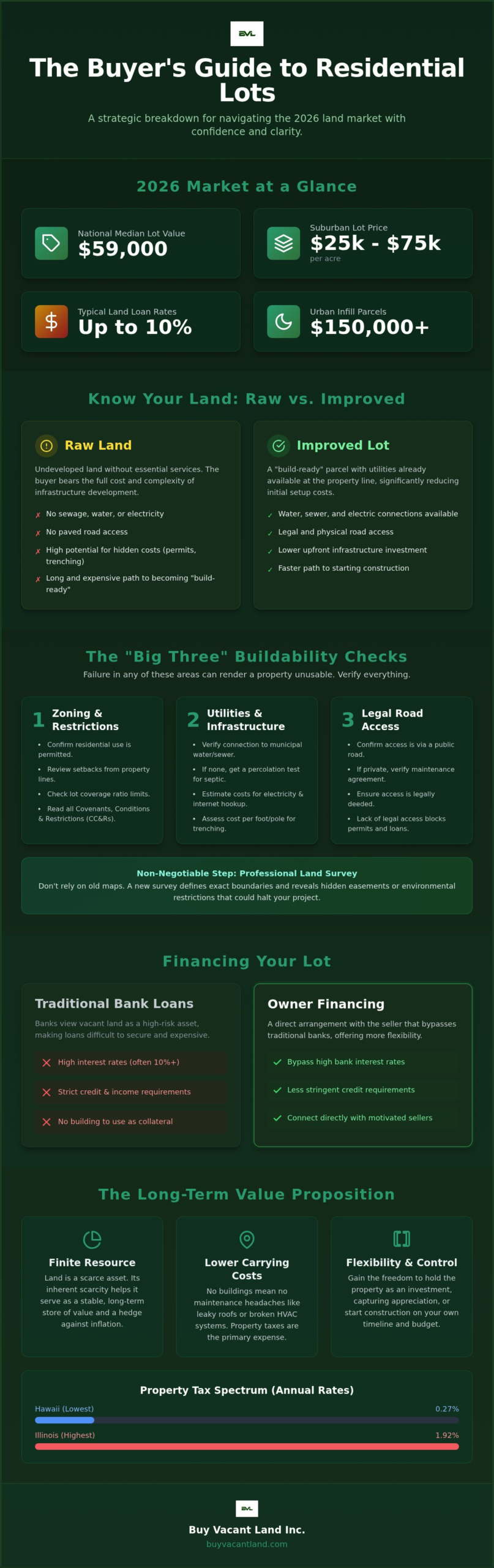
In 2026, the national median lot value for single-family detached homes reached $59,000. Prices vary significantly by location. Suburban lots often range from $25,000 to $75,000 per acre, while urban infill parcels can exceed $150,000. Buying land now serves as a critical hedge against the rising costs of finished housing inventory. You secure your footprint today and build when your budget allows. This strategy provides a level of financial control that buying an existing home simply cannot match. You must know exactly what you are buying before you sign a contract. A mistake in the identification phase can lead to owning land that is legally or physically impossible to build on.
Residential vs. Raw Land: Know the Difference
Vacant land is a broad category. Don’t assume every empty field is ready for a foundation. Raw land is completely undeveloped. It lacks basic infrastructure like sewage, water, electricity, and paved road access. Improved residential lots are often “build-ready” with these utilities already at the property line. The cost implications are massive. Moving from raw land to a residential lot requires expensive permits, trenching, and utility hookups. These hidden fees can add thousands to your total investment. Always verify the status of “vacant” land to ensure it meets your construction timeline.
The Long-Term Value of Undeveloped Residential Parcels
Land is a finite resource. You can’t manufacture more of it. This scarcity makes residential parcels a stable long-term asset. Carrying costs for land are significantly lower than for developed property. You don’t have to worry about roof leaks or broken HVAC systems. In 2026, property tax rates vary by state; Hawaii offers the lowest at 0.27 percent, while Illinois is the highest at 1.92 percent. Researching how to buy a residential lot in the path of national development trends allows you to capture appreciation. You gain the flexibility to hold the property as an investment or start construction whenever you are ready. This versatility is the hallmark of a smart land purchase.
Critical Due Diligence: Verifying Your Lot is Buildable
Assuming a property is buildable just because it is listed as “residential” is a catastrophic mistake. It is the most common error buyers make when learning how to buy a residential lot. A listing title does not guarantee that local laws or physical conditions allow for construction. You must perform rigorous due diligence when buying land to protect your investment. Focus your efforts on the “Big Three” of land verification: zoning, utilities, and legal access. If any of these fail, your project stops before it starts.
A professional land survey is a non-negotiable expense. Don’t rely on old plat maps or verbal assurances from a seller. A fresh survey identifies precise property boundaries and reveals hidden easements that could restrict your building footprint. It also highlights environmental restrictions like wetlands or steep slopes that might require expensive mitigation. These assessments can add thousands of dollars to your total cost, but they prevent you from buying an unusable parcel. You can find buildable residential lots that have already undergone initial vetting, but the final verification always rests with you.
Zoning and Land Use Restrictions
Check the local zoning map immediately. Confirm the parcel falls within a district that allows your specific type of home. Review the setbacks, which define how far your house must be from property lines. High-density areas often have strict lot coverage ratios that limit the size of your footprint. If the property is part of a planned development, read the Covenants, Conditions, and Restrictions (CC&Rs). These private rules can dictate everything from roof materials to the types of vehicles you can park in your driveway. Ensure your building plans align with these standards before you commit.
Utilities and Infrastructure Assessment
Assess infrastructure early to avoid massive budget overruns. Confirm if the lot connects to municipal water and sewer systems. If not, you will need a percolation test to determine if the ground supports a septic system. Bringing electricity and high-speed internet to a remote property line can cost thousands of dollars per pole or foot of trenching. Evaluate road access with equal scrutiny. A lot on a public, county-maintained road is ideal. If the property sits on a private easement, verify who is responsible for maintenance. Without legal, deeded access, you cannot secure a building permit or a traditional loan.
Financing a Residential Lot: Cash vs. Owner Financing
Lenders view vacant land as a high-risk gamble. Banks see empty lots as vulnerable assets because there is no building to serve as collateral. This creates a financing gap that stalls most projects before they begin. If you are researching how to buy a residential lot, you must choose between a cash purchase, a complex bank loan, or owner financing. Cash transactions offer the fastest closing times and the most leverage. However, many buyers prefer to keep their liquid capital for construction costs rather than tying it up in the soil.
Bank loans for land are notoriously difficult to secure in 2026. Interest rates for vacant parcels typically sit 1 to 3 percent higher than standard mortgage rates. While a home mortgage might be 7 percent, a land loan can easily reach 10 percent. Down payment requirements are also much steeper. The FDIC requires at least 35 percent down for raw land and 25 percent for unimproved land. Some institutional lenders demand up to 50 percent. This high barrier to entry makes traditional banking a slow and frustrating path for most land buyers.
Why Traditional Banks Decline Land Loans
Lenders worry that buyers will walk away from land more easily than a primary residence. Without a house on the site, the bank has less security. They also require intensive documentation. You often need to provide detailed construction plans and timelines just to qualify. This process can take months and involves high closing costs, often 2 to 4 percent of the purchase price. If your credit score is below 700, your chances of approval from a conventional lender are slim. For many, the red tape is simply not worth the effort.
The Benefits of Buying Owner-Financed Land
Owner financing is the most accessible alternative for 2026 buyers. This model allows you to negotiate terms directly with the seller. You can often secure owner financed land without a traditional credit check or bank approval. This speed is a major advantage in a competitive market where buildable lots are scarce. You avoid the strict underwriting that kills most land deals.
Sellers typically offer much lower down payments than banks. This flexibility helps you find cheap land for sale with monthly payments that fit your actual budget. By bypassing the financing gap, you move from searching to owning in a fraction of the time. Owner financing turns a complex financial hurdle into a simple, direct agreement. It’s the most efficient way to learn how to buy a residential lot without the stress of traditional bank rejections.
The 5-Step Strategy to Find and Buy Your Lot
Finding the right property is a process of elimination. You must filter out the noise to find a parcel that actually fits your build plan. Mastering how to buy a residential lot requires a tactical approach that prioritizes speed and verification. Follow this 5-step sequence to secure your property without the usual industry delays.
Step 1: Define your non-negotiables. Start with a clear list of must-haves. This includes your maximum budget, minimum acreage, and specific utility requirements. If you need municipal sewer, don’t waste time on rural parcels that require septic systems. Step 2: Use specialized marketplaces. Avoid the clutter of traditional home-listing sites. Focus on platforms built specifically for land to find parcels that meet your zoning needs. Step 3: Conduct a preliminary desk audit. Use local GIS maps and satellite imagery to check property lines and vegetation. This saves you hours of unnecessary driving. Step 4: Visit the property in person. Walk the dirt to evaluate the topography. Look for drainage issues or neighborhood factors that don’t show up on a map. Step 5: Prepare your offer. Review how do you buy land basics to ensure your proposal is professional and legally sound.
Navigating National Land Marketplaces
General real estate websites are built for houses. They often hide the technical details land buyers need, such as specific zoning codes or utility access. Specialized sites allow you to filter results by “Owner Financing” or “Residential” tags immediately. This efficiency is vital when buildable lots are in high demand. Set up automated alerts for new listings in your target price range. This ensures you are the first to see fresh inventory before it hits the broader market. You can browse thousands of verified listings on BuyVacantLand.com to find your ideal home site today.
Making a Competitive Offer and Closing
Your purchase agreement must include a dedicated due diligence period. This is your safety net. It gives you 15 to 30 days to confirm the land is buildable before your deposit becomes non-refundable. Work with a reputable title company or a real estate attorney to handle the closing. They will perform a title search to ensure there are no hidden liens or ownership disputes. Always demand a Warranty Deed. This provides the highest level of protection by guaranteeing the seller has the clear right to sell the property. Avoid Quitclaim Deeds, as they offer no protection against future title claims.
Why BuyVacantLand.com is Your Best Resource for Residential Lots
Traditional real estate sites are cluttered with existing homes, rentals, and commercial leases. This noise slows down your search and wastes your time. BuyVacantLand.com removes this friction by focusing exclusively on vacant property. You won’t find single-family homes or apartment complexes here. This specialization allows you to master how to buy a residential lot without being distracted by irrelevant listings. We provide the relief and peace of mind that come from a swift, assured transaction. Our platform is built for those who value efficiency over ornamentation.
Our marketplace offers an extensive range of inventory to fit any construction project. This includes everything from remote off-grid parcels to shovel-ready suburban lots. If you are looking for high-growth areas, you can browse land for sale in Florida or explore our national database across the United States. We connect you with the exact type of property your project requires. Our goal is to simplify complex industry processes into a clear, manageable sequence that gets you to the closing table faster.
Direct Access to Motivated Sellers
Most land deals fail because of bureaucratic middlemen and unnecessary procedural hurdles. We solve this by connecting you directly with land owners and sellers. This direct-to-seller model allows for faster negotiations and more flexible terms. You can find cheap land and unlisted opportunities that never reach the traditional MLS. Our specialized vacant land listing services prioritize total transparency. You see the details that matter: zoning, acreage, and location. There are no hidden service fees or traditional transactional costs to slow you down.
By negotiating directly, you can often secure an equitable financial proposal that works for both parties. This is especially useful for those learning how to buy a residential lot using owner financing. You bypass the bank and work with a seller who values your time. We position ourselves as a helpful ally in your search for the perfect build site. We cut through the traditional red tape to ensure your transaction is as simple as possible.
Start Your Search Today
Time is your most valuable asset in the competitive 2026 market. Our simple interface is designed for quick discovery and comparison. You can filter by state, price, and financing options in seconds. This national reach helps you find buildable land in regions where other sites often fail. Stop scrolling through home listings that don’t meet your needs. We provide a multi-step path to completion that removes the stress of asset acquisition.
Secure a tangible asset for your future today. The path to ownership is clear, direct, and efficient. Don’t let traditional real estate hurdles stand in your way. Take the first step and find your perfect lot now. Our platform is ready to help you secure your property with total confidence.
Secure Your Future Home Site Today
You now have the exact framework for how to buy a residential lot in a competitive market. Success depends on prioritizing verification before price and choosing the right financing path. You don’t have to navigate high bank interest rates or complex red tape alone. By focusing on buildability and direct seller relationships, you bypass the traditional hurdles that stall most buyers. This guide provides the clarity needed to move from searching to owning with total confidence. The relief of an assured transaction is finally within your reach.
We provide a specialized vacant land marketplace designed to simplify your search. You get direct access to seller listings and national coverage across the United States. This focused approach removes the clutter of home listings and connects you with the assets you need. Take action now to secure a tangible piece of land for your future project. The peace of mind that comes from a clear building site is a click away. Our platform makes the entire process efficient and reliable.
Browse available residential lots on BuyVacantLand.com and find your perfect parcel today. Your path to ownership is direct, efficient, and ready for you to begin.
Frequently Asked Questions
How do I know if a residential lot is buildable?
You confirm buildability by verifying zoning codes and physical site conditions with the local planning department. A residential classification is only the first step. You must also ensure the soil supports a foundation and that there are no environmental encumbrances like protected wetlands. Request a zoning verification letter to get this status in writing before you close the deal.
Can I get a mortgage to buy a residential lot?
You can secure a land loan, but banks require higher down payments than standard home mortgages. In 2026, lenders demand between 15 and 35 percent down depending on whether the lot is improved or raw land. Expect interest rates to be 1 to 3 percent higher than current 30-year fixed rates. Many buyers choose owner financing to avoid these strict bank requirements.
What are the typical closing costs when buying vacant land?
Closing costs for vacant land typically range from 2 to 4 percent of the purchase price for cash transactions. These costs include title insurance, escrow fees, and recording fees. If you use bank financing, your costs will be higher due to loan origination fees and appraisals. Always request a settlement statement early to see the exact breakdown of fees before your scheduled closing date.
Do I need a real estate agent to buy a residential lot?
You don’t need a real estate agent to purchase land. Buying directly from a seller allows you to negotiate terms without paying traditional commission fees. This direct approach often speeds up the transaction and simplifies the communication process. You should still use a title company or attorney to ensure the deed transfer is legal and the title is clear of all liens.
What is the difference between a residential lot and an agricultural lot?
The primary difference is the legally permitted use defined by local zoning laws. Residential lots are specifically zoned for housing, while agricultural lots are intended for farming, livestock, or timber. Building a house on agricultural land often requires a rezoning process or a special use permit. Residential lots usually have easier access to municipal utilities and sit closer to existing infrastructure.
How much does a land survey cost in 2026?
Land survey costs vary based on the parcel size, terrain complexity, and local labor rates. In 2026, a standard boundary survey for a residential lot typically adds several hundred to a few thousand dollars to your total investment. This is a critical expense that identifies property lines and easements. Never skip this step, as it prevents legal disputes and ensures your home fits within required setbacks.
What happens if I buy land and can’t get utilities connected?
Buying land without guaranteed utility access can make the property unbuildable or extremely expensive to develop. You may have to pay for long-distance line extensions or install alternative systems like a well and septic tank. This is why the due diligence period is vital when learning how to buy a residential lot. Always get utility availability in writing from providers before the deal is final.
Is owner financing a safe way to buy a residential lot?
Owner financing is a safe and efficient alternative to bank loans when you use a legally binding contract. Ensure the agreement is recorded with the county to protect your interest in the property. This method allows for flexible terms and lower down payments without the stress of credit checks. It is a pragmatic solution for securing land quickly while keeping your cash available for construction.




Join The Discussion