
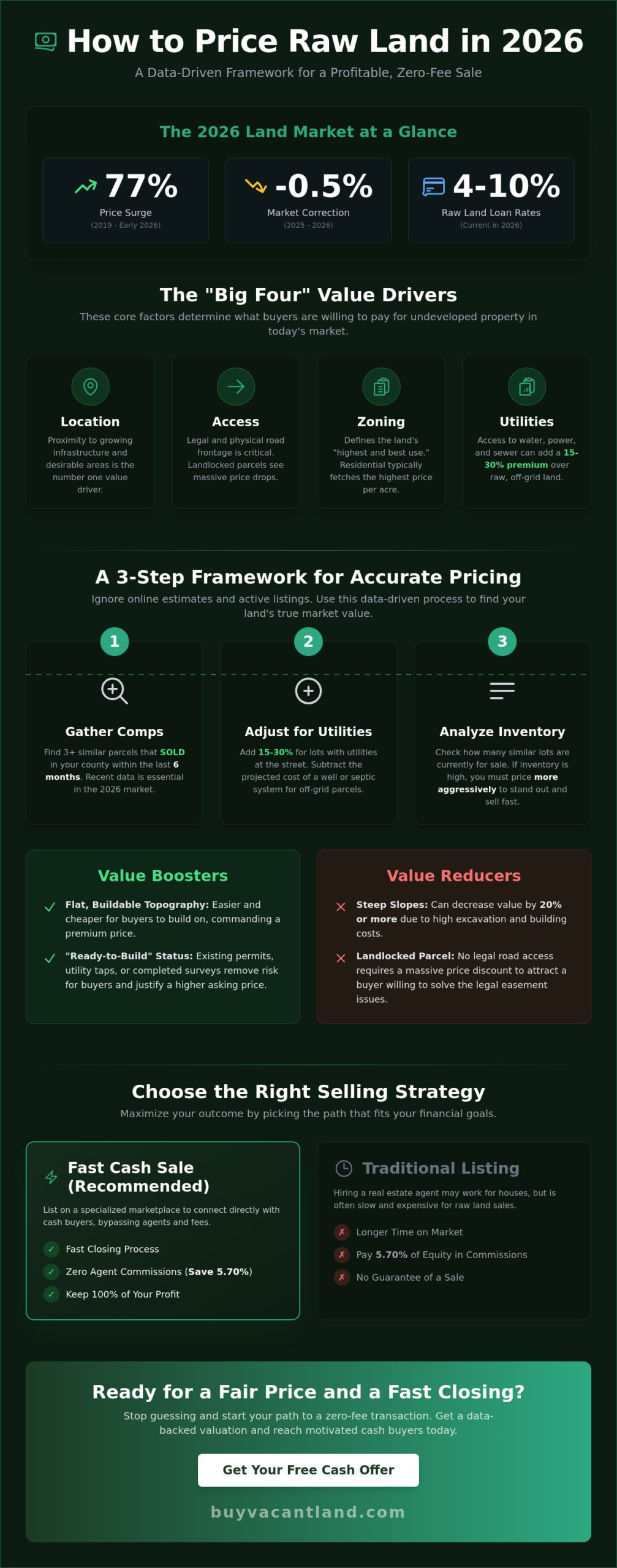
Land prices across the United States surged 77% between early 2019 and the start of 2026, but the market is now cooling with a 0.5% price dip in the last year. You’re likely tired of watching property taxes drain your bank account while you wonder if your asking price is too high or too low. It’s frustrating to feel stuck with an asset that just sits there. Learning how to price raw land for sale shouldn’t be a guessing game based on hope; it’s a cold calculation of utility and access.
You deserve a clear price tag and a fast closing process without losing 5.70% of your equity to agent commissions. This guide provides the exact framework you need to value your vacant land for a profitable sale in today’s stabilizing 2026 market. We’ll show you how to analyze recent comps, account for 2026 interest rates that range from 4% to 10%, and use a simple three step process to get your fair cash offer. Stop overthinking the math and start your path to a zero fee transaction today.
Key Takeaways
- Identify the “Big Four” value drivers. Location, Access, Zoning, and Utilities determine what buyers actually pay for undeveloped land.
- Master how to price raw land for sale using a 3-step framework based on recent county comps rather than inaccurate automated tools.
- Eliminate the “Sentimental Tax” and the “Zestimate Trap” to stop overpricing and start moving your property fast.
- Choose the right strategy between a fast cash sale and a long-term listing to maximize your specific financial outcome.
- List your land on a specialized marketplace to bypass expensive agents and keep 100% of your profit with zero commissions.
What Determines Raw Land Value in 2026?
Raw land value is the current market price a buyer is willing to pay for undeveloped property today. It isn’t a reflection of what you paid five years ago or a guess based on your neighbor’s house price. In the 2026 market, value is driven by the “Big Four” factors: Location, Access, Zoning, and Utilities. While land prices surged 77% between 2019 and early 2026, the market has entered a stabilization phase. Overall prices per acre dipped by 0.5% from 2025 to 2026, meaning buyers are more sensitive to these core drivers than ever before. Understanding these variables is essential when learning how to price raw land for sale without scaring off potential cash buyers.
The primary driver of land price is its “highest and best use,” which is the legally allowed and physically possible use that generates the most value for the owner. Professional real estate appraisal methods use this concept to establish a baseline. In 2026, market trends favor two distinct paths. “Residential-ready” lots in areas with growing infrastructure hold their value well. Conversely, “off-grid” land is popular for lifestyle buyers, but these buyers now demand lower prices to offset the 4% to 10% interest rates found on raw land loans. If your land lacks a clear purpose, its value will drop as buyers look for safer assets during this market correction.
The Impact of Physical Characteristics
Physical traits can make or break your asking price. Topography is a major factor; a flat, buildable lot commands a premium, while steep slopes can decrease your price by 20% or more due to high excavation costs. Road frontage also dictates value. Commercial lots need high visibility, while residential buyers pay for privacy. Soil quality is another hidden value driver. If the soil can’t pass a percolation test for a septic system, your pool of buyers shrinks instantly. Finally, beware of the landlocked label. If your parcel has no legal road access, you’ll need to apply a massive price discount to attract anyone willing to handle the legal headache of gaining an easement.
Zoning and Legal Restrictions
Zoning defines who can buy your land and what they can do with it. Residential zoning usually fetches the highest price per acre because of development potential. Agricultural and unrestricted land offers more freedom but often sells for less unless it’s prime farmland. You must also account for easements and setbacks. These legal restrictions limit the buildable area and lower the total value. However, if you have “ready-to-build” permits or utility taps already in place, you can justify a higher price. This preparation removes risk for the buyer, which is a powerful tool when you’re figuring out how to price raw land for sale in a competitive environment.
A 3-Step Framework for Pricing Your Vacant Land
You don’t need an expensive appraiser or a high commission broker to value your property. Mastering how to price raw land for sale requires a practical, data driven approach. Start by ignoring active listings on sites like Zillow. Those numbers represent a seller’s dream, not reality. Instead, focus entirely on “sold” data from the last six months within your specific county. This gives you a clear picture of what buyers are actually paying in the current market. Following the IRS Real Property Valuation Guidelines for comparative analysis ensures your math stays grounded in professional standards. Follow this three step sequence to find your number.
- Step 1: Gather Comps. Find at least three parcels of similar size and zoning that sold recently.
- Step 2: Adjust for Utilities. Add or subtract value based on the presence of water, power, and sewer.
- Step 3: Analyze Inventory. Check how many similar lots are currently for sale. High inventory means you must price more aggressively to stand out.
The 2026 market is in a stabilization phase. National land prices dipped by 0.5% between early 2025 and early 2026. If you use pricing data from 2024, you’ll likely overprice your land and watch it sit for months. Accuracy is the key to a fast closing. Once you have your data, you can list your land for sale on a specialized platform to reach the right buyers immediately.
How to Find and Use Comparable Sales
Look for sales data through your local county assessor’s office or specialized land websites. Filter your search by acreage size. A 1 acre residential lot has a much higher price per acre than a 40 acre ranch because the buyer pool is larger. Do not compare your land to properties sold over a year ago. The market shift in 2026 makes older data irrelevant. Focus on the most recent 180 days to reflect current interest rates and buyer demand.
The Utility Value Adjustment
Utility access is a massive value multiplier. Land with “utilities at the street” often commands a 15% to 30% premium over raw acreage. If a buyer has to drill a well or install a septic system, they will deduct those projected costs from their offer. In 2026, many buyers prefer “residential-ready” lots to avoid the hassle of permitting. If your land is truly off-grid, you must target a specific buyer profile. Price these parcels based on recreational value rather than development potential to ensure a fair and profitable sale.
Why Most Landowners Overprice Their Property
Most sellers fail because they let emotions drive their asking price. This is the single biggest mistake people make when researching how to price raw land for sale in a cooling market. Your personal history with the property doesn’t add market value. Buyers don’t care about the family camping trips or the effort you spent clearing brush three years ago. This “Sentimental Tax” creates a price gap that stops deals before they start. To a buyer, your land is a financial asset or a build site, not a collection of memories. If your price doesn’t align with the 0.5% market dip seen in 2026, your listing will simply sit.
Many sellers also fall into the “Zestimate Trap.” Automated home value tools are designed for houses with standard features and recent neighborhood sales. They fail miserably for raw land. These algorithms can’t see a steep 30% slope, a lack of road access, or the absence of a sewer connection. Relying on an AI guess leads to a price that is often 20% to 40% higher than what a cash buyer will actually pay. An overpriced lot is a “dead lot” that scares off serious buyers who assume something is wrong with the title or the soil.
Holding land isn’t free. You are losing money every month through property taxes and maintenance costs. National land sales volume increased by only 0.8% in 2025, which means the competition is stiff. Every month your land doesn’t sell, your net profit shrinks. You must price for the market you have today, not the peak prices of 2022.
The Danger of “Testing the Market”
Sellers often think they can list high and “see what happens.” In 2026, this strategy is toxic. Savvy land investors track how long a property has been on the market. A listing that sits for 150 days becomes “stale.” Buyers assume there is a hidden defect like a failed perc test or a legal easement issue. When you finally drop the price, investors smell desperation. They will often lowball you even harder than if you had priced it correctly from day one. Start with a realistic number to create a sense of urgency and attract multiple offers.
Hidden Costs That Lower Your Net Profit
You need to focus on your “walk away” number. Traditional real estate agents charge an average commission of 5.70%, but for raw land, that fee often jumps to 10%. You can use BuyVacantLand.com to avoid traditional broker fees and keep 100% of your equity. Consider the value of a fast cash sale. Waiting 12 months for a “retail” buyer might seem smart, but after paying a year of taxes and a 10% commission, you often net less than a quick wholesale close. Speed has a dollar value. Calculate your total costs before you set your final ask price.
Strategic Pricing: Cash Sale vs. Long-Term Listing
You have two paths when deciding how to price raw land for sale in 2026. You can wait for a retail buyer or target a fast cash exit. Retail pricing aims for the absolute highest dollar amount. This strategy often takes 6 to 12 months of waiting and negotiation. Wholesale pricing targets professional land buyers who close in days. Because the 2026 market is cooling, your strategy determines how long you’ll keep paying taxes on land you don’t want. Don’t let an unwanted asset bleed your bank account while you wait for a perfect offer that may never arrive.
Follow the “90-Day Rule” to protect your equity. If your land hasn’t sold in three months, your price is the problem. In a market where national sales volume only grew 0.8% in 2025, a stagnant listing is a liability. Buyers see old listings and assume there’s a title issue or a physical defect. You must adjust your price quickly to stay relevant. High inventory levels in 2026 mean buyers have plenty of options. If you don’t stand out on price, you’ll be left holding the bag.
Pricing for a Quick Cash Exit
Professional land buyers typically look for a 70% of market value entry point. While this sounds like a steep discount, it offers a no-contingency close. You skip the appraisals, the 20% to 30% down payment hurdles for buyers, and the 10% broker commissions. In May 2026, land loan interest rates range from 4% to 10%, making traditional financing difficult for many. A cash buyer removes this friction entirely. Speed is often more valuable than chasing the final 5% of a sales price. It’s about certainty and peace of mind.
Using Owner Financing to Boost Value
If you want a higher price, consider owner financed land. This strategy allows you to sell for 10% to 20% above market cash value. Since traditional lenders view raw land as risky, many buyers can’t get bank funding. By becoming the bank, you attract residential buyers who care more about the monthly payment than the total sticker price. You get a steady monthly note and a solid down payment upfront. This expands your buyer pool significantly in a tight credit market. Ready to move your property? List your land for sale now and reach thousands of motivated buyers instantly.
List Your Land for Maximum Exposure with Zero Commission
You’ve mastered how to price raw land for sale using the 2026 framework. Now you need to reach the right buyers without losing your profit to middleman fees. Traditional real estate agents often charge up to 10% for raw land transactions. On a $50,000 sale, that’s $5,000 out of your pocket. BuyVacantLand.com offers a direct alternative. We built a specialized marketplace for landowners who value efficiency and transparency. You list your property, connect with buyers, and keep 100% of the sale price. It’s a zero commission model designed to put you in control of your financial outcome.
A fair price only works if you justify it to a skeptical buyer. Use high quality photos that show the road access, the topography, and the surrounding area. Don’t just describe the land; prove its value. If you’ve identified the “Big Four” value drivers, highlight them in your description. Mention the utility connections or the specific zoning benefits you discovered during your research. A clear, direct listing reduces friction and builds trust with potential investors. Every listing must include a strong call to action. Tell buyers exactly what to do next to secure the property. This simple step converts casual viewers into serious offers.
The Power of a Specialized Marketplace
General real estate platforms are built for houses. They often bury land listings under thousands of residential rentals and single family homes. Our platform caters specifically to people looking for cheap land, off grid parcels, and residential lots. You get immediate access to a national audience of cash buyers for land. These are professionals and lifestyle investors who understand the value of raw acreage. You can sell land faster when you put it in front of people who are already looking for exactly what you have. Skip the stress of traditional real estate and focus on a guaranteed result.
Final Checklist Before You Go Live
Before you hit the publish button, verify your property details one last time. Inaccurate data can kill a deal during the escrow process. Check these three items immediately:
- Confirm the exact acreage from your most recent survey or tax bill.
- Verify the current zoning status and any 2026 tax liens.
- Set your “Bottom Line” price so you can negotiate with confidence.
The 2026 market is stabilizing, and buyers are looking for well documented deals. Don’t let your land sit on the market for another 12 months while you pay unnecessary property taxes. Take action now to clear your debt and find peace of mind. List your land on our marketplace today.
Stop Paying Taxes on Land You Don’t Use
You now have the framework to stop guessing and start selling. Mastering how to price raw land for sale requires looking at the hard data of recent county comps and adjusting for utility access. Don’t let your property become a “dead lot” by testing the market with an unrealistic sentimental price. The 2026 market demands precision and speed. You can choose a fast cash exit or use owner financing to boost your final return; either path requires a specialized platform to reach the right audience.
Traditional brokers often take up to 10% of your equity in commissions. You don’t need them. Our specialized platform connects you directly with thousands of motivated land buyers across the country. You keep 100% of your sale price with zero hidden fees. It is time to turn that unwanted acreage into liquid cash. List your vacant land for sale on our national marketplace today! You have the tools to succeed. The path to a stress free closing is clear. Get started now and secure your fair cash offer.
Frequently Asked Questions
How do I find the value of my land for free?
You can find your land value for free by searching the county clerk’s “sold” records for the last six months. Don’t use automated house valuation tools; they fail for empty parcels. Look for properties with the same zoning and acreage within your specific zip code. This DIY approach gives you a realistic baseline without paying for a professional valuation.
Is an appraisal necessary for selling raw land?
A formal appraisal is not required for a private or cash sale. Most land investors perform their own valuation based on utility access and recent comps. You can master how to price raw land for sale by following the three step framework of gathering data and adjusting for site specific features. Skipping the appraisal saves you money and speeds up the closing process.
How much does one acre of raw land cost in 2026?
There is no single price, but national averages show a 0.5% dip in acre prices from early 2025 to early 2026. Raw land with no infrastructure outperformed build ready land during the 2019-2026 boom, rising nearly 87%. Your specific cost depends on the “Big Four” drivers. A 1 acre residential lot in a growing area will cost significantly more than a remote 40 acre hunting tract.
What is the difference between market value and assessed value?
Market value is the actual cash price a buyer will pay today. Assessed value is a figure generated by the county for property tax purposes. Tax assessments often rely on outdated data and don’t reflect the 2026 market stabilization. Always price your land based on recent sales rather than the number on your tax bill to ensure a fast transaction.
Does having a survey increase the price of my land?
A recent survey can increase your final sales price by removing buyer uncertainty. It confirms your boundaries and exact acreage, which is critical when lenders require 20% to 50% down payments for land loans. Providing a survey makes your land “ready to buy.” This professional documentation justifies a higher price point because it saves the buyer the time and cost of ordering their own.
How do I price land that has no road access?
Price landlocked property at a 30% to 50% discount compared to parcels with road frontage. Without legal access, your buyer pool shrinks to neighbors or specialized investors. You must account for the legal cost of obtaining an easement. Pricing aggressively is the only way to move land that has physical or legal access hurdles in a competitive market.
Can I sell my land for cash if it has back taxes?
You can absolutely sell land with back taxes for a fast cash payout. The escrow company or title agent will pay the county directly from the sale proceeds at closing. This clears the title and stops the interest from mounting. It’s a pragmatic solution for owners who want to walk away from the burden of unpaid debt without more out of pocket costs.
Why is my land worth less than my neighbor’s land?
Value is determined by utility and access, not just proximity. If your neighbor has power at the street and your lot is off grid, their land is worth more. Factors like a 20% slope or a failed percolation test can drop your value significantly. Buyers in 2026 are highly informed and will pay a premium for parcels that are easier and cheaper to develop.



Join The Discussion