

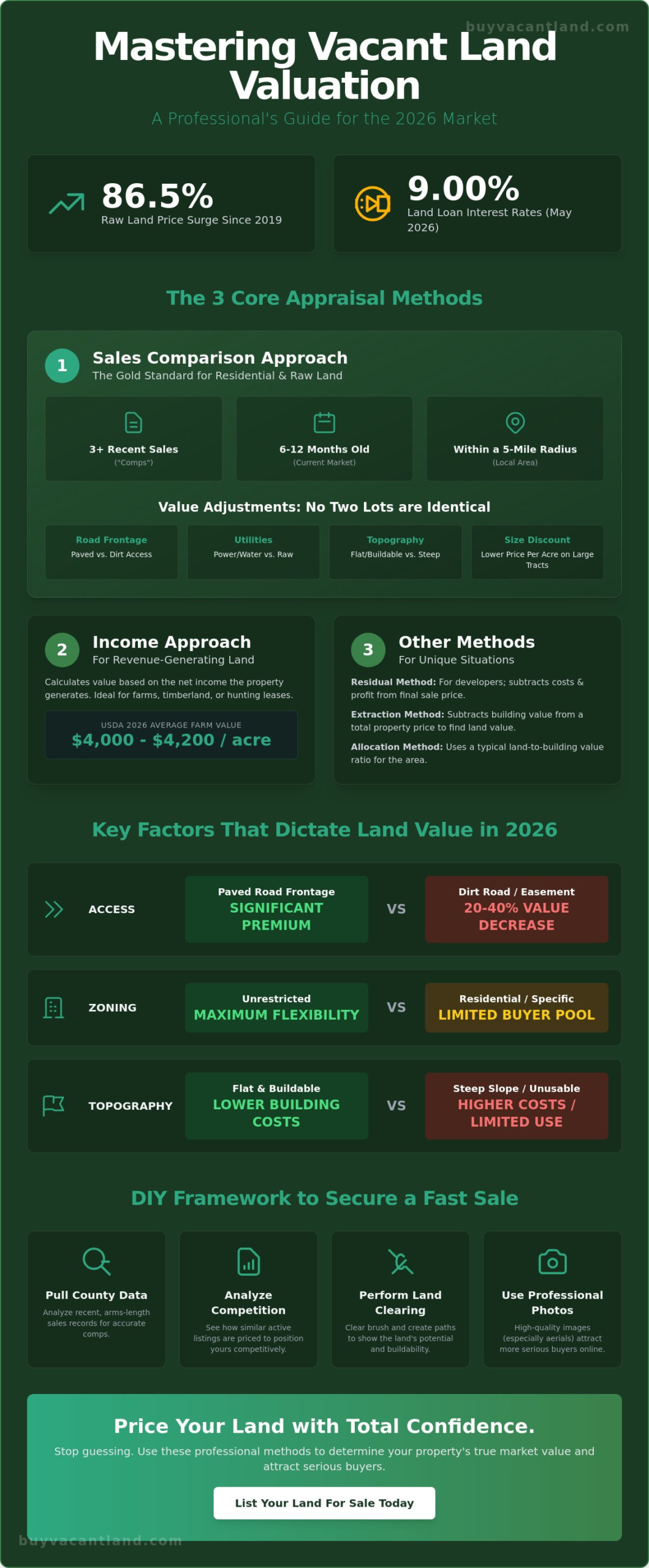
Raw land prices have surged by 86.5% since the first quarter of 2019. This massive growth means your acreage is likely worth more than you realize, but you cannot cash out if you cannot price it accurately. With interest rates for land loans hitting 9.00% in May 2026, buyers are more selective than ever. It’s frustrating to look at a vacant lot and wonder how “comparables” work when there are no houses in sight. You don’t want to spend $2,000 on a professional appraisal only to watch your listing sit on the market for months.
Mastering the right vacant land appraisal methods is the only way to ensure you get a fair price and a fast closing. You deserve a clear path to valuing your property without the guesswork. This 2026 guide explains the three core valuation strategies, provides a checklist of factors that drive up land value, and gives you the tools to list your property with total confidence. Stop worrying about zoning or utility access and start pricing your land like a professional.
Key Takeaways
- Benchmark your residential lot using the Sales Comparison Approach to find accurate local market values.
- Identify how “unrestricted” zoning and buildable topography drive up your asking price in the 2026 market.
- Master specialized vacant land appraisal methods like the Income Capitalization Approach for farms and hunting properties.
- Follow our DIY framework to pull county data and analyze active competition before you list your property.
- Learn how land clearing and professional photos can secure a fast sale without the cost of a formal appraisal.
The Sales Comparison Approach: The Gold Standard for Vacant Land
You need hard data to price land correctly. The Sales Comparison Approach is the most reliable of all Real estate appraisal methods for raw acreage. It works by analyzing what buyers actually paid for similar land in your immediate area. For residential lots and small parcels, this is the gold standard. It reflects current market demand and buyer behavior. You must follow the “Three Comp” rule to establish a valid estimate. One sale is a fluke. Two sales are a coincidence. Three recent sales provide a solid baseline for your property value. This strategy is the foundation of modern vacant land appraisal methods.
Identifying Valid Land Comparables
Accuracy depends on the quality of your data. Don’t use family transfers, “love and affection” deeds, or forced foreclosures. You need “arms-length” transactions. These are sales between two unrelated parties where both act in their own self-interest. Focus on sales recorded within the last 6 to 12 months. The 2026 market moves fast. A price from 2024 is irrelevant today. Search your county records or use online listing platforms to find these numbers. Look for parcels within a five-mile radius for the most accurate results. Ensure your comparables have the same “highest and best use” designation. A residential lot is not a valid comparison for a parcel zoned for industrial use.
Common Adjustments in Land Valuations
No two pieces of land are identical. You must “plus” or “minus” value based on specific features. A comparable sale is a property that a buyer would consider an alternative to the subject land. Start with the “Size Discount” adjustment. A 10-acre lot rarely costs exactly ten times more than a 1-acre lot. Larger parcels typically have a lower price per acre because the pool of buyers is smaller. Road frontage is another critical factor. A parcel with paved road access commands a significant premium. Dirt road access or limited easements can reduce value by 20% to 40%. Utilities also drive adjustments. If a comp has a well and septic already installed, subtract that cost from your subject property’s estimated value if your land is still raw. Topography forces adjustments too. If a comparable lot is flat and your land is on a 30-degree slope, you must decrease your price to account for higher construction costs. Professional vacant land appraisal methods require these precise calculations.
Advanced Valuation Techniques for Unique or Income-Producing Land
Standard sales comparisons don’t always work for specialized parcels. You need a strategy for land that earns its keep. The Income Capitalization Approach is the best choice for farms, ranches, and leased hunting properties. This method views the land as a business. It calculates value based on the net income the property generates. Professional appraisers study Advanced valuation techniques to handle these complex cases accurately. Another option is the Cost Approach. It estimates value by determining the cost to replace the land’s utility elsewhere. This is rare for raw land but useful for highly specific industrial sites.
When local sales data is missing, use the Extraction or Allocation methods. The Extraction Method takes a total property price and subtracts the value of all improvements like houses or barns. The remaining figure is your land value. The Allocation Method uses a typical land-to-building ratio for your county. If houses in your area usually represent 20% of the total property value, you apply that ratio to your site. These are critical vacant land appraisal methods for unique situations.
The Land Development (Residual) Method
Developers rely on the Residual Method to avoid overpaying. They start with the “Gross Sell-Out” value. This is the total price they expect to get from finished lots. They then subtract development costs. These include roads, sewers, and 2026 permit fees. They also subtract a profit margin. The leftover amount is the maximum price they will pay for the raw acreage. This method is the standard for industrial and commercial vacant lots where the end use is clearly defined.
When to Use Income-Based Appraisals
Timberland value depends on projected harvest yields and current mill prices. Agricultural land is often appraised using the cash-rent capitalization rate. The USDA reports the average farm real estate value at $4,000 to $4,200 per acre as of early 2026. These income-based numbers are essential for structuring owner financed land deals. Buyers need to know the land can support the payments. If your property generates revenue, list your land for sale to attract serious investors looking for yield.
Key Factors That Dictate Vacant Land Value in 2026
Every acre isn’t equal. Value depends entirely on what a buyer can legally and physically do with the dirt. Zoning is your primary value driver. If your land is zoned “Residential,” you have a specific buyer pool. If it is “Unrestricted,” you open the door to off-grid enthusiasts and tiny home builders. The California Department of Real Estate’s guide to appraisal confirms that the “highest and best use” of a property dictates its market price. You must check local codes before picking a number. For example, a North Carolina bill (NC S688) effective January 1, 2026, recently limited how local governments regulate building designs. This shift impacts how vacant land appraisal methods evaluate residential density and potential profit.
Utilities are the hidden cost of land ownership. Bringing electricity to a remote lot can cost $10,000 to $30,000 per mile. If your land is off-grid, its value drops compared to a lot with “power at the line.” Legal access is even more critical. Landlocked parcels are a seller’s nightmare. Without a recorded easement for a driveway, your property value can plummet by 50% or more. Buyers won’t touch land they can’t legally reach. These factors are non-negotiable in a professional valuation.
Physical Characteristics and Buildability
Buildability is binary; the land either works for construction or it doesn’t. Wetlands and flood zones are major deal-breakers. If 40% of your lot sits in a FEMA flood zone, your appraisal must reflect that loss of utility. A perc test is your most valuable document for residential lots. It proves the soil can handle a septic system. Without a passing perc test from a certified lab, you don’t have a home site; you have a very expensive garden. High ground always commands a premium because it’s cheaper to develop and provides better drainage.
Legal and Regulatory Constraints
Don’t ignore the fine print in your deed. Easements for shared driveways or utility lines can restrict where a buyer builds. These encumbrances often lower your fair market price. High-impact vacant land appraisal methods also look for up-zoning potential. If your rural land is near a growing city, it might be rezoned for higher density soon. This can double your value overnight. Always check the county’s 2026 master plan to see if your undeveloped acreage is actually a future development site. Hidden restrictions from HOAs or strict building codes can also shrink your buyer pool, so disclose these early to keep the sale moving fast.
A Step-by-Step DIY Framework for Estimating Land Value
You don’t always need to spend $2,000 on a professional appraisal. You can use the same vacant land appraisal methods experts use to get a reliable price estimate. Start by gathering your property data. Locate your Assessor’s Parcel Number (APN) on your latest tax bill. This number is the key to unlocking county records. Use it to verify your exact acreage and current zoning. Zoning can change, so check the 2026 county master plan for any recent updates that might affect your land’s use.
Next, analyze the competition. Search for cheap land for sale in your immediate area. Look for active listings that match your lot’s size and features. If three similar lots are sitting on the market at $20,000, yours won’t sell for $40,000. You must be realistic about the current supply. Once you see what others are asking, dig into the sold records. Listing prices are just wishes; sold prices are facts. Apply the sales comparison logic by finding at least three similar parcels that closed in the last six months. Adjust your final number based on unique features. A property with an existing well or a cleared building site commands more than a raw, overgrown lot. Once you have a firm price in mind, list your land for sale to attract serious buyers today.
Where to Find Reliable Sales Data
County assessor websites are the most reliable source for deed transfers. These sites show the actual price paid at closing. Filter your search to look at the last 180 days of activity. For large tracts of land, focus on the “Price per Acre” metric. A 50-acre ranch might sell for $3,000 per acre, while a half-acre residential lot nearby sells for $20,000. Don’t mix these two categories. Total price is useful for small lots, but price per acre is the standard for undeveloped acreage. Marketplace data is also helpful, but only if you filter for “Sold” listings to see what actually moved.
Avoiding Emotional Pricing Traps
Don’t let your feelings dictate your listing price. The “What I Paid” fallacy is a common mistake. If you bought land for $15,000 twenty years ago, that figure doesn’t matter to a buyer in 2026. The market only cares about current demand. Market value is what a willing buyer pays a willing seller, regardless of sentiment. Avoid the “Neighbor Said” trap too. Hearsay about a nearby sale is often inaccurate or missing critical details like owner financing terms. Trust hard data from recorded deeds over neighborhood rumors to ensure your land sells fast.
Maximizing Your Land’s Value for a Fast Market Sale
You have analyzed the data and understand your property’s worth. Now you must present it to the market to capture that value. A formal appraisal is a useful tool, but it is not always a requirement. You don’t always need to pay the national average of $2,000 for a certified report just to sell land. Most cash buyers and professional investors use their own internal vacant land appraisal methods to evaluate a deal. If your asking price is rooted in the hard data from our DIY framework, you are ready to move. Spend your budget on property improvements that drive higher offers instead.
Land clearing is one of the most effective ways to increase perceived value. A cleared building envelope or a mowed path allows a buyer to walk the property easily. This simple step can increase your final sale price by 15% or more. Professional photography is also non-negotiable in 2026. Buyers rely on high-resolution images and drone shots to judge topography and road access. On April 23, 2026, the Appraisal Standards Board adopted Advisory Opinion 41, which emphasizes the role of technology in modern valuations. Use this to your advantage. High-quality digital media provides the data that both buyers and appraisers need to justify a premium price.
Preparing Your Land for Listing
Help your buyer visualize their future on the lot. Mark your property boundaries with visible stakes or bright flags. You don’t need a full $1,500 survey for this; just use your plat map and a GPS app to find the corners. This prevents trespassing and builds confidence during site visits. You should also secure a Preliminary Title Report before you list. This document proves your land is “clean” and ready for a fast closing. It eliminates the fear of hidden liens or ownership disputes. Finally, highlight specific use cases in your marketing. Don’t just list “acreage.” Label it as “Perfect for Off-Grid Living” or “Hunting Ready” to attract targeted buyers immediately.
Listing on BuyVacantLand.com
Traditional real estate agents often focus on houses and neglect raw land listings. You can skip the high commissions and the red tape. Listing on a specialized marketplace connects you with a national audience of cash buyers and developers. These are people who specifically want undeveloped dirt. This direct exposure ensures you find the “highest and best” price through active market competition. You deserve an efficient, solution-oriented selling experience. List your vacant land on our marketplace today and get your property in front of thousands of active investors instantly.
Take Control of Your Land’s Value Today
You now have the tools to price your property like a seasoned professional. You understand how to use the Sales Comparison Approach to find real market data from 2026 deed transfers. You know that buildability, zoning, and legal access are the true drivers of value. Applying these vacant land appraisal methods saves you time and prevents expensive pricing mistakes. Don’t let your acreage sit idle while the market moves. You have the data to back up your asking price and the confidence to negotiate with any buyer.
Stop overpaying for traditional real estate services that don’t understand raw land. We offer a specialized marketplace built for undeveloped parcels only. You get direct access to a national network of cash buyers looking for residential lots, farms, and off-grid acreage. We guarantee zero commissions and zero hidden fees. This is the fastest way to turn your unwanted dirt into a liquid asset without the typical real estate red tape.
List your land for sale on BuyVacantLand.com and start the process now. You’ve done the research. It’s time to secure your fair market price and move on to your next project.
Frequently Asked Questions
What is the difference between an appraisal and a tax assessment?
An appraisal determines the current market value based on what a buyer will pay today. A tax assessment is a figure generated by the local government to calculate property taxes. Assessments often rely on mass valuation models and can lag behind actual market prices by 12 to 24 months. You should never use a tax bill to price your land because it rarely reflects the 86.5% surge in raw land prices seen since 2019.
Can I use the Sales Comparison Approach for land with no nearby sales?
You can use the extraction or allocation method when local data is scarce. These vacant land appraisal methods involve looking at similar parcels in neighboring counties or subtracting building values from improved property sales. You must find land with the same “highest and best use” to keep the estimate valid. If no raw land has sold nearby, developers often look at the price of finished lots and work backward to find the value of your acreage.
How much does a professional vacant land appraisal cost in 2026?
The national average cost for a vacant land appraisal is $2,000 as of April 6, 2026. Fees typically range from $1,000 for simple residential lots to $6,000 for large, complex commercial tracts. The price depends on the property’s size, its remoteness, and the amount of research required. If the appraiser has to travel long distances to find comparables, expect to pay on the higher end of that spectrum.
Does having utilities on-site significantly increase land value?
On-site utilities can increase your property value by 20% to 30% compared to raw, off-grid land. Bringing electricity to a remote lot can cost between $10,000 and $30,000 per mile in 2026. Buyers pay a premium for “shovel-ready” land because it eliminates the high cost and long wait times associated with utility installation. Having a well and septic already permitted adds even more to your fair market price.
What happens if my land is appraised for less than I owe?
You must pay the difference at the closing table if the appraisal comes in lower than your remaining debt. Lenders will not fund a loan for more than the appraised value of the property. This is known as being “underwater” on your land. You might need to negotiate a short sale with your lender or wait for further market appreciation to cover the gap before you list.
Is a land survey required for an appraisal?
A survey is not strictly required for an appraisal, but it is highly recommended for accuracy. Appraisers usually rely on county plat maps and aerial imagery to estimate boundaries. However, a survey confirms the exact acreage and identifies encroachments that could lower your value. If there is a dispute over a fence line or a shared driveway, a survey is the only way to prove what you actually own.
Can I appeal a low land appraisal for a mortgage?
You can appeal a low valuation by filing a formal Reconsideration of Value (ROV). You must provide the appraiser with at least three recent comparable sales that they missed in their initial report. These sales must have occurred within the last six months to reflect current 2026 market conditions. Pointing out specific features like new road frontage or utility hookups can also help justify a higher number.
How does zoning change affect my property’s appraised value?
Zoning changes can double or triple your property’s value overnight if the land is “up-zoned” for higher density. Moving from “Agricultural” to “Residential” or “Commercial” opens the door to more profitable development. This shift increases the number of potential buyers and the total income the land can generate. Always check your local 2026 master plan to see if your area is slated for rezoning, as this directly impacts all vacant land appraisal methods.




Join The Discussion