
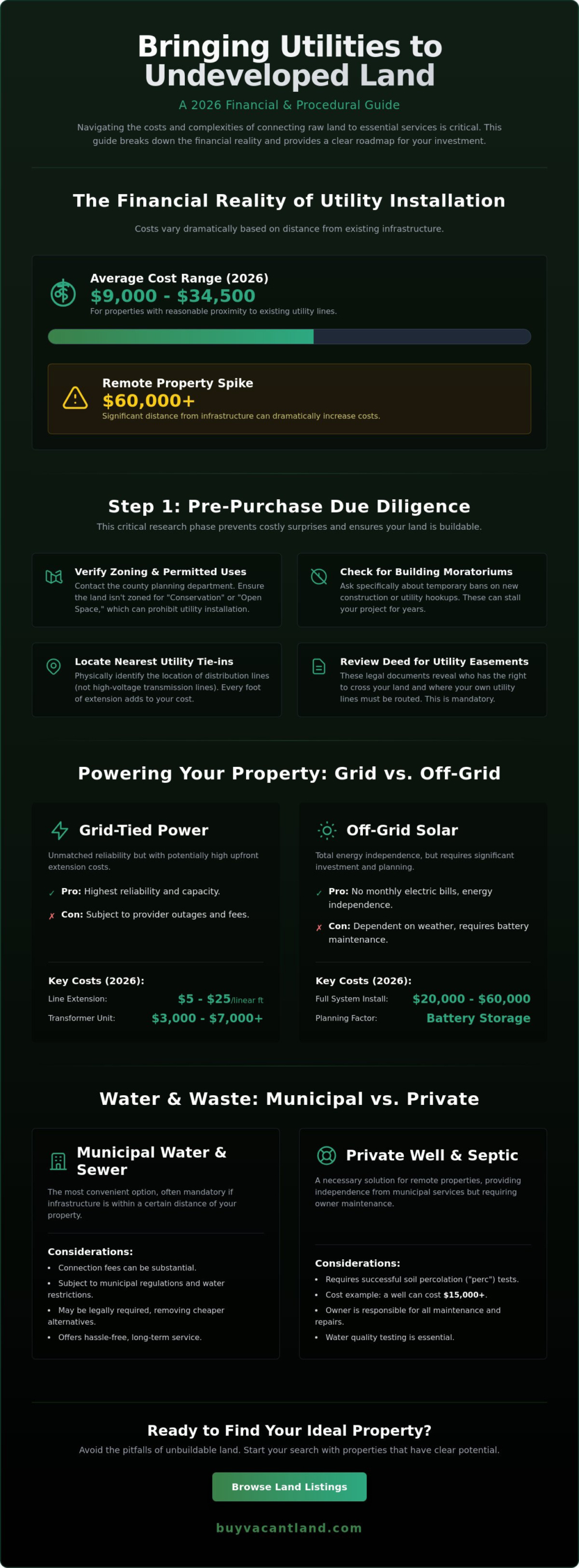
Did you know that the average cost to bring utilities to a vacant lot in 2026 ranges from $9,000 to $34,500? That figure can quickly spike to $60,000 or more if your land sits too far from existing infrastructure. It’s a significant financial risk that often stops buyers before they even start. You’re likely feeling the stress of choosing a parcel that might be unbuildable due to hidden costs or complex permit requirements. Mastering how to get utilities on undeveloped property is the only way to ensure your investment stays viable and your budget remains intact.
You need a clear path forward, not a maze of government red tape and confusing utility company demands. We’ve built a pragmatic roadmap to help you secure power, water, and waste systems with total efficiency. This guide delivers a step-by-step checklist of who to call first and how to avoid properties with impossible utility hurdles. You’ll understand the real differences between municipal services and private options like $15,000 wells or $60,000 off-grid solar systems. We’re cutting through the noise to give you the facts you need for a swift, assured transaction.
Key Takeaways
- Verify zoning status and locate physical tie-in points before you commit to a purchase to avoid expensive infrastructure surprises.
- Evaluate the cost-benefit of grid extensions against stand-alone solar systems by requesting a direct line estimate from your local electric cooperative.
- Compare municipal water and sewer connections with private well and septic options to determine the most cost-effective long-term solution for your specific parcel.
- Master how to get utilities on undeveloped property by coordinating trenching schedules and securing legal easements for lines that must cross adjacent land.
- Understand how transitioning from raw land to an improved lot maximizes your property value and attracts a wider pool of ready buyers.
Step 1: Conduct Due Diligence and Utility Research
Successful land development depends on data, not assumptions. Verify the current zoning status of the parcel before you request any services. Zoning laws dictate what you can build and which public utilities are permitted. If the land is zoned for “Open Space” or “Conservation,” bringing in power lines might be prohibited. Contact the county planning department immediately. Ask specifically about current building moratoriums. These temporary bans on new construction or utility hookups can stall your project for years. You don’t want to own land you can’t use.
Identify the exact location of the nearest existing utility tie-ins. Don’t assume the line at the road is available for your use. Some lines are high-voltage transmission lines that you cannot tap into. You need distribution lines. Searching for existing utility easements on the property deed is also mandatory. These documents reveal who has the right to cross your land and where your own lines must go. Use this checklist during your initial research phase:
- Current zoning classification and permitted uses
- Active building moratoriums in the county
- Existing utility easements on the property deed
- Proximity to the nearest distribution lines
Learning how to get utilities on undeveloped property requires a deep dive into local records. If you skip this, you risk buying a parcel that’s functionally unbuildable.
Checking Proximity and Feasibility
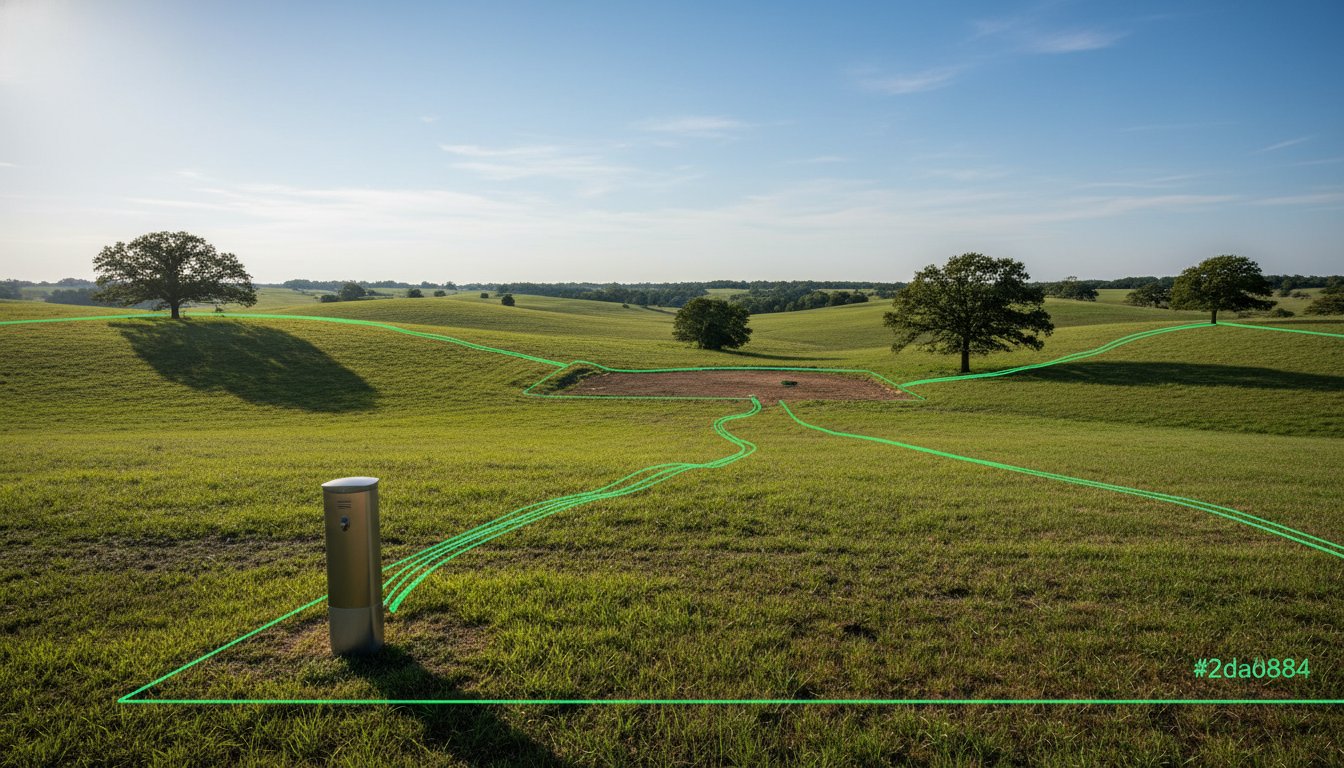
Distance is the primary driver of your installation costs. Use a rangefinder or a professional tool to measure the distance from the property line to the nearest utility pole or water main. Every foot of extension adds to your final bill. Look at the neighboring properties. If they have active municipal connections, your path is likely simpler. If they rely on private wells and septic, you should prepare for the same. Hire a local surveyor early in the process. They can mark potential utility corridors and identify the exact physical location of the nearest tie-ins. This eliminates the guesswork from your budget and ensures you have a viable plan before you break ground.
Understanding Zoning and Legal Restrictions
Identify setbacks and “no-build” zones that restrict where you can place utility lines. These legal boundaries often dictate the entire layout of your property. Confirm if the county requires specific utility types. In some jurisdictions, a mandatory sewer hookup is required if the municipal line is within a certain distance of the property. This rule can eliminate the option for a cheaper septic system. Review our beginner’s guide to buying land for more due diligence basics. Understanding these legal realities is the only way to master how to get utilities on undeveloped property without making costly procedural errors. You must clear these hurdles before moving to physical construction.
Bringing Power to Raw Land: Grid-Tied vs. Off-Grid
Deciding how to get utilities on undeveloped property starts with a critical choice: the local electrical grid or a stand-alone solar system. Grid-tied power provides unmatched reliability but carries high upfront extension costs. If your build site sits far from the road, you must account for transformer requirements to maintain voltage. These units typically add between $3,000 and $7,000 to your total bill. Contact your local electric cooperative immediately for a line extension estimate. They’ll tell you exactly where the existing line ends and what it costs to bring it to your property line. In 2026, typical costs for these extensions range from $5 to $25 per linear foot.
Don’t wait for your house to be finished to secure electricity. Request “builder power” or a temporary service pole during the initial construction phase. This allows your contractors to run tools and lights without relying on expensive portable generators. It’s a small logistical step that prevents massive site delays. If you’re still searching for the right location, you can browse off grid land listings to see which parcels are best suited for alternative energy or near existing infrastructure.
The Grid Connection Process
Submit a load calculation sheet to your utility provider as your first step. This document tells the utility company how much electricity your specific home will consume. Without it, they cannot size your transformer or lines correctly. You also need to obtain a permit for the meter base and main disconnect. This usually requires a formal inspection from the county before the utility company will finalize the hookup. Always coordinate with a licensed electrician for the final connection. They ensure your system meets all 2026 safety codes and local regulations.
Off-Grid Power Alternatives
Off-grid systems offer total independence but require rigorous planning. Assess your property’s solar potential by checking the aspect and canopy cover. Dense trees or northern slopes can significantly reduce your energy production. A full-scale solar system with batteries for a standard home in 2026 typically costs between $20,000 and $60,000. Evaluate your battery storage requirements to ensure 24/7 reliability during the winter months. Many owners now opt for hybrid systems. These pair solar arrays with propane generators as a backup. This setup ensures you have power even when the sun doesn’t shine for several consecutive days.
Solving Water and Sanitation: Municipal vs. Private Systems
Securing water and sanitation is the most critical phase of how to get utilities on undeveloped property. If the land cannot support a septic system or access a reliable water source, it’s effectively unbuildable. You must compare the long-term costs of municipal water against drilling a private well. Connecting to a city water supply generally costs between $1,000 and $6,000. In contrast, drilling a new well typically costs between $5,000 and $15,000. This price fluctuates based on the required depth, which can range from $25 to $65 per foot. Understanding these costs is essential for anyone learning how to get utilities on undeveloped property without overspending.
Always identify state-mandated water rights or usage restrictions before signing a land contract. In many western states, owning the surface land does not guarantee the right to use the water beneath it. Schedule a percolation (perc) test before you finalize any land purchase. This test, which costs between $450 and $2,300, determines if the soil can absorb liquid waste. If the soil fails, you may be forced to install an advanced septic system costing over $20,000. Don’t skip this step. A failed perc test can immediately slash your property’s market value.
Water Supply Options
Determine the specific tap-on fees for municipal lines by calling the local water district. These fees are often separate from the actual trenching and plumbing costs. If you choose a private well, research local drilling depths and water quality standards from neighboring records. Some areas have high sulfur or iron content that requires expensive filtration systems. For properties with low-yield wells, explore cistern systems. These tanks store water delivered by truck or collected from low-flow wells to ensure you have enough volume for peak daily usage.
Waste Management and Septic Planning
Understand the difference between conventional and aerobic septic systems. Conventional systems are cheaper, costing between $3,400 and $11,500. Aerobic systems are necessary for poor soil conditions but cost significantly more. Map out your drain field location early. This area must remain clear of all structures, driveways, and heavy vehicles to prevent soil compaction and system failure. If municipal sewer is an option, check the requirements for line extensions. Connecting to a city sewer system ranges from $1,500 to $10,900. This is often a better long-term investment than maintaining a private septic tank.
Managing Logistics: Easements, Permits, and Site Prep
Logistics are where most land development budgets fail. You must secure legal easements if your utility lines need to cross a neighbor’s property. Without a recorded easement, a utility company will refuse to extend service. This isn’t a handshake deal. You need a formal agreement drafted by a real estate attorney. Coordinate your trenching schedule to lay multiple lines simultaneously. Digging once for power, water, and fiber optic saves thousands in labor and machinery costs. It’s the most efficient way to handle how to get utilities on undeveloped property.
Obtain all necessary right-of-way permits from the Department of Transportation if your lines connect near a state-maintained road. This process often takes several weeks. Start early to avoid delays. Prepare the site by clearing brush and trees from your planned utility corridors. Utility crews need a clear, flat path to operate heavy equipment. Permits for utility installation in 2026 typically range from $500 to $5,000. These costs are non-negotiable and must be factored into your initial budget. If you haven’t secured a parcel yet, you can find undeveloped vacant land that already has these corridors identified.
Navigating Easements and Access
Draft formal easement agreements with a real estate attorney to protect your long-term access. These documents must be precise. They should define the exact width and location of the utility path. Verify existing owner financed land contracts for specific utility clauses. Some sellers retain certain rights or have pre-negotiated access points. Ensure all easements are recorded with the county clerk. If it’s not on the deed, it doesn’t exist for the next buyer. This legal clarity is vital for maintaining your property’s value.
Permitting and Inspections
Identify the exact sequence of inspections required by your local building department. You usually need an open-trench inspection before you can bury any lines. If you cover the pipes too soon, the county will force you to dig them back up. Schedule a “Call Before You Dig” (811) service at least 48 hours before any excavation. This service marks existing lines to prevent life-threatening accidents and costly repairs. Maintain a physical file of all signed-off permits. This documentation proves your property is fully compliant and ready for construction. Mastering how to get utilities on undeveloped property means staying organized from day one.
How Utility Access Impacts Property Value and Sellability
Utility access is the ultimate value multiplier in real estate. It creates the dividing line between “raw land” and “improved lots” in the 2026 marketplace. Raw land is a speculative asset that carries significant risk for a buyer. An improved lot is a shovel-ready project. When you solve the puzzle of how to get utilities on undeveloped property, you remove the primary barrier to construction. This shift dramatically increases the pool of eligible buyers. Most traditional lenders refuse to finance land without a clear path to water and power. By installing these systems, you make your land “bankable” for the next owner.
Analyze the ROI of bringing utilities to cheap land for sale before you list it. If you spend $15,000 to extend a water main and clear a utility corridor, the market value of the parcel often jumps by significantly more than your initial investment. You aren’t just selling dirt. You’re selling time and certainty. Prepare a comprehensive “Utility Packet” for prospective buyers. Include your perc test results, utility company estimates, and recorded easements. This transparency builds immediate trust and accelerates the closing process.
Marketplace Positioning for Sellers
Use utility status as your primary differentiator. Listings that lead with “Utilities at the Street” or “Permitted for Septic” receive significantly more engagement than generic descriptions. Explain exactly how these improvements reduce buyer friction. Position your land as a turnkey development opportunity rather than a logistical headache. In a market where 54% of urban dwellers are looking to downsize to rural areas, providing a clear path to hookups is your best sales tool. It transforms a complex project into a simple transaction.
Investment Strategies for Buyers
Smart investors identify undervalued parcels that have hidden utility potential. Look for properties where the grid ends just a few hundred feet away or where neighboring wells are shallow and high-yielding. Calculate your “all-in” costs by adding the utility installation estimates to the purchase price before you commit. This prevents you from overpaying for a lot that requires $60,000 in infrastructure. Consult BuyVacantLand.com for listings that already feature existing infrastructure or detailed utility disclosures. Mastering how to get utilities on undeveloped property allows you to spot these high-margin opportunities before the rest of the market catches on.
Secure Your Land’s Future Today
Bringing infrastructure to raw land doesn’t have to be a financial disaster. Success comes down to early verification and aggressive coordination. You now understand that zoning research and perc tests are mandatory before any purchase. You also know that coordinating trenching for power, water, and fiber optic lines can save thousands in labor costs. Mastering how to get utilities on undeveloped property transforms a risky asset into a high-value, shovel-ready lot. It’s the only way to ensure your project stays on schedule and under budget.
Efficiency is the best tool for protecting your investment. Don’t waste time on parcels with impossible utility hurdles or hidden legal restrictions. Our national marketplace provides a direct connection between land owners and buyers, cutting through traditional procedural noise. We offer specialized listings for residential lots, farms, and off-grid land suited for your specific goals. Browse Vacant Land Listings with Utility Access to find your next property today. You have the roadmap. Take the final step toward ownership with total confidence and peace of mind.
Frequently Asked Questions
How much does it typically cost to bring utilities to raw land?
Bringing utilities to raw land typically costs between $9,000 and $34,500 in 2026. This range includes standard connections for power, water, and a conventional septic system. Remote parcels requiring long line extensions can easily see these costs exceed $60,000. You must obtain specific quotes from local providers to account for your property’s unique distance from existing infrastructure.
Can I get a loan to install utilities on undeveloped property?
You can bundle utility installation costs into a comprehensive construction loan. Most traditional lenders don’t offer standalone loans for utility improvements on vacant land because the collateral is limited. Local credit unions are often the most reliable source for land development financing. They understand regional costs and can provide more flexible terms than national banks.
What is the first utility I should install on my vacant lot?
Electricity is usually the first utility you should install to provide “builder power” for construction tools. However, you must confirm your water and waste systems are viable before committing to an electrical hookup. A failed percolation test makes a lot unbuildable regardless of power access. Secure your septic permit and water source before laying any electrical lines.
How do I find out where the nearest utility lines are located?
Contact the local utility companies and the county planning department to identify the closest tie-in points. You can also walk the property perimeter to look for utility poles, transformers, or water meter boxes. Hire a professional surveyor to map these locations precisely. This ensures your site plan is accurate and prevents expensive mistakes during the trenching phase.
Do I need an easement to bring power to my property?
You need a legal easement if your power lines must cross any portion of a neighbor’s property. Utility companies will refuse to begin work until a formal, written easement is recorded with the county clerk. This document ensures permanent access for maintenance and repairs. Handshake deals are insufficient and will cause significant delays during the permitting process.
What happens if my land fails a percolation test for septic?
Failing a percolation test means your soil cannot absorb liquid waste through a conventional system. You’ll be forced to install an advanced aerobic or engineered mound system, which often costs over $20,000. These systems require more space and regular professional maintenance. Always include a successful perc test as a contingency in your land purchase agreement to protect your investment.
Is it cheaper to go off-grid than to connect to the city grid?
Connecting to the city grid is generally cheaper if the distribution lines are already at the road. A standard power hookup typically ranges from $2,500 to $12,500, while a full off-grid solar system with batteries starts at $20,000. Mastering how to get utilities on undeveloped property requires comparing these specific quotes. Off-grid only becomes the economical choice when grid extension fees exceed the cost of a standalone power plant.




Join The Discussion