
You can still secure a five-acre parcel of raw land for less than the price of a used SUV. While traditional real estate markets feel like a closed door, the path to self-sufficiency remains open for those who look in the right places. Most people struggle with how to find cheap off grid land because they use the same bloated websites meant for suburban houses. You need a different strategy. You need to target unrefined parcels that lenders won’t touch and sellers want to move quickly.
It’s frustrating to see prices skyrocket in developed areas while banks demand 50% down payments for raw dirt. You likely fear buying a lemon property that lacks legal access or has hidden zoning restrictions that kill your plans. This guide solves those problems. You’ll learn the exact strategies to locate, evaluate, and secure affordable property without ever stepping into a bank. We’ll show you how to verify if a lot is truly off-grid capable and how to use owner financing to close the deal. Here is your 2026 roadmap to land ownership.
Key Takeaways
- Identify high-value “raw” land that lacks municipal utilities to secure the lowest possible price per acre.
- Learn how to find cheap off grid land by utilizing specialized marketplaces instead of traditional residential real estate websites.
- Verify legal road access and local zoning codes to ensure your property is actually usable for cabins or RVs.
- Secure your parcel through owner financing to avoid high down payments and traditional bank credit requirements.
- Filter searches by “Off-Grid” or “Owner Financed” to instantly locate parcels priced under $10,000 across the country.
What Defines Cheap Off-Grid Land in 2026?
Cheap land is not a mystery; it is simply land that lacks infrastructure. To understand how to find cheap off grid land, you must recognize that off-grid property operates independently of municipal water, sewer, and power networks. You can research What off-grid means to understand the systems you will need to replace. In 2026, the market value of a parcel is tied directly to its level of development. The less work a seller has done to the dirt, the less they can charge for it. Undeveloped vacant land is the most affordable entry point for new buyers because it represents a blank slate with zero modern conveniences.
Cheap land typically starts in the unrestricted or low-regulation categories. These areas are characterized by a lack of strict building codes or homeowner association (HOA) fees. This freedom allows you to build at your own pace and use alternative materials that would be banned in suburban environments. By focusing on the rawness of the land, you bypass the premiums charged for finished lots.
The Raw Land Advantage
Raw land offers a significant financial edge through lower carrying costs and taxes. Property taxes on a completely unimproved 20-acre lot are often negligible compared to land with a structure. Traditional developers avoid these parcels because they require too much capital to prepare for residential sales. This neglect creates a vacuum where you can find high-value acreage. A cheap parcel is just low-cost; a good value parcel is affordable because it is raw but still possesses legal access and buildable terrain. Target these neglected assets to secure your homestead without overpaying for someone else’s failed development project.
The Role of Utilities in Land Pricing
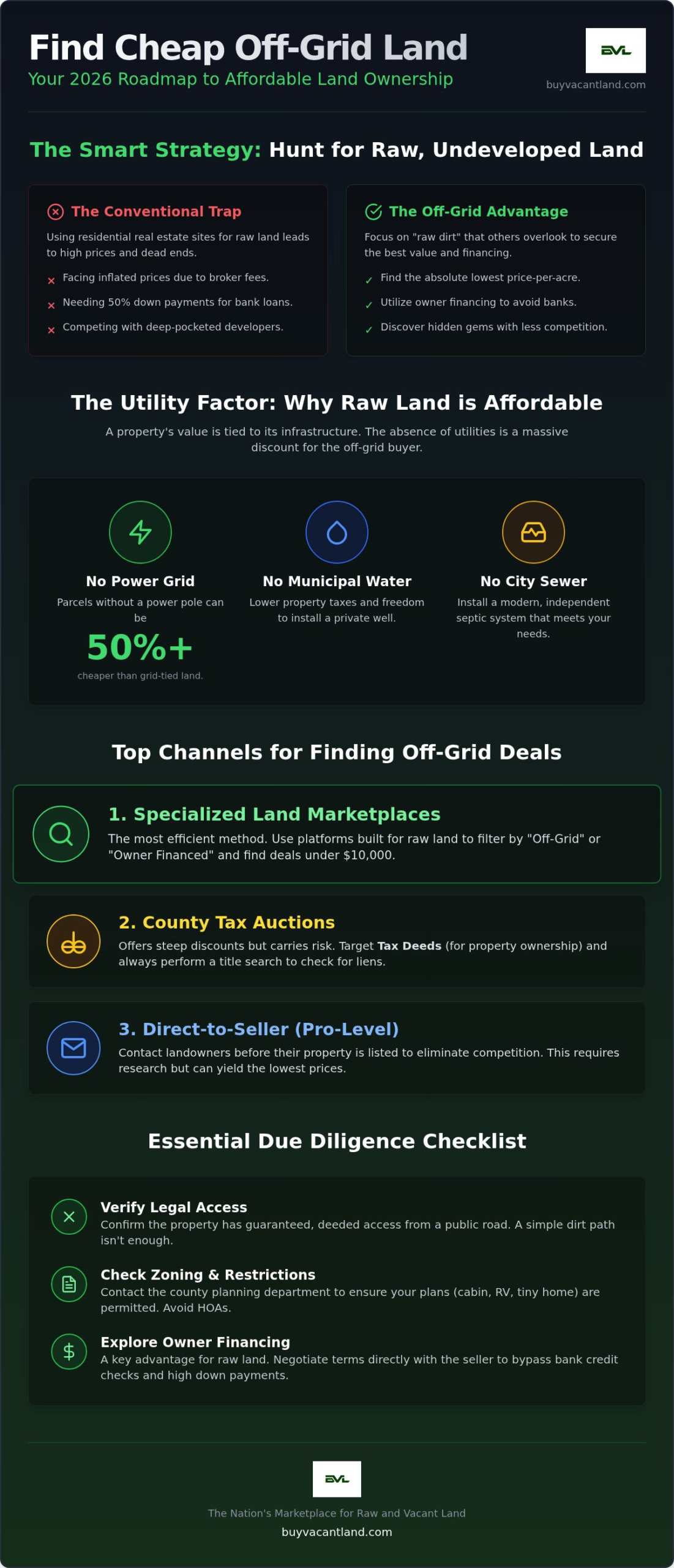
Utilities are the single biggest factor in rural land pricing. The absence of a power pole can drop the asking price of a property by 50% or more. Bringing in municipal power often costs tens of thousands of dollars per mile in 2026. If you plan to use a professional solar system, which typically costs between $20,000 and $60,000, you don’t need those municipal services. You are essentially getting a massive discount for a service you never intended to use.
Unimproved land is your best friend. It allows you to bypass the utility premium that most buyers are forced to pay. Always evaluate the cost of staying off-grid versus the inflated price of grid-tied land. Remember that unimproved is a technical term used by appraisers. It means the land has no structures, no well, and no septic. By searching for these specific terms, you cut through the listings meant for luxury cabin builders and find the wholesale-style deals that fit an off-grid budget.
The Best Channels for Finding Affordable Off-Grid Parcels
Retail real estate websites like Zillow or Redfin are designed for suburban homes. They are inefficient for land buyers. To understand how to find cheap off grid land, you must look where the wholesale deals live. Specialized land marketplaces offer focused results that skip the noise of residential listings. Wholesale land websites operate on high-volume and low-margins. They move raw land fast. You can also find deep discounts through county tax auctions or by marketing directly to sellers before their land hits the open market.
These channels bypass the traditional brokerage fees that inflate prices. By going straight to the source or using specialized platforms, you access inventory that never reaches the general public. This is the most effective way to secure a parcel before a developer spots the potential and bids up the price.
Utilizing Specialized Land Marketplaces
Platforms like BuyVacantLand.com allow you to filter specifically for off-grid keywords. This saves time. You don’t have to scroll through thousands of city lots. Set up alerts for specific price-per-acre thresholds. This ensures you see the deal the moment it goes live. If you are looking for a broad starting point, check this list of cheap land for sale to see national inventory trends. These marketplaces are superior because the sellers already understand the “raw land” buyer. They often include critical details like GPS coordinates and terrain descriptions that residential sites omit.
Exploring Tax Sales and Foreclosures
County tax auctions provide some of the steepest discounts available. You must understand the difference between tax deeds and tax liens. A tax lien gives you the right to collect debt; a tax deed gives you the property itself. Many off-grid parcels end up in tax delinquency because owners lose interest or forget about the small annual bills. Buying sight-unseen at these auctions is risky. Always perform a title search to ensure no other liens exist. Despite the risks, these sales are often where professional land flippers find their best inventory. If you want to skip the auction house stress, you can often find these same parcels listed by professionals on a national vacant land marketplace after the title has been cleared.
Direct-to-seller marketing is another pro-level strategy. It involves sending mailers to owners of vacant land in specific counties. You find the land before it reaches a marketplace. This eliminates competition. It requires more effort but yields the lowest possible prices. If you prefer a faster path, browsing a curated national database is often more efficient for the average buyer. This allows you to compare multiple parcels side-by-side without the overhead of a direct mail campaign.
Evaluating Suitability: Is That Cheap Land Actually Usable?
Cheap land is only a deal if you can actually use it. If you are researching how to find cheap off grid land, you must verify legal access before signing any paperwork. Never buy landlocked property without a deeded easement. Without legal access, you cannot build, and you may face trespassing charges just to reach your own dirt. Check the plat map and the title report during your due diligence. If the access is prescriptive or unrecorded, walk away. Practical ownership starts with a clear, legal path to your front gate.
Zoning and Building Codes
Unrestricted land is the gold standard for off-grid living. It allows you to avoid the bureaucratic hurdles of suburban life. You must call the county planning department before you buy. Ask specifically about minimum square footage requirements. Many counties mandate that a dwelling must be at least 600 or 1,000 square feet. This requirement kills your plan if you want a tiny home or a simple cabin. Verify if you can park an RV long-term or live in a tent while building. Don’t rely on the seller’s description. Get the facts directly from the officials who enforce the codes.
The “Big Three” of Off-Grid Survival
Water is your most critical asset and your largest potential infrastructure expense. In 2026, drilling a water well typically ranges from $10,000 to $30,000. If the water table is too deep, you may need a rainwater harvesting and filtration system. These systems cost between $5,000 and $15,000. Hauling water is a temporary option, but it limits your long-term independence. Always check the depth of neighboring wells to estimate your costs.
Waste management is the second pillar. A basic septic system costs between $6,000 and $18,000. If the soil is too rocky or clay-heavy, it won’t pass a percolation test. This means you cannot install a traditional septic system. Composting toilets are a legal alternative in some low-regulation areas, but you must verify this with local health codes first.
Energy is the final piece. Your solar exposure determines your power potential. A professional 8-12 kW solar system with batteries costs between $20,000 and $60,000 in 2026. Ensure your parcel has a clear, south-facing slope or an open clearing. If the land is in a deep canyon or covered in dense forest, your energy costs will skyrocket as you buy more panels to compensate for the shade. Mastering these technical checks is the key to how to find cheap off grid land that is actually habitable.
Financial Strategies: Owner Financing vs. Cash
Traditional banks avoid raw land. They view it as high risk because there is no house to serve as immediate collateral. If you want to know how to find cheap off grid land, you must master alternative financing. Cash offers provide the heaviest leverage in this market. A cash buyer can often demand a 10% to 30% discount on the listing price. Sellers prefer the certainty of a quick close over the complexity of a financed deal. By removing the bank from the equation, you eliminate appraisal fees and long waiting periods.
In these transactions, you will encounter either a Land Contract or a Deed of Trust. A Land Contract means the seller retains the legal title until you pay the final installment. A Deed of Trust transfers the title to you immediately, while the seller holds a lien against the property. Always clarify which structure is being used before you send a deposit. This choice affects your legal rights if you miss a payment or want to sell the land later.
How Owner Financing Works for Off-Grid Land
Owner financing is the engine of the off-grid market. It bypasses credit checks and rigid income requirements. This is essential for buyers with non-traditional income or those who want to keep their debt off their credit report. For a deeper dive into these structures, read our guide on owner financed land. It explains how to protect your investment when buying without a bank.
Typical terms in 2026 involve interest rates between 6% and 12%. Down payments are often as low as $1,000. Be careful with balloon payments. These require you to pay the entire remaining balance in a single lump sum after a predetermined number of years. Ensure your budget can handle the payoff or that you have a plan to refinance before the deadline hits. Financing makes land accessible, but you must read the fine print.
Negotiating for the Best Price
Sellers of off-grid land are frequently more motivated than residential home sellers. Many of these parcels are held by out-of-state owners who inherited the property and have no intention of using it. Use this to your advantage. Research comparable sales in the same county to justify a lower offer. If a similar lot sold for less last month, bring that data to the table.
The “Quick Close” strategy is your best negotiation tool. Offer to close the transaction in 10 days or less. Sellers hate long escrow periods. By removing the wait time, you provide immediate relief to the seller, which they will often reward with a lower price. You can find these motivated sellers and start negotiating directly on our national land listing platform today.
Securing Your Deal on BuyVacantLand.com
You have the strategy. Now you need the inventory. BuyVacantLand.com provides a national database specifically for raw land buyers. This is the most direct path for anyone learning how to find cheap off grid land without the interference of residential agents. Most sites clutter your screen with houses and rentals. We don’t. We focus exclusively on vacant land parcels. This focus allows you to find wholesale-style deals that never appear on traditional retail platforms. Use our specialized filters to narrow your search by price, acreage, or specific off-grid features.
Our platform is designed to alleviate the stress of land ownership. We cut through the noise. You can view high-resolution topography maps and raw land features directly on the listing page. This transparency ensures you know exactly what you are buying before you ever leave your home. Speed is a massive advantage in the 2026 market. Our interface gives you that speed and the reliability you need to make a move.
Starting Your Search Today
Our search interface is built for efficiency. You can filter by “Off-Grid” or “Owner Financed” to skip thousands of irrelevant urban lots. This precision is why our marketplace is more efficient than general real estate sites. If you are a first-time buyer, read our beginner’s guide on how do you buy land. It provides a clear, numbered sequence for the entire transaction. You can set up custom alerts to receive notifications the moment a parcel under your budget hits the market. This ensures you are always first in line for the best deals.
Connecting with Land Sellers
Contact sellers directly through our platform to ask critical due diligence questions. Every buyer should ask about legal access, mineral rights, and any existing easements. Don’t assume the information is complete. Verify it. Our sellers frequently offer an equitable financial proposal that bypasses traditional bank hurdles. This means you can secure land with a low down payment and no credit check.
Review the listing for specific topography details. Is the land flat or sloped? Is it heavily wooded or cleared? These factors impact your solar potential and building costs. Once you are satisfied with the answers, you can move forward with confidence. Finalizing your purchase is simple. Follow the seller’s instructions, secure your deed, and start your off-grid journey. The land you want is available right now. Take the first step and secure your future homestead today.
Start Your Off-Grid Journey Today
Finding affordable acreage in 2026 requires a practical shift in your strategy. You must prioritize raw, undeveloped parcels and look beyond traditional residential websites. By understanding how to find cheap off grid land through specialized marketplaces and owner-financed deals, you bypass the high costs and rigid requirements of traditional banks. Success depends on verifying legal road access and confirming that local zoning allows for your specific off-grid plans. Don’t let the complexity of traditional real estate stop your progress.
BuyVacantLand.com is a dedicated national US land marketplace specialized in raw and off-grid parcels. Our platform facilitates direct-to-seller communication, allowing you to ask critical due diligence questions and secure an equitable financial proposal without the overhead of a middleman. We provide a streamlined, transparent environment to help you finalize your purchase with speed and certainty. You can filter by your exact budget and location needs to find the perfect match instantly.
Your path to self-sufficiency starts with the right piece of dirt. Browse Cheap Off-Grid Land Listings Now and secure your future today. Ownership is within your reach when you use the right tools.
Frequently Asked Questions
Is it legal to live off-grid in the United States?
Off-grid living is legal across the country, but local regulations create the actual hurdles. Most restrictions stem from county building codes or health department mandates regarding waste disposal. Some jurisdictions require a minimum square footage for dwellings or a connection to the power grid for a certificate of occupancy. Researching how to find cheap off grid land must include a check of local ordinances to ensure your lifestyle choice remains compliant with municipal laws.
What is the cheapest region to buy off-grid land?
Arid desert regions and remote rural counties with low population density generally offer the lowest price per acre. While prices fluctuate, undeveloped parcels in these areas are consistently the most affordable entry points for buyers. However, these low entry costs usually mean higher infrastructure expenses for water and solar power. Always factor in the total cost of development when comparing prices across different national markets to ensure the deal is actually a good value.
Can I get a loan for off-grid land?
Traditional banks rarely provide loans for raw land, but alternative options exist for savvy buyers. Most utilize owner financing or specialized land lenders who understand the value of undeveloped dirt. These options typically require a down payment between 20% and 50% with interest rates ranging from 6% to 12% in 2026. If you are learning how to find cheap off grid land, targeting sellers who offer bank-free financing is the most efficient path to securing a deal.
How do I know if land has water rights?
Water rights are often severed from the property title and must be verified independently before you close. Do not assume that owning the land gives you the right to the water beneath it. You must conduct a title search and consult with the state water authority to confirm your rights to drill a well or harvest surface water. In some regions, water usage is strictly regulated or owned by third parties. Securing these rights is essential for a viable homestead.
What does “unrestricted land” actually mean?
Unrestricted land refers to property that is free from Homeowners Association (HOA) rules and specific municipal building codes. This classification allows for maximum flexibility, such as living in an RV, building a tiny home, or using alternative materials. However, you must still comply with state-level health department regulations for waste management and environmental protection. Unrestricted land offers the freedom many off-grid buyers seek but requires a thorough understanding of the limited rules that still apply to the property.
Do I need a survey for a cheap off-grid lot?
Yes, a professional survey is the only way to verify the exact boundaries and legal acreage of your property. Relying on old fence lines or verbal descriptions is a significant risk that can lead to boundary disputes. A survey identifies encroachments, confirms total land size, and maps out any existing easements. In remote areas, these disputes are expensive and stressful to resolve. Investing in a survey during your due diligence ensures the land you buy matches the legal description.
How much does it cost to clear raw land for a home site?
Clearing costs vary based on vegetation density and terrain but typically range from $3,000 to $15,000 for a standard home site. Leveling an area for a foundation or an RV pad requires heavy machinery and experienced operators. Steep slopes or dense forests increase the labor and time required, driving up the total price. When budgeting for your off-grid project, always include a contingency for site preparation. This work is critical for establishing a stable area for your infrastructure.
What happens if I buy landlocked property?
Buying landlocked property means you have no legal way to access your land without a neighbor’s permission or a deeded easement. Without legal access, you are effectively trespassing every time you visit your property. Securing an easement of necessity through the court system is a slow and expensive process with no guaranteed outcome. To avoid this burden, always confirm that a parcel has direct frontage on a public road or a recorded legal easement before signing any purchase agreement.




Join The Discussion