
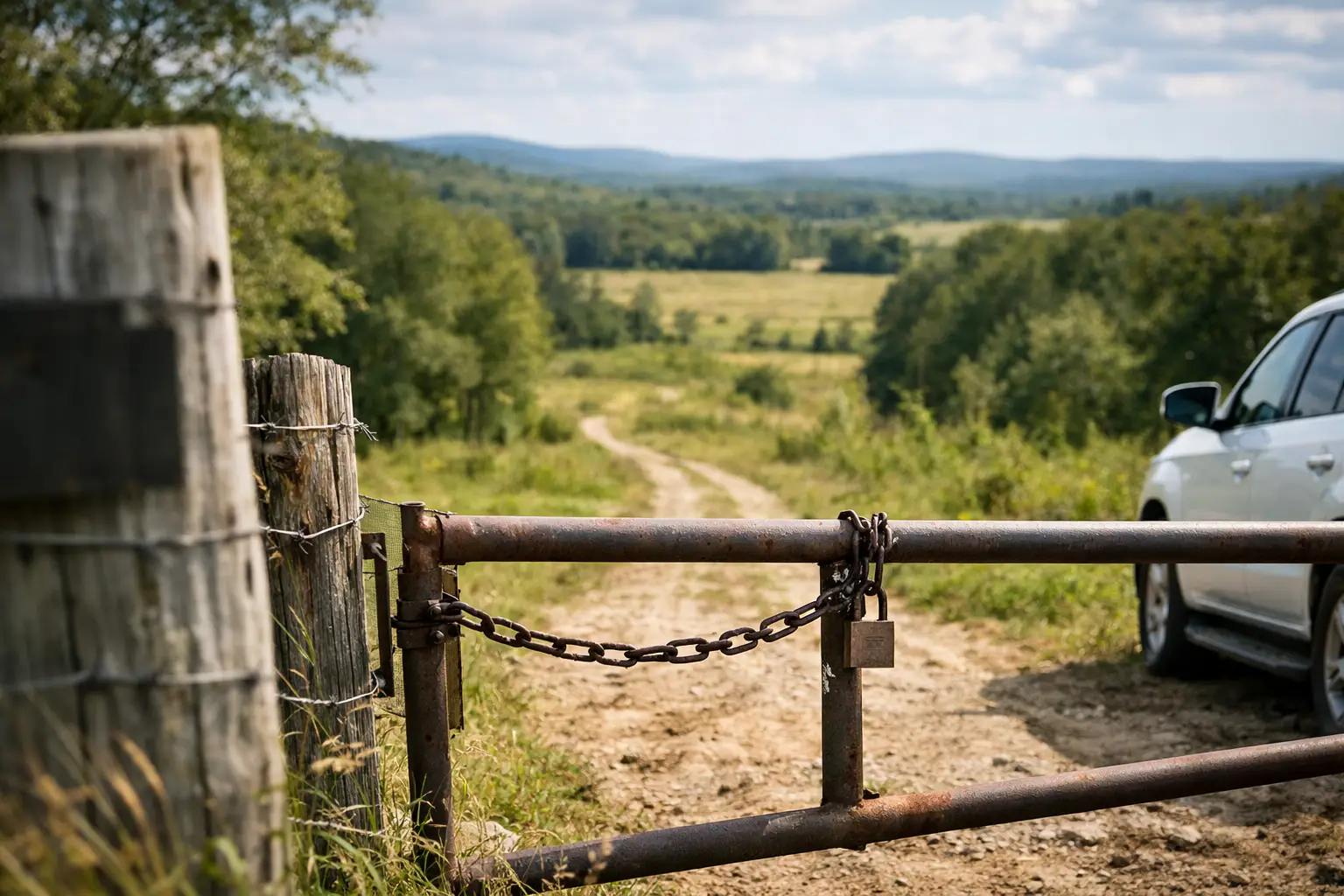
A low price on acreage can look like the opportunity of a lifetime – until you notice there is no recorded route from a public road to the property. So, can land have no legal access? Yes. A parcel can be legally owned, taxed, bought, and sold while lacking a documented right to cross neighboring land to reach it. That issue can turn an affordable property into a costly, difficult-to-use investment.
For buyers who want land for a cabin, homestead, hunting, recreation, or long-term appreciation, access deserves the same attention as price, zoning, utilities, and flood risk. A beautiful parcel is only valuable if you can legally and practically get to it.
Can Land Have No Legal Access?
Land with no legal access is often called landlocked. It is surrounded by other privately owned parcels, or separated from a public road by land the owner has no legal right to cross. The key word is legal. You may see a dirt trail, farm lane, logging road, or a neighbor’s driveway leading toward the property, but that does not automatically give you the right to use it.
Legal access usually comes from direct frontage on a public road or a recorded easement. An easement is a legal right that allows someone to use a specified part of another person’s property for a stated purpose, such as ingress and egress. It should be recorded in the county land records and clearly tied to the parcel being purchased.
Some landlocked properties have a history of informal access. A neighbor may have allowed the prior owner to pass through for years, perhaps without ever charging a fee. That arrangement can be friendly and convenient, but it is not the same as a permanent property right. The neighbor can sell, change their mind, install a gate, or limit use when the relationship changes.
Why Buyers Should Treat Access as a Deal Breaker Until Proven
Lack of access does not always mean a parcel is worthless. It does mean the buyer needs a clear plan before closing. Without legal access, you may be unable to drive onto the property, bring in equipment, build a home, place an RV, harvest timber, or obtain financing. Even if you can walk in, a lender, appraiser, future buyer, or contractor may view the property very differently.
Access also affects marketability. Cash buyers may consider a remote, landlocked parcel for hunting, conservation, or speculative investment. But the resale pool is smaller, which can make the property harder to sell and reduce its value compared with similar acreage that has reliable road frontage.
There is another practical distinction: legal access is not necessarily usable access. A recorded easement may cross a steep slope, flood-prone creek, narrow trail, or unimproved forest road. It may permit passage but not support a residential driveway, utility installation, heavy construction equipment, or year-round vehicle travel. The easement language and the physical ground conditions both matter.
How to Verify Legal Access Before You Buy
Never rely on an aerial map, a listing description, or a verbal assurance that a road is available. Those resources can help you identify questions, but they are not proof of access. Make legal access a written contingency in your purchase agreement whenever possible.
Start by reviewing the current deed and prior deeds in the chain of title. Look for language describing road frontage, easements, rights-of-way, reserved rights, or exceptions. A title company or real estate attorney can examine recorded documents and identify whether an access easement benefits the parcel.
Next, order a title search or title commitment. This can reveal recorded easements, restrictions, liens, and gaps that may affect your use of the land. If title insurance is available, ask the title professional whether the policy will insure the stated access. A policy does not replace your review, but it is an important layer of protection.
A survey is equally valuable, especially when roads, fences, or old trails do not line up with parcel boundaries. The survey can show whether the property touches a public right-of-way, where an easement lies, and whether the apparent route actually crosses someone else’s land. If the access corridor has not been surveyed or its description is vague, resolving that uncertainty may be worth the expense.
Finally, contact the county road department, planning office, or assessor’s office. Ask whether the adjacent road is public, private, county-maintained, or merely a paper road shown on a map. A road that appears on a plat may not be constructed or open for travel. Local officials can also explain driveway permit requirements, road maintenance policies, and any development standards that affect access.
Common Ways Landlocked Parcels Gain Access
The cleanest solution is a negotiated, recorded easement from a neighboring owner. In this arrangement, the buyer or seller agrees on the route, width, permitted uses, maintenance responsibilities, gate rights, utility rights, and payment. The agreement should be prepared and recorded properly so it runs with the land rather than depending on a handshake.
In some cases, a parcel may qualify for an easement by necessity. This is a legal concept that can apply when land was divided in a way that left one piece without access. State laws and court decisions vary, and proving necessity can require legal action, historical deed research, and time. Do not assume this remedy is automatic simply because a parcel is landlocked.
An easement by prescription may be claimed when someone has openly and continuously used a route for the legally required period without permission. This can be even more fact-specific and contentious. The route, duration, type of use, and state law all influence whether a claim exists.
Sometimes the best move is to buy a small connecting strip from an adjoining owner. A narrow piece of frontage can create direct road access and eliminate ongoing easement uncertainty. It can also be more expensive than expected, particularly if the neighbor knows your parcel has limited options. Still, for a property with strong long-term potential, acquiring access can add meaningful value.
Questions to Ask About an Existing Easement
A recorded easement is encouraging, but read beyond the word “easement.” The document should answer what you may do and what you may not do. Is it limited to the current owner, or does it benefit the parcel and future owners? Does it allow vehicles, guests, deliveries, construction equipment, and emergency services? Can utilities be installed in the corridor?
You also need to know who maintains the road. A gravel road may need grading, drainage work, tree clearing, culvert replacement, and snow removal. If several owners use it, the agreement should explain how costs are shared. Without a maintenance arrangement, access disputes can become expensive quickly.
Pay attention to width and route. A 10-foot easement may be enough for a basic trail but too narrow for some driveways, fire access expectations, or utility needs. If your goal is to build, place a manufactured home, use an RV regularly, or operate a small farm, confirm that the easement supports that intended use before you commit.
When a Landlocked Property May Still Be Worth Buying
There are situations where a parcel without immediate legal access can be a calculated opportunity. Perhaps it adjoins land you already own. Perhaps the seller is offering a deep discount, neighboring owners are open to a reasonable access agreement, and the property’s recreational or timber value justifies the work. Investors with patience, cash reserves, and professional guidance may find value where other buyers see complexity.
The discount must reflect the real risk. Budget not only for the purchase price, but also for surveys, title work, legal review, negotiations, road construction, permits, and possible litigation. If the numbers only work when every neighbor cooperates, the deal is probably too fragile.
For first-time buyers, a parcel with direct public road frontage or a well-documented, usable easement is usually the smarter choice. It keeps your options open, makes future financing and resale easier, and lets you focus on the reason you wanted land in the first place.
When searching land listings, make access one of your first filters rather than an afterthought. A promising property can still become your place to build, camp, hunt, or hold for the future – but only after the route in is as clear on paper as it is on the ground.



Join The Discussion