
What if the most expensive mistake you make this year is mispricing a piece of dirt because you ignored a new federal law? In 2026, the market has shifted. You cannot rely on outdated comps to determine the factors affecting land value. With the 21st Century ROAD to Housing Act now in effect, recent zoning reforms are rewriting the rules for residential and commercial lots across the country.
Pricing land shouldn’t feel like a guessing game. It’s stressful to worry about overpaying for a lot or leaving money on the table when you list. You need certainty and a clear path to a fair deal. This guide identifies the seven core variables that drive vacant land prices right now. You will get a clear checklist to value your property accurately, gain confidence in your listing price, and close deals faster.
Key Takeaways
- Learn why “highest and best use” determines your property’s market price more than simple acreage.
- Understand the critical role of road frontage and legal access in securing traditional financing and higher offers.
- Identify how physical constraints like topography and soil quality dictate a lot’s actual buildable potential.
- Analyze the current economic factors affecting land value, including interest rates and local inventory levels.
- Discover how simple improvements like clearing brush and providing a survey can lead to a faster, more profitable sale.
What Defines Vacant Land Value in 2026?
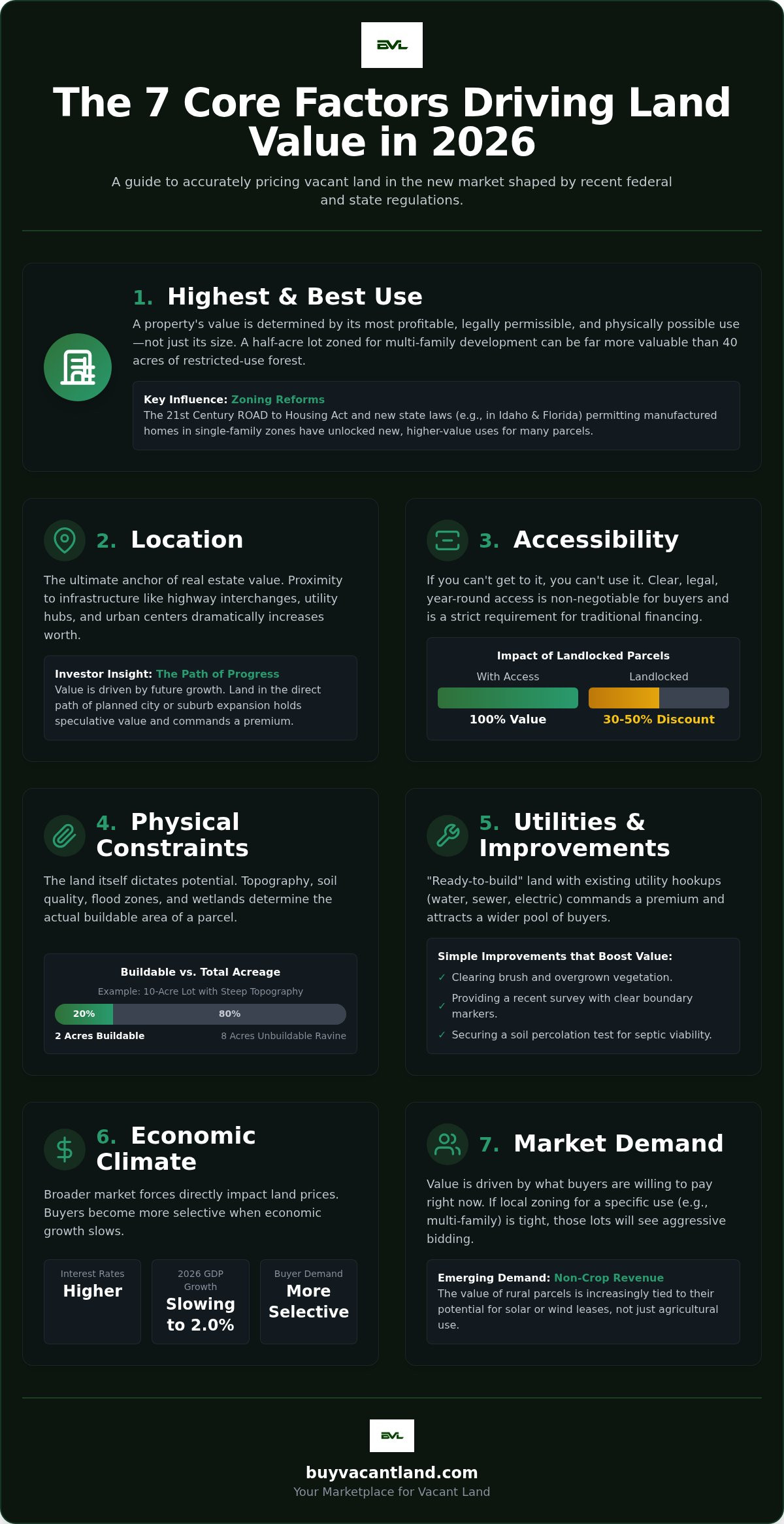
Land value is not just a price tag on a map. It is the monetary worth of a parcel based on its highest and best use. In the 2026 market, utility dictates price more than simple acreage. You might own 40 acres of forest, but if it lacks legal access or buildable soil, its value stays low. Conversely, a small half-acre lot with utility hookups and road frontage can command a premium. Understanding these factors affecting land value is the difference between a fast sale and a listing that rots on the market.
Scarcity drives the price. If local zoning for multi-family housing is tight, those specific lots will see aggressive bidding. Market demand reflects what a buyer is willing to pay right now, not what you hope it was worth five years ago. With 2026 GDP growth slowing to 2.0%, buyers are more selective. They want land that solves a problem or offers immediate utility. This is why non-crop revenue, such as solar leases, has become a massive driver for rural parcels. If your land can host a wind turbine or a solar array, its value is no longer tied strictly to soil fertility.
Land Value vs. Property Value
Don’t confuse land value with total property value. Property value includes every structure, fence, and well on the site. Land value focuses strictly on the raw earth and its inherent potential. Buildings are wasting assets. They require maintenance and eventually depreciate. Raw land is different. It is a finite resource. If the location is right, the dirt appreciates while the house on top of it falls apart. To value your land accurately, you must look past the old shed or the broken fence and evaluate the ground itself.
The Principle of Highest and Best Use
Appraisers use a specific lens called “Highest and Best Use.” They look for the most profitable, legally permissible, and physically possible use for your lot. A parcel zoned for a high-density apartment complex is worth more than one restricted to a single-family home. This assessment is a core part of the land development process. You must determine if your land reaches its maximum financial potential under current 2026 regulations.
The 21st Century ROAD to Housing Act has streamlined regulations for manufactured homes. If your lot is in Idaho or Florida, new state laws now require cities to permit these homes in single-family zones. This legal shift immediately increases the pool of potential buyers and boosts your bottom line. Always check if recent zoning reforms have unlocked new development paths for your property. These changes are among the most critical factors affecting land value today.
Location and Accessibility: The Primary Value Drivers
Location is the anchor of real estate. Road frontage provides the highest value because it guarantees easy entry for vehicles and equipment. Without it, your property is just an island. Proximity to major infrastructure like highway interchanges or utility hubs increases interest from both residential developers and commercial investors. Accessibility remains one of the most significant factors affecting land value in the 2026 market. If a buyer cannot reach the dirt, they will not buy it.
Access is non-negotiable for traditional financing. Banks won’t touch a property that doesn’t have a clear, legal path to the entrance. Landlocked parcels typically sell at a 30% to 50% discount compared to accessible lots. This steep price drop reflects the time and legal fees required to secure an easement. If you are looking at economic factors impacting farmland, you’ll see that accessibility is just as vital as soil quality. You can check current market prices for accessible lots on our vacant land marketplace to see this price gap in action.
The Path of Progress
Smart investors follow the path of progress. This means identifying land located in the direct line of city or suburb expansion. Future utility drives speculative value. Look for planned highway exits or utility extensions in your county’s five-year plan. If the city is moving north, buy north. Positioning your property in this trajectory is one of the strongest factors affecting land value. Speculators pay a premium for land that will be in high demand tomorrow.
Physical Access vs. Deeded Access
Do not confuse a visible dirt path with legal right-of-way. Deeded access ensures you have a permanent legal right to reach the lot. Physical access without a deeded easement is a liability. Neighbors can block your path at any time. Always verify access before you list your land for sale. A missing easement can kill a deal at the closing table. It creates uncertainty that scares away serious buyers and lowers your final sale price.
Physical and Legal Constraints on Land Value
The physical reality of the ground often clashes with the legal reality of the deed. You cannot value a property accurately without looking at what the law allows and what the earth supports. Topography determines how much of your acreage is actually buildable. If your 10-acre lot is 80% steep ravine, you only have 2 acres of true value. These physical and legal hurdles are primary factors affecting land value in 2026. Ignore them, and you will misprice your asset.
Environmental risks are absolute deal-killers. Properties in designated flood zones or containing protected wetlands face massive valuation drops. Mitigation is expensive. Regulations are strict. Buyers will demand a steep discount if they must navigate federal environmental permits just to clear a driveway. These are key investment considerations that every professional buyer evaluates before making an equitable financial proposal. High-risk land moves slowly and sells for less.
Zoning and Land Use Restrictions
Zoning dictates your financial ceiling. Residential, commercial, and industrial categories each have different price floors based on their income potential. You must also check for private deed restrictions or HOA rules. These contracts can be even more restrictive than city code. They might dictate minimum square footage or forbid certain types of storage, limiting your buyer pool.
Unrestricted land is a gold mine for specific buyers. Those looking for off-grid land often pay a premium for the freedom to build without intrusive oversight. In 2026, zoning is shifting rapidly. New laws like Idaho’s House Bill 800 now require cities to permit manufactured homes in single-family zones. This expansion of legal use directly increases the marketability and price of previously restricted lots. Keeping up with these factors affecting land value ensures you don’t leave money on the table.
Topography and Soil Productivity
Flat land is cheaper to develop. Steep slopes require retaining walls and specialized foundations that eat into a builder’s profit. If you’re selling rural property, the soil’s “perc test” result is critical. This test determines if the ground can support a septic system. No perc means no house, which slashes the value to recreational levels only.
Agricultural parcels rely on yield potential. High-quality cropland in 2025 reached an average value of $5,830 per acre because of its productivity. If the soil is poor or rocky, the price drops significantly. You must also account for usable square footage. While wetlands offer natural beauty, they reduce buildable acreage. Always verify the usable portion of your lot before setting your final listing price.
Economic and Market Forces Affecting Prices
Economic forces are the invisible hand of real estate. Interest rates directly impact how much a buyer can borrow and what they are willing to pay. As of July 2026, the effective federal funds rate sits at 3.63%. This has kept the average 30-year fixed mortgage rate between 6.58% and 6.75%. When borrowing costs stay elevated, purchasing power shrinks. This is one of the primary factors affecting land value. Buyers become more cautious. They look for deals that offer long-term stability rather than speculative flips.
Regional economic growth acts as a catalyst for local prices. Even with a national GDP growth forecast of 2.0%, specific areas are booming. Commercial investment is expected to rise 16% this year, reaching $562 billion. If your land is near a new industrial park or a growing tech corridor, your value will climb regardless of national trends. Local inventory levels also play a role. If you are the only seller with a five-acre lot in a popular school district, you hold all the leverage. High demand coupled with low supply is a guaranteed recipe for price appreciation.
Supply and Demand Dynamics
Scarcity creates value. Low supply in desirable counties leads to rapid price spikes. If you are a buyer, you must act fast to avoid being outbid. Knowing how do you buy land in a competitive environment is essential for securing a fair deal. Conversely, high inventory levels force sellers to compete on price. If there are fifty similar off-grid lots for sale in one zip code, the price will naturally soften. You must price your lot accurately to stand out from the crowd and attract serious offers.
The Power of Owner Financing
You can bypass traditional bank hurdles to close deals faster. Offering owner financed land often allows you to achieve a higher total sale price. Many buyers cannot secure a standard land loan because banks often demand 30% to 50% down. When you provide the financing, you open the door to a much larger buyer pool. The monthly payment becomes the focus rather than the total sticker price. This flexibility is one of the most effective factors affecting land value for private sellers in a high-interest environment.
Ready to reach motivated buyers? Post your listing on our national marketplace and get your property in front of thousands of active land seekers today.
Maximizing Your Land Value for a Swift Sale
Value is not a static number. It is the result of preparation and market exposure. You can influence the factors affecting land value by removing obstacles for your buyer. A lot covered in thick brush looks like a liability. A cleared lot with marked corners looks like a future home. This physical preparation shifts the buyer’s perception from “work” to “opportunity.” It creates a sense of momentum that pushes them toward an offer.
Boundary uncertainty kills deals. Obtain a recent survey before you list your property. It proves exactly what you own and eliminates disputes with neighbors. In a 2026 market where interest rates hover around 6.75%, buyers have no patience for legal drama. They want a clean, fast transaction. Providing a professional “perc test” result for rural residential lots is equally vital. It proves the ground can support a septic system. This is the difference between a high-value buildable lot and a low-value recreational tract.
Preparing the Lot for the Market
Small improvements yield high returns. Mark the property corners with bright stakes. This allows potential buyers to walk the perimeter with confidence. Gather every scrap of zoning and utility information. Know exactly where the nearest power line is. Verify if the county allows manufactured homes under the 21st Century ROAD to Housing Act. Write a single, punchy sentence for your listing that describes the land’s best possible use. A phrase like “Perfect five-acre site for an off-grid solar homestead” helps investors see the immediate potential.
Listing on a Specialized Marketplace
Don’t waste time on generic real estate websites. Those platforms prioritize houses and apartments. They bury raw land listings under thousands of home photos. You need a specialized audience. BuyVacantLand.com connects you with a national network of investors who are specifically searching for undeveloped parcels. This targeted exposure is one of the most overlooked factors affecting land value. It ensures your property is seen by people who actually understand its worth.
When you list on a dedicated platform, you avoid home-buyer noise. You reach serious buyers looking for residential lots, farms, or industrial land. If you are ready to move, you can sell land efficiently by using our streamlined listing process. We cut through traditional procedural hurdles to get your property in front of the right eyes immediately. Accurate pricing combined with high-impact visibility ensures a swift, assured transaction.
Take Control of Your Land’s Future Today
You now have the tools to price your property with precision. Remember that utility and legal access drive the market price more than simple acreage. Recent 2026 zoning reforms have unlocked new development paths for many parcels. Understanding these specific factors affecting land value is your first step toward a successful transaction. Don’t let uncertainty keep your asset sitting idle.
Generic real estate sites prioritize houses and bury raw land. You need a specialized platform to reach motivated investors. Our direct and efficient listing process connects you with national land buyers who understand the worth of your dirt. We cut through the traditional procedural hurdles that slow down typical sales. List your property on our vacant land listing marketplace today to maximize your visibility and secure a fair deal. Your property has potential; it’s time to realize it.
Frequently Asked Questions
How do I find out the zoning of my vacant land?
Contact your local county or city planning department to confirm your property’s designation. Most municipalities offer online GIS maps where you can enter your Parcel ID or address to see current land use rules. If the online tool is unclear, call the zoning office directly. They can tell you if the lot is residential, commercial, or agricultural and if any recent 2026 reforms apply to your area.
Does having utilities on-site increase land value?
Yes, on-site utilities significantly boost market value. Buyers pay a premium for land that already has electricity, water, and sewer connections. It removes the high cost and long wait times associated with new utility installation. Shovel-ready lots move faster and command higher prices. This remains one of the most immediate factors affecting land value for residential and commercial buyers.
What is a perc test and why does it matter for land value?
A percolation test measures how quickly soil absorbs water. It determines if the ground can support a private septic system. Without a passing perc test, you cannot build a home on rural land that lacks city sewer access. A failed test can drop property value by 50% or more. Always secure a recent test result before listing rural residential lots to prove the land’s buildability.
How much does a land survey affect the final sale price?
A survey removes boundary uncertainty and can increase the final sale price by thousands. It proves the exact acreage and identifies any encroachments or easements. Buyers feel safer making higher offers when they have a certified map in hand. Without a survey, you risk deals falling through during the due diligence period when a buyer discovers a boundary dispute.
Is landlocked land worth buying as an investment?
Landlocked property is a high-risk investment that typically sells at a 30% to 50% discount. You should only buy if you have a clear, documented path to obtaining a legal easement. Negotiating access with neighbors is often difficult and expensive. Unless you can solve the legal access problem, the resale value remains low and traditional financing is nearly impossible to secure.
How do interest rates affect the price of raw land?
High interest rates lower land prices by reducing buyer purchasing power. In July 2026, the effective federal funds rate is 3.63%, which keeps mortgage rates near 6.75%. When borrowing is expensive, buyers must make lower offers to keep their monthly payments manageable. This is a critical economic driver among the many factors affecting land value in the current market.
What is the difference between an easement and a deed restriction?
An easement gives someone else the legal right to use part of your land, usually for access or utility lines. A deed restriction limits how you can use your own land. For example, a restriction might forbid manufactured homes or specify a minimum house size. Both impact your property’s utility and marketability. You must disclose both to potential buyers during the sale process.
Can I increase my land’s value without building on it?
Yes, you can increase value through simple site preparation. Clear thick brush to improve visibility and mark property corners with visible stakes. Secure a passing perc test or a clean environmental report to remove buyer doubt. Providing these documents upfront removes risk for the buyer and justifies a higher sticker price. Small improvements in presentation often lead to a much faster sale.




Join The Discussion