

The U.S. commercial real estate market is on track to reach a $1.72 trillion valuation in 2026. This growth creates a massive opportunity for savvy buyers, but finding viable commercial lots for sale remains a stressful hurdle. You’re likely tired of fighting opaque zoning laws and the constant fear of buying property you can’t actually develop. It’s difficult to find specialized listings that don’t hide the true costs of site preparation.
We agree that land acquisition shouldn’t feel like a gamble. You deserve a clear path to a profitable asset without the traditional procedural headaches. This guide provides a pragmatic framework to master the essentials of identifying and acquiring vacant commercial land. We’ll strip away the complexity so you can act with total confidence and speed.
You’ll discover how to evaluate high-potential lots while navigating new 2026 regulations like California’s Senate Bill 79 and Florida’s HB 1389. We’ll also break down current commercial mortgage rates, which currently start as low as 5.60%. This is your straightforward roadmap to understanding zoning constraints and securing an equitable transaction without the usual fees or delays.
Key Takeaways
- Master zoning categories like Retail and Industrial to ensure your property choice aligns with your development goals.
- Navigate the 2026 market by identifying high-potential commercial lots for sale that capitalize on rising logistics and retail demand.
- Protect your investment with a two-step due diligence process that includes verifying entitlements and environmental safety.
- Streamline your search by using a dedicated marketplace that focuses exclusively on raw land and specialized commercial parcels.
Understanding Commercial Lots for Sale in 2026
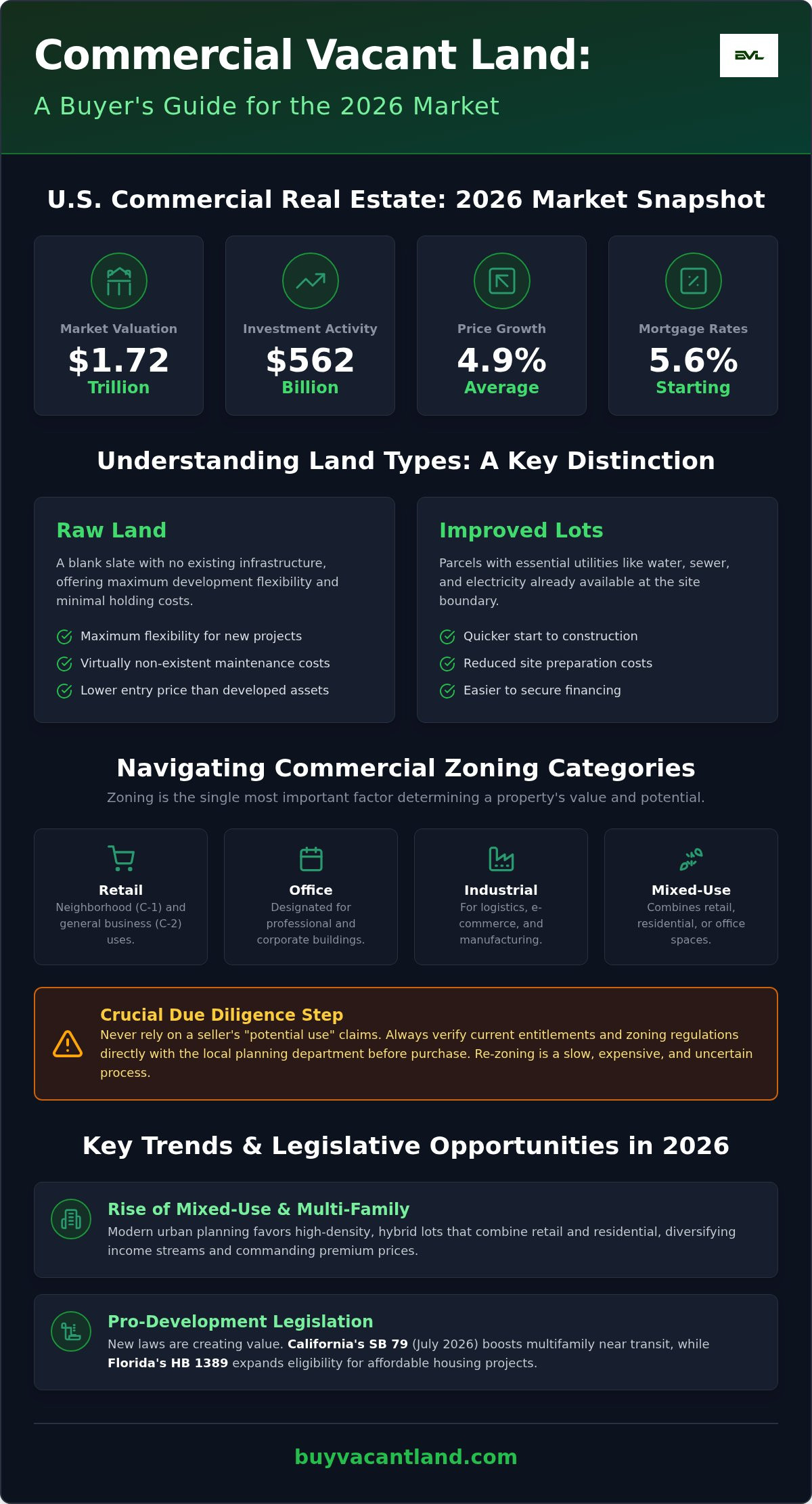
Commercial vacant land is property specifically designated for business, retail, industrial, or multi-family use. It is a specialized asset class that requires a pragmatic approach. In 2026, the U.S. commercial market is estimated to reach USD 1.72 trillion. This growth signals a stabilizing market after years of volatility. Investment activity is expected to hit $562 billion this year, which is nearly equal to pre-pandemic levels. Identifying the right commercial lots for sale now allows you to get ahead of this capital influx. You gain a foothold in a sector that is projected to grow steadily through 2034.
You must distinguish between raw land and improved lots before you buy. Raw land has no infrastructure. It’s a blank slate. Improved lots already have essential utilities like water, sewer, and electricity at the site boundary. Choosing vacant land over developed assets offers several benefits. Maintenance costs are virtually non-existent. You don’t have to worry about building repairs or property management headaches. You gain maximum flexibility to develop the site according to current market trends like adaptive reuse or mixed-use projects. This flexibility is a powerful tool for mitigating risk in a changing economy.
The Asset Class: Why Invest in Raw Commercial Land?
Scarcity drives value in real estate. Prime commercial property locations are limited. As cities expand, the demand for well-positioned lots increases. Many investors use a buy and hold strategy to wait for maximum appreciation. This approach is particularly effective in 2026, as average commercial property price growth is expected to hit 4.9%. You also benefit from a lower entry price. Buying a vacant lot costs a fraction of what you’d pay for a finished building. It’s an efficient way to secure a footprint in high-growth corridors without immediate construction pressure.
Commercial vs. Residential Lots: The Key Differences
Commercial and residential investments are not the same. Zoning is the primary differentiator. Commercial zoning is often more rigid but offers a higher potential ROI through long-term corporate leases. Utility requirements are also more intense. A commercial site might need three-phase power or specialized drainage systems that residential lots don’t support. Understanding these technical needs is vital for a successful transaction. If you’re just starting out, read our guide on how do you buy land to get the basics right. Focus on the zoning constraints early to ensure the property fits your specific business goals.
Navigating Commercial Zoning and Land Use Categories
Zoning is the single most important factor in the value of commercial lots for sale. It dictates exactly what you can build, how high it can go, and how many parking spots you must provide. Without the right designation, a prime corner lot is just expensive dirt. You’ll typically encounter categories like Retail, Office, Industrial, and Mixed-Use. Each carries its own set of rules and potential returns. For instance, industrial land is seeing a massive surge in 2026 due to the continued growth of e-commerce and logistics needs. If the zoning doesn’t match your vision, the deal is dead before it starts.
Stop and verify. Never buy land based on a seller’s “potential use” claims. You must verify the current entitlements with the local planning department yourself. Re-zoning is a slow, expensive, and risky process. It often requires public hearings and architectural reviews that can take years. If the city denies your request, you’re stuck with an unusable asset. Protect your capital by focusing on lots that already align with your development goals. You can view verified commercial parcels that meet specific zoning criteria to save time and reduce risk.
Common Commercial Zoning Classifications
Most municipalities use a variation of C-1 for neighborhood retail and C-2 for general business. Industrial designations often separate light manufacturing from heavy industrial use. Investors must understand the concept of “Highest and Best Use” (HBU). This is the use that is physically possible, legally permissible, and financially feasible. It’s how professional appraisers determine a lot’s true market value. Local zoning laws vary significantly by county; always consult the specific local code before you sign a contract.
Mixed-Use and Multi-Family Opportunities
The biggest trend in 2026 is the high-density hybrid. Modern urban planning favors mixed-use lots that combine retail on the ground floor with residential units above. These parcels command a premium price because they diversify your income streams. New legislation is making this easier across the country. California’s Senate Bill 79, effective July 1, 2026, encourages multifamily housing near transit stops. Similarly, Florida’s HB 1389 expands site eligibility for affordable housing. If you’re looking at the Southeast, check out our guide on land for sale in Florida to see how these regulations impact local zoning. These legislative shifts are turning underutilized commercial lots for sale into high-value residential goldmines.
Key Factors That Drive Commercial Land Value
Price per acre is a deceptive metric. When evaluating commercial lots for sale, you must focus on utility and location-specific value drivers instead. A cheap lot with no road access is a liability, not an asset. While zoning sets the legal rules for what you can build, physical and environmental factors dictate your actual construction costs and potential revenue. You need to look past the listing price and analyze the site’s ability to support a profitable business operation.
Retail success depends on eyeballs and ease of entry. High daily trip counts justify higher land costs because they provide a built-in customer base. If a lot isn’t visible from the main road, your marketing costs will skyrocket to compensate. For industrial land, visibility matters less than the proximity to logistics hubs and major highways. You’re looking for “last-mile” efficiency. If a truck can’t easily turn into the property, the lot’s value for warehousing drops significantly.
Physical constraints are the silent killers of a deal. Look at the dirt before you commit. Steep slopes, rock outcroppings, or wetlands reduce the buildable footprint and inflate your site preparation budget. Soil quality determines your foundation costs. If the soil is unstable or contaminated, you’ll spend your entire development budget on remediation before you ever pour a slab. Professional investors prioritize Understanding Land Values through the lens of these physical realities to avoid overpaying for unusable acreage.
Infrastructure and Utility Access
Utilities are the lifeblood of any commercial development. “At the curb” means the pipes and lines are already at the property line. “Off-site” means you pay to bring them in. Extending municipal water or sewer lines can cost hundreds of thousands of dollars and requires complex city approvals. You must also check for existing easements. These legal rights-of-way allow utility companies to cross your property and can prevent you from building on large portions of your own land. Always verify the capacity of existing power lines to ensure they can handle your intended industrial or retail load.
Traffic Patterns and Demographic Shifts
Data-driven decisions win in 2026. Use traffic data to prove your investment case. High daily trip counts are non-negotiable for retail and service-based businesses. You should also analyze demographic shifts; follow the path of new residential growth. If you’re looking for speculative industrial plays where visibility is secondary to highway access, consider searching for cheap land for sale in emerging logistics corridors. These areas offer high upside as regional distribution networks expand to meet e-commerce demand. Focus on the data, not the scenery.
Essential Due Diligence for Commercial Land Buyers
Due diligence is the most critical phase of any acquisition. It is the process of verifying every claim a seller makes about commercial lots for sale. You must act with speed but never skip a step. A failed inspection or an undiscovered lien can turn a promising investment into a financial sinkhole. Follow this five-step sequence to protect your capital and ensure a straightforward transaction.
- Step 1: Verify zoning and entitlements. Confirm with local planning departments that your intended use is legally permitted. Don’t rely on old records; check the current 2026 code.
- Step 2: Conduct a Phase I Environmental Site Assessment (ESA). This identifies potential contamination from previous uses. It is a non-negotiable requirement for most commercial lenders.
- Step 3: Order a professional ALTA survey. A standard boundary survey isn’t enough. An ALTA survey shows easements, right-of-ways, and encroachments that could restrict your building footprint.
- Step 4: Review title reports. Look for hidden liens, back taxes, or restrictive covenants. These legal encumbrances can prevent a clean transfer of ownership.
- Step 5: Perform a feasibility study. Analyze the total cost of development against projected revenue. If the numbers don’t provide an equitable financial return, walk away.
Successful investors use a checklist to stay organized. You can browse commercial parcels for sale that already include basic property data to jumpstart your evaluation process.
Environmental and Physical Assessments
Physical constraints are often invisible to the naked eye. A Phase I ESA is mandatory for securing traditional financing, such as SBA 7A or 504 loans. If the Phase I report suggests issues, you’ll need a Phase II study involving soil and groundwater sampling. You must also conduct soil boring tests to determine load-bearing capacity. Unstable soil requires expensive pilings or remediation. Wetlands are another major deal-breaker. Federal and state regulations often prohibit building on these areas entirely. Identify these physical limits early to avoid overpaying for unusable acreage.
Financial Due Diligence and Closing Costs
Budget for closing costs beyond the purchase price. Expect to pay for the ALTA survey, professional appraisals, and legal fees for contract review. Commercial closing timelines are significantly longer than residential deals. A typical transaction takes 60 to 90 days to allow for thorough inspections and financing approvals. If traditional bank rates, currently ranging from 5.60% to 8.92%, are too restrictive, explore other paths. Read our guide on owner financed land to learn how to secure property without a bank. This can simplify the transaction and provide a faster path to ownership.
Finding and Listing Commercial Properties on BuyVacantLand.com
Traditional real estate platforms are cluttered with residential noise. You don’t need to see suburban homes or apartment rentals when you’re searching for commercial lots for sale. BuyVacantLand.com is a specialized marketplace designed exclusively for raw and undeveloped land. We eliminate the distractions of the traditional market to provide a streamlined, high-efficiency experience. This focus allows you to identify high-potential parcels across the United States without wading through thousands of irrelevant listings. It is the most direct path to finding your next investment asset.
Our platform categorizes land by its specific use case. You can filter for industrial land, retail sites, or multi-family parcels with a few clicks. This level of precision is essential for professional investors who value their time. We provide a direct connection between land owners and buyers; we cut through the typical procedural hurdles of a standard brokerage. It’s a pragmatic solution for a market that is estimated to reach $1.72 trillion this year. We prioritize transparency and speed so you can move from discovery to due diligence without delay.
Why a Specialized Land Marketplace Matters
Traditional sites treat land as an afterthought. We treat it as the primary asset. By focusing solely on vacant property, we attract a targeted audience of professional developers and investors. You won’t find rental properties or existing office buildings here. This specialization ensures that every user on the platform has a shared goal: a swift and assured land transaction. Our listing process is equally direct. Sellers can present their commercial parcels to a national network without paying for unnecessary marketing fluff. You reach people who actually understand the value of raw dirt.
Next Steps: Start Your Search or List Your Lot
The 2026 market is stabilizing, but prime locations won’t wait for hesitant buyers. Buyers should start their national search today to secure a foothold in high-growth corridors. Use our filters to find property that meets your specific zoning and infrastructure needs. If you’re looking to exit an investment, listing your property takes only minutes. We connect you with buyers who understand the value of raw land and are ready to move toward a closing. We provide the tools to make your transaction as simple as possible.
If you’re a land owner ready to capitalize on current market growth, read our guide on how to sell land effectively. This resource provides a clear path for those looking to liquidate assets quickly. Whether you’re buying your first commercial lot or selling a portfolio of industrial sites, BuyVacantLand.com is your reliable problem-solver. Stop fighting the noise of traditional sites. Start making moves that lead to a successful closing today.
Secure Your Commercial Investment Today
The 2026 commercial real estate market offers a clear window for strategic growth. You now have the framework to identify high-potential assets while avoiding the common pitfalls of development. Success in this sector requires strict adherence to due diligence. You must verify zoning entitlements and conduct thorough environmental assessments to protect your capital. Identifying viable commercial lots for sale is no longer a matter of guesswork; it is a matter of using the right data and acting with speed.
BuyVacantLand.com provides the specialized, land-only marketplace you need to succeed. We eliminate the noise of traditional residential sites to focus exclusively on raw land and commercial parcels. Our platform offers national listings across the U.S. with total transparency. This specialized focus is built for professional investors who demand efficiency and reliable results. You gain a direct path to land owners without the usual procedural hurdles or hidden fees.
Stop searching through cluttered sites and start making moves that lead to a successful closing. Take the next step toward building your portfolio with confidence. Find your next commercial lot on BuyVacantLand.com and secure a straightforward transaction today. Your next profitable acquisition is just a few clicks away.
Frequently Asked Questions
Is commercial land a good investment in 2026?
Commercial land is a strong investment in 2026 as the market reaches an estimated $1.72 trillion valuation. Average price growth for commercial property is projected at 4.9% this year. Focus on high-demand sectors like logistics, data centers, and mixed-use developments to maximize your potential returns.
What is the difference between commercial and industrial lots?
Commercial lots are designated for customer-facing businesses like retail stores, offices, or restaurants. Industrial lots are reserved for production, manufacturing, and logistics operations. Industrial sites typically require specialized infrastructure; they need heavy-load road access and high-capacity utility connections that standard commercial sites don’t provide.
How do I find out the zoning of a commercial lot for sale?
Contact the local city or county planning department to verify the current zoning of a commercial lot for sale. You’ll need the Assessor’s Parcel Number (APN) to access the specific land-use records. Always confirm the 2026 zoning code directly with officials rather than relying on a seller’s verbal claims or outdated brochures.
Can I get a loan for vacant commercial land?
You can secure financing for vacant land through SBA 7A or 504 loan programs. Conventional commercial mortgage rates in 2026 range from 5.60% to 8.92% depending on the lender and your credit profile. Expect to provide a larger down payment; lenders view raw land as a higher risk than developed property.
What is a Phase I Environmental Site Assessment?
A Phase I ESA is a professional report that identifies potential environmental contamination on a property. It involves a review of historical records and a visual inspection of the site and surrounding areas. Lenders require this report to ensure the land doesn’t have hidden liabilities that could impact its value or safety.
How much does it cost to develop a commercial lot?
Development costs vary by location, but construction expenses in 2026 remain over 40% higher than early 2020 levels. You must budget for site preparation, utility extensions, and local impact fees. Conduct a professional feasibility study early to ensure your total project costs align with your projected revenue.
What is an ALTA survey and why do I need one for commercial land?
An ALTA survey is a high-precision map that meets strict national standards set by the American Land Title Association. It identifies property boundaries, easements, and encroachments that standard surveys might overlook. Lenders and title companies require this survey to issue title insurance and protect your legal interest in the land.
How can I sell my commercial vacant lot fast?
List your property on a specialized marketplace like BuyVacantLand.com to reach a targeted audience of professional buyers. Investors searching for commercial lots for sale prefer land-only platforms because they eliminate the noise of residential listings. Provide clear zoning data and utility information upfront to facilitate a swift and assured transaction.




Join The Discussion