

The S&P 500 has posted a 9.27% return so far in 2026, yet many investors feel more anxious than ever. You know the feeling of refreshing a brokerage app only to see months of gains vanish in a single afternoon. When you compare investing in land vs stock market assets, you’re looking for more than just a percentage. You’re looking for peace of mind.
It’s frustrating to watch your wealth tied to a digital screen. You want a diversified portfolio that resists inflation without the high entry costs or management burdens of traditional rental properties. This guide proves why raw land is the most efficient hedge against market volatility. You’ll learn how to secure tangible assets that don’t require repairs, tenants, or constant oversight. We focus on the relief that comes from owning a physical asset that doesn’t blink when the ticker tape turns red.
We’ll break down the 2026 tax rules for capital gains, compare historical farmland appreciation of 4% to 6% against stock performance, and show you how to find everything from off-grid acreage to residential lots. It’s time to cut through the complexity and protect your wealth with a straightforward, low-maintenance strategy.
Key Takeaways
- Understand the fundamental differences between paper assets and tangible dirt when investing in land vs stock market options.
- Discover how to create massive ROI through zoning changes and development paths on undeveloped vacant land.
- Eliminate management headaches with a low-maintenance asset that requires no tenants, no toilets, and no constant repairs.
- Learn a simple due diligence framework to mitigate risk and verify the potential of any parcel before you buy.
- Access a direct marketplace to find residential lots, farms, and off-grid land without dealing with traditional middlemen.
Investing in Land vs. Stock Market: Comparing the Core Fundamentals
Choosing between investing in land vs stock market assets is a choice between digital digits and physical reality. Stocks represent equity in a business enterprise. You own a piece of a company’s future earnings and its management’s decisions. Land is different. It is a physical parcel of the earth. It exists regardless of quarterly earnings reports or CEO scandals. This fundamental difference shapes your risk profile and your daily stress levels.
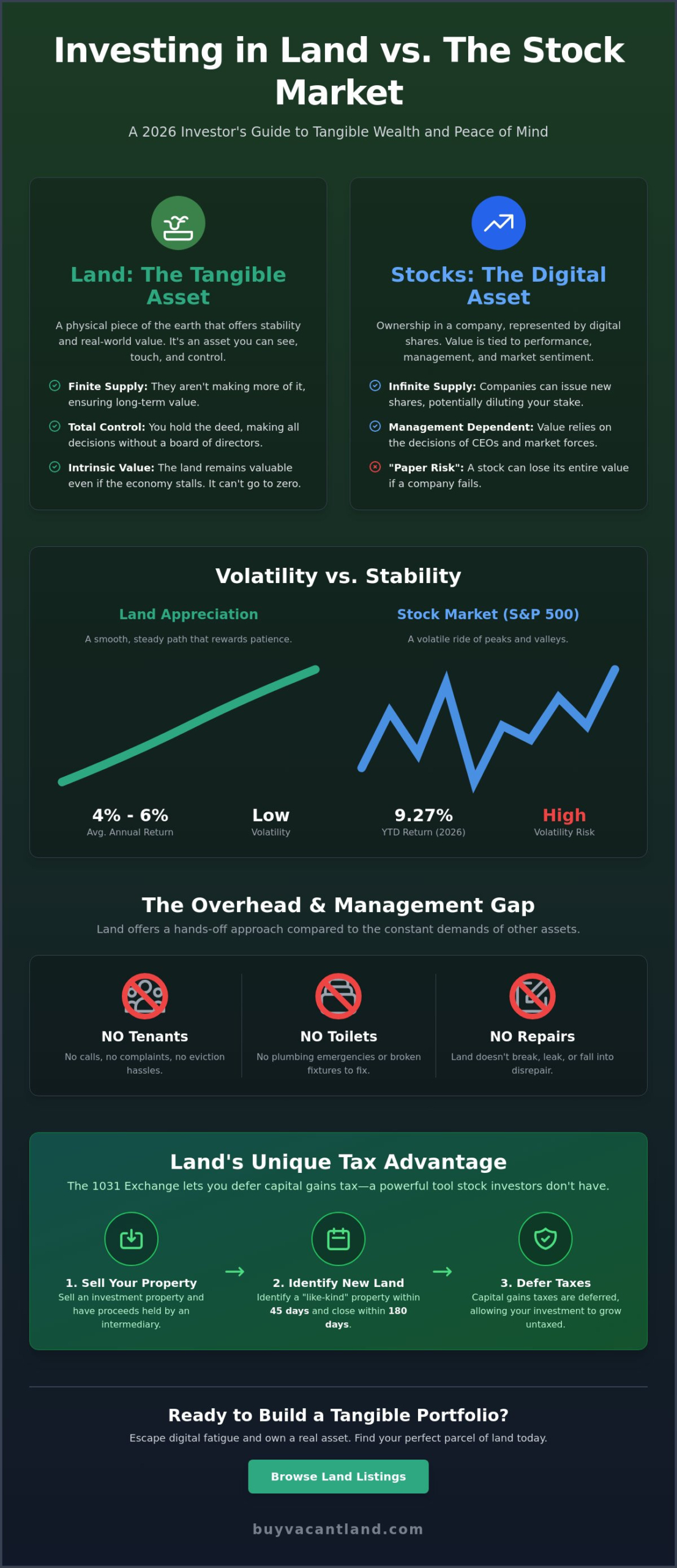
Market psychology drives stock prices. Algorithms and news cycles cause massive swings in seconds. As of May 21, 2026, the S&P 500 year-to-date total return is 9.27%. While that sounds positive, the path to get there involves constant volatility. Land stays grounded. It doesn’t fluctuate based on a social media post or a sudden interest rate hike. When comparing the stability of investing in land vs stock market volatility, the physical asset offers a much smoother ride. It is a slow, steady asset that rewards patience rather than reaction.
Supply and demand also separate these classes. Corporations can issue new shares or dilute existing ones at will. Land is finite. Nobody is making more of it. This scarcity provides a natural floor for your investment. When you own a parcel directly, you cut out the middleman. You don’t answer to a board of directors. You hold the deed, giving you total control over the asset’s future.
Asset Class Breakdown: Stocks vs. Land
Stocks are paper assets. Their value depends on the performance of others. Land is a tangible asset with intrinsic value. Even if the economy stalls, the dirt remains. Understanding real estate investing fundamentals helps you see why land is a unique pillar of wealth. National farmland has historically averaged an annual appreciation of 4% to 6%. It lacks the 10% historical average of the S&P 500, but it also lacks the gut-wrenching 30% drops that stocks occasionally suffer.
The 2026 Investor Mindset
Digital fatigue is real in 2026. Investors are tired of watching their net worth bounce around on a smartphone screen. They want something they can touch. Raw land serves as a powerful hedge in a post-inflationary economy. It preserves purchasing power when currencies lose value. If you are ready to move beyond the brokerage account, you need to know how do you buy land to start building a portfolio that exists in the real world. This shift toward tangible assets provides a level of security that paper simply cannot match.
Wealth Growth Mechanisms: Land Appreciation vs. Stock Dividends
Growth strategies differ significantly when investing in land vs stock market portfolios. Stocks rely heavily on dividends and corporate expansion. Companies distribute profits to shareholders, which you then reinvest to trigger compounding. This works well for liquid wealth, but it leaves you vulnerable to “Paper Risk.” If a company fails or a sector collapses, your shares can hit zero overnight. Land doesn’t go to zero. It is a finite resource that gains value through scarcity and utility rather than corporate management.
The “Buy and Hold” strategy for vacant parcels is a classic wealth protector. You aren’t just waiting for the price to go up. You are waiting for the world to move toward you. This is known as path-of-growth investing. As cities expand, what was once “middle of nowhere” becomes a prime residential lot or commercial hub. Zoning changes can transform a low cost parcel into a high value asset. This guide to investing in vacant land highlights how strategic acquisitions create massive ROI without the daily stress of stock tickers.
How Land Appreciates Over Time
Land value is tied to the physical world. In the United States, usable land is becoming increasingly scarce in high demand areas. Buying cheap land for sale in the path of future development can yield returns that outperform even the most stable blue-chip stocks. You don’t need a CEO to perform well. You only need the local population to grow. This passive appreciation is a quiet but powerful wealth builder. If you are looking for a place to start, you can browse current land listings to see where the best opportunities are located today.
Stocks and the Power of Compounding
Stocks excel at liquidity. You can sell shares in seconds to cover an emergency. Reinvested dividends provide a steady climb over decades. The historical average return of the S&P 500 is roughly 10%, but that comes with significant volatility. Land appreciation is slower but more predictable. For the 2026 tax year, you can also leverage the 1031 exchange. This allows you to sell an investment property and reinvest the proceeds into a “like-kind” parcel without immediately paying capital gains tax. You must identify the new property within 45 days and close within 180 days. This tax deferral is a massive advantage for land owners that stock investors simply don’t have.
The Overhead Gap: Why Vacant Land Is the Low-Maintenance Alternative
Traditional real estate investing often feels like a second job. You deal with leaky roofs, broken HVAC systems, and difficult tenants. Vacant land is different. It offers the benefits of property ownership without the operational headaches. When you compare investing in land vs stock market options, you must look at the overhead. Raw land is a set it and forget it asset. It sits there while the market matures around it. You aren’t responsible for repairs, garbage collection, or daily management. You hold the control. You decide when to sell. You don’t wait for a board of directors to approve a dividend or a merger.
When you weigh the pros and cons of investing in land vs stock market assets, the maintenance gap becomes the deciding factor. Control is a major factor in wealth protection. In the stock market, you are a minority shareholder. You have no say in company strategy. With land, you own the asset 100%. If you want to hold it for twenty years, you can. If you want to sell it next week, you can. You don’t have to worry about a CEO’s bad behavior tanking your investment value. This autonomy provides a level of security that paper assets can’t match. You are the CEO of your own dirt.
The Hidden Costs of Stock Investing
Stock investing carries invisible weights. Expense ratios and management fees eat your returns over time. Taxes add another layer of complexity. For the 2026 tax year, long-term capital gains are taxed at 0%, 15%, or 20% depending on your income. For example, a single filer pays 0% on income up to $49,450. High-income earners may face an additional 3.8% Net Investment Income Tax (NIIT). Every trade has a cost.
There is also an emotional burden. You check the ticker every morning. You feel the stress of a 2% drop in your portfolio value. This often leads to panic selling during market corrections. Land investors don’t panic. They know their asset is still there. It doesn’t disappear if a company goes bankrupt or a sector falls out of favor with Wall Street.
The Minimal Carrying Costs of Land
Undeveloped land is incredibly cheap to maintain. Property taxes on raw parcels are significantly lower than on developed homes or commercial buildings. You don’t have to worry about structure insurance or liability for a falling roof. This makes it the ultimate low-overhead investment. Our guide to lands of america showcases diverse options with minimal carrying costs.
You can secure a residential lot or hunting land and let it appreciate for years. It costs very little to hold. This simplicity is the primary reason why land is the superior choice for those seeking a stress-free portfolio. You avoid the high entry costs of developed real estate while keeping the tangibility that stocks lack. It’s a pragmatic solution for 2026 wealth protection.
Building Your 2026 Strategy: Portfolio Allocation and Risk
A resilient portfolio requires balance. You need the liquidity of stocks to cover immediate needs. You need the tangibility of land to protect against long-term erosion. When investing in land vs stock market assets, don’t think of it as an “either/or” decision. It’s a “both/and” strategy. Stocks provide the engine for growth. Land provides the anchor for stability. This combination ensures that a bad day on Wall Street doesn’t wipe out your entire net worth.
Liquidity is the primary trade-off. You can sell a stock in seconds. Selling a parcel of undeveloped land takes longer. You manage this risk by keeping your emergency fund in liquid paper assets while moving your legacy wealth into the dirt. This structure ensures you never have to fire-sale your land during a temporary cash crunch. Balance your fast-moving trades with slow-moving, high-certainty land parcels to achieve true diversification.
Due Diligence Checklist for Land Buyers
Risk in land investing comes from what you don’t see. You must verify the physical and legal status of a parcel before you sign any paperwork. Follow this simple framework to protect your capital:
- Verify Access: Confirm the property has legal road access. Landlocked parcels are difficult to sell.
- Check Utilities: Identify the nearest power lines and water sources. Off-grid land is valuable, but you must know the costs of bringing in services.
- Review Zoning: Ensure the land can be used for your intended purpose, whether it’s a residential lot or a farm.
- Confirm Title: Always insist on a clean title. It protects you from hidden liens or ownership disputes.
Use national marketplaces to find comparable sales. This data prevents you from overpaying and helps you spot equitable financial proposals. You can view current land listings to compare prices across different states and regions right now.
Financing Your Investment
Banks are notoriously difficult when it comes to raw land. They see it as a higher risk because it doesn’t produce monthly rent. As of May 20, 2026, some lenders offer raw land loans at an interest rate of 8.250%, but they often require a 40% down payment. This high entry cost can stall your progress.
Owner financed land is the solution for building a portfolio quickly. This method allows you to deal directly with the seller. Owner financing bypasses traditional credit hurdles and eliminates the need for strict bank approvals. It turns a complex industry process into a simple agreement between two parties. You get the land you want without the procedural hurdles of a big bank.
Secure Your First Parcel: How BuyVacantLand.com Streamlines the Process
Buying land shouldn’t be hard. Most real estate websites clutter your screen with houses and rental properties you don’t want. BuyVacantLand.com is different. We focus exclusively on dirt. When you decide between investing in land vs stock market assets, you need a platform that respects your time and your capital. We provide a nationwide marketplace of vacant land listings designed for speed and efficiency. You connect directly with owners and sellers. This direct link removes the middleman and the extra costs that come with them. There are no service fees. You keep more of your money in the land itself.
We simplify the acquisition process. You can filter your search by specific land types to find exactly what fits your 2026 wealth protection strategy. Whether you want residential lots, off-grid land, or farms and ranches, the tools are at your fingertips. This streamlined approach mirrors the efficiency you expect from a stock brokerage but adds the security of a physical asset. You get the relief of a swift transaction and the peace of mind that comes from owning a tangible piece of the earth. Don’t let market volatility dictate your future. Take control of your portfolio with a direct, no-nonsense land purchase.
Why Use a Specialized Land Marketplace?
Traditional real estate sites aren’t built for land investors. They lack the specific filters needed for undeveloped parcels. Our marketplace solves this problem. You save time with targeted search tools that find cheap land or commercial vacant lots in seconds. This specialized focus allows you to discover “under the radar” deals. Many of these listings never reach the local MLS. You get access to high-potential acreage before the general public even knows it’s for sale. It’s the most pragmatic way to build a diversified portfolio in 2026.
Your Path to Ownership Starts Here
Building a tangible portfolio starts with a single step. You can browse everything from hunting land to industrial parcels in one centralized location. The process follows a simple, transparent sequence:
- Search: Use our filters to find the perfect parcel for your budget and goals.
- Evaluate: Review the equitable financial proposal provided directly by the seller.
- Connect: Use our direct communication tools to speak with the owner without middlemen.
This direct path removes the procedural hurdles that stop most investors. You don’t need to wait for bank approvals or deal with high-priced agents. When you compare investing in land vs stock market options, the ease of acquisition on our platform stands out. Secure your first parcel today and experience the certainty of physical ownership. Your path to long-term wealth protection is just a few clicks away.
Secure Your Financial Future with Tangible Assets
Stock markets move fast. Digital assets can vanish in a single news cycle. Real wealth protection requires a balance between digital growth and physical security. You now understand why investing in land vs stock market options is the pragmatic choice for 2026. Raw land doesn’t require repairs, tenants, or constant monitoring. It remains a quiet, finite resource while the world expands around it. You hold the deed and the total control.
Stop relying solely on a flickering ticker tape. Our specialized vacant land marketplace provides national coverage across the United States. You get a direct seller-to-buyer connection without middleman markups or service fees. This streamlined process removes the procedural hurdles that hold most investors back. It’s time to add a permanent pillar to your portfolio. You get the relief of a swift transaction and the security of a physical asset.
Start building your land portfolio on our national marketplace today. You deserve the peace of mind that comes from owning a piece of the earth. Take the first step toward lasting stability now.
Frequently Asked Questions
Is land a safer investment than the stock market?
Land is safer in terms of volatility because it is a tangible, physical asset that cannot go bankrupt or disappear. Stocks represent equity in a business and are subject to daily price swings based on news and market psychology. While stocks offer higher liquidity, land provides a stable floor for your wealth. It protects you from the emotional stress of watching a digital portfolio drop significantly in a single week.
How much money do I need to start investing in land?
You can start with much less capital than required for developed real estate. Many undeveloped parcels and residential lots are available at accessible price points across the United States. Using a specialized marketplace allows you to find cheap land in various regions without high entry costs. Owner financing also reduces the initial cash burden, allowing you to secure a parcel with a modest down payment rather than the full purchase price.
Does vacant land appreciate faster than stocks?
Historically, the S&P 500 has a higher average annual return at roughly 10% compared to national farmland appreciation of 4% to 6%. However, investing in land vs stock market assets isn’t just about the top-line percentage. Land offers steady, predictable growth without the gut-wrenching drops seen in paper assets. Strategic purchases in the path of urban growth can often outperform the market average as zoning changes increase the land’s utility.
What are the tax benefits of owning land vs. stocks?
Land owners can use a 1031 exchange to defer capital gains taxes when trading one investment property for another. This strategy is not available for stock investors. For the 2026 tax year, long-term capital gains on both assets are taxed at 0%, 15%, or 20% based on income. Land also has lower carrying costs than developed property, which preserves more of your profit over the long term. High-income earners should also account for the 3.8% Net Investment Income Tax on both asset classes.
How do I sell my land if I need cash quickly?
Land is a less liquid asset than stocks, so you shouldn’t invest money you might need for immediate emergencies. Selling a parcel typically takes longer than clicking a button in a brokerage app. You can speed up the process by listing on a national marketplace to reach a wider audience of motivated buyers. A direct seller-to-buyer connection ensures you find the right match quickly without the delays and fees of traditional real estate agents.
Can I buy land with owner financing if I have bad credit?
Yes, you can often secure owner-financed land regardless of your credit score. These transactions happen directly between you and the seller, bypassing the strict requirements of big banks. Sellers are often more interested in your down payment and ability to make monthly installments than your past credit history. This makes land an excellent entry point for building a tangible portfolio when traditional financing isn’t an option. It turns a complex industry process into a simple agreement.
What are the biggest risks of investing in raw land?
The primary risks include low liquidity and potential zoning restrictions. If you buy a parcel without legal road access or utility availability, its resale value may suffer. You mitigate these risks by performing thorough due diligence before every purchase. Verify the physical characteristics and legal status of the dirt to ensure it meets your long-term goals. When investing in land vs stock market options, the risk in land is manageable through research rather than being tied to market luck.
How do I know if a piece of land is a good deal?
A good deal is defined by the price relative to comparable sales and the land’s future utility. Look for parcels located in the path of growth where city expansion is likely to increase demand. Check the prices of similar lots in the same county to ensure you are receiving an equitable financial proposal. If the price is low and the location is strategic, you have found a solid foundation for wealth protection. Focus on the intrinsic value of the dirt rather than short-term market trends.




Join The Discussion