

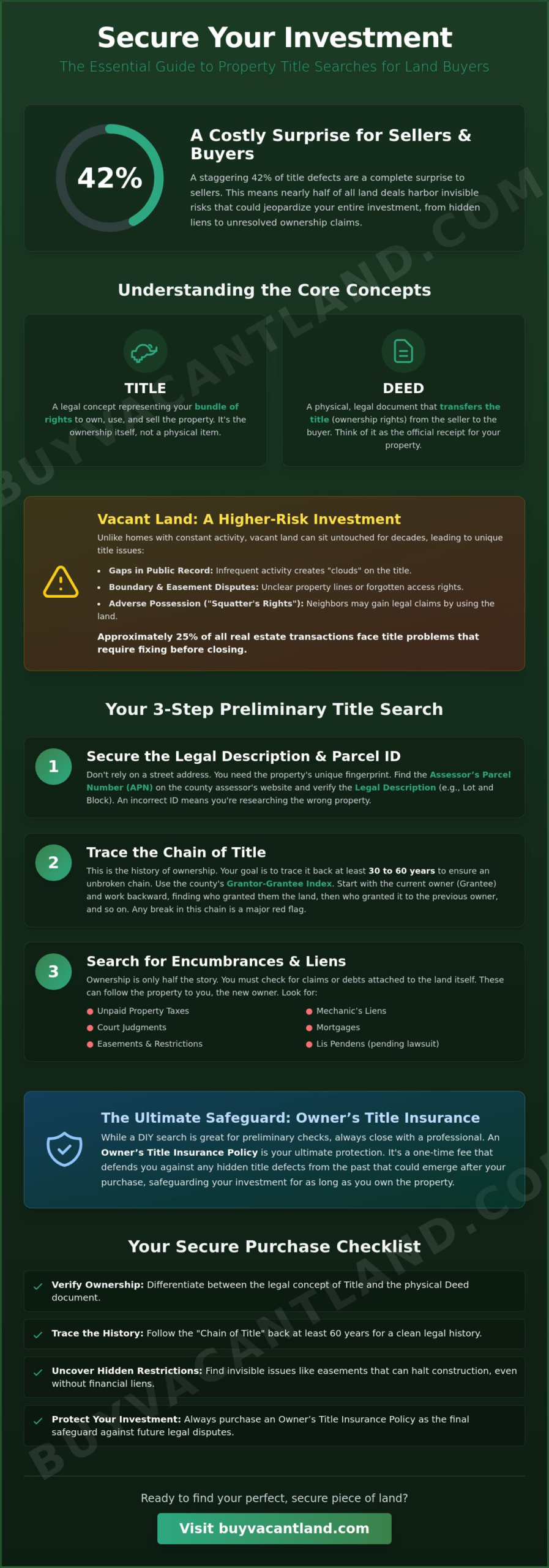
Did you know that 42% of title defects discovered in 2025 were a complete surprise to the sellers themselves? This means nearly half of all land deals carry invisible risks that could cost you your entire investment. You must understand how to do a title search on property before you commit your hard-earned capital. Waiting for a third party to find a problem is a risk you don’t need to take. You want a clean chain of title and the absolute certainty that no hidden liens will surface after the sale.
Buying land should be a fast, transparent process. It’s common to feel overwhelmed by legal terms like encumbrances or to fear the high costs of traditional title companies. This guide eliminates that confusion. You’ll learn the exact steps to verify ownership and uncover hidden debts to ensure your purchase is legally secure. We’ll cover everything from using the 85% of county portals now available online to navigating the new 2026 FinCEN reporting rules for all-cash transactions. You’ll gain the confidence to move forward with a clean, secure land purchase.
Key Takeaways
- Differentiate between a physical deed and the legal concept of title to verify absolute ownership of a vacant lot.
- Master how to do a title search on property by tracing the “Chain of Title” back 60 years for a clean legal history.
- Uncover invisible restrictions like easements that can stop construction even if no financial liens exist on the land.
- Conduct your own preliminary search to save time but use a licensed professional to finalize the transaction for your lender.
- Purchase an owner’s title insurance policy to provide the ultimate safeguard against hidden defects and future legal disputes.
What is a Property Title Search and Why is it Essential?
What is a Property Title Search is the systematic process of retrieving public records to verify the history of a piece of real estate. You need to know exactly who owned the land before you and if they left any financial or legal baggage behind. Understanding how to do a title search on property is your first line of defense against fraud and hidden debt. It transforms a risky gamble into a calculated, secure transaction. This process examines every recorded event in the land’s history. It includes mortgages, tax liens, and court judgments that might still be attached to the dirt.
The Difference Between Title and Deed
Many buyers confuse these two terms, but the distinction is vital for a secure purchase. You don’t hold a title in your hand; you have title. Title is a legal concept representing your bundle of rights to the property. It gives you the legal authority to use, sell, or lease the land. The deed is the physical document. It acts as the vehicle that transfers those rights from the seller to the buyer. Think of the deed as the receipt for the transaction and the title as the ownership itself. Clear Title is a specific status where ownership is undisputed and the land is free of all liens.
Why Land Buyers Face Unique Title Risks
Vacant land requires significantly more scrutiny than a typical residential home. Houses have constant utility bills, regular maintenance, and frequent tax assessments that keep the paper trail fresh and active. Vacant land often sits for decades without any activity. This leads to gaps in the public record chains. These gaps create “clouds” on the title that can stop a future sale or development project in its tracks. You must ensure the chain of ownership is unbroken for at least 30 to 60 years to avoid surprises.
Land is also more susceptible to “squatter” claims or adverse possession issues. If a neighbor has been using a portion of the land for years without objection, they might have a legal claim to it. Learning how do you buy land must include a rigorous title search to be considered a secure investment. Approximately 25% of all real estate transactions encounter title issues that require resolution before closing. Don’t let an invisible lien or an old property line dispute ruin your investment. Your goal is to achieve a clear title that is free of any disputes or hidden encumbrances.
How to Perform a DIY Property Title Search: A 5-Step Process
Performing a preliminary search yourself saves time and protects your capital. Your primary goal is to trace the history of ownership back at least 30 to 60 years. This specific timeline ensures you uncover old mortgage releases or forgotten claims that could haunt your investment. To begin, locate the County Recorder or Registrar of Deeds office for the specific county where the land sits. Most counties now offer digital portals, but some rural areas still require a physical visit or a mail-in request. Knowing how to do a title search on property requires patience and a sharp eye for detail. You are looking for a continuous, unbroken path of ownership that proves the seller has the right to sell.
Step 1: Secure the Legal Description and Parcel ID
Don’t rely on a simple street address. Street names change over decades, and many rural parcels don’t have a formal address yet. You need the legal description, which uses Lot and Block or Metes and Bounds to define the exact boundaries. Find the Assessor’s Parcel Number (APN) on the county tax assessor’s website first. This number is the unique fingerprint for that specific piece of dirt. Always verify this ID against the cheap land for sale listing details. Discrepancies here are an immediate red flag that you might be researching the wrong property.
Step 2: Trace the Chain of Title
The Chain of Title is the sequence of historical transfers from one owner to the next. Use the Grantor-Grantee index to build this ownership timeline. A Grantee is the person receiving the property, while the Grantor is the one selling or transferring it. Start with the current owner as the Grantee and find who granted them the land. Then, search for that previous owner as a Grantee to find the owner before them. Repeat this until you have reached your 30 or 60 year goal. Watch for common breaks in the chain. Name changes from marriage, unrecorded deaths, or simple clerical errors can create a gap. If you find a break, the seller must resolve it before you close.
Step 3: Search for Encumbrances, Liens, and Judgments
Ownership is only half the battle. You must search for involuntary liens that stick to the land regardless of who owns it. This includes unpaid property taxes, mechanic’s liens from past contractors, or even child support judgments against previous owners. Check for a “lis pendens” filing, which indicates pending litigation involving the property. The Final Safeguard: Why You Need Title Insurance is often necessary because these liens follow the property, not the person. If you buy land with a $10,000 tax lien, you become responsible for that debt the moment the deed is recorded. Once you have cleared these hurdles, you can confidently browse available parcels for your next project.
Identifying Land-Specific Red Flags: Easements and Access
A clear title confirms ownership. It does not guarantee you can build your dream home or even drive a truck onto the lot. Invisible restrictions often hide in the public record. These can make vacant land unusable or slash its market value. When learning how to do a title search on property, you must look for Covenants, Conditions, and Restrictions (CC&Rs). These are private rules that govern land use. They might ban off-grid living or require specific building materials. If the CC&Rs conflict with your plans, the land is a bad investment regardless of the price. You want to identify these “clouds” before you commit your capital.
Easements: Who Else Can Use Your Land?
An easement gives someone else the legal right to use a portion of your property. Utility easements for power lines or water pipes are common. They are usually manageable. Private access easements are more complex. You might find a neighbor has the right to drive across your land to reach their own. This reduces your privacy and could interfere with your building site. Worse, you might discover the parcel is land-locked. This means no legal road access exists. You would then need to secure an “Easement by Necessity” through the courts. This is a slow and expensive process. Different states have varying rules on access. For example, land for sale in florida often involves specific drainage or wetland easements that are rare in other regions.
Mineral, Water, and Timber Rights
In many states, you can own the surface of the land without owning what lies beneath it. These are called severed rights. You must check the deed for “reservations” where a previous owner kept the oil, gas, or mineral rights. If a mining company owns the subsurface rights, they may have the legal authority to enter your land to extract resources. Timber and water rights work similarly. Knowing how to do a title search on property correctly involves verifying if these rights are still attached to the surface parcel. Severed rights lower resale value and can prevent you from getting a construction loan. Always confirm you are buying the full “bundle of rights” before you sign a contract. This ensures your investment is secure and your plans are feasible.
Professional vs. DIY Title Searches: A Pragmatic Comparison
When DIY is Sufficient
Use DIY searches when you are narrowing down your shortlist of potential investments. It is an efficient way to rule out lots with massive tax liens or obvious ownership gaps. This knowledge provides leverage. If you find a small lien the seller missed, you can negotiate a lower price or demand they clear the debt before you sign. DIY is also pragmatic for very low-value parcels. If a professional search fee represents more than 20% of the land’s total value, your own due diligence might be the only cost-effective path. This is especially relevant when exploring owner financed land. In these deals, the seller acts as the lender and may accept your independent research to move the transaction forward quickly.
The Limitations of Public Records
County websites have improved significantly. As of May 2026, 85% of US county assessors offer online portals for property records. But these portals are not exhaustive. Some rural records still live in paper ledgers in county basements. They require a physical search that online tools cannot replicate. Public records also fail to reveal “hidden” risks. A deed might look perfect on a screen but could be forged. An undisclosed heir or an ex-spouse could surface years later to claim the dirt. Professional title companies use proprietary “Title Plants.” These are private databases that are often more updated and detailed than official government records. They provide an “Abstract of Title,” which is a certified summary of every recorded instrument affecting the property. This document provides the legal certainty you need for a high-value transaction.
Ready to find your next investment? View verified land listings today and start your preliminary due diligence with confidence.
The Final Safeguard: Why You Need Title Insurance
You may master how to do a title search on property, but even the best research has limits. Title insurance is your final safety net. It provides the ultimate peace of mind for any land investment by protecting you against risks that don’t appear in public records. Most real estate transactions require a Lender’s Policy to protect the bank’s financial interest. You should also purchase an Owner’s Policy. This is an optional but highly recommended shield for your own equity. Unlike other insurance types, you pay a one-time premium at closing. This single payment protects you and your heirs for as long as you own the land. There are no monthly fees and no renewals required.
The most valuable feature of this coverage is the “Duty to Defend” clause. If a long-lost heir or a neighbor disputes your ownership in court, the insurance company pays all legal fees. They handle the litigation and the costs associated with defending your title. This removes the massive financial burden of legal disputes. You get to keep your land and your capital while the professionals handle the conflict. It transforms a potential legal nightmare into a managed administrative task.
How Title Insurance Works with Vacant Land
Title companies perform their own exhaustive search before issuing a policy. If they find minor defects or clerical errors, they often “insure over” them. This means they accept the risk so the deal can move forward. However, every policy contains a list of “Exceptions” in a section called Schedule B. These are specific items the insurer found but will not cover. Common exceptions include known utility easements or existing mineral rights. Read your Schedule B carefully before you sign. You must understand exactly what is excluded from coverage to ensure the land still meets your needs. If an exception prevents you from building, you need to know that before the money changes hands.
Closing the Deal Securely
A secure transaction follows a strict logical progression. You start with your search, receive a title commitment, secure your insurance, and finally reach the closing table. Efficiency is key to a successful land deal. Sellers can help by preparing their own title information and previous deeds in advance. This preparation allows them to sell land faster by removing procedural hurdles for the buyer’s title company. Once you understand how to do a title search on property and have your insurance lined up, you are ready to act. You can move forward with the confidence that your investment is legally secure and your ownership is undisputed.
Ready to find your next parcel? Browse our vacant land listings today and start your journey toward secure property ownership.
Secure Your Land Investment Today
You now have the exact roadmap for how to do a title search on property. You can trace the chain of title back 60 years and spot invisible easements that would stop a construction project. This knowledge protects your capital from hidden liens and ownership disputes. Use your DIY research to rule out high-risk parcels early. Then, finalize your purchase with a professional search and an owner’s title insurance policy. These steps eliminate the stress of the unknown and ensure your land is a legal asset, not a liability.
Finding the right parcel shouldn’t be a struggle. Our national marketplace specializes in raw and undeveloped land. We offer a streamlined discovery process for off-grid and residential lots across the country. Whether you want a hunting tract or a suburban lot, we connect you directly with sellers. Find your next investment on our vacant land marketplace today. Take the first step toward secure ownership with confidence. Your future property is waiting for you.
Frequently Asked Questions
Is a property title search the same as a property survey?
No, a title search and a property survey are distinct processes. A title search examines the legal history and ownership rights recorded in public documents. A survey is a physical inspection of the land to determine exact boundaries and markers. You need both to ensure you own the dirt and know exactly where it ends.
Can I do a property title search for free online?
Yes, you can often perform a preliminary search for free through county assessor websites. As of May 2026, 85% of US counties offer online property record portals. Keep in mind that some deeper historical documents or certified copies may still require a small administrative fee. This is a great way to start learning how to do a title search on property without upfront costs.
How far back does a standard title search go?
A standard search typically traces ownership back 30 to 60 years. This timeframe is generally sufficient to establish a reliable chain of title and uncover most active liens. Some states or lenders may require a full search that goes back even further if the property history is complex.
What happens if a title search reveals a lien?
If a lien appears, the seller is responsible for clearing the debt before the transaction closes. Liens follow the property, not the owner. If you close on a property with an active tax lien, you inherit that debt immediately. Always demand a lien release or proof of payment before signing the final deed.
How much does a professional title search cost in 2026?
In 2026, a standard residential title search typically costs between $75 and $200. Properties with complex histories or multiple historical transfers can cost $300 or more. A comprehensive search that includes more detailed records often ranges from $150 to $400. These fees are a small price to pay for legal certainty.
Can I buy a property if the title is not clear?
You can buy property with an unclear title, but it is extremely risky. Traditional lenders will refuse to issue a mortgage on land with ownership disputes or active liens. You would be personally liable for all previous debts and could lose the property if a superior claim emerges later.
What is a “cloud” on a title?
A “cloud” on a title is any claim or encumbrance that casts doubt on the owner’s legal rights. This includes unreleased mortgages, pending litigation, or missing signatures from previous transfers. You must resolve these clouds through a quiet title action or by obtaining proper releases to achieve a clear title status.




Join The Discussion