
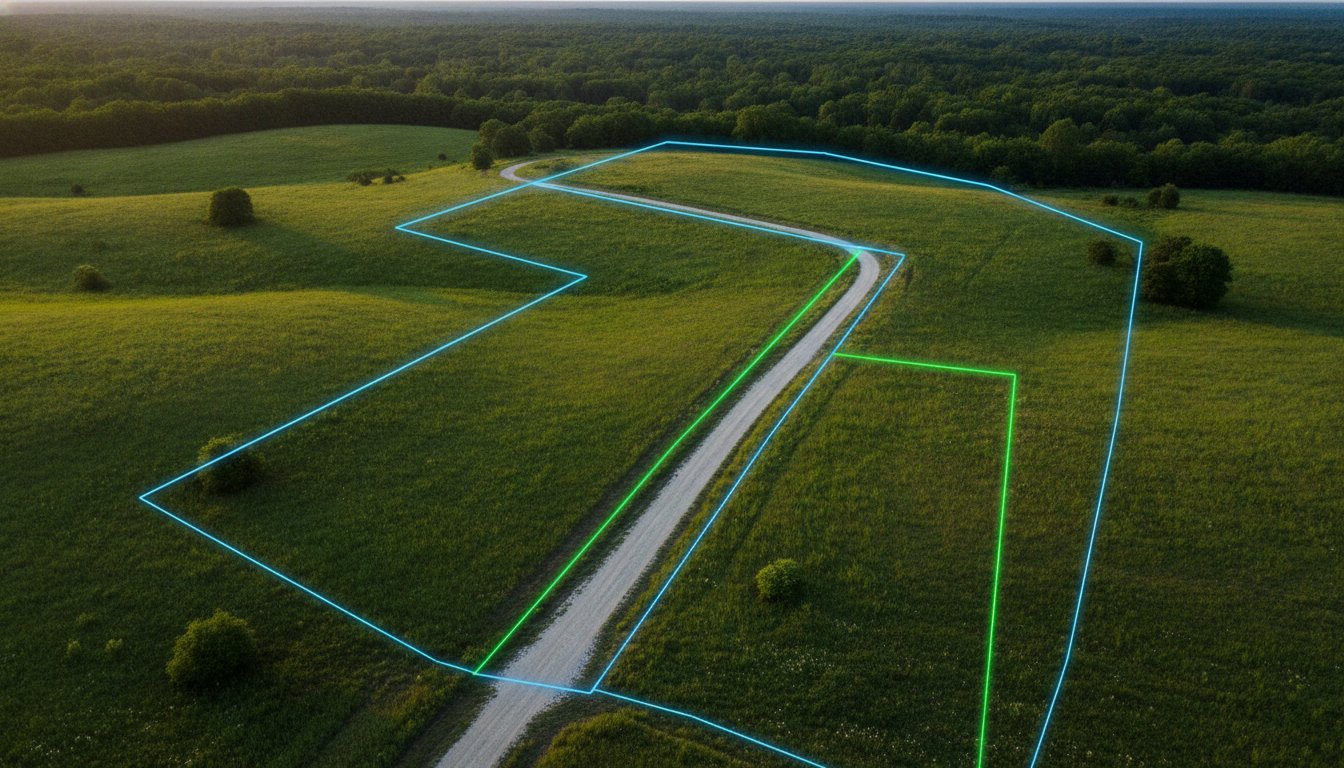
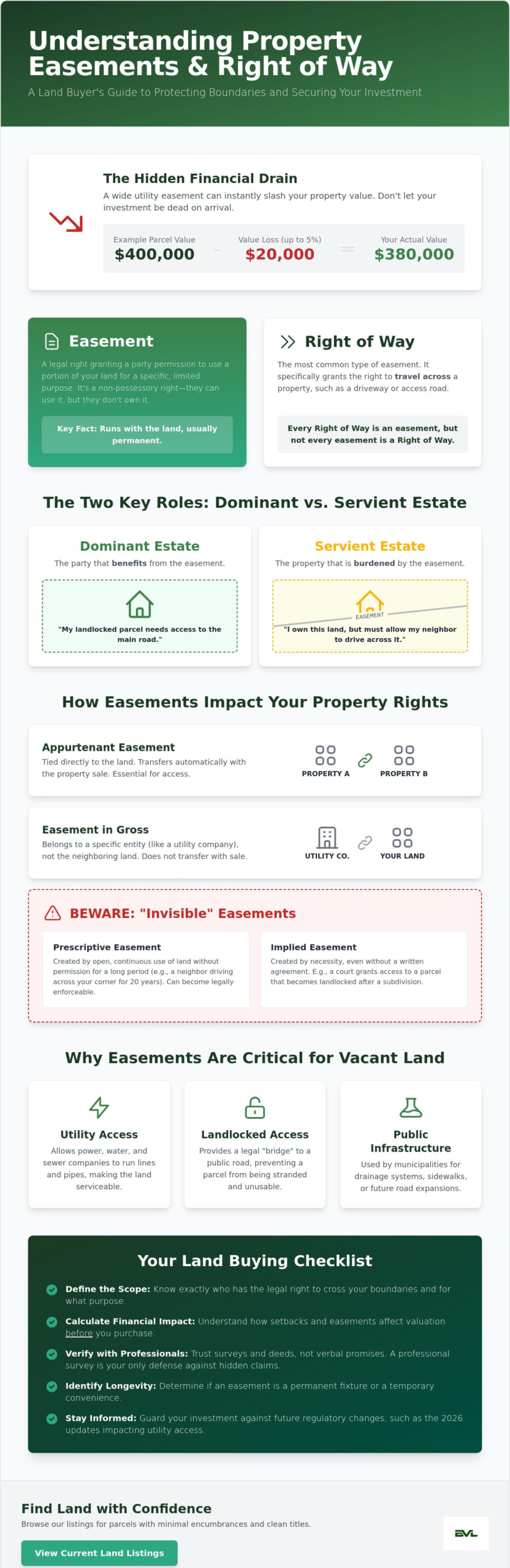
You don’t truly own every square inch of your land if a utility company or a neighbor holds the legal right to cross it. A wide utility easement can slash your property value by up to 5% instantly. That is a $20,000 loss on a $400,000 parcel before you even break ground. Understanding property easements and right of way is the only way to ensure your investment isn’t dead on arrival.
It’s frustrating to stare at a complex deed full of servitudes and encumbrances while worrying if you’re buying a landlocked nightmare. You want a clean title and total privacy. We’ll simplify these legal hurdles so you can protect your boundaries and secure your access. This guide breaks down the differences between easements and rights-of-way, explains how to read a survey like a pro, and highlights the 2026 legal changes you need to know to stay out of court.
Key Takeaways
- Define the precise scope of land access to ensure you know exactly who has the legal right to cross your private boundaries.
- Calculate the financial impact of building setbacks and valuation drops before you commit to a purchase.
- Master understanding property easements and right of way to verify access rights through surveys and deeds instead of trusting verbal promises.
- Identify the longevity of legal agreements to determine if an easement is a permanent fixture or a temporary convenience.
- Guard your investment against 2026 regulatory changes that impact utility access and land use restrictions.
What Are Property Easements and Rights of Way?
An easement is a legal agreement that grants a specific party the right to use a portion of your land for a limited purpose. It is a non-possessory right. This means the person holding the easement doesn’t own the dirt; they only own the legal right to use it. When you are researching What is a property easement?, you’ll find that these rights are usually permanent. They run with the land. This means if you sell the property, the easement stays attached to the deed for the next owner. It is not a personal deal between neighbors; it’s a permanent part of the property’s legal identity.
A Right of Way is the most common version of this concept. While people often use the terms interchangeably, they aren’t identical. Every Right of Way is an easement, but not every easement is a Right of Way. A Right of Way specifically grants the right to travel across a property. It’s the legal bridge that connects a landlocked parcel to a public road or a utility hub. If you see a gravel path cutting through a lot you’re eyeing, you’re likely looking at a Right of Way.
To master understanding property easements and right of way, you must identify two roles: the Dominant Estate and the Servient Estate. The Dominant Estate is the party that benefits from the access. The Servient Estate is the property that is burdened by it. If your neighbor drives across your driveway to reach their house, your land is the Servient Estate. You own the land, but you must allow that traffic to pass. You can’t put up a fence or a gate that blocks their access without risking a major legal battle.
The Legal Foundation of Land Access
Property ownership is often described as a bundle of sticks. Each stick represents a right, like the right to build, the right to sell, or the right to exclude others. An easement is a carve-out from that bundle. You still hold the title, but you’ve legally surrendered the right to stop a specific use. These agreements are recorded in public county records and are legally binding. If you block a valid easement, a court can force you to remove obstructions at your own expense. It doesn’t matter if the easement hasn’t been used in years; if it’s on the deed, it’s usually enforceable.
Why Easements Exist on Vacant Land
Easements are critical for the functionality of undeveloped parcels. Without them, modern infrastructure would be impossible. Most vacant land buyers will encounter these three types:
- Utility Access: Power companies need to run lines. Water and sewer districts need to bury pipes. These easements ensure your land can actually be serviced.
- Landlocked Access: If a parcel has no direct road frontage, the law often requires an easement across an adjacent lot. This prevents stranded property that can’t be used or sold.
- Public Infrastructure: Municipalities use easements for drainage systems, sidewalks, or future road expansions.
Types of Easements: How They Impact Your Property Rights
Easements are not one-size-fits-all. They dictate exactly how you can use your land and who else can step onto it. When understanding property easements and right of way, you must distinguish between the beneficiary and the burdened party. You are either the one using someone else’s land or the one forced to share yours. Voluntary easements are negotiated through a contract. Involuntary easements are created by legal necessity or long-term use. Both types are legally binding. They can drastically alter the utility of a vacant parcel. You must know which structure governs your dirt before you sign a closing statement.
Appurtenant vs. In Gross Easements
Appurtenant easements are tied directly to the land. They transfer automatically when the property changes hands. If a parcel has an appurtenant easement for road access, that right remains even if you sell the lot. This is the most common access right for anyone learning how do you buy land. Conversely, easements in gross belong to a specific entity. A power company holds an easement in gross to maintain lines. This right does not belong to the neighboring property owner. It belongs only to the utility provider.
Private vs. Public Easements
Private easements are agreements between specific neighbors. A shared driveway is a classic example. These are usually narrow in scope. Public easements grant rights to the government or the general public. These might include a path to a public beach or a city drainage system. Public easements often carry much stricter usage regulations. You cannot build a shed on a public drainage easement without risking immediate demolition by the county. If you want to avoid these restrictions, browse our current land listings for parcels with minimal encumbrances.
Prescriptive and Implied Easements
These are the most dangerous for off-grid land buyers. They are often “invisible” on a standard title search. A prescriptive easement is created when someone uses your land openly and continuously for a set period without your permission. If a neighbor drives across your corner for twenty years, they might win a legal right to keep doing it. Implied easements occur by necessity. If a seller subdivides a lot and leaves one portion landlocked, a court will likely grant an implied easement for access. The legal definition of an easement confirms that these rights are enforceable even without a written contract. Never assume a lack of paperwork means a lack of access rights. A professional survey is your only defense against these hidden claims.
Easement vs. Right of Way: Key Differences for Land Buyers
You’ll often hear these terms used interchangeably during a land deal. They aren’t the same thing. Every Right of Way (ROW) is a specific type of easement. However, many easements have nothing to do with a Right of Way. Master understanding property easements and right of way by looking at the specific intent of the document recorded at the county office. A Right of Way grants the right to travel across a property. An easement can grant the right to bury a pipe, preserve a view, or even prevent a neighbor from building a structure that blocks sunlight. One is about movement; the other is about a specific utility or restriction.
Defining the Scope of Access
A Right of Way is strictly about transit. It allows a person or a group to get from Point A to Point B. This usually involves visible, physical changes to the land. You might see a gravel road, a cleared path, or a paved driveway. A standard utility easement is different and often less intrusive. For example, a water company might have an easement to maintain a buried main line across your back 40. This gives them the right to dig if a pipe bursts, but it doesn’t give them a general right of passage for their trucks to use your land as a shortcut. They have a specific, limited use. To see how these distinctions play out in real-world planning, review this guide on Easement vs. Right of Way. It clarifies how public utility projects differ from general transit rights.
Ownership vs. Usage Rights
Ownership is where the legal fine print can catch you off guard. In a private easement, you still own the soil. You are responsible for the property taxes on that acreage. You simply share the usage of a specific strip of dirt. However, some municipal rights of way are held “in fee.” This means the government or the city actually owns that strip of land outright. You don’t own it at all. This distinction is vital for your total acreage count and building setbacks. If the city owns the ROW in fee, your property line starts much further back than you might expect.
Maintenance responsibilities also follow the type of agreement. Generally, the dominant estate—the party that benefits from the access—is responsible for maintaining the path. If your neighbor has a Right of Way across your land to reach their house, they are typically responsible for filling potholes or clearing snow. You don’t have to provide a pristine road for them; you just can’t block their ability to use it. Always check the written agreement for specific maintenance clauses to avoid expensive disputes with neighbors later.
Calculating the Impact: Land Value, Building, and Resale
Does an easement always destroy land value? Not necessarily. While most buyers fear restrictions, the truth is more nuanced. Some easements are essential for the property to function. A parcel with a guaranteed utility easement for power and water is often more valuable than a remote lot with no legal path for services. However, a “burdened” lot with a massive pipeline running through the center is a different story. Understanding property easements and right of way allows you to distinguish between a helpful utility link and a restrictive nightmare. Often, the low price tag on cheap land for sale directly reflects these legal burdens. You aren’t getting a deal; you’re getting a restriction.
Construction and Setback Restrictions
You cannot build permanent structures over an easement. This includes houses, detached garages, and even swimming pools. If you ignore this rule, you face the risk of “encroachment.” The easement holder has the legal right to demand you tear down your fence or foundation at your own expense to allow them access. Local zoning laws often compound this issue by adding extra buffer requirements. If a utility easement is 20 feet wide, the county might require an additional 10-foot setback for any new construction. This can turn a seemingly large three-acre lot into a tiny, unbuildable strip of dirt. Always verify the exact dimensions on a survey before you buy.
Marketability and Financing
Lenders are risk-averse. If you apply for a construction loan, the bank will scrutinize every encumbrance on the title. They may refuse to finance a property with “blanket easements.” These are old, vague agreements that grant access to a company without specifying a physical location on the land. Until that easement is “defined” or narrowed down, the entire lot is technically under threat of a future utility project. Understanding property easements and right of way ensures you don’t get stuck with a property that banks won’t touch. For example, land for sale in florida frequently includes non-negotiable drainage easements due to the state’s high water table. Buyers who don’t account for these find themselves with useless acreage that can never be developed. Protect your capital by browsing clean title land parcels that have been vetted for clear access and buildable footprints.
Due Diligence: How to Identify Easements Before You Buy
Never take a seller’s word for “legal access.” They want to close the deal. You want to protect your money. Verification is your only shield. Understanding property easements and right of way requires digging into the paperwork yourself. If you skip this step, you risk buying a beautiful lot that you can’t actually reach or build on. Title insurance is your primary defense. It protects you against “undisclosed” easements that don’t show up in a standard search. If an unknown claim arises later, your insurer pays for the legal defense or the loss in value. Using a specialized marketplace like BuyVacantLand.com helps you start with better data. Our listings often feature clearly defined attributes, helping you filter out problematic parcels before you waste time on a title search.
Searching Title Reports and Deeds
Your due diligence starts at the county recorder’s office or with a title company. Follow these three steps to uncover hidden burdens:
- Step 1: Order a preliminary title report immediately. Do this during your escrow or due diligence period. Don’t wait until the day before closing.
- Step 2: Scan “Schedule B” exceptions. This section is the most important part of the report. It lists every encumbrance, lien, and easement currently attached to the property.
- Step 3: Scrutinize the “legal description.” Look for specific phrasing like “subject to an easement for” or “together with a right of way.” These words define your legal boundaries.
Reading Property Surveys and Plats
Paperwork only tells half the story. A physical survey is the only way to “see” where an easement actually sits on the ground. A “boundary survey” confirms the edges of your lot. However, you need a more detailed look for easement identification. A “topographic survey” or an “as-built” survey shows existing utility lines, drainage ditches, and access roads. These maps reveal if a neighbor’s driveway is creeping onto your land or if a power line is cutting through your ideal build site. If the map shows a path that isn’t on the deed, you’ve found a prescriptive easement risk. Solve these issues before you buy. If the seller can’t provide a clean survey, negotiate a price drop or walk away from the deal.
Secure Your Future with Verified Land Access
You now have the tools to navigate complex deeds and surveys without fear. A clean title is your most valuable asset when buying undeveloped acreage. Verify every Schedule B exception. Insist on a physical survey to see exactly where access rights sit on your dirt. Mastering understanding property easements and right of way is the difference between a profitable development and a legal disaster.
Don’t let legal terminology stall your progress. We’ve simplified the land buying process by connecting you directly with land sellers. Our platform features exclusively vacant land listings. You’ll never pay hidden service fees to browse or buy. It’s the most efficient way to find your next investment without the traditional procedural hurdles.
Browse Easement-Verified Land Listings on BuyVacantLand.com
Take the next step toward ownership today. Your ideal parcel is waiting. Buy it with the confidence of a professional who knows exactly what they’re looking at.
Frequently Asked Questions
Can a property owner block an easement?
No. You cannot legally block a valid easement. Obstructing a recorded access right is a violation of property law that can lead to a lawsuit. If you install a gate or a fence that prevents the dominant estate holder from using their right, a court can force you to remove it at your own expense. You must keep the designated area clear for its intended purpose.
Does a right of way mean the general public can walk on my land?
Not necessarily. Most rights of way are private and only grant access to specific neighbors or entities named in the deed. A public right of way is different and allows anyone to pass, such as a city sidewalk or a designated hiking trail. You must review your title report to see if the access is restricted to a private party or open to the public.
How do I find out if my vacant land has an easement?
You must perform a title search and hire a professional land surveyor. The title report lists all recorded encumbrances in the Schedule B section. A survey physically maps these legal rights on your dirt so you can see exactly where they sit. Understanding property easements and right of way requires verifying both the written record and the physical boundaries before you close the deal.
Can an easement be removed or terminated?
Yes, but the process is often complex. An easement can end if both parties sign a legal release or if the two properties merge under one owner. It can also be terminated through abandonment if the holder stops using it for a long period, though this is hard to prove in court. Most easements are permanent and run with the land unless a judge rules otherwise.
Who is responsible for maintaining a shared driveway easement?
The dominant estate holder who uses the driveway is typically responsible for its upkeep. However, most modern properties have a written maintenance agreement that outlines how neighbors split the costs for gravel, paving, or snow removal. If no written agreement exists, state laws generally require the person who benefits from the easement to keep it in a safe and usable condition.
Can I build a fence across a utility easement?
You can usually build a fence, but it is a major risk. Most utility companies require a gate for access to their lines or pipes. If they need to perform emergency repairs, they have the legal right to tear down your fence without paying for the damage. You will be responsible for the cost of any repairs to your own structures. It’s safer to build outside the easement zone.
What is a “landlocked” property and how do easements fix it?
A landlocked property has no legal access to a public road. Easements fix this burden by granting the owner a right of way across an adjacent parcel. This is often called an easement by necessity. Understanding property easements and right of way is critical because landlocked parcels are nearly impossible to finance or build on without a recorded, permanent access agreement in place.
Do I have to pay taxes on the portion of land covered by an easement?
Yes. You still hold the legal title to the soil, so you are responsible for the property taxes. An easement only grants a right of use; it does not transfer ownership. However, if an easement significantly limits what you can build, it may lower your property’s market value. You can use this valuation drop to request a lower tax assessment from your local county appraiser.



Join The Discussion