
Setting the wrong price on your land is the fastest way to kill a deal before it starts. Land value is determined by utility and comparable demand, not subjective hope. Learning how to price land for sale requires looking past your tax assessment and focusing on what a buyer can actually build. You’ve likely felt the frustration of staring at a raw lot, wondering if you’re leaving thousands on the table or scaring away every lead with an inflated number. Zoning confusion and a lack of recent comps often make the process feel like a stressful guessing game.
We provide a pragmatic, step-by-step framework to value your raw land accurately and attract serious buyers fast. With average U.S. farm real estate values hitting $4,500 per acre in 2026, you cannot afford to guess. This guide breaks down the specific variables that dictate your final asking price, from road access to utility availability. You’ll learn how to analyze current market data, evaluate pasture versus cropland rates, and set a price that triggers immediate inquiries. Follow this path to gain confidence in your property value and secure a faster, assured sale.
Key Takeaways
- Understand why raw land valuation differs from residential property by focusing on utility and potential use rather than finished structures.
- Master three proven valuation methods to determine how to price land for sale based on current market data and potential income.
- Identify specific legal and physical factors, such as road access and utility availability, that can double or halve your property value.
- Learn the exact process for gathering and adjusting local comparable sales to set a competitive asking price that triggers immediate buyer inquiries.
- Discover why listing on a specialized platform like BuyVacantLand.com connects you with serious buyers faster than generic real estate websites.
Understanding Why Land Valuation Differs from Residential Real Estate
Pricing a house is straightforward. You count bedrooms, check the square footage, and look at three identical homes on the same street. Raw land doesn’t work that way. It lacks the “finished product” metrics that drive residential sales. There are no granite countertops or master suites to boost the value. Instead, the value is derived entirely from what a buyer can build or do with the dirt. This shift in perspective is the first step in learning how to price land for sale effectively. You must trade aesthetic finishes for infrastructure assessments.
Raw land markets are also more volatile than residential neighborhoods. While home prices often remain stable due to local housing demand, land values fluctuate based on interest rates, development trends, and local zoning shifts. For example, the USDA reported in August 2026 that U.S. farm real estate values reached an average of $4,500 per acre. However, this number changes the moment you move from agricultural use to residential or commercial potential. You aren’t selling a lifestyle; you’re selling a foundation for a future project.
The “Highest and Best Use” Concept
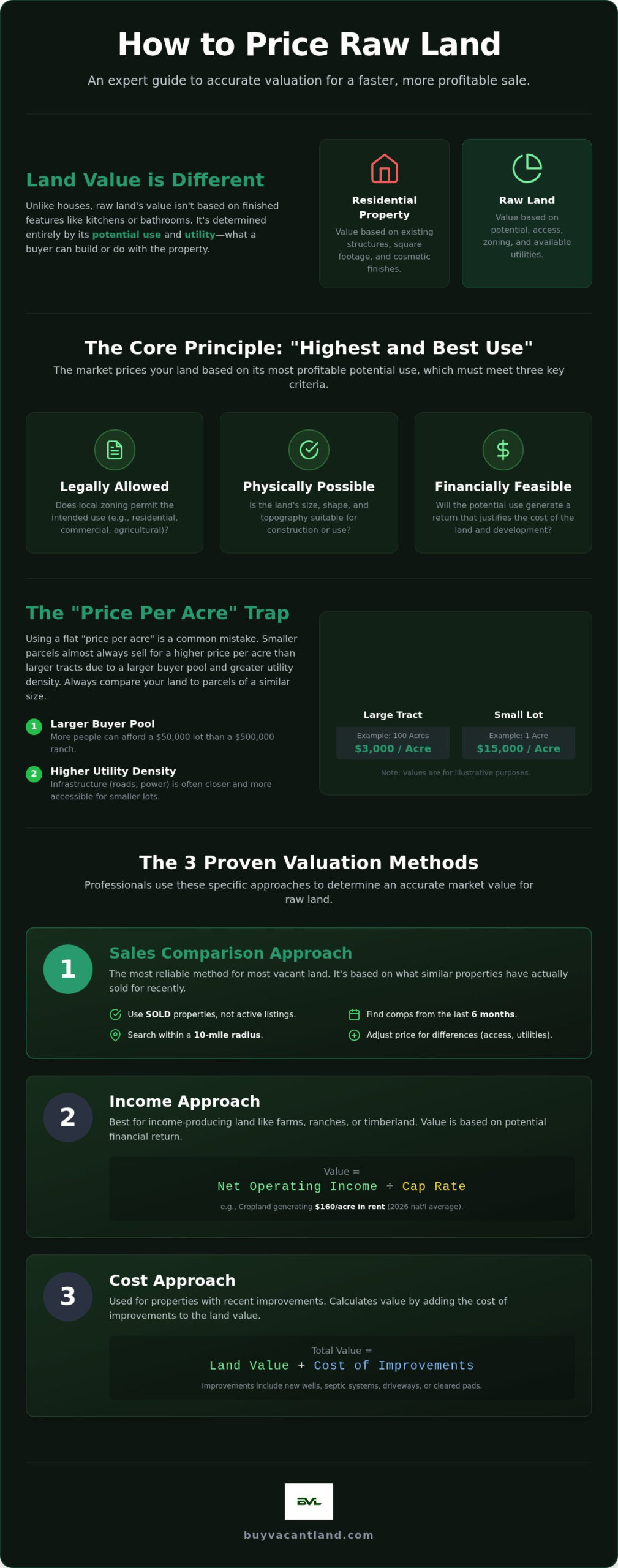
The most important factor in land value is “Highest and Best Use.” This concept is a pillar of professional real estate appraisal. It determines which use of the property is physically possible, legally allowed, and financially feasible. A five-acre lot zoned for a single off-grid cabin will never be worth as much as a five-acre lot zoned for a ten-unit housing subdivision. Your personal intended use for the property doesn’t set the price. The market’s most profitable use does. If your land sits on a commercial corner, pricing it as a hobby farm will cost you thousands in lost equity.
Why “Price Per Acre” Can Be Deceptive
Sellers often fall into the trap of using a flat price per acre to value their land. This ignores the law of diminishing returns. In the land market, smaller parcels almost always sell for a higher price per acre than large tracts. Consider these factors:
- Buyer Pool: More people can afford a $15,000 one-acre lot than an $800,000 ranch.
- Utility Density: A small lot often has road access and power already at the line, while a 100-acre tract may require miles of new infrastructure.
- Total Utility: A 40-acre parcel is not 40 times more useful than a 1-acre lot for a single homeowner.
When you research how to price land for sale, only compare your property to lots of a similar size. Comparing a five-acre residential lot to a 2026 average cropland value of $6,020 per acre will result in a price that is far too low. Always compare apples to apples to ensure your asking price reflects the true utility of the land.
The Three Proven Methods for Determining Raw Land Value
Professionals don’t guess. They use three specific formulas to decide how to price land for sale accurately. The Sales Comparison Approach is your primary tool for residential lots and undeveloped parcels. The Income Capitalization Approach works best for productive assets like agriculture. Finally, the Cost Approach helps when you’ve already added improvements like wells, septic systems, or cleared pads. Choose the method that matches your land’s highest and best use to avoid leaving money on the table.
Mastering the Sales Comparison Approach
This is the most reliable way to find market value. You look at what people actually paid, not what they hope to get. Never base your price on “active” listings. Those properties haven’t sold for a reason. Follow the 6-month rule. Real estate markets in 2026 are disciplined, so data older than six months is often obsolete. Find three “sold” comps within a 10-mile radius. Adjust your price based on differences. If a comp has a paved road and yours is dirt, subtract value. If yours has power and the comp doesn’t, add value.
When to Use the Income Approach
Use this for farms and ranches or timberland. Value is calculated by dividing the net operating income by a “cap rate.” If your cropland generates $160 per acre in rent, which is the 2026 national average, a buyer will pay based on that return. This is purely a financial calculation. It ignores emotional appeal and focuses on the bottom line. It’s the standard for commercial vacant lots where the buyer expects a specific yield. If your land produces income, this method provides the strongest justification for a premium price.
The Cost Approach is simpler but less common for raw dirt. It adds the land value to the current cost of replacing improvements. If you spent money on a new well or driveway in early 2026, you factor those costs in. However, don’t expect a dollar-for-dollar return on every improvement. Buyers only pay for what they can use. Prioritize the Sales Comparison method for most parcels. It provides the most accurate snapshot of current buyer behavior. Using these three methods takes the emotion out of the process. You’ll stop wondering how to price land for sale and start acting like a professional seller. Once you have your data, you can list your land to reach active buyers immediately.
Critical Factors That Can Double (or Halve) Your Asking Price
The physical reality of your dirt dictates its final market value. You can have the best location in the county, but if a buyer can’t reach it or build on it, the price will plummet. Determining how to price land for sale requires a cold, hard look at infrastructure and legal constraints. These factors create the “utility” that buyers pay for. If your property lacks these essentials, you must adjust your expectations downward immediately to avoid a stagnant listing.
The Value of Access and Infrastructure
Paved road frontage is the gold standard for land sellers. It commands a massive premium because it provides reliable, year-round entry without the need for expensive private maintenance. Landlocked parcels are a different story. They often sell for 50% less than accessible lots because of the legal hurdles involved. An easement is a legal right to cross someone else’s property to reach your own, and its absence makes a parcel virtually unbuildable.
Utilities are the next major price driver. In 2026, buyers view high-speed internet as a tier-one utility, right alongside electricity and water. If power lines are already at the property boundary, you’ve saved a buyer thousands in installation costs. Bringing electricity to a remote site can cost between $10,000 and $50,000 per mile depending on the terrain. If your land is truly off-grid, your price must reflect the reality that the buyer will need to invest in solar or well-drilling before the land is functional.
Zoning: The Invisible Price Driver
Zoning is the legal framework that tells a buyer what they can actually do. Residential, commercial, and agricultural designations act as hard ceilings on value. A lot zoned for a single-family home has a lower price ceiling than one zoned for a multi-unit apartment complex. Local setbacks and building codes further limit the “building envelope,” or the actual square footage where a structure can sit. When you analyze how to price land for sale, use land for sale with utilities as a benchmark to see how zoning and infrastructure improvements create a price floor in your region.
Topography and soil quality are the final hurdles. Flat, dry land is always worth more than a steep hillside or a swampy bottom. A “perc test” is essential for any land without city sewer. This test determines if the soil can absorb liquid from a septic system. If the land fails a perc test, it’s effectively unbuildable for residential use. This single factor can cut your property value in half overnight. Always verify your soil status before setting a premium price.
A Step-by-Step Strategy to Set Your Competitive Listing Price
Setting a price is a mathematical exercise. You must gather at least three recent sold comps within a 10-mile radius to establish a baseline. Relying on “active” listings will lead to overpricing because those properties haven’t found a buyer yet. Use county records or specialized land sites to find actual transaction prices from the last six months. This data ensures your strategy for how to price land for sale is rooted in reality. If you don’t use sold data, you are just guessing.
Finding and Adjusting Your Comps
Use an “Adjustment Table” to level the playing field. Start with the sale price of your closest comp. Add value if your land has better features, like paved road frontage. Subtract value if the comp has superior infrastructure, like a pre-installed well. If a comp sold for $50,000 but included a $15,000 septic system your land lacks, your starting point is $35,000. Ignore outliers. One desperate buyer paying double or one family transfer at half-price will ruin your average. Focus on the middle of the pack to find the “Retail” price.
Cash Price vs. Owner Financing Premium
Your financing strategy directly impacts your bottom line. In August 2026, securing a bank loan for raw land remains difficult. Lenders typically demand 20% to 30% down payments with interest rates ranging from 4% to 10%. You can bypass this hurdle by offering terms. owner financed land typically sells for a 15% to 25% premium over cash prices. You trade immediate liquidity for a higher total sale price and monthly interest income. This attracts a much larger pool of buyers who cannot qualify for traditional financing.
If you need a quick exit, set a “Wholesale” price. This is usually 20% below the retail average. It targets investors who can close in days. For most sellers, a “90-day” price is the best balance. This is a competitive retail price designed to move the property within one fiscal quarter. If your phone isn’t ringing within the first 30 days, your price is too high for the current market. Review your data and adjust quickly to stay relevant. Once you have calculated your optimal number, list your vacant land to get it in front of serious buyers immediately.
Maximize Your Exposure: Listing Your Land on a Specialized Marketplace
Setting the right number is only half the battle. You now need to put that price in front of the right people. Generic real estate websites are designed for home buyers who care about school districts and master suites. These platforms bury raw land listings under a mountain of residential noise. Using a specialized marketplace like BuyVacantLand.com ensures your property is seen by people specifically looking for dirt. This targeted exposure is the final step in your strategy for how to price land for sale because it validates your valuation with real-time market feedback.
A well-priced listing on a niche platform generates immediate lead flow. When your price aligns with the market data you gathered, serious buyers recognize the value instantly. You won’t waste time defending your price to people who don’t understand land utility. Instead, you’ll receive inquiries from investors who have been waiting for a parcel with your specific features. This efficiency is the hallmark of a professional transaction. It moves you from “listed” to “sold” without the typical procedural hurdles found on general listing sites.
Why Niche Marketplaces Outperform General Sites
Land buyers search differently than home buyers. They don’t look for bedroom counts or kitchen finishes. They filter for specific land types such as off-grid land, hunting acreage, or industrial lots. On a specialized platform, your listing doesn’t compete with a suburban bungalow for attention. You reach a national audience of serious developers who understand the value of raw property. This focus eliminates “tire kickers” and connects you with buyers who have the cash or financing ready to move. Avoiding the noise of residential listings is essential for a swift sale.
Ready to Sell Your Land?
Your presentation must be as professional as your pricing. High-quality visuals are non-negotiable in the 2026 market. Use drone shots to show boundaries, road access, and the surrounding terrain clearly. If you are selling property in California, comply with the AB 723 law by disclosing any digitally altered or AI-edited marketing photos. This transparency builds trust and prevents legal delays during the closing process. Your description should be direct and benefit-driven. Mention the zoning, utility status, and any owner financing terms you decided to offer.
Review your data one last time before you publish. Ensure your adjustments for road access and power are clearly reflected in the description. A transparent, well-documented listing gives buyers the confidence to make an offer without endless back-and-forth questions. You have done the work to understand how to price land for sale accurately. Now, use the right tools to finish the job. List your vacant land on our national marketplace today.
Take Control of Your Land Sale Today
You now have the framework to stop guessing and start selling. Mastering how to price land for sale means looking past your tax bill and focusing on the actual utility of your dirt. Whether you’re adjusting for road frontage or offering owner financing to bypass 2026 interest rates, your price is now rooted in market reality. You’ve identified your sold comps and accounted for the building envelope. The stress of underpricing is gone. It’s time to move from valuation to a closed transaction.
A precise price deserves a specialized audience. Avoid the noise of residential sites and put your property where serious land buyers look first. Our specialized marketplace provides national exposure to thousands of active buyers looking for residential lots, farms, and off-grid land. The process is streamlined and efficient. List Your Vacant Land for Sale Now to experience a no-nonsense listing process designed for speed. You’ve done the research. Now, let the market respond to your competitive offer. Your path to a successful sale is clear and assured.
Frequently Asked Questions
How do I find out what land sold for in my area?
You find actual sold prices through county records or specialized land portals. Search the public deed records for recent transfers in your township. This data is the only way to verify what buyers actually paid. Avoid using active listing prices for your research. They represent hope, not reality. Use these confirmed numbers to build your baseline and ensure your valuation is rooted in current market demand.
Does having a survey increase the price of my land?
A professional survey increases the price and marketability of your land. It eliminates boundary confusion and gives the buyer legal certainty. Buyers in 2026 prioritize parcels that are shovel-ready. A survey removes a major procedural hurdle and justifies a higher asking price. You aren’t just selling dirt; you are selling a documented and verified asset that is ready for development or resale immediately.
Is land more expensive if it is already cleared?
Cleared land is more expensive because it is ready for immediate use. Clearing brush and trees is a major expense and a logistical burden for buyers. A cleared lot shows the property’s best features and topography clearly. It attracts residential builders who want to start construction without a three-month site preparation delay. You can price cleared land higher to reflect these saved costs and the added convenience.
How much value does a well or septic system add to vacant land?
A well or septic system adds value that often exceeds the installation cost. These improvements move your property from the raw land category to a buildable lot status. Buyers don’t have to worry about the 2026 risk of a failed perc test or an empty well. This certainty triggers faster offers. It is one of the most effective ways to increase your equity before you list the property for sale.
Should I price my land higher if I offer owner financing?
You should price your land 15% to 25% higher when offering owner financing. This premium covers the convenience of bank-free buying and the risk of carrying the note. Many buyers in 2026 struggle with strict lending criteria and high down payments. Your financing terms provide a solution to their problem. The higher price is an equitable trade for the accessibility and speed you offer through your private lending structure.
What is the best month to list land for sale?
March through May is the most effective time to list. Buyers want to walk the terrain when it is visible and accessible. Spring listings capture the surge of interest from people planning summer projects. Early fall is a strong secondary window before the winter weather sets in. Aligning your listing with these seasons ensures you reach the largest pool of motivated buyers when they are most active in the market.
How long does it typically take to sell vacant land in 2026?
Expect a 90 to 180-day window for a successful sale in 2026. Land is a specialized asset and doesn’t move as fast as a suburban home. The speed of your sale depends entirely on your pricing accuracy and market exposure. Using a specialized marketplace can cut this time down by connecting you with serious land buyers immediately. Focus on quality leads rather than a high volume of tire-kickers.
Can I price my land based on the tax assessment value?
Never rely on tax assessments to decide how to price land for sale. These values are calculated for tax revenue and rarely reflect the true market price. They are often months or years behind current sales data. Use recent comparable sales to find a price that buyers will actually pay. A professional valuation based on current utility and demand is the only way to ensure you don’t lose money.



Join The Discussion