
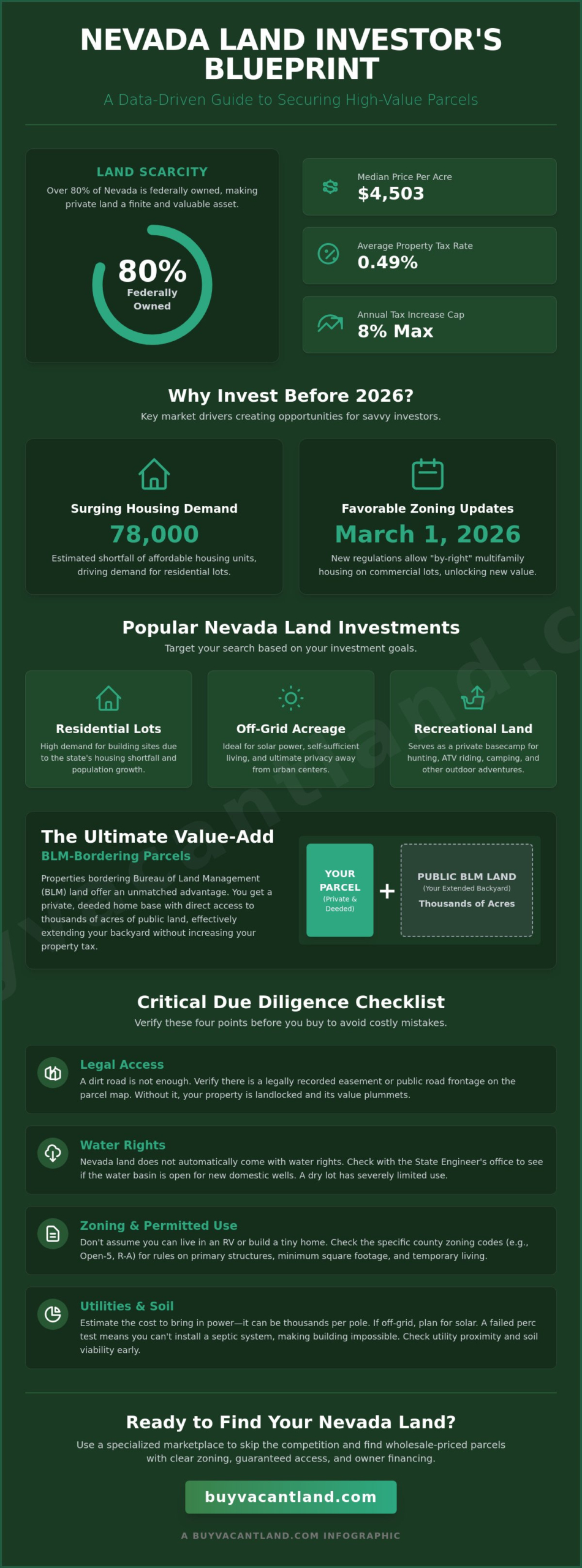
Over 80% of Nevada’s land is owned by the federal government. This makes the remaining land for sale in nevada a scarce, high-value asset that demands a precise investment strategy. You likely recognize the potential for off-grid freedom or residential growth, yet you fear sinking capital into a “useless” desert lot with no water or road access. It’s a reasonable concern when the median price per acre is $4,503 and Western zoning laws are notoriously complex.
This guide provides a direct path to securing a high-value parcel without the typical procedural hurdles. You’ll learn to navigate water rights, understand the 0.49% property tax rate, and leverage the March 1, 2026, zoning updates that allow for “by-right” multifamily housing on commercial lots. We’ll simplify the legal requirements for building or RV use and show you how to find reliable owner-financing. Read on to master the essentials and turn a raw lot into a secure investment with total confidence.
Key Takeaways
- Pinpoint why Nevada’s tax-friendly market makes raw land a superior asset for 2026 investors.
- Verify legal access and water rights to ensure your land for sale in nevada is usable and high-value.
- Skip generic real estate sites and use specialized marketplaces to access wholesale pricing on raw acreage.
- Secure your property instantly through owner financing with low down payments and no credit checks.
- Follow a simplified, multi-step sequence to close your transaction with speed and total transparency.
The Nevada Land Market: Why Investors Are Buying in 2026
Investors are flooding the Silver State because land for sale in nevada remains one of the most affordable high-growth assets in the country. The median price per acre sits at $4,503, offering a low barrier to entry compared to neighboring California or Arizona. This isn’t just about cheap dirt; it’s about a strategic tax environment. Nevada’s average effective property tax rate is just 0.49% of the assessed value. For vacant land investors, the annual property tax increase is capped at 8%. These numbers create a predictable, low-cost holding environment for long-term appreciation. You aren’t just buying land; you’re securing an asset with fixed overhead and high upside potential.
The state’s geographic reality drives its scarcity and value. Over 80% of Nevada’s land is managed by the federal government. This massive federal footprint limits the supply of private land, making every available parcel a finite resource. Much of this land involves historical federal rangelands in Nevada, where the distinction between public and private use is critical for property owners to understand. When you buy here, you’re buying into a market with a hard supply ceiling. Private parcels are becoming increasingly rare as the state continues to grow and the population expands into the high-desert plateaus and mountainous terrain.
Popular Types of Land for Sale in Nevada
Investors typically target three specific categories based on their goals and risk tolerance. Residential lots are in high demand as the state faces a shortfall of nearly 78,000 affordable housing units. Off-grid acreage is perfect for solar power and self-sufficient living, providing a level of privacy that is disappearing elsewhere. Recreational land serves as a permanent basecamp for hunting, ATVs, and camping. Each type offers a different path to value, whether through immediate development or long-term land banking.
The Appeal of BLM-Bordering Parcels
A Bureau of Land Management (BLM) bordering parcel is the ultimate value add in Nevada. These properties share a boundary with public land, which effectively expands your usable space by thousands of acres without increasing your tax bill. You get direct access to vast wilderness for hiking or riding while maintaining a private, deeded home base. This proximity to public land creates a permanent buffer against new neighbors and ensures your views remain unobstructed. It’s a high-impact strategy to secure premium privacy for a standard land price.
Nevada Due Diligence: What You Must Check Before You Buy
Buying land for sale in nevada requires a clinical approach to due diligence. Many buyers assume a deed guarantees full use of the property. It doesn’t. You must verify legal access before signing any contract. A physical dirt road doesn’t always equal a legal right of way. Check for recorded easements on the parcel map. Without them, you’re landlocked. This creates a massive liability that can tank your property value instantly. Verify everything. Trust nothing but the recorded documents.
Understanding Nevada Water Rights
Nevada operates under the “prior appropriation” doctrine. This means water rights are often separate from the land itself. Owning a lot doesn’t automatically grant you the right to drill a domestic well. You must check the water basin status with the State Engineer’s office. Some basins are over-allocated or closed to new drilling. If you buy a lot without existing water rights or the ability to drill, you’ve bought a dry desert parcel with limited utility. Always confirm these details to avoid expensive legal traps.
Zoning and Building Codes for Rural Lots
Zoning dictates your daily life on the property. Common classifications like Open-5 or Residential-Agricultural (R-A) have strict rules. Don’t assume you can live in an RV or park a mobile home indefinitely. Most counties require a primary structure or specific permits for temporary living. Tiny houses also face hurdles regarding minimum square footage and septic requirements. Compliance with the Nevada Land Sales Law ensures that developers follow state standards, but you must still verify local county codes. If you want a property that allows immediate use, start by browsing listings with clear zoning descriptions.
Utilities are your biggest hidden cost. Bringing power to a remote site can cost thousands of dollars per pole. If the grid is too far, solar is your only option. You also need to perform a perc test for septic systems. Not all desert soil drains properly. If the soil fails, your building plans are dead. Check these factors early. A cheap lot becomes an expensive burden if you can’t install basic infrastructure. Secure your peace of mind by confirming utility proximity before you commit funds.
How to Find Cheap Land for Sale in Nevada
Finding the best land for sale in nevada requires a tactical shift. Don’t rely on general real estate websites. Their algorithms prioritize high-commission homes and suburban lots. They often hide the raw, rural acreage where the real value lies. You need a specialized approach to find wholesale deals that haven’t been marked up by multiple intermediaries. Focus your search on platforms that cater specifically to vacant land investors.
Traditional realtors often avoid vacant land because the commissions are low relative to the effort required. This creates a massive opportunity for the direct investor. By using a focused platform like BuyVacantLand.com, you connect directly with sellers who understand the specific needs of land buyers. You can filter for specific Nevada features like solar potential or proximity to public lands without wading through irrelevant house listings. This direct connection cuts out the middleman and saves you time.
Before you commit to a “cheap” lot, consult the Nevada Real Estate Division publications. These official documents provide the legal framework for residential disclosures and state-specific laws. Reviewing these guides ensures you aren’t buying a liability. Cheap land is only a deal if it remains an asset. Use these resources to verify that the seller is compliant with state standards before you move to the closing phase.
Marketplace vs. Traditional Realtor
Direct marketplaces offer speed and transparency. You see the price, the terms, and the owner financing options immediately. Traditional realtors may take days to respond to a query about a five-acre lot. On a dedicated platform, you skip the gatekeepers. This efficiency allows you to secure a parcel before the general public even knows it’s available. It’s the most pragmatic way to build a portfolio in a competitive market.
Identifying High-Value, Low-Cost Opportunities
Look for parcels in the path of future state growth. As urban centers like Las Vegas and Reno expand, peripheral land values rise. Target rural counties where the price-per-acre remains low. Some investors even look for landlocked parcels that have the potential for a legal access easement negotiation. This is a high-risk play, but it can unlock massive value if successful. Always evaluate the topography to ensure the land is physically usable for your intended purpose.
Owner financing is your best tool for lowering the barrier to entry. Many wholesale sellers on specialized platforms offer terms with low down payments and no credit checks. This allows you to control a large asset with minimal upfront capital. It’s a strategic way to scale your holdings while the market for land for sale in nevada continues to normalize through 2026. Secure your parcel now and benefit from the long-term appreciation of a finite resource.
Financing Your Nevada Land Purchase
Traditional banks are not your allies when buying raw land. They view undeveloped dirt as a high-risk liability. Unless you have a specific construction plan and a licensed contractor ready to break ground, most institutions will deny your application. Even if you qualify, you’ll face interest rates around 7.50% APR as of May 2026. This is why most successful investors avoid the bank entirely. They use more efficient methods to secure land for sale in nevada without the red tape.
Owner financing is the standard for the Silver State’s vacant land market. It bypasses traditional lending hurdles and lets you deal directly with the seller. This structure typically uses a Land Contract or a Deed of Trust. In a Land Contract, the seller retains the title until the final payment is made. A Deed of Trust involves a trustee and provides a clear legal framework for both parties. Both methods allow you to control the property immediately while paying it off over time.
The Benefits of Owner Financed Land
Seller financing eliminates the stress of credit scores. Most land sellers on specialized marketplaces offer terms with no credit checks and low down payments. You gain immediate access to the property for camping, storage, or future planning. To protect your investment, ensure your contract is recorded with the county recorder’s office. This creates a public record of your interest in the land and prevents the seller from conveying the title to another party. It’s a pragmatic way to build an asset portfolio with minimal upfront capital.
Preparing for a Cash Transaction
Cash is your strongest negotiating tool. A cash offer removes the uncertainty of financing and allows for a rapid closing. You can often finalize a deal in 7 to 14 days. Buying outright also saves you thousands in interest over the life of the investment. If you have the capital, use it to drive the price down and simplify the process. For more details on bank-free strategies, read our Owner Financed Land Guide.
Whether you choose terms or cash, the goal is a swift transaction. Don’t let complex bank requirements stall your progress. Identify your budget, choose your financing method, and move toward ownership. You can find owner-financed land for sale in nevada today and secure your parcel with a simple, transparent agreement. This approach cuts through traditional procedural hurdles and puts the deed in your hands faster.
Closing the Deal: Steps to Owning Your Nevada Property
Owning land for sale in nevada is a straightforward process when you follow a logical sequence. It begins with a formal intent to purchase. Submit your offer directly through the listing platform to establish a clear paper trail. This initial step secures your interest and starts the legal clock. Don’t skip the formal offer phase. It’s your primary protection against competing buyers and shifting terms. A documented offer ensures both parties are committed to the agreed price.
For larger transactions, you must open escrow with a reputable Nevada title company. They act as a neutral third party to manage funds and documents. This eliminates the risk of sending money into a void. You’ll receive a preliminary title report during this time. Review it carefully. You need to ensure the land is free of surprise liens, back taxes, or unresolved ownership claims. If the title isn’t clear, don’t close until the seller resolves the issue. This verification is the only way to guarantee a “clean” asset.
The Role of Title and Escrow
Title insurance is a critical shield for your investment. It protects you from historical claims that might surface years after the purchase. In Nevada, you typically receive a Grant, Bargain, and Sale Deed. This specific deed type implies that the seller has not previously conveyed the property to anyone else. It provides a higher level of certainty than a simple quitclaim deed. Using an escrow agent ensures that your money only moves when the deed is ready for recording. This neutral oversight provides peace of mind for both buyer and seller.
Finalizing Your Purchase on BuyVacantLand.com
Our marketplace simplifies the search for high-value parcels. You can browse curated listings for every budget, from industrial lots to hunting land. Use the platform to connect directly with sellers. Ask technical questions about soil quality or road access before you sign. Direct communication cuts through traditional procedural hurdles. If you’re new to the process, check out our guide on How Do You Buy Land? to master the basics.
The final step is recording the deed with the County Recorder. Nevada’s Real Property Transfer Tax (RPTT) will apply. Rates range from $1.95 to $2.55 per $500 of value depending on the county. Once the deed is recorded, the property is legally yours. You can now begin planning your custom build, solar setup, or long-term land bank. Ownership provides security. Follow these steps to secure your piece of the Silver State with total confidence and zero unnecessary stress.
Secure Your Nevada Asset Today
Private land in the Silver State is a finite resource. With over 80% of the state under federal management, the available land for sale in nevada represents a unique opportunity for long-term growth. You’ve learned how to verify water rights, navigate 2026 zoning laws, and bypass bank restrictions through owner financing. These tools turn a complex process into a predictable path to ownership. Don’t let traditional procedural hurdles stop you from securing a high-value lot.
BuyVacantLand.com is your primary resource for efficient land acquisition. We are a specialized vacant land marketplace that prioritizes direct-to-seller communication and transparency. You get national reach combined with local Nevada insights to ensure every transaction is fast and secure. Stop worrying about useless desert lots and start building your portfolio with confidence. Every listing on our platform is a step toward your goal of land ownership.
The path to your next investment is clear. Take action now to secure your parcel before supply tightens further. Browse Nevada Land for Sale Now
Frequently Asked Questions
Can I live in an RV on my land in Nevada?
You generally cannot live in an RV permanently on vacant land without a primary residence. Most Nevada counties allow temporary RV use for 14 to 30 days per year. If you are actively building a home, you can often apply for a temporary use permit to live on-site. This usually requires an approved septic system and a reliable water source. Always check with the specific county building department to avoid fines.
How do I find out if my Nevada land has water rights?
Check the database maintained by the Nevada Division of Water Resources. They track all water rights and domestic well logs across the state’s various basins. Owning the land for sale in nevada doesn’t automatically grant you the right to pump water. You must verify if the basin is over-allocated or closed to new domestic wells. This step is the only way to ensure your property remains a functional asset.
Are there property taxes on vacant land in Nevada?
Yes, you must pay annual property taxes on all vacant land. The average effective property tax rate in Nevada is 0.49% of the assessed value. For non-primary residences like raw land, the annual tax increase is capped at 8%. These taxes are managed at the county level. You can view the current tax status of any parcel through the local County Treasurer’s website.
What does ‘unrestricted land’ mean in Nevada?
‘Unrestricted’ typically means the property is free from Homeowners Association (HOA) rules or private CC&Rs. It does not mean you can ignore state or county laws. You must still comply with local zoning codes and health department regulations for septic and water. This status gives you more freedom for off-grid living but requires you to manage your own infrastructure and land use standards.
Do I need a survey before buying land in Nevada?
You should always obtain a professional survey for raw acreage. Many rural Nevada parcels were mapped years ago using less accurate technology. A modern survey confirms your exact boundaries and identifies any existing easements or encroachments. It provides the legal certainty you need to build fences or structures without risking a neighbor dispute. It’s a small upfront cost that protects your long-term investment.
How do I access my land if it is surrounded by private property?
You must verify that a legal, recorded easement exists on the property deed. Physical tracks or dirt roads don’t guarantee a legal right to cross someone else’s land. If your parcel is landlocked, you’ll need to negotiate an easement with a neighbor and record it with the County Recorder. Never buy land for sale in nevada without confirmed legal access, as landlocked property is extremely difficult to develop or resell.
Can I build a tiny house on rural Nevada lots?
Tiny houses are permitted if they meet the International Residential Code (IRC) and local county standards. Most counties require a permanent foundation and a minimum square footage for primary dwellings. You also need approved systems for waste and water. While Nevada is friendly to alternative living, you must still pull the necessary permits to ensure your tiny home is legally recognized and safe.
What are the common closing costs for land in Nevada?
Common costs include the Real Property Transfer Tax (RPTT), which ranges from $1.95 to $2.55 per $500 of value. You’ll also pay for title insurance, escrow fees, and document recording fees. These costs are often split between the buyer and seller based on the purchase agreement. Using a title company ensures these funds are handled safely and all state-mandated taxes are paid during the transaction.



Join The Discussion