

Your land investment is a liability until you secure the title and the perimeter. Closing the deal is only the start of your responsibility. Most new owners face immediate anxiety over squatters, vague property lines, and complex tax deadlines. You worked hard to find the right parcel. Now you need to know exactly what to do after buying land to keep it safe. Confusion at this stage leads to legal headaches and lost equity.
This guide delivers a pragmatic, step-by-step roadmap to secure your investment immediately. You’ll learn how to handle the essential administrative, legal, and physical tasks required in 2026. We provide clear instructions on recording your deed and managing the national average 0.99% property tax rate. We also outline the process for establishing physical security and planning utility connections. Follow this prioritized checklist to transform your raw land into a secure, development-ready asset without the typical stress of ownership.
Key Takeaways
- Secure your legal title by confirming the deed is recorded and your title insurance is active.
- Prevent liability and trespassing with mandatory signage and specific vacant land insurance policies.
- Use professional surveys and perc tests to define your property lines and development potential.
- Learn what to do after buying land to navigate the permitting process for driveways and utility hookups.
- Protect your asset’s future value through proactive brush management and consistent zoning oversight.
Finalize the Administrative Paper Trail
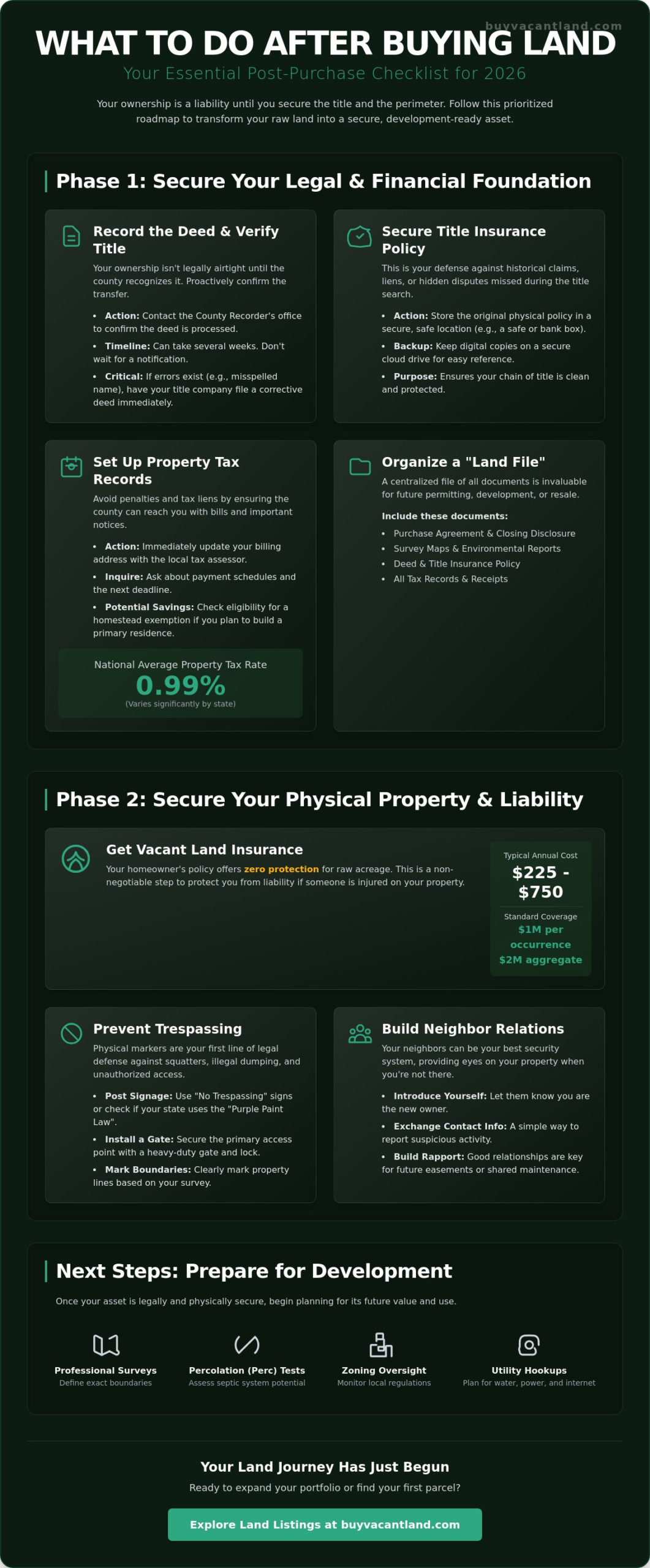
Closing the purchase is only the first half of the transaction. Your ownership isn’t legally airtight until the local government recognizes it. Many buyers assume the title company handles every detail perfectly. This is a mistake. You must take proactive control of your documentation to prevent future disputes. Knowing what to do after buying land starts with securing your legal standing through a verified paper trail.
Recording the Deed and Title Verification
Confirm that the County Recorder or Registrar has officially processed your deed. This process can take several weeks depending on the county’s backlog. Don’t wait for a notification that may never arrive. Contact the office directly to verify the transfer is complete. A recorded deed is your primary defense against competing claims. If you find a clerical error, such as a misspelled name or incorrect parcel number, contact your title company immediately. They must file a corrective deed to fix the public record. This ensures the chain of title remains unbroken.
Keep your title insurance policy in a secure, physical location. This policy protects you from historical liens or hidden ownership disputes missed during the initial title search. Digital copies are helpful for quick reference, but original documents are essential for legal challenges. This administrative foundation is vital for understanding land use planning and how your specific parcel fits into local development regulations. Secure these documents before you begin any physical work on the site.
Setting Up Property Tax and Ownership Records
Update your billing address with the local tax assessor immediately. The county sends tax bills to the address on file. If that address is outdated, you won’t receive the bill. Missing a payment leads to interest penalties or even tax liens. The national average effective property tax rate is approximately 0.99%, but this varies significantly by state. Ask the assessor for the exact payment schedule and the next deadline. This simple step ensures you maintain clear ownership without financial surprises.
Check if you qualify for a homestead exemption. This can significantly lower your tax burden if you plan to build a primary residence on the lot. Most counties require a specific application form and proof of residency. Additionally, ensure the county has your current mailing address for all legal notices. This is your first line of defense against zoning changes or utility assessments that could affect your property value. Knowing what to do after buying land involves managing these recurring obligations from day one.
Organize a dedicated “Land File” to store all purchase documents and receipts. Include the purchase agreement, closing disclosure, survey maps, and any environmental reports. Create a digital backup on a secure cloud drive for easy access. This file will be your most valuable asset when you eventually apply for building permits or decide to list the property for sale. Efficiency now saves significant time and money later.
Secure the Property and Manage Liability
Ownership is a liability until you secure the perimeter. Raw land is an open target for trespassers, illegal dumping, and accidents. You must act fast to protect your equity and your bank account. Deciding what to do after buying land requires a shift from administrative filing to physical protection. If someone gets hurt on your property, you are responsible. If a squatter moves in, you face a legal nightmare. Security is not an option; it is a requirement for maintaining your investment’s value.
Vacant Land Insurance and Liability
Your existing homeowners insurance policy likely offers zero protection for raw acreage. You need a dedicated vacant land liability policy immediately. In 2026, the annual cost for this coverage typically ranges from $225 to $750. A standard policy provides $1 million per occurrence and $2 million aggregate coverage. This small investment prevents a single accident from wiping out your entire land investment. These policies cover injuries to third parties and can even cover fire liability. Look for specialized providers who understand rural parcels. They offer no-deductible options that simplify the claims process if an incident occurs. This is a non-negotiable step for any serious landowner.
Trespass Prevention and Neighbor Relations
Physical markers are your first line of legal defense. Many states recognize the “Purple Paint Law.” In these areas, vertical purple stripes on trees or posts serve as a legal “No Trespassing” notice. Check your local statutes to ensure your signage meets specific height and visibility requirements. If you are buying land to build a home, securing the site is even more critical to protect future building materials. Install a heavy-duty gate at the primary access point. This stops unauthorized vehicle traffic and discourages illegal dumping. Fencing the entire boundary is ideal, but a gate and clear signage are the minimum requirements for security.
Your neighbors are your best security system. Introduce yourself early. Exchange contact information and let them know you are the new owner. Neighbors who know you are more likely to report suspicious activity or unauthorized hunters. This “neighborhood watch” approach provides constant monitoring that technology cannot always match. It also builds the rapport necessary for future utility easements or shared fence maintenance. Once your current lot is secure, you might even consider expanding your portfolio by browsing more undeveloped vacant land in the area. Taking these steps ensures your investment remains a source of wealth rather than a source of stress.
Conduct Professional Site Evaluations
Walking your property is a good start, but visual inspections don’t reveal legal or physical boundaries. You need hard data to avoid expensive mistakes. Many owners skip formal evaluations to save money. This often leads to building over property lines or discovering unusable soil after construction begins. Understanding what to do after buying land requires a commitment to technical due diligence. You must verify what the land can actually support before you invest in infrastructure.
The Necessity of a Modern Boundary Survey
Don’t trust old fence lines or rusted markers. These are frequently inaccurate and rarely hold up in court. Commission a professional boundary survey to establish your exact legal limits. In 2026, the average cost for a land survey is approximately $2,300. While a basic residential lot survey might cost as little as $475, complex parcels can reach $25,000. Request “pins and stakes” to mark every corner with permanent iron rods. This physical evidence is your primary defense against encroachment. If a neighbor’s shed or driveway crosses your line, you must address it now. Resolving these issues early prevents title clouds when you eventually sell your residential lots or farms and ranches.
A topographic survey is equally important for development. It maps elevation changes and drainage patterns across your acreage. This data dictates where you can place a foundation or a driveway without causing erosion issues. Knowing the “lay of the land” through a professional lens ensures your site plan is both legal and functional. It transforms a vague plot of dirt into a mapped, manageable asset.
Environmental and Soil Testing
Soil quality determines the future of your property. If you plan to build on off-grid land or undeveloped vacant land, you must order a soil percolation (perc) test. This test measures the water absorption rate of your ground. It is the deciding factor for septic system viability. If the soil fails to drain properly, you may be forced to install an expensive “mound” system or be restricted from building entirely. This test is a critical component of what to do after buying land to ensure your long-term plans are feasible.
You also need to identify environmental constraints. Check for designated wetlands, high-water marks, or protected species habitats. These areas are often subject to strict federal or state regulations that limit clearing and construction. Review the property for existing easements as well. Utility companies or local governments may have the right to access specific portions of your land, which can shrink your usable footprint. Identifying these “no-build” zones early prevents regulatory fines and helps you design a more efficient site layout. Get these facts on paper before you hire a contractor or purchase building materials.
Establish Infrastructure and Utility Access
Raw land remains inaccessible until you establish a physical entry point and basic services. Many owners wait too long to start this process. They face significant delays when contractors can’t reach the site or power tools. Master what to do after buying land by following a strict order of operations for infrastructure. This prevents backtracking and wasted capital. You must secure access before you can move heavy equipment or building materials onto the property.
- Step 1: Apply for a driveway permit or “curb cut” with the local road department.
- Step 2: Contact the electric co-op or utility company for a service estimate.
- Step 3: Determine your water source based on local availability.
- Step 4: Research septic or sewer requirements using your perc test results.
- Step 5: Install a temporary construction pole for site work.
Power and Connectivity Solutions
Contact your utility provider immediately to calculate line extension costs. In 2026, running electricity from the road to a site costs between $2,500 and $12,500. This averages $5 to $25 per linear foot. If your build site is deep within the parcel, these costs can become prohibitive. Compare these estimates against the cost of a professional solar array. For remote off-grid land, solar often provides a faster and more cost-effective solution. Don’t forget high-speed internet. Check for fiber availability or consider Starlink for immediate connectivity. Request a temporary power pole from your electric company. This provides the power needed for tools and security systems during the development phase.
Water and Waste Management
Your water source is your most critical utility. Municipal tap-in fees vary, but they are generally more predictable than drilling. If you must drill a domestic well, expect to navigate a specific permitting process through the county. The combined cost for installing a water well and septic system in 2026 typically ranges from $6,000 to $20,000. Your waste management choice depends entirely on your soil quality. Traditional septic tanks are efficient but require specific drainage conditions. If your soil failed a standard perc test, you may need an alternative waste system, such as a mound or aerobic treatment unit. These are more expensive but allow for development on challenging terrain. Secure these permits now to avoid construction stops later. If you are still looking for the perfect location, view our available residential lots to find properties with existing utility access.
Execute Your Long-Term Land Strategy
Securing your title and utilities is only the beginning. Long-term success depends on consistent stewardship and market awareness. You must transition from a buyer to a disciplined asset manager. Many owners fail because they ignore the land until they are ready to build or sell. This neglect leads to code violations, invasive species takeovers, and lost equity. Knowing what to do after buying land means protecting your investment from both physical decay and regulatory shifts. You must treat the parcel as a dynamic asset that requires active oversight.
Maintenance and Stewardship
Create a strict maintenance schedule immediately. Clear brush and manage invasive species to prevent local blight citations and fire hazards. If your parcel is heavily wooded, create firebreaks to protect the timber and future structures. Managing timber health increases the property’s aesthetic and financial value over time. It is vital to buy land with an exit strategy already in mind. Even if you plan to keep the parcel for decades, maintaining its condition ensures a faster sale if your financial needs change. Follow local weed control ordinances to avoid aggressive fines from the county. Proactive care proves to neighbors and local officials that the land is actively managed and monitored.
Investment Monitoring and Resale
Monitor local zoning boards for changes that could impact your property value. In 2026, many jurisdictions are reforming zoning laws to allow for higher density or “missing-middle” housing. These shifts can significantly increase the value of residential lots overnight. Conversely, new environmental restrictions could limit your development options. Stay informed to pivot your strategy as needed. You should also evaluate the potential for passive income to offset your holding costs. You can lease farms and ranches for grazing or hunting land to local sportsmen. These agreements often include maintenance clauses, shifting the burden of brush clearing to the tenant. This reduces your overhead while keeping the land productive.
If your goal is a quick flip, track market trends for cheap land for sale in your specific county. National land prices per acre increased by 76.6% from 2019 to 2026, though the market has recently entered a period of stabilization. Use a specialized marketplace like BuyVacantLand.com to track valuations and list your parcel when the timing is right. Holding land remains a powerful hedge against inflation, provided you manage the asset with discipline. Knowing what to do after buying land ensures your capital remains productive and your title stays secure for the long haul.
Take Control of Your Land Investment
Securing your property requires immediate action. You’ve learned how to record your deed, establish physical security, and plan for essential utilities. These steps transform a raw parcel into a protected financial asset. Don’t let administrative delays or poor site planning compromise your equity. A clear, prioritized approach ensures your land remains a source of wealth rather than a liability. You now have the full 2026 roadmap for what to do after buying land to maintain legal and physical control.
Success in land ownership comes from efficiency and reliability. If you’re ready to grow your holdings, use a platform built for speed and transparency. BuyVacantLand.com is a national marketplace exclusively focused on raw land and vacant lots. We provide a streamlined discovery process for undeveloped property without the typical procedural hurdles of traditional real estate sites.
Ready to expand your portfolio? Browse the latest vacant land listings here.
Your path to successful land ownership is now clear. Execute your strategy with precision and watch your investment grow.
Frequently Asked Questions
Do I need to record my deed myself after buying land?
If you used a title company or attorney, they likely recorded the deed for you at closing. However, you must contact the County Recorder or Registrar to confirm the transfer is complete. Don’t assume the work is done. A failure to record means you don’t legally own the property in the eyes of the public record. Verification is a critical part of what to do after buying land to protect your investment.
How much does it cost to clear a lot for building?
Clearing costs depend on the density of the vegetation and the size of the parcel. Professional contractors typically charge based on the equipment required and the volume of debris for removal. Request multiple quotes from local excavators to get an accurate estimate for your specific terrain. Budget for this early so you don’t stall your development plans later.
What is the first thing I should build on my new land?
Establish a secure access point first. This usually means applying for a driveway permit and installing a heavy-duty gate. Once you have a permitted “curb cut,” you can move equipment and materials onto the site safely. Following this, focus on a temporary power pole or security fencing. Building these foundational elements first makes all subsequent construction steps more efficient.
How do I find my property lines without a professional survey?
You can use county GIS maps and plat maps to find approximate boundaries. Look for existing iron pins or markers at the corners. While smartphone apps can help you navigate, they aren’t accurate enough for legal boundary disputes. Never build a structure or fence based on a DIY search. Always hire a professional surveyor to mark the lines permanently and legally.
Can I live in an RV on my land while I build?
Zoning laws and HOA regulations determine if you can live in an RV. Many rural counties allow it with a temporary use permit while a primary residence is under construction. Other areas strictly prohibit it to prevent long-term camping. Contact the local planning department to verify the rules before you move your trailer onto the site. This avoids expensive fines and forced removals.
What happens if I forget to pay my property taxes on vacant land?
Missing a tax payment leads to immediate interest penalties and late fees. If the debt remains unpaid, the county will eventually place a tax lien on the property. This can lead to a tax sale where your ownership is auctioned off to the highest bidder. Ensure the tax assessor has your correct mailing address. This simple step is a vital part of what to do after buying land to keep your title clear.
How do I get an address for my new piece of land?
You must apply for a physical address through the county planning or emergency services department. Most jurisdictions won’t issue an address until you have a permitted driveway or a foundation in place. The address is necessary for utility hookups and mail delivery. Contact the 911 addressing coordinator in your county to start the application process once your access is established.
Is title insurance necessary for raw land purchases?
Title insurance is essential for every land purchase. It protects you from hidden liens, undisclosed heirs, and historical errors in the public record. Without it, you are personally liable for the costs of defending your ownership in court. A one-time premium at closing provides permanent protection. It is the only way to guarantee your financial interest in the property is secure.




Join The Discussion