

What if you purchased a prime acreage only to watch a third-party set up a drilling rig in your backyard? It’s a valid fear. In most energy-producing states, the mineral estate is the dominant estate. This means a subsurface owner can often access your land regardless of your surface plans. Finding verified land with mineral rights for sale is the only way to ensure you own the entire asset. You want total control over your investment without the stress of severed rights or sudden legal disputes.
We recognize the frustration of navigating complex deeds and vague listings. Over $3 billion in U.S. mineral rights changed hands in 2025 alone. You need a clear strategy to compete. This 2026 guide provides the pragmatic steps you need to identify unified estates and value net mineral acres in high-demand basins like the Permian. We’ll break down the latest regulatory shifts, explain current 25% royalty rates, and provide a simple path to securing a valuable land portfolio. Let’s get straight to the facts so you can invest with certainty.
Key Takeaways
- Secure your investment by distinguishing between unified and severed estates before you sign a contract.
- Identify the true value of subsurface resources by evaluating producing versus speculative potential in active basins.
- Protect your property from third-party access by verifying that no prior mineral reservations exist in the chain of title.
- Streamline your search for land with mineral rights for sale by using specialized filters for farms, ranches, and undeveloped lots.
- Gain peace of mind by following a clear, multi-step sequence to verify ownership from the original patent to the present day.
What is Land with Mineral Rights for Sale?
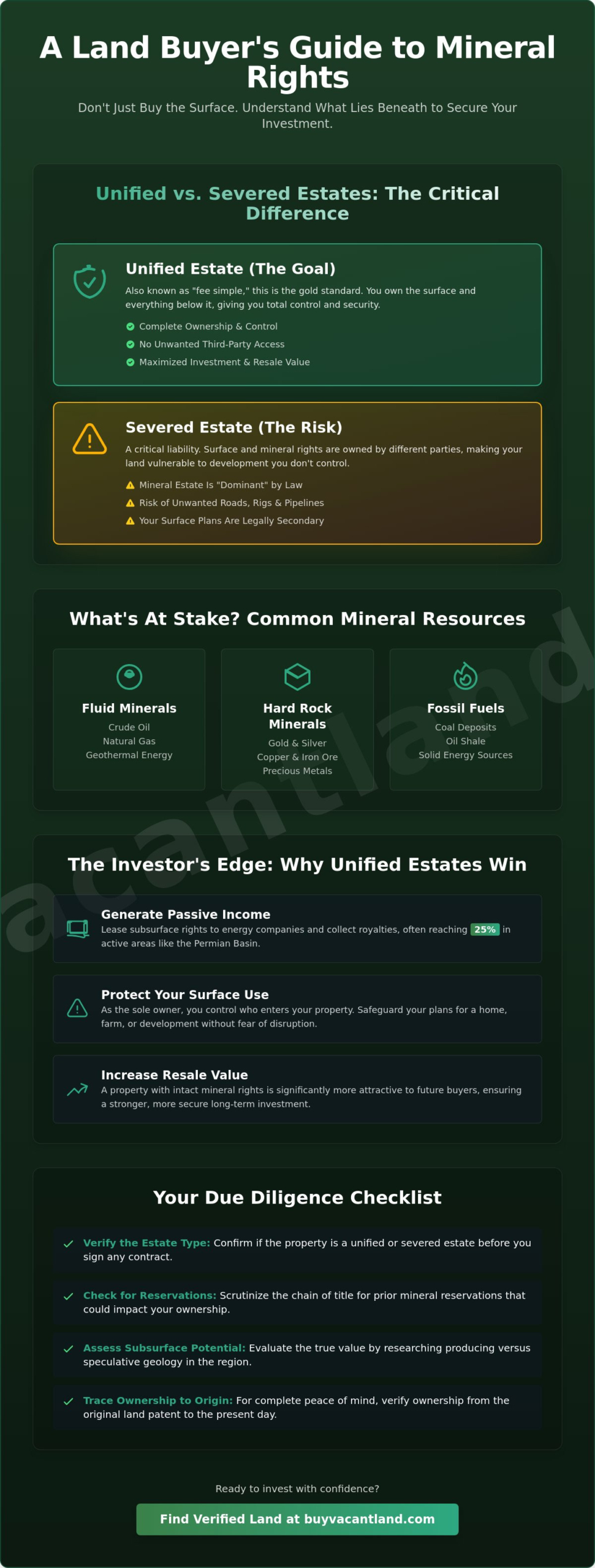
Ownership isn’t always what it seems. When you look at land with mineral rights for sale, you’re seeking a unified estate. This means you own the surface and everything below it. Many buyers assume that buying a deed automatically gives them the rights to the oil, gas, or gold beneath the soil. That is a dangerous mistake. In the United States, mineral rights are often severed from surface rights. This creates a “split estate” where two different parties own different layers of the same property.
Understanding What are Mineral Rights? is the first step in your due diligence. In 2026, these assets are more than just dirt; they are financial safeguards. With global oil demand projected to reach nearly 105 million barrels per day by 2030, owning the source of energy provides a massive hedge against inflation. If you don’t secure the mineral rights during the purchase, you’re only buying half the asset. A third party could legally drill on your property without your permission if they hold the mineral deed. You need to verify exactly what is included before you wire any funds.
Common Resources Included in Mineral Rights
Mineral rights cover a wide range of valuable materials. These are generally categorized into three main groups:
- Fluid minerals: This includes crude oil, natural gas, and even geothermal energy resources.
- Hard rock minerals: Precious and industrial metals like gold, silver, copper, and iron ore fall into this category.
- Fossil fuels: This covers solid energy sources like coal and oil shale deposits.
Why Investors Target Mineral-Rich Property
Smart investors prioritize unified estates for three specific reasons. First, it creates potential for passive income. You can lease your subsurface rights to energy companies and collect royalty rates, which in 2026 often reach 25% in active areas like the Permian Basin. Second, it protects your surface use. If you own the minerals, you control who enters your property to drill or mine. Finally, it increases resale value. A property with intact mineral rights is far more attractive to future buyers than a split estate with unresolved legal access issues. Securing land with mineral rights for sale ensures you have the peace of mind that comes with total ownership and long-term resource security.
Unified vs. Severed Estates: The “Split Estate” Reality
When you buy property, you want the whole package. A unified estate, also known as fee simple ownership, means you own the surface and the minerals. It’s the gold standard for long-term security. However, reality often involves a split estate. This occurs when the subsurface rights are legally separated from the surface. If you’re browsing land with mineral rights for sale, verifying this distinction is your most critical task. You don’t want to buy a beautiful lot only to find out you’re just a surface tenant.
Here is the hard truth. In most energy-producing states, the mineral estate is “dominant” over the surface estate. This legal status gives the mineral owner the right to use your surface to reach their resources. They don’t need your permission to build a road or a drill pad. They only need to show it’s “reasonably necessary” for extraction. This can ruin your plans for a quiet homestead or a commercial development. You must understand that your surface rights are secondary to the subsurface owner’s industrial schedule.
The Doctrine of Implied Easement
This doctrine is the legal engine behind a split estate. It grants the mineral owner an implied easement to enter your land. They can use your water for drilling, install pipelines, and set up storage tanks. Your ability to build a house or plant crops is legally subordinate. If you don’t own the minerals, your surface use is always at risk of disruption. This is why savvy buyers use our platform to find farms and ranches where the title is clear and unified. Don’t leave your surface control to chance.
How Rights Get Severed Over Time
Severance happens through specific language in the deed. A previous owner might have sold the land but “reserved” the minerals for their family. Railroad companies in the 1800s often kept mineral rights when they sold land grants to homesteaders. State laws vary wildly on how these rights are managed. Some states have “Dormant Mineral Acts” that can reunite estates if the minerals aren’t used for a set period. However, you can’t rely on these acts without a professional title search. Always trace the chain of title back to the original land patent to confirm you are buying land with mineral rights for sale. Total ownership is the only way to guarantee your investment’s future.
Calculating the Real Value of Mineral Ownership
Price per acre is only the surface story. When you evaluate land with mineral rights for sale, you’re looking at two distinct asset classes. The surface value depends on road access and soil quality. The subsurface value depends on geology and proximity to active production. In 2026, the gap between “Speculative Value” and “Producing Value” has never been wider. Speculative value applies to land in quiet areas where minerals might exist but aren’t yet proven. Producing value applies to land where pumps are already moving. In the Permian Basin of West Texas, producing mineral rights can reach over $30,000 per net mineral acre. In contrast, speculative rights in less active basins might only fetch a few hundred dollars per acre.
Data drives these numbers. Modern investors rely on geological surveys and seismic data to justify a higher land price. Horizontal drilling technology has revitalized areas once thought to be dry. This technological shift means land that was worthless ten years ago could be a goldmine today. Lenders also prefer unified estates. It’s much easier to secure financing when a bank knows a third-party oil company won’t suddenly disrupt the property. A clear title makes you a lower risk for traditional mortgage providers.
Income Potential: Leases and Royalties
Ownership opens the door to passive income. When you sign a lease with an energy company, you typically receive a “signing bonus” per acre. This is upfront cash before any drilling starts. After production begins, you collect royalties. In 2026, standard royalty rates in competitive regions have climbed to 25% (1/4th). This is a significant jump from the historical 12.5% standard. You need to distinguish between a “Royalty Interest,” where you collect a check without paying for operations, and a “Working Interest,” where you share the costs and the risks of drilling. Understanding these financial structures is vital for long-term resource security.
Risks of Owning Surface Without Minerals
Buying the surface alone is a gamble. A split estate can lead to the massive devaluation of residential lots if a resource company decides to set up a rig nearby. You’ll face noise pollution, heavy truck traffic, and potential environmental liabilities that you didn’t create. Title insurance companies also view split estates with caution. It’s often difficult to obtain full coverage when the subsurface ownership is unclear. You can learn How to Verify Mineral Rights to avoid these pitfalls. Protect your investment by ensuring the subsurface assets are part of the deal. Don’t let a third party dictate the future of your property.
How to Verify and Buy Land with Mineral Rights
Verification is the only barrier between a secure asset and a legal disaster. Never take a seller’s word for it. You must conduct a preliminary title search to identify any “Mineral Reservations.” These are clauses where a previous owner kept the subsurface rights while selling the surface. If you are browsing land with mineral rights for sale, you need to confirm that the rights actually exist and are ready for transfer. This process requires speed and precision to ensure you don’t lose a prime opportunity to a more prepared buyer.
Review the “Chain of Title” back to the original land patent. A standard 30-year search is not enough for minerals. You must trace ownership back to the first time the government granted the land. This is where most severances occurred. If the chain is broken, you don’t own the minerals. Hire a professional landman or a mineral attorney to provide a “Mineral Title Opinion.” This document acts as your legal roadmap and confirms exactly what percentage of the subsurface you are buying. It’s the only way to avoid expensive litigation later.
Check if the minerals are currently under lease to an energy company. If they are, you’ll need to review the Lease Agreement and Division Orders. These documents dictate how much you’ll be paid and when. If you are forced to buy a split estate, request a “Surface Use Agreement.” This contract limits where a resource company can place rigs or roads. It protects your ability to use the surface for your own projects. You can find verified listings for undeveloped vacant land with mineral potential right now.
Questions to Ask the Seller Directly
Get answers in writing before you sign any purchase agreement. Use these three direct questions to cut through the noise:
- “Do you own 100% of the mineral, oil, and gas rights?”
- “Is there an active lease on the subsurface property?”
- “Can you provide a copy of the deed showing the mineral conveyance?”
Essential Documents for Your Due Diligence
Gather these papers to prove ownership before you wire funds. Review the Warranty Deed specifically for “subject to” clauses that might hide a reservation. You also need any Mineral Deeds or Quitclaim Deeds that have been filed in the county records. Finally, secure copies of all active Lease Agreements and Division Orders to understand your immediate income potential. Having these documents ready ensures a swift, assured transaction. Tracing land with mineral rights for sale requires a strict logical progression, but the payoff is total property control.
Finding Verified Land Listings on BuyVacantLand.com
Finding the right parcel shouldn’t take months. We’ve built a marketplace that cuts through the noise of residential real estate. Most sites bury empty lots under thousands of house listings. BuyVacantLand.com does the opposite. We focus exclusively on empty parcels, making it easier to locate land with mineral rights for sale without the distraction of suburban rentals. You get direct access to sellers who understand the specific value of their subsurface assets. This focused approach saves you time and reduces the stress of sorting through irrelevant data.
Dealing directly with the owner is a major advantage. You can ask tough questions about mineral reservations and active leases immediately. There are no middleman brokers to filter the information or slow down the transaction. This transparency allows you to verify the chain of title faster and move toward a closing with confidence. Our platform streamlines the discovery of cheap land for sale across the country. You can filter specifically for farms and ranches that sit right in the heart of active energy corridors like the Anadarko or Delaware Basins.
Securing Your Investment with Direct Listings
Learning how do you buy land starts with choosing a specialized marketplace. Traditional brokers often add significant commissions to the final price. Buying direct eliminates these unnecessary costs. We also feature owner financed land options. This is a massive benefit for mineral-rich parcels that might be harder to finance through rigid, traditional banks. You get an equitable financial proposal directly from the seller, allowing for a swift and assured closing on your terms.
Next Steps: Start Your Search
Don’t wait for the perfect deal to find you. The 2026 market moves fast. High-quality land with mineral rights for sale is in high demand due to projected global energy needs. Set up custom alerts for new vacant land listings in your target counties. Use our interactive map tools to pinpoint properties near successful wells or proven mining operations. Take control of your portfolio today and avoid the legal headaches of split estates. Browse our current vacant land listings now to secure your long-term resource investment before the competition does.
Secure Your Subsurface Future Today
True land security requires a unified estate. Owning the surface is only half the battle. You’ve learned that a split estate leaves your property vulnerable to third-party drilling and legal disputes. In 2026, the demand for resource-backed assets is rising. You must verify your chain of title and secure subsurface rights to protect your long-term resale value. Don’t let complex legal terminology or hidden reservations derail your investment goals.
Finding verified land with mineral rights for sale doesn’t have to be a procedural hurdle. We provide a streamlined path to total ownership. Our marketplace offers an exclusive focus on raw, undeveloped land across all 50 states. You can skip the traditional broker fees and work directly with sellers for a transparent transaction. This direct-to-seller model ensures you get the facts you need without the wait. It’s time to build a portfolio that includes both the soil and the wealth beneath it.
Your next opportunity is waiting. Find your next land investment on BuyVacantLand.com and take control of your assets with certainty. Start your search now and invest with peace of mind.
Frequently Asked Questions
Do mineral rights include water and timber?
No. Mineral rights only cover subsurface substances like oil, gas, coal, and precious metals. Water and timber are considered part of the surface estate. In most jurisdictions, groundwater has its own legal status and is not bundled with your subsurface resource rights. You must verify the specific language in your deed to see if any surface resources were explicitly included or excluded during the sale.
Can I sell my mineral rights but keep the land?
Yes. You can sever the estate by selling the subsurface rights while retaining the surface for your own use. This is a common practice for owners who want immediate cash without giving up their homestead or farm. Once you sell these rights, the property becomes a split estate. This means a third party will own the assets beneath your soil and may have legal access to your surface for extraction purposes.
What is the difference between a mineral interest and a royalty interest?
A mineral interest gives you the executive right to explore, drill, and sign leases with energy companies. It is an active form of ownership where you control the subsurface decisions. A royalty interest is a passive right to a share of the production revenue. Royalty owners don’t pay for drilling costs or manage operations; they simply collect a percentage of the profits once resources are sold. Most investors prefer mineral interests because they provide more control over the land’s future.
How much does it cost to verify mineral ownership?
Costs depend on the complexity of your property’s history and the professional you hire. A simple title search at the county clerk’s office is the most affordable starting point. However, a full Mineral Title Opinion from a specialized attorney or landman involves a deep dive into the chain of title. You should request quotes from local professionals in the county where the land is located to get an accurate estimate for these professional services.
What happens if a mineral owner wants to drill on my land?
The mineral owner holds the dominant estate and has the legal right to access your surface to reach their resources. They can build roads, drill pads, and pipelines as long as the work is reasonably necessary for extraction. You cannot block their access if the rights were properly severed. Your best defense is a Surface Use Agreement, which sets strict rules on where they can build and how they must restore the land after production ends.
Is “Fee Simple” ownership the same as owning the minerals?
Yes, but only if the minerals haven’t been severed previously. Fee simple absolute is the highest form of ownership and includes the surface and everything below it. However, many deeds labeled as fee simple contain “subject to” clauses. These clauses often hide prior mineral reservations made by past owners. If you are searching for land with mineral rights for sale, you must look past the fee simple label and verify the specific mineral conveyance in the chain of title.
Can mineral rights expire if they are not used?
It depends entirely on state law. Some states have implemented Dormant Mineral Acts. These laws allow unused mineral rights to revert to the surface owner after a set period of non-production, often 20 years. Other states allow mineral ownership to last forever regardless of whether any drilling occurs. You should check the specific statutes in the state where the property is located to see if a reversion is possible.
Do I pay property taxes on mineral rights?
Yes, in many jurisdictions you will pay taxes once the minerals are producing or if they are assessed as a separate asset. Many counties tax the value of the oil and gas as it is extracted from the ground. If you own land with mineral rights for sale that is currently under lease, you must factor these potential tax obligations into your financial plan. Non-producing minerals in quiet areas often have minimal tax impact until a discovery is made.




Join The Discussion