
Your dream vineyard will fail if you prioritize the view over the drainage. It is a hard truth. Many buyers lose thousands because they fall in love with a landscape before testing the dirt. You want a productive asset, not a scenic liability. Finding land suitable for a vineyard requires a focus on soil health and water rights rather than aesthetics. Land prices in premium regions like San Luis Obispo can reach $75,000 per acre in 2026. You cannot afford a mistake at those rates. It’s natural to feel overwhelmed by technical jargon or the fear of buying land with poor drainage. We understand that stress. You need a reliable path to ownership without the traditional procedural hurdles.
This guide provides that path with total certainty. You will learn the critical physical factors required for grape production and how to navigate 2026 legal changes like California’s AB 720 tasting permits. We provide a clear list of requirements to vet any property before you make an offer. We also show you how to find affordable acreage through a specialized marketplace. This article breaks down the complex vetting process into a simplified sequence. Follow these steps to secure your site and start planting with confidence.
Key Takeaways
- Master the concept of terroir to identify the perfect intersection of soil, climate, and topography.
- Identify land suitable for a vineyard by prioritizing south-facing slopes that maximize sun exposure and air drainage.
- Target low-fertility, rocky, or loamy soil types that produce higher quality fruit than traditional agricultural land.
- Verify agricultural zoning and water rights to ensure your commercial grape production is legally protected.
- Find undervalued acreage and off-market parcels by using specialized filters for farms and ranches.
What Defines Land Suitable for a Vineyard?
Don’t buy a view. Buy the dirt. Many buyers make the mistake of choosing a property based on the sunset. Professionals look at the drainage. Land suitable for a vineyard is a specialized asset. It isn’t just a large residential lot or a scenic hill. It is a productive site defined by terroir. This term describes the specific intersection of soil composition, local climate, and topography. This combination creates the unique character of your grapes. If one element is missing, your harvest will suffer.
Distinguish between landscaping land and productive viticulture land early in your search. Landscaping land is for aesthetics and privacy. Productive land is for yield and quality. Raw, undeveloped acreage is often your best starting point. It gives you a blank canvas. You can align your vine rows perfectly with the sun. You won’t have to work around existing structures or old, poorly placed irrigation lines. Starting fresh ensures your infrastructure is efficient from day one. It’s the most reliable way to build a vineyard that lasts.
The Core Components of Viticulture Sites
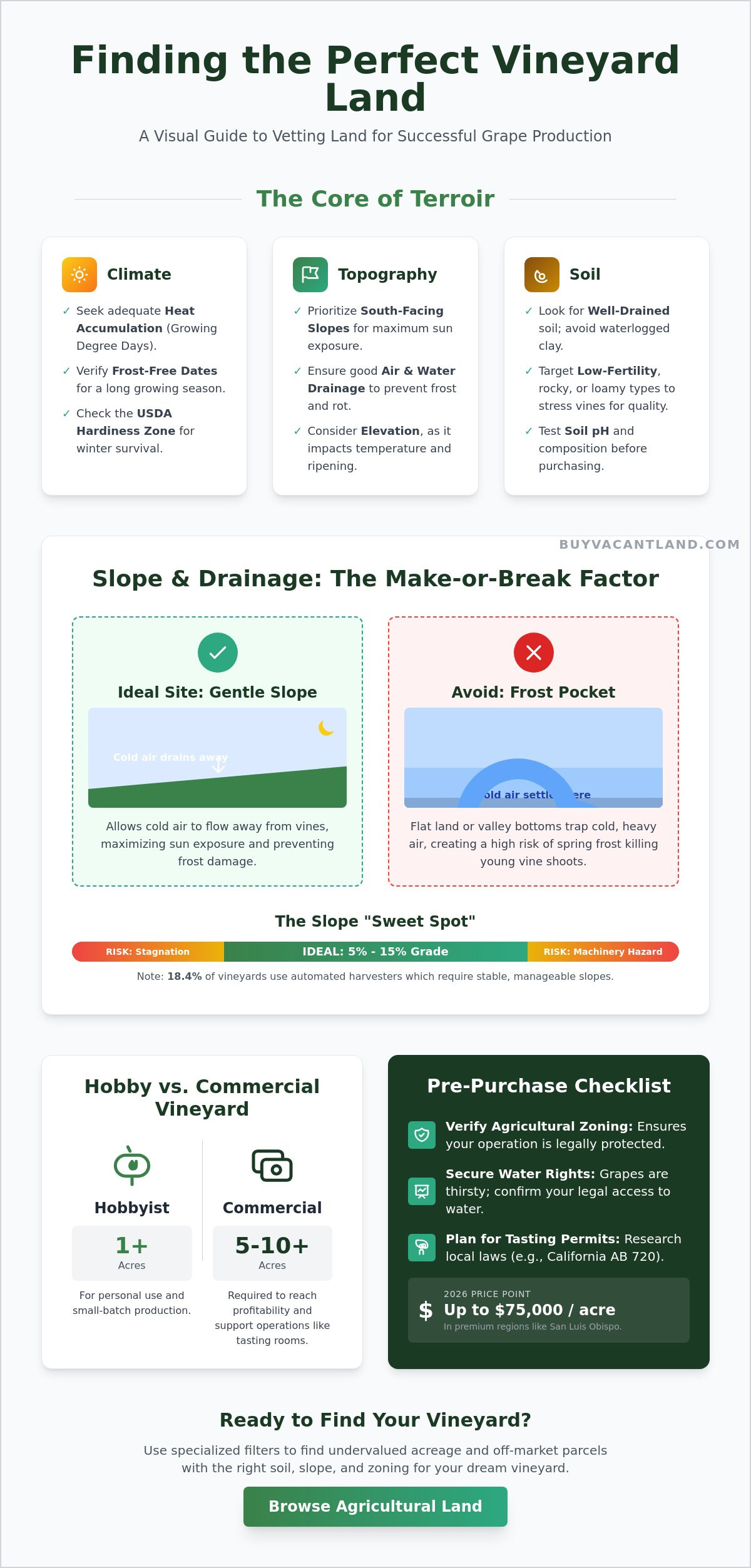
Success depends on the Big Three. These are climate, topography, and soil. You cannot easily fix these factors if the land is poor. A site with a high frost risk will kill your vines every spring. A site with zero drainage will rot your roots. Understanding these grape cultivation factors is essential before you sign a contract. You must also match your site to a specific grape variety. In 2026, premium land in Santa Barbara County can cost up to $75,000 per acre. You can’t afford to plant the wrong variety on expensive dirt. These physical traits are the foundation of your investment.
- Climate: Focus on heat accumulation and frost dates. Grapes need specific temperature ranges to ripen.
- Topography: Look for slopes that allow cold air to drain away. Flat land often traps frost.
- Soil: Prioritize drainage over high fertility. Grapes thrive when they have to work for nutrients.
Commercial vs. Hobbyist Land Requirements
Your goals dictate your acreage. A hobbyist growing for personal use can thrive on a single acre. A commercial vineyard usually needs at least five to ten acres to reach profitability. Proximity to markets also impacts your success. If you want a tasting room, look for properties that benefit from new laws. For example, California’s AB 720 now allows estate tasting events at specific properties. Always look for unrestricted land. This gives you the flexibility to pivot your agricultural operations as the market changes. It ensures you aren’t trapped by narrow zoning rules that limit your revenue.
Evaluating Topography and Microclimate for Grape Production
Don’t buy flat land. It is a trap. While level ground looks easy to manage, it often lacks the air circulation required for a healthy crop. Topography is about physics, not just aesthetics. You need to understand how air and water move across your parcel before you make an offer. Stagnant air leads to rot and disease. High-quality land suitable for a vineyard must have a strategic slope to ensure both water and air drainage remain consistent throughout the growing season.
Focus on “Aspect” during your search. In the United States, south-facing or southwest-facing slopes are the gold standard. These slopes catch the most sunlight during the day. This maximizes photosynthesis and ensures your grapes reach full ripeness before the first frost hits. North-facing slopes stay too cold and damp. They often result in under-ripe fruit with high acidity. High elevation also impacts your ripening cycle. Temperatures drop roughly 3.5 degrees Fahrenheit for every 1,000 feet of gain. This delay can be the difference between a successful harvest and a total loss.
The Role of Slope and Air Drainage
Cold air behaves like water. It flows downhill and settles in the lowest points of the landscape. If your land sits at the bottom of a hill, you have a “frost pocket.” This is a death sentence for tender vine shoots in the spring. You want a site on a gentle grade where cold air can roll off the vines and continue down the valley. The “sweet spot” for a vineyard slope is typically between 5% and 15% grade. Anything below 5% risks air stagnation. Anything above 15% becomes a safety hazard for machinery. In 2026, automation is a lifeline for growers. Recent surveys show 18.4% of vineyards now use automated harvesters. These machines require stable, manageable slopes to operate efficiently. If you are ready to scout for these specific features, browse undeveloped agricultural land to find parcels with the right topography.
Microclimates and USDA Hardiness Zones
Check your USDA Hardiness Zone first to see if your chosen variety can survive the winter. However, broad maps don’t tell the whole story. Nearby bodies of water or large hills create unique micro-environments. A large lake acts as a thermal buffer. It keeps the air cooler in the summer and warmer in the winter. You must also calculate “Heat Summation,” or growing degree days. This metric determines the sugar content potential of your grapes. Without enough heat, your vines won’t produce the sugar levels needed for quality wine. Always verify the local weather history for the specific coordinates of the property. General county data is often too vague for a serious investment.
Soil Composition and Drainage: The Hidden Drivers of Viticulture
Forget everything you know about traditional agriculture. High-quality corn land makes terrible wine land. Rich, black soil encourages too much leaf growth and watery fruit. This dilutes the quality of your harvest. You want land that forces the vine to struggle. Land suitable for a vineyard typically features rocky, sandy, or loamy soils with low fertility. This stress concentrates flavor in the grapes. It produces the premium quality that buyers demand in 2026. Professional growers look for “poor” soil because it yields superior wine.
Check the depth of your topsoil before you buy. Grapevines are survivors. They send roots deep into the earth to find water and minerals. You need at least three to four feet of permeable soil before hitting bedrock or a water table. Shallow soil restricts root growth. It makes your vineyard vulnerable to drought and nutrient deficiencies. Deep roots provide the stability needed for long-term production. If the soil is too thin, your investment won’t last a decade.
Understanding Soil pH and Chemistry
Aim for a pH range between 5.5 and 7.0. This is the sweet spot for nutrient uptake. If your soil is too acidic or too alkaline, your vines will starve even if nutrients are present in the dirt. Watch out for high lime or salt content. These can stunt growth or kill vines entirely. Always test for soil-borne pests like phylloxera before you plant. In 2026, establishing a new vineyard costs between $25,000 and $40,000 per acre. You can’t afford to plant in contaminated or chemically imbalanced dirt. A simple lab test saves you from a six-figure mistake.
The “Vines Hate Wet Feet” Rule
Standing water is a death sentence. It causes root rot and vine death within a single season. Surface runoff is not enough. You need excellent internal drainage. Water must move through the soil profile quickly. Look for a “hardpan” layer. This is a dense, compacted layer of clay or rock that blocks water and roots. Use a simple field test. Dig a hole two feet deep. Fill it with water. If it doesn’t drain within an hour, walk away. Your land suitable for a vineyard must breathe. Proper internal drainage is the single most important factor for vine longevity and health.
Legal Restrictions and Infrastructure Requirements for Raw Land
Zoning is the first hurdle. Don’t assume you can farm just because a property has dirt and sun. You must verify that the parcel is zoned for commercial agriculture. Many residential lots have strict limits on crop production and chemical use. Check for “Right to Farm” laws in your specific county. These laws protect you from nuisance lawsuits filed by neighbors who dislike the noise or smells of a working farm. Finding land suitable for a vineyard requires legal due diligence before you ever test the soil. If the zoning doesn’t align with your commercial goals, the property is a liability.
Water Rights and Irrigation Access
Water is your most valuable asset. Understand the difference between riparian rights and prior appropriation. Riparian rights allow you to use water from a source that touches your land. Prior appropriation follows a “first in time, first in right” rule. This is common in the western United States. If you don’t have senior water rights, your supply could be cut off during a drought. Drilling a well is an option, but it’s expensive and depends on local groundwater availability. Always test the water quality for salinity and boron levels. High concentrations will kill your vines over time. Secure your water source before you sign the deed.
Zoning, Easements, and Land Use
Verify every easement on the title report. A hidden utility line can ruin your vineyard layout and irrigation plans. If you’re starting a new operation, consider the benefits of owner financed land. This strategy allows you to bypass traditional bank hurdles and secure a site quickly. It’s an efficient path for agricultural startups that need to preserve capital for planting. Once you have the right zoning and clear access, you can focus on production. Use our marketplace to search for agricultural parcels that already meet these legal requirements. Don’t waste time on properties that will trap you in red tape.
Navigating the Marketplace to Secure Your Vineyard Property
Stop researching and start searching. The “perfect” site won’t wait for a second opinion. You need a streamlined way to filter thousands of listings for specific viticultural traits. Traditional real estate sites focus on bedrooms and bathrooms. Our marketplace focuses on the dirt. Use filters to target farms and ranches that already possess the core requirements. Speed is your biggest advantage in 2026. Premium parcels in regions like Monterey County are moving fast. Buyers want to secure domestic grape sources now.
Finding land suitable for a vineyard often means looking where others aren’t. Don’t just look for established wineries. Look for undervalued, raw acreage. Buying cheap land for sale allows you to allocate more capital toward planting and automation. Establishing a vineyard can cost up to $40,000 per acre. Saving on the initial purchase price is a smart financial move. It gives you the capital needed for the first few years of growth.
Filtering for Viticultural Potential
Use targeted keywords in your search. Look for terms like “sloped,” “well-drained,” or “unrestricted.” These indicate a property that might handle the air drainage requirements. Don’t rely solely on the description. Pull up satellite imagery immediately. Check the aspect. Confirm the slope faces south or southwest. Look at neighboring agricultural use. If the neighbors are successfully farming, it is a good sign for your soil health. Finally, verify road access. You need a clear path for harvest logistics. If a truck can’t get in, your grapes can’t get out.
The Buying Process for Raw Land
Buying dirt is different than buying a house. You will use a standard land contract rather than a residential agreement. This process is faster. It carries fewer fees. However, you must include a feasibility period. This is your window to conduct soil and water tests. If the percolation test fails or the water salinity is too high, you must be able to walk away. Use this time to confirm the property is land suitable for a vineyard before your money is locked in. Once the tests clear, move to close immediately. Efficiency wins the deal. Browse our current listings of vacant land to find your future vineyard site today.
Secure Your Viticultural Future Today
Success in viticulture starts beneath your feet. You now have the technical blueprint to identify high-quality acreage. Prioritize internal soil drainage and air circulation over scenic vistas. Verify your water rights and local zoning early to avoid legal traps. These steps ensure your investment remains a productive asset rather than a liability. Finding land suitable for a vineyard is a matter of checking the right boxes on a structured list. It doesn’t have to be a mysterious or overwhelming process.
Our platform eliminates the stress of the search. We provide a specialized marketplace for raw and undeveloped land across all US climate zones. You get a direct connection between sellers and buyers. This transparency cuts through traditional procedural hurdles and saves you time. We help you find the right terroir with total certainty and efficiency. Take the next step toward your harvest goals right now.
Find your perfect vineyard site on our national land marketplace today. Secure your site. Start planting. Build your legacy with confidence.
Frequently Asked Questions
How many acres do I need for a viable vineyard?
Commercial viability typically starts at 5 to 10 acres. This size allows you to justify the cost of specialized machinery and labor. Hobbyists can produce wine for personal use on just 1 acre. In 2026, fixed monthly operational costs for professional vineyards are estimated at $73,750. Smaller plots can’t absorb these high overhead costs. Choose your acreage based on your revenue goals and the level of automation you plan to implement.
Can I grow grapes on flat land if I install drainage?
You can, but it is a significant risk. Mechanical drainage fixes wet soil, but it doesn’t fix “frost pockets.” Flat land traps cold air that settles near the ground. This kills tender spring shoots and ruins your harvest. Sloped land suitable for a vineyard is always superior because it allows cold air to roll away naturally. Don’t rely on expensive engineering to fix a fundamentally bad location.
What is the best soil type for a vineyard?
Look for low-fertility soils like rocky loam or sandy gravel. Grapes need to struggle to produce high-quality fruit with concentrated flavors. Rich, deep soil leads to excessive leaf growth and watery grapes. Excellent internal drainage is non-negotiable. If water stands on the surface after a rain, the site is unusable. Vines require soil that breathes and allows roots to reach deep for moisture.
Does vineyard land need to be south-facing?
South-facing or southwest-facing slopes are highly prized in the United States. These orientations maximize sunlight hours and heat accumulation. This ensures your grapes reach the necessary sugar levels for high-quality wine. North-facing slopes stay too cold and damp for most varieties. While some cool-climate grapes can survive on north slopes, they rarely reach the same premium quality as those grown with full sun exposure.
What are the deal-breakers when buying land for a vineyard?
Lack of water rights is the ultimate deal-breaker. Without a legal, reliable water source, your vines will die during the first drought. Other red flags include “hardpan” layers that block drainage and restrictive residential zoning. If you can’t spray necessary pesticides or host a tasting room, the property is a bad investment. Always verify these legal and physical constraints during your feasibility period before you close the deal.
Is it better to buy raw land or an established farm?
Raw land is often better for a custom, efficient operation. It allows you to align rows perfectly with the sun and install modern irrigation from day one. Established farms may have outdated trellis systems or diseased vines that are expensive to remove. Starting with undeveloped acreage ensures you aren’t paying for someone else’s mistakes. It is the most direct path to a high-yield, modern vineyard.
How much does it cost to prepare raw land for vines?
What is the difference between agricultural and residential zoning for vineyards?
Agricultural zoning is mandatory for commercial success. It provides “Right to Farm” protections that shield you from neighbor complaints about noise or smells. Residential zoning often prohibits commercial sales or tasting events. New 2026 laws like California’s AB 720 specifically help estate properties host tastings, but only if the zoning allows it. Verify that your parcel’s zoning permits both the cultivation and the sale of wine before making an offer.




Join The Discussion