

Why are you paying thousands of dollars for a patch of dirt that produces zero income? It’s a frustrating reality for many owners. You bought the land as an investment, but now the property tax on vacant land is eating your savings. It feels like a penalty for simply owning an asset. You expected a low bill because there are no buildings. However, local assessors often value your lot based on its potential rather than its current state. In 2026, many jurisdictions are increasing rates on vacant lots to incentivize development. This creates an urgent need for owners to act before their tax bills spiral out of control.
You deserve to keep more of your money and protect your property from foreclosure. Master the assessment process and discover legal strategies to lower your tax burden through this guide. We’ll cover everything from agricultural exemptions to the specific 2026 rate changes hitting owners across the country. You’ll gain a clear understanding of how your land is valued and the exact steps needed to protect your investment. Stop guessing about your annual budget. It’s time to turn a confusing liability into a predictable asset. We provide a straightforward path to financial clarity without the hidden costs or procedural hurdles typical of the industry.
Key Takeaways
- Understand how “Highest and Best Use” valuations can unexpectedly inflate the property tax on vacant land.
- Calculate your exact tax liability using the standard formula of assessed value multiplied by the local millage rate.
- Apply for specific exemptions like agricultural, timber, or wildlife management to reduce your annual overhead.
- Follow a clear sequence to appeal unfair assessments and protect your land from potential tax foreclosure.
- Determine when the carrying costs outweigh appreciation and use a specialized marketplace to exit the property efficiently.
Understanding Property Tax on Vacant Land: The Basics
Ownership of any land parcel comes with a mandatory financial obligation to the local government. To understand What is Property Tax, you must view it as a fee for local services and infrastructure. Even if your land is empty, you still benefit from county-maintained roads, police protection, and emergency services. Schools are also heavily funded by these tax pools. Ad valorem tax is a financial charge based strictly on the assessed value of your specific land parcel.
You must distinguish between market value and assessed value to manage your budget. Market value is the price a buyer would pay for your land today. Assessed value is a specific percentage of that market price used by the county to calculate your bill. Local governments rely on this revenue to maintain community standards. If you own raw land, you are a stakeholder in the county budget. Understanding the property tax on vacant land starts with recognizing that your bill is tied to the land’s potential, not just its current state.
The Role of the County Tax Assessor
Assessors act as the gatekeepers of your annual tax bill. They use satellite imagery, local sales data, and zoning maps to categorize your property tax on vacant land. Most counties follow a fixed reassessment schedule. Some jurisdictions update values every year; others use a triennial cycle where your value stays flat for three years before a potential jump. Every year, you receive a Notice of Valuation (NOV). This document is not a bill. It is a formal statement of what the county believes your land is worth. Review this notice immediately. If the value seems inflated, your window to file a formal appeal usually begins the day the notice is mailed.
National vs. Local Tax Variables
The general tax framework is national, but the actual costs are hyper-local. Your total bill depends on the millage rate set by local taxing authorities. One mill equals one dollar of tax for every $1,000 of assessed value. Zoning classifications play a massive role in this calculation. A parcel zoned for residential development often carries a higher tax rate than a lot zoned for agricultural use. This explains why two identical lots on opposite sides of a county line can have vastly different bills. One county might prioritize school funding with high rates, while the neighbor focuses on attracting development with lower costs. Knowing these variables helps you plan for long-term ownership without financial surprises.
How Vacant Land Property Tax is Calculated
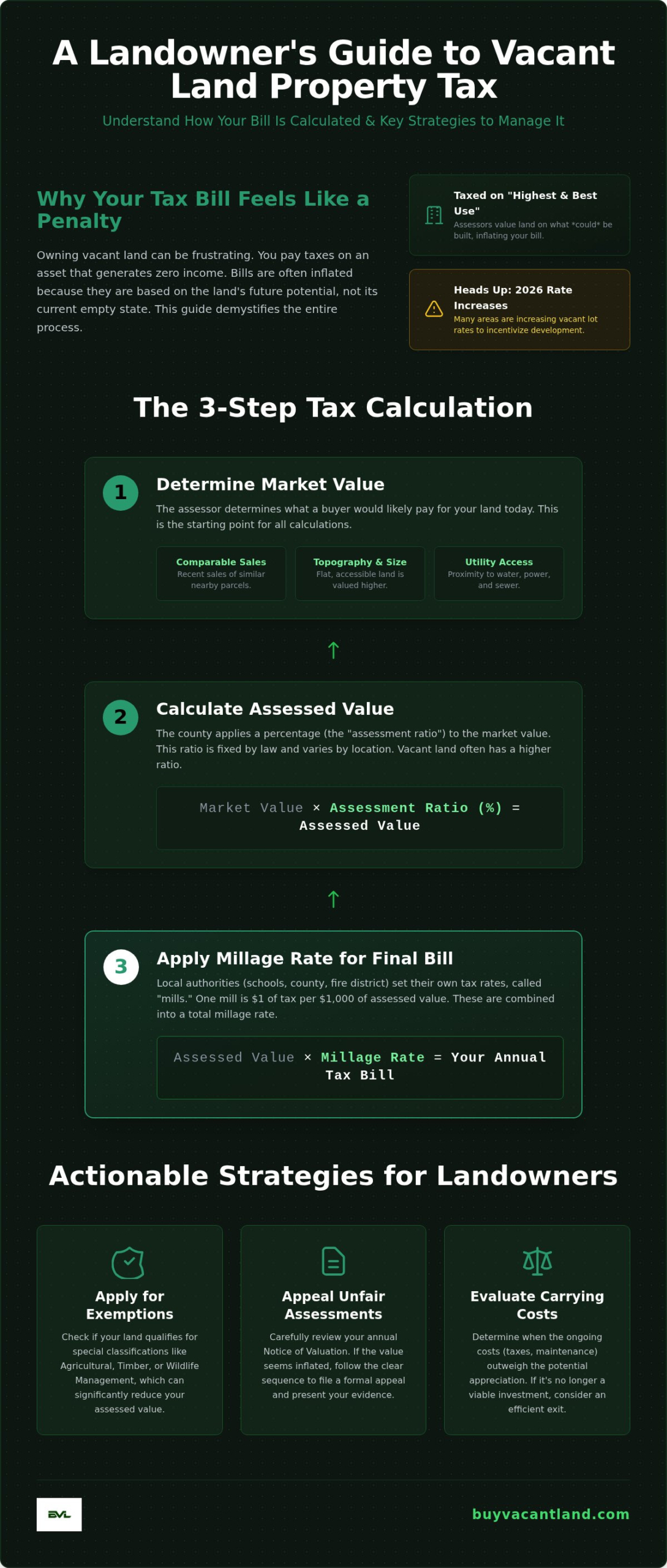
Calculating your tax bill isn’t guesswork. It follows a rigid mathematical formula. You take the Assessed Value and multiply it by the local Millage Rate. The result is your annual bill. However, the variables inside that formula often surprise owners. Assessors look at “Highest and Best Use” (HBU). This means they tax you based on what could be built on the land, not what is there now. If your raw dirt is zoned for a shopping center, you’ll pay taxes as if it were a commercial hub. Proximity to developed areas and utility access also drive this potential value upward. The closer your land is to a city center, the higher the property tax on vacant land will be.
Step 1: Determining the Market Value
Assessors start with the market value. They look at comparable sales. Comparable sales are recent transactions of similar land parcels in the same geographic area. Size and topography matter here. Flat land with road access is worth more than a steep, landlocked hillside. Assessors also check for utility availability. A lot with a capped well and electric hookups carries a higher valuation than off-grid acreage. If you’re still in the planning phase, learn how do you buy land to account for these ongoing carrying costs before you commit to a purchase.
Step 2: Applying the Assessment Ratio
The market value isn’t your taxable amount. Counties apply an assessment ratio first. This ratio is a percentage, such as 10% or 20%, that converts market price into “Assessed Value.” Vacant land often faces higher ratios than owner-occupied homes. Local governments view undeveloped land as speculative. They use higher ratios to encourage owners to build or sell. This is part of the ongoing national debate surrounding Alternative Property Taxes and how they impact urban development. Your final assessed value is simply the market price multiplied by this ratio.
Step 3: Factoring in the Millage Rate
The final step is the millage rate. One mill represents $1 of tax for every $1,000 of assessed value. Your local school board, fire district, and county government each set their own levies. These individual rates combine into your total millage rate. A high millage rate can turn a cheap parcel into an expensive liability. If the math doesn’t work for your investment, you can list your land for sale on a specialized marketplace to stop the financial drain. Understanding these steps allows you to predict your property tax on vacant land with total accuracy.
Vacant Land vs. Improved Property: A Tax Comparison
Raw land is usually the most cost-effective real estate asset to hold long-term. You pay only for the dirt. Your tax bill reflects this through two distinct categories: Land Value and Improvement Value. On a vacant lot, the “Improvement” line remains at zero. This keeps your overall liability low compared to properties with houses or commercial buildings. However, adding even a small structure can disrupt this balance. A simple shed or a paved driveway can trigger a full reassessment. Local authorities view these as signs of development and will adjust your Property Tax Valuation accordingly. Improving land involves more than just construction costs. You must account for permits, impact fees, and the permanent increase in annual taxes. These hidden expenses often surprise investors who focus only on the purchase price.
Tax Implications of Residential Development
Zoning changes transform your financial landscape. Moving a parcel from “Raw Land” to a “Residential Lot” classification usually results in a higher tax bracket. The most significant spike occurs the moment construction is completed. Assessors don’t wait for you to move in. They revalue the property based on its new improved status immediately after the final inspection. For example, when looking at land for sale in Florida, you’ll see that developed lots carry significantly higher carrying costs than adjacent undeveloped parcels. Plan for this jump before you break ground. If your goal is long-term holding, keeping the land in its raw state is the most efficient way to control your overhead.
Carrying Costs: The True Price of Holding Land
Successful land investment requires a clear break-even analysis. You must calculate how much the land appreciates versus the annual property tax on vacant land. In high-tax regions, a 2% or 3% annual tax rate can easily erase your capital gains over a decade. This makes “buy and hold” strategies risky if you don’t have a development plan or an exit strategy. Calculate your ROI by subtracting total taxes paid from your eventual sale price. If the taxes exceed your projected profit, it is time to sell. Efficient ownership means knowing when the tax burden outweighs the potential reward. Don’t let annual bills turn your investment into a liability. Track every dollar spent on taxes to ensure your land remains a profitable part of your portfolio.
Strategies to Lower Your Land Tax Burden
Don’t accept your annual tax bill as a final, unchangeable number. It is often an opening valuation from the county that you can challenge. You have several legal paths to reduce your property tax on vacant land. Proactive management is the only way to protect your investment from rising local rates. Common exemptions and formal appeals are your best tools for financial relief. If these methods don’t lower your overhead, you can always list your property for sale to exit the investment before the next tax cycle begins.
Applying for Agricultural Exemptions
Agricultural or “Greenbelt” exemptions offer the most significant tax breaks for raw land. Most states require a minimum acreage and proof of “intent to produce.” You don’t have to be a full-time farmer to qualify. Leasing your land to a local farmer for grazing or hay production often satisfies the requirement. This simple contract can slash your tax bill by 50% or more. Check your local county guidelines for specific timber or wildlife management programs that offer similar benefits. These programs reward you for keeping the land undeveloped and ecologically productive.
How to Appeal Your Assessment
You typically have a narrow window of 30 to 60 days to protest after receiving your Notice of Valuation. Missing this deadline means you forfeit your right to appeal for the entire year. Start by gathering hard evidence to support a lower valuation. Independent appraisals and recent sales data of similar nearby lots are essential. Take photos of land defects like severe flooding, steep slopes, or lack of legal access. Present these facts clearly during your hearing with the Board of Equalization. Focus on data; avoid emotional arguments about the fairness of taxes.
Correcting Property Record Errors
Review your property record card at the assessor’s office for “phantom” improvements. Errors in acreage, zoning, or utility access are common. Ensure the assessor hasn’t missed “unbuildable” features like protected wetlands or rock outcroppings. A professional land survey provides the legal proof needed to correct the record and lower your taxes. You can also consider conservation easements. This involves trading your development rights for permanent tax breaks. It is a long-term commitment that ensures your land stays raw while significantly reducing your annual property tax on vacant land.
Selling Your Tax-Heavy Land: A Strategic Exit
Owning raw land is only profitable if the value grows faster than the carrying costs. If your annual bill for property tax on vacant land is eating your equity, it’s time to sell. Stop waiting for a market boom that might not cover your tax losses. New punitive tax structures are emerging nationwide to force development on empty parcels. This makes holding unused dirt a high-risk gamble for many owners. A strategic exit allows you to recoup your capital and reinvest in more productive assets before the next bill arrives.
Avoiding Tax Foreclosure
Unpaid tax bills lead to a predictable and painful conclusion. The timeline starts with interest penalties and ends at a tax deed auction. Once the county places a lien on your property, the clock starts ticking toward foreclosure. You lose all equity if the land sells at a public auction. Selling your lot on the private market is the only way to preserve your investment. Learn how to sell land quickly to avoid the next tax cycle and the risk of total loss. Don’t let a “Tax Deed” auction wipe out your savings.
Listing on BuyVacantLand.com
Traditional real estate sites prioritize houses and rental properties. Your raw land needs a specialized platform that connects you with dedicated land hunters. BuyVacantLand.com reaches buyers looking for residential lots, off-grid parcels, and commercial acreage nationwide. Our marketplace eliminates the noise of the general housing market. We use a simple, 3-step process to get your lot off your books:
- Create your listing with clear photos and property details.
- Connect directly with cash buyers and land investors who understand raw land value.
- Close the deal and stop your tax liability immediately.
Closing the Deal
The final hurdle is the closing table. You must clear all back-taxes to provide a clean title to the buyer. Property taxes are usually prorated at closing. This means you only pay for the portion of the year you actually owned the land. The buyer takes over the property tax on vacant land from the day of the transfer. This clean break stops the financial drain on your bank account once and for all. Position your land for a quick sale by highlighting its potential use to cash buyers. Don’t let another year of taxes erode your net worth. List your vacant land today and stop the tax bleed.
Take Control of Your Land Investment Today
Managing your land requires constant vigilance. You now understand how “Highest and Best Use” valuations and local millage rates dictate your annual bill. Use this knowledge to challenge unfair assessments or apply for agricultural exemptions that protect your equity. If the annual property tax on vacant land continues to erode your profit margins, don’t wait for a tax lien to complicate your title. Selling is often the most pragmatic move for non-performing assets.
You can stop the financial drain right now. List your vacant land on our national marketplace today to reach a dedicated audience of raw land buyers. Our process is simple and direct; we’ve eliminated the noise of traditional real estate sites. There are no hidden service fees for basic listings, ensuring you keep more of your sale proceeds. Take the first step toward a clean break from high-tax properties and focus on more profitable investments. You have the tools to master your taxation or make a swift, certain exit.
Frequently Asked Questions
Do you have to pay property taxes on land with no house?
Yes, you must pay taxes on all privately owned land regardless of improvements. Local governments use these funds to maintain infrastructure like roads and emergency services. Even if the land is empty, you still benefit from county resources. In 2026, many jurisdictions are increasing these rates to incentivize development. If you don’t pay, the county can place a lien on your property and eventually sell it at auction.
How much is property tax on vacant land per year?
Annual costs vary based on your local millage rates. National averages for raw land typically range from 0.20% to 2.25% of the assessed value. Some states offer significantly lower rates for undeveloped parcels while others tax vacant land at much higher levels to discourage speculative holding. To find your exact bill, multiply the assessed value by the local millage rate. Understanding the property tax on vacant land helps you budget for long-term ownership.
Can I lose my land if I don’t pay the property taxes?
Yes, the county can seize and sell your property through a tax deed auction if you fail to pay. This process starts with interest penalties and a formal tax lien. If the debt remains unpaid after a specific redemption period, the land is sold to the highest bidder. You will lose all equity in the property. It is better to sell your land on a marketplace than to lose it to a government foreclosure.
What happens to property taxes if I build a small cabin on my land?
Your tax bill will likely increase once the structure is completed and assessed. Adding a cabin changes the property status from “raw land” to “improved property.” Assessors will add an “improvement value” to your land value, raising the total assessed amount. Even a small unpermitted structure can trigger a reassessment if discovered. You should also account for potential impact fees and permit costs that accompany any new construction on your lot.
Is there a way to get an exemption for vacant land?
Yes, many states offer exemptions for specific land uses like agriculture, timber, or wildlife management. These programs, often called “Greenbelt” laws, can reduce your tax bill by 50% or more. You must meet minimum acreage requirements and prove the land is being used for its intended purpose. Leasing your acreage to a farmer is a common way to qualify. Contact your county assessor to see which programs are available in your area.
How do I find out how much property tax is owed on a piece of land?
You can find this information through the local county treasurer or tax collector’s website. Most counties provide a searchable database where you can enter the parcel number or owner name. The record will show the current year’s bill and any delinquent taxes from previous years. If you are buying a lot, always verify these numbers before closing. Unpaid taxes stay with the land and become your responsibility after the purchase.
Can I deduct property taxes on vacant land from my federal income tax?
You can generally deduct property taxes on vacant land if you hold the land for investment purposes. These are itemized deductions on Schedule A of your federal return. However, current tax laws limit the total state and local tax (SALT) deduction to $10,000 for individuals. If you are holding the land for personal use, different rules may apply. Always consult a tax professional to ensure you are following the latest IRS guidelines.
Why did my vacant land taxes go up if I haven’t changed anything?
Your property tax on vacant land often rises because of county-wide reassessments or shifts in local millage rates. Assessors look at market trends in your area. If nearby parcels sell for higher prices, your land’s value increases automatically. Local governments also hike rates to fund new school bonds or infrastructure projects. Review your annual Notice of Valuation to see if the value or the rate changed. You have a right to challenge these increases.




Join The Discussion