

A land sale contract is a specialized legal shield, not a simplified home agreement. Treating a vacant lot purchase like a standard residential deal is a mistake that leads to expensive litigation. You want a fast, secure way to transfer property without the fear of hidden encumbrances or the stress of complex legal paperwork. Don’t let owner financing or the new March 2026 FinCEN reporting requirements turn your deal into a legal minefield. We agree that the traditional process is too slow and often far too expensive.
This guide helps you master every essential to ensure a transparent transaction for any vacant lot. You will gain a clear understanding of contract clauses and a streamlined path to closing. We break down the 2026 capital gains thresholds and explain how to manage the 2% to 5% closing costs typical for land deals. Follow this simplified sequence to avoid the common pitfalls that trap unprepared sellers and buyers. It’s time to secure your investment with absolute certainty and zero unnecessary fees.
Key Takeaways
- Differentiate your land sale contract from standard residential forms to avoid common legal errors specific to raw acreage.
- Secure your boundaries by including precise metes and bounds descriptions and lot/block numbers in every agreement.
- Evaluate the trade-off between immediate cash liquidity and the steady, long-term returns of owner financing.
- Use the feasibility period to perform critical soil and perc tests that determine the true value of your lot.
- Ensure a transparent transaction by utilizing professional escrow agents and reviewing every line of your closing statement.
Understanding the Land Sale Contract Basics
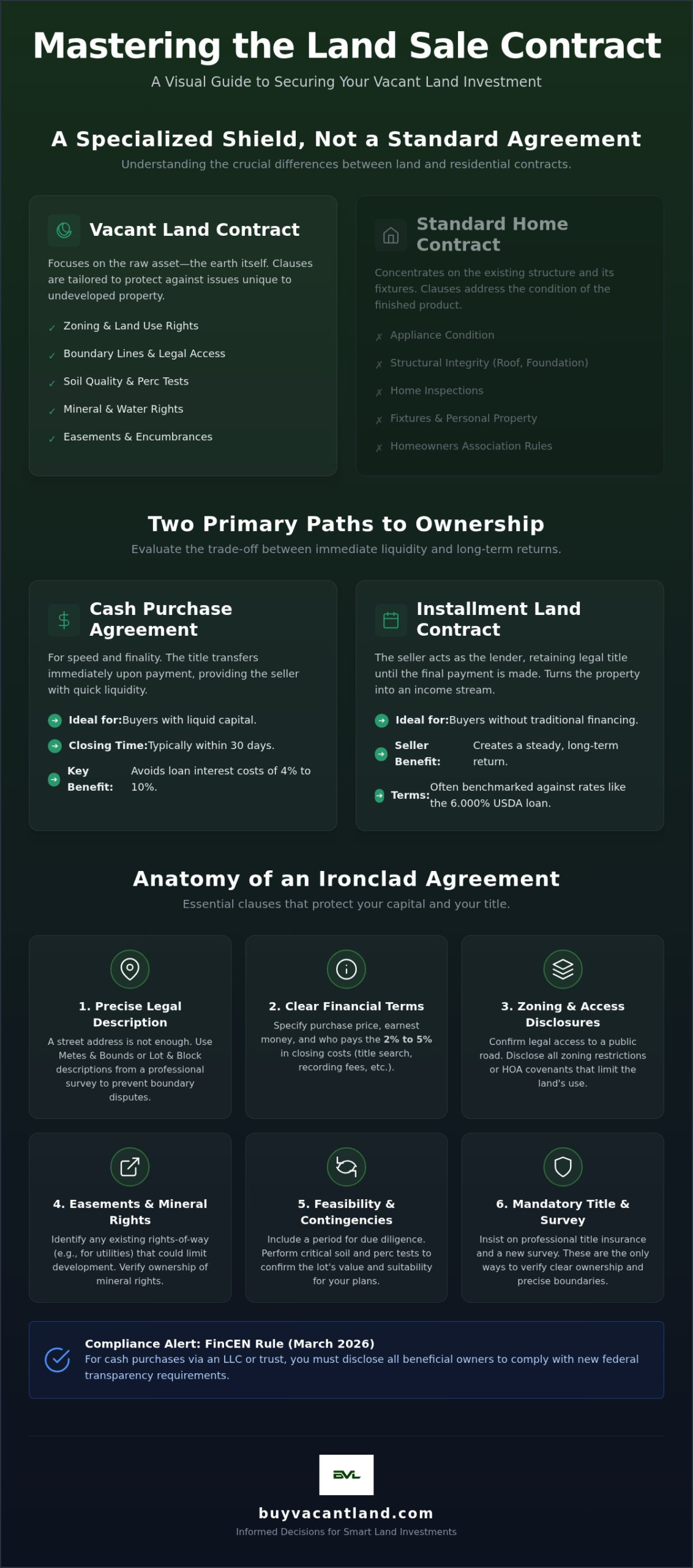
A land sale contract is a legally binding agreement. It defines the exact terms for transferring raw land from a seller to a buyer. This isn’t a standard residential form. You don’t need clauses for broken dishwashers or leaky roofs. You need a document focused on the soil, the boundaries, and the legal right to use the property. We use a straight-shooter approach. This means keeping the agreement direct and focused entirely on the asset. It removes the fluff that slows down traditional real estate deals.
Vacant land contracts differ from residential ones because the risks are different. In a home sale, you worry about the structure. In a land sale, you worry about zoning, easements, and road access. This pragmatic focus ensures you don’t waste time on irrelevant paperwork. Understanding Land Contracts requires recognizing that you are buying a physical portion of the earth, not a finished product. Every paragraph in your agreement should reflect that reality.
There are two primary ways to structure these deals. You either close with a one-time payment or set up a long-term payment plan. Both paths require a clear, written agreement to prevent future litigation. As of August 2026, market conditions favor those who can move quickly. Whether you are selling a remote hunting lot or a residential parcel, your contract is your primary shield.
Purchase Agreements for Cash Sales
Cash sales are about speed and finality. A purchase agreement for a cash transaction facilitates an immediate transfer of title. Once the funds clear, the deed is recorded. This path is ideal for buyers with liquid capital or those who have secured independent financing. As of August 2026, interest rates for traditional land loans generally range between 4% and 10%. Many buyers choose cash to avoid these costs entirely. The contract focuses on delivering a clean title and ensuring a fast closing, often within 30 days. It provides the seller with immediate liquidity and the buyer with total ownership from day one.
Installment Land Contracts (Seller Financing)
An installment land contract is different. The seller retains the legal title until the buyer makes the final payment. The buyer receives “equitable title” and immediate use of the property. This structure is the foundation of owner financed land transactions. It allows buyers to bypass strict bank requirements. The contract must be precise. It outlines the interest rate, the payment schedule, and the consequences of default. For context, August 2026 USDA Farm Ownership Loans are set at 6.000%. Many sellers use these benchmarks to create competitive financing terms. This method turns a vacant lot into a steady stream of income for the seller while simplifying the path to ownership for the buyer.
Essential Clauses Every Land Purchase Agreement Must Include
A land sale contract is only as strong as its specific clauses. You cannot rely on a generic template designed for houses. Every detail must protect your capital and your title. This section outlines the non-negotiables for a secure transaction. Clear terms prevent expensive litigation and ensure both parties understand their obligations from day one.
Start with the purchase price and earnest money terms. Clearly state the total amount and the specific deposit required to hold the property. In 2026, closing costs for vacant land typically range from 2% to 5% of the sale price. Your agreement should specify who pays for title search fees, recording fees, and transfer taxes. If you are buying through an LLC or trust with cash, remember the March 2026 FinCEN mandate. You must disclose beneficial owners to maintain transparency and compliance during the transaction.
Next, address easements and mineral rights. A beautiful lot is worthless if a utility company has an irrevocable right to build a substation in the middle of it. Check for existing rights-of-way that could limit your future development. Reference the legal definition of a land contract to understand how these specific obligations transfer between parties. It’s your responsibility to verify that the seller actually owns the rights they are promising to transfer.
The Legal Description: Avoiding Boundary Disputes
A street address is a postal convenience, not a legal boundary. Raw land requires a precise legal description to prevent future ownership disputes. Most agreements use either the lot and block system for subdivided areas or the metes and bounds system. A metes and bounds description is a system of describing land by using physical features, directions, and distances to trace the perimeter of the property. Attach a recent survey to the contract. The surveyor is your most important ally here. They finalize the contract attachments by verifying the exact acreage you are purchasing before you sign.
Zoning and Access Disclosures
You must confirm legal access to public roads within the document. Landlocked parcels are common and often lead to legal nightmares that destroy property value. Explicitly state in the contract if the land is “unrestricted” or subject to strict HOA covenants. This determines if you can build residential lots or if the site is limited to industrial use. Check for soil quality and perc test results during this stage. If the land cannot support a septic system, the deal should be voidable under your contingencies.
Finally, mandate title insurance and a professional survey. These are the only ways to verify boundaries and ownership with absolute certainty. If you are ready to find your next property and apply these standards, you can browse available land listings to see how different parcels are described in the marketplace. Secure your investment by demanding clarity in every paragraph.
Owner Financing vs. Cash Sales: Contractual Differences
Choosing between a cash sale and owner financing changes your land sale contract significantly. Cash deals offer immediate relief and a clean break. Financing provides a steady income stream but requires long-term management. You must understand the differences in seller financing to protect your interests. In many states, a ‘Deed of Trust’ secures the seller’s position. This legal instrument often allows for a faster non-judicial foreclosure if payments stop. Every land sale contract needs a clear default clause. This ensures the seller can reclaim the asset without a multi-year legal battle. Buyers should watch for prepayment penalties in the fine print. These fees punish you for paying off the debt early. Negotiate these terms before signing to ensure your future flexibility.
Land loans are harder to secure than traditional mortgages. In August 2026, general land loan interest rates sit between 4% and 10%. Buyers often need a 20% to 30% down payment to satisfy commercial lenders. Owner financing bypasses these hurdles. It allows the seller to act as the bank, creating an equitable financial proposal for both parties. This method is especially effective for moving parcels that don’t qualify for conventional financing due to their remote location or lack of utilities.
The Mechanics of Seller Financing Contracts
Seller financing relies on precise math and clear responsibilities. Most contracts use a fixed-rate amortization schedule to define monthly principal and interest. In August 2026, many sellers benchmark their rates against the USDA Farm Ownership rate of 6.000%. A balloon payment often ends the term after five or ten years. This structure requires the buyer to refinance or pay the balance in full by a specific date. You must also decide who pays the property taxes and insurance. Typically, the buyer pays these directly. The seller should demand proof of payment annually to avoid tax liens. Record your contract with the county immediately. This public notice protects the buyer’s equitable interest from any future liens filed against the seller.
Cash Sale Efficiency
Cash transactions are built for speed and simplicity. They are the standard for acquiring cheap land for sale across the country. Without a bank’s appraisal or underwriting, you can close in as little as 14 to 30 days. Use a simple checklist for a 30-day close: verify the title, confirm the survey, and sign the deed. Remember the March 2026 FinCEN rules for cash purchases. If you buy through an LLC or trust, you must disclose beneficial owners. This transparency is now a federal requirement for all-cash residential lot deals. This efficiency saves money and eliminates the stress of long-term debt.
Due Diligence and Contingencies: Protecting Your Investment
Protecting your capital requires a robust feasibility period. This timeframe serves as your safety net. It allows you to investigate every physical and legal aspect of the lot before the final commitment. A land sale contract without strong contingencies is a gamble you don’t need to take. Use this window to verify environmental hazards and flood zone designations. These factors can prevent building entirely or lead to astronomical insurance costs later. You must also confirm utility availability. Don’t assume water, sewer, and power are at the lot line just because a neighbor has them. Demand written verification from local utility providers during your due diligence window to ensure the site meets your specific needs.
In August 2026, thorough due diligence is more critical than ever. With tightening credit conditions, lenders require a high level of certainty before approving land loans. Even if you are paying cash, you must perform the same rigorous checks. This pragmatic approach eliminates the stress of discovering hidden encumbrances after you have already transferred the funds. Focus on the facts and the dirt. Everything else is secondary to the physical and legal viability of the parcel.
The Perc Test Contingency
A perc test is a soil evaluation that determines how quickly water drains through the ground to ensure a site can support a septic system. This is the number one deal-breaker for off grid land intended for residential use. Your land sale contract must include a specific “right to cancel” if the soil fails this test. Phrase this clause clearly to protect your earnest money. State that your obligation to close is contingent upon receiving a passing result from the county health department. If the ground doesn’t drain, the deal is dead. Secure this contingency to avoid owning a beautiful but unbuildable lot.
Title Search and Survey Contingencies
Verify the exact acreage and boundary lines before the final signature. Encroachments from neighboring fences or structures can trigger expensive legal battles. A title search identifies “clouds” like old liens, unresolved ownership claims, or the new 2026 federal reporting requirements for cash deals. Clear these issues entirely before you close. If a professional survey shows a discrepancy in total acreage compared to the listing, use your contract to adjust the price or walk away. You can search for vacant land listings that already have preliminary title work or surveys available to speed up your acquisition process. Demand clarity on every boundary to secure your investment.
Closing the Deal: From Contract to Deed
The final stage of your land sale contract is the closing. This is where the legal promise becomes physical ownership. You must choose a professional escrow agent or a title company to handle the logistics. They act as a neutral third party. They hold the buyer’s funds and the seller’s deed until every contractual obligation is satisfied. This neutral oversight prevents fraud and ensures a secure transfer. Don’t skip this step to save a few dollars. The protection it provides is worth the administrative cost.
Review your Closing Statement with a critical eye. This document outlines every fee, credit, and prorated tax associated with the deal. Verify that the closing costs align with the 2% to 5% range typical for vacant land in 2026. Check for recording fees, title insurance premiums, and any transfer taxes required by your county. If you are using owner financing, ensure the down payment and initial interest calculations match your amortization schedule. Errors are common in manual calculations. Catching them at the closing table is much easier than fixing them after the deed is recorded.
The type of deed you sign determines your long-term security. A Warranty Deed is the gold standard. It provides a legal guarantee that the seller owns the land free of undisclosed liens. A Quitclaim Deed is different. It only transfers whatever interest the seller might have without any guarantees. Avoid Quitclaim Deeds unless you are transferring property between family members or have a long history with the parcel. You can sell land faster and for a higher price by offering a Warranty Deed backed by title insurance. It gives the buyer the certainty they need to move forward.
Final Documentation and Recording
A Notary Public must witness the signing of the deed. Their seal verifies that the signatures are authentic and voluntary. Without this notarization, the County Recorder’s Office will reject your documents. Once the signing is complete, submit the deed for recording immediately. Many counties now offer electronic recording, which can be finalized in hours. This public record is your ultimate shield. It notifies the world that the transaction is complete and the title has moved. This finality is the goal of every well-structured land sale contract.
Next Steps for Buyers and Sellers
Sellers should prepare for their next transaction as soon as the funds clear. List your next parcel on our marketplace to reach a national audience of motivated buyers. We simplify the process for residential lots, off-grid parcels, and farms. Buyers should focus on their development timeline or portfolio expansion. If you are wondering, How do you buy land for your next project without the stress? You use the pragmatic path we’ve outlined. Apply these contract standards to every lot you evaluate. This consistent, no-nonsense approach is how you build a successful land portfolio with absolute confidence.
Take Control of Your Land Transaction Today
Mastering the land sale contract is the only way to ensure a fast and secure transaction. You now have the tools to navigate legal descriptions, perc test contingencies, and the complexities of 2026 financial reporting. Whether you choose the immediate liquidity of a cash sale or the long-term income of owner financing, precision is your best defense against litigation. A well-structured agreement eliminates the stress of hidden encumbrances. It provides the peace of mind you need to move forward with absolute certainty.
Efficiency is the hallmark of a successful deal. Our specialized vacant land marketplace connects land owners directly with motivated buyers across the country. We eliminate the middleman and ensure there are no hidden service fees for buyers. This direct approach creates a streamlined path to closing without unnecessary procedural hurdles. Don’t let your property sit idle or your capital remain tied up in traditional delays. List your vacant land for sale on our national marketplace today. Take the pragmatic path to a swift closing and start your next land project with confidence.
Frequently Asked Questions
Is a land sale contract the same as a mortgage?
No. A mortgage involves a third-party lender, like a bank, which pays the seller in full while the buyer takes the title immediately. In a land sale contract, the seller acts as the bank. The buyer makes payments directly to the owner and only receives the legal deed after the final installment. This bank-free approach is faster but requires a different legal structure to protect both parties.
Can I write my own land sale contract without a lawyer?
You can legally draft your own agreement. Many successful transactions use standardized forms to save time and money. However, you must include specific land-based details like metes and bounds descriptions and zoning disclosures. If your document lacks these essentials, it won’t hold up in court. Efficiency matters, but accuracy is the only way to ensure your deal is truly secure and enforceable.
What happens to the earnest money if the land sale falls through?
The fate of the earnest money depends on your specific contingencies. If a buyer backs out because a perc test failed or the title wasn’t clear, the deposit is typically refunded. If the buyer simply changes their mind without a legal excuse, the seller usually keeps the money as compensation for taking the lot off the market. Clear contract language is the only way to avoid a stressful fight over these funds.
Do land sale contracts need to be recorded with the county?
Yes, recording is a critical step for buyer protection. It creates a public record of your interest in the property. This prevents the seller from encumbering the land with new debt or selling it to a different party. In states like Illinois, laws mandate recording within 10 days of signing. Don’t leave your investment to chance; record the document at the County Recorder’s Office immediately to ensure your claim is secure.
What is the difference between a land contract and a deed?
A land sale contract is the financing agreement, while a deed is the instrument that transfers legal ownership. During the term of the contract, the buyer holds equitable title, which means they have the right to use the land. The seller retains legal title until the final payment is received. Once the debt is paid, the seller signs and records a deed to finalize the transfer of full ownership and control.
Can a seller back out of a land contract after it is signed?
A seller cannot back out once the contract is signed without a valid legal excuse. If the buyer meets all payment and due diligence obligations, the seller is legally bound to complete the transfer. If a seller refuses to close, the buyer can seek a court order for specific performance. This forces the seller to honor the original agreement. Reliability is the foundation of every successful and transparent land deal.
How long does it typically take to close a land sale contract?
Closing times vary based on the transaction type. Cash deals for raw land often close within 14 to 30 days because there is no bank appraisal or underwriting. Deals involving seller financing might take slightly longer to set up the payment structures and recording. Your speed depends on having your paperwork in order and completing your feasibility study quickly. Efficiency is the goal for every buyer and seller using a land sale contract.
What are the risks of buying land via an installment contract?
The biggest risk is that you don’t hold the legal deed during the payment term. If the seller has undisclosed liens or loses the property to foreclosure, your payments could be lost. You can mitigate this by conducting a professional title search and recording the contract immediately. These steps turn a risky installment deal into a secure path toward land ownership without the hurdles and costs of traditional banking.




Join The Discussion