
Buying a vacant lot without a verified checklist is a $40,000 gamble that most people lose. You want a buildable property, not a legal nightmare or a plot of dirt that costs $25,000 just to bring in power. We understand the fear of buying unusable land or getting hit with surprise closing costs. It’s stressful to navigate zoning terminology and legal disputes on your own. You deserve a simple, risk-free transaction that leads to total peace of mind. This guide reveals the essential questions to ask when buying raw land so you can avoid hidden traps and build with confidence. We’ve simplified the due diligence process into a clear, actionable roadmap for 2026. We will walk you through the 12 critical questions that expose hidden expenses and ensure your land is 100% buildable. From checking utility proximity to uncovering deed restrictions, you’re getting the facts you need to close the deal safely.
Key Takeaways
- Verify legal access immediately. Physical paths mean nothing without a recorded right-of-way to protect your property value and investment.
- Stop overpaying for utilities. Discover the critical cost differences between curb-side connections and expensive remote infrastructure.
- Master the essential questions to ask when buying raw land to bypass restrictive zoning laws and hidden HOA traps.
- Identify environmental obstacles before they become liabilities. Learn how soil quality and flood zones dictate your true buildable area.
- Ensure a clean title to guarantee a secure transaction. Avoid hidden liens and back taxes that could derail your ownership and future sale.
Verifying Physical and Legal Access to the Property
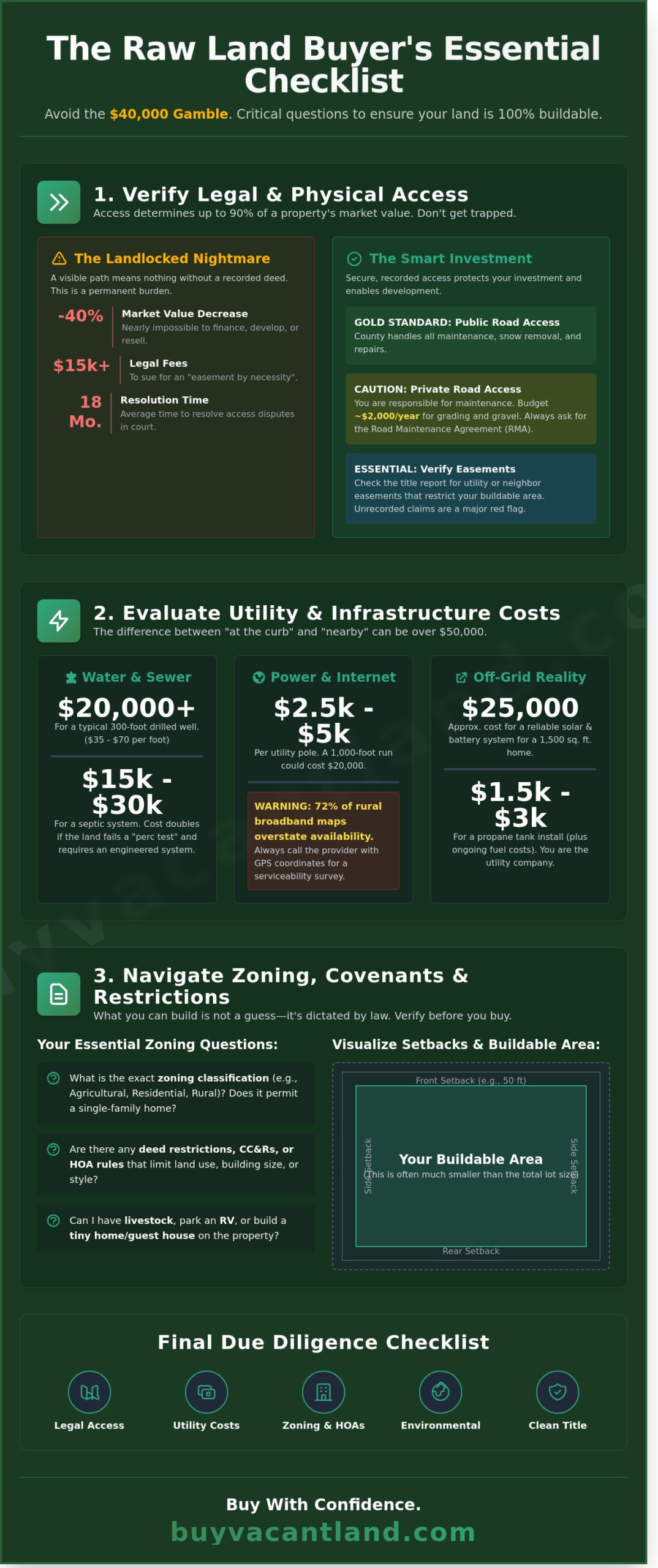
Access determines 90% of a property’s market value. You cannot build, live, or sell if you cannot reach the dirt. One of the most critical questions to ask when buying raw land is whether the access is legal or merely physical. Physical access means a visible trail or road exists. Legal access means you have a recorded, permanent right to use that path. A property without legal access is landlocked. These parcels often sell for 40% less than accessible land because they are nearly impossible to finance or develop. Don’t assume a visible driveway guarantees entry. Always verify the deed first.
Landlocked properties create immediate legal headaches. You might have to sue a neighbor for an “easement by necessity,” which can cost $15,000 in legal fees and take 18 months to resolve. We focus on simplicity and speed. If you want to avoid these traps, verify the access status before you sign any contract. It’s the difference between a smart investment and a permanent burden.
Public vs. Private Road Access
Bordering a county-maintained road is the gold standard for any buyer. The local government handles snow removal, grading, and culvert repairs. If the road is private, you own the maintenance. Ask the seller for a copy of the Road Maintenance Agreement (RMA). Without one, you might pay $2,000 per year just for basic gravel and grading. Check for weight limits on bridges or culverts. A 10-ton limit prevents concrete trucks or heavy machinery from reaching your site. This restriction can stop a construction project before the foundation is poured.
Understanding Easements and Rights-of-Way
Check the title report for recorded easements. A neighbor might have a legal right to drive across your lot to reach their own. This often restricts where you can build your home or fence. Utility companies often hold “blanket easements” on rural parcels. These allow them to install poles or lines anywhere on the property without your specific permission. Start by understanding land use classifications and how they impact your specific site plan.
Verify every easement claim through a professional title search. Do not rely on verbal promises from a neighbor or a seller. In 2024, boundary and access disputes accounted for 17% of rural real estate litigation. Secure your investment by confirming every right-of-way is documented in the county records. If the paperwork isn’t clean, the deal isn’t worth your time. We value transparency and efficiency, so we recommend walking away from any deal with “unrecorded” access claims.
Evaluating Utility Availability and Infrastructure Costs
Raw land is rarely “plug-and-play.” Most buyers assume utilities are easily accessible. This mistake costs thousands. Bringing services to a vacant lot is often the most expensive phase of development. You must prioritize specific questions to ask when buying raw land to avoid a financial disaster. The price difference between “at the curb” and “nearby” is massive. If a power line is 500 feet away, your connection cost can jump by $15,000 or more. Buying land with existing hookups offers a high ROI. It eliminates the 6-month wait times for utility company permits and installs.
Off-grid land does not mean “no infrastructure” costs. You still need a system to survive. A reliable solar setup with battery storage for a standard 1,500-square-foot home costs roughly $25,000 in 2025. You are the utility company. You pay for the maintenance. If the costs of developing your site seem too high, you can always get a fair cash offer for your property and walk away with zero fees.
Water and Sewerage Requirements
Municipal water connections are rare for rural acreage. You will likely need a private well. In 2024, drilling costs averaged $35 to $70 per foot. A 300-foot well can easily exceed $20,000. You also need a septic system. The land must pass a “perc test” to ensure the soil absorbs liquid. If the site fails, you may need an engineered system. These cost $15,000 to $30,000; this is double the price of a standard gravity-fed system. Always verify local regulations for alternative waste systems before you buy. This is a vital step in due diligence for prospective land buyers.
Power, Gas, and High-Speed Internet
Electricity requires poles or underground trenching. One utility pole currently costs between $2,500 and $5,000. If your build site is 1,000 feet from the road, you might need four poles. Natural gas is often unavailable in remote areas. You will need a propane tank. These tanks usually cost $1,500 to $3,000 plus installation. Do not trust internet provider maps. 72% of rural broadband maps overstate actual availability. Call the provider with the specific GPS coordinates. Ask for a serviceability survey. High-speed access is a requirement for modern resale value. This is one of the most important questions to ask when buying raw land if you plan to work from home.
Navigating Zoning Laws and Property Restrictions
Zoning laws dictate exactly what you can build. They control how you live on your property. Never assume you can park an RV or build a cabin just because the land looks empty. These regulations are the most critical questions to ask when buying raw land because they determine your total return on investment. A mistake here costs thousands in legal fees or lost property value. You need facts, not guesses.
Distinguish between county zoning and private restrictions immediately. County laws are public mandates. HOA or POA rules are private contracts. In 2024, market data showed that 25% of rural land buyers overlooked deed restrictions that prohibited their intended use. Truly unrestricted land represents less than 12% of available inventory in high-demand counties. These parcels command a 15% price premium because they offer total control. Always check the 2030 Municipal Development Plan. A neighboring 50-acre forest could become a high-density industrial park in 36 months.
Common Zoning Categories and Their Impact
Residential (R-1) zones often enforce a 1,000 square foot minimum for new builds. Agricultural (A-1) zones might require 10 acres for a single-family home permit. If you plan on a tiny home or an RV, check the 2026 local ordinances. Many counties now limit RV occupancy to 14 days per year. These rules are non-negotiable. Local code officers enforce them with daily fines that start at $100.
HOA and Deed Restrictions
Private rules are often stricter than county laws. Review the Covenants, Conditions, and Restrictions (CC&Rs) before you move to escrow. Look for these specific costs and limitations:
- Annual maintenance dues ranging from $300 to $1,800 per year.
- Permit requirements for clearing more than 20% of existing timber.
- Strict bans on livestock, including small chicken coops or horse stalls.
- Architectural review boards that must approve your paint colors and roof materials.
Knowing these questions to ask when buying raw land ensures you buy a solution, not a headache. Get the facts from the county clerk. Verify the codes with the planning department. Protect your cash by doing the work upfront. This is the only way to guarantee your land remains an asset rather than a liability.
Assessing Environmental Factors and Soil Quality
Nature is often a buildable lot’s greatest obstacle. It doesn’t care about your blueprints or your timeline. You must identify environmental restrictions before you sign a contract. These are the critical questions to ask when buying raw land to avoid a total financial loss. If the land isn’t buildable, it’s just a tax liability.
Start with flood zones. Check the FEMA Flood Map Service Center immediately. If the lot sits in a 100-year flood plain, mandatory flood insurance premiums can exceed $3,200 annually based on 2024 National Flood Insurance Program averages. Beyond the cost, local ordinances might prohibit permanent structures entirely. You also need to check for protected wetlands. Section 404 of the Clean Water Act gives the U.S. Army Corps of Engineers authority over these areas. If your land contains jurisdictional wetlands, you might wait 12 months for a permit that never arrives.
Soil Composition and Buildability
You cannot guess what is under the surface. Order a geotechnical report and a percolation (perc) test right away. Stable soil supports a standard foundation, but expansive clay or loose sand can double your construction costs. Watch for massive rock formations. Blasting through granite or basalt can cost $5,000 to $8,500 per day. Check the water table depth too. If groundwater is less than 10 feet below the surface, a dry basement is nearly impossible to guarantee.
Topography and Drainage
The shape of the land dictates your budget. A site with a grade higher than 15% requires expensive retaining walls and specialized engineering. Excavating a driveway on a steep slope can add $25,000 to your initial site prep costs. Observe the natural drainage paths during your walkthrough. You cannot legally obstruct water flow that affects neighboring properties in 48 states. If the land slopes toward your intended building site, you’ll spend thousands on French drains and culverts just to keep the foundation dry.
- FEMA Zone: Determine if the lot is in an A or V zone.
- Soil Type: Identify if you’re building on bedrock, clay, or silt.
- Habitat: Check for endangered species that halt development.
- Slope: Calculate the percentage of grade across the build site.
Don’t get stuck with a piece of land that’s impossible to build on. If the environmental risks are too high, we provide a simple way out. Get your fair cash offer today and let us handle the soil tests and topography issues for you.
Finalizing the Deal: Title, Taxes, and Marketplace Advantages
The final hurdle in your due diligence involves verifying ownership. You must confirm the seller has the legal right to transfer the deed. A clean title is non-negotiable for vacant land. Without it, you risk inheriting legal battles or losing your investment. Verify the chain of title back at least 30 years. This ensures no hidden heirs or ancient claims surface after you close. Use a reputable title company to handle the escrow process. It protects your cash until the deed is recorded. These are the essential questions to ask when buying raw land to ensure your money stays safe.
Property Taxes and Back Liens
Check for outstanding tax liens immediately. In many jurisdictions, a single year of unpaid taxes triggers a tax sale process. Ask the seller for the current annual tax bill. For instance, a 10-acre lot in Florida might have an annual tax of $450, but accumulated back taxes could exceed $3,500. You need to know if the property will be reassessed at a higher rate after purchase. New assessments often jump by 15% to 25% based on the 2026 purchase price. Clear these hurdles before signing any contracts.
Using BuyVacantLand.com to Find Your Perfect Lot
Finding the right deal shouldn’t take months of searching. BuyVacantLand.com streamlines the discovery process by connecting you directly with sellers. You can browse thousands of listings and skip the middleman markups. Filter your search by land type. Choose from off-grid mountain escapes to residential lots ready for a foundation. This platform removes the stress of land acquisition. Find your next investment on BuyVacantLand.com today.
You’ve moved from the “Question Stage” to the “Offer Stage.” You have the data. You understand the risks. Now, move with confidence. Secure your land with a clear purchase agreement and a 30-day closing window. Speed is your biggest advantage in the 2026 market. Stop searching and start owning. Your due diligence is complete. The right lot is waiting for your signature. These questions to ask when buying raw land have prepared you for a successful transaction. Take the final step and close the deal.
Take Control of Your Land Search Today
Buying property in 2026 requires a sharp eye and a strict due diligence checklist. You’ve now mastered the critical questions to ask when buying raw land, from verifying 100% legal access to calculating utility hookup fees that can exceed $20,000. These steps ensure you don’t waste capital on unusable acreage. Use these strategies to avoid the 3 most common title errors that frequently derail rural transactions. Success in real estate depends on moving fast with accurate data and clear communication.
Don’t let complicated paperwork or high middleman fees slow your progress. Our specialized marketplace focuses exclusively on raw land to give you a competitive edge. You’ll get direct access to property owners across all 50 states without the noise of traditional residential listings. We guarantee a streamlined process with 0% commissions for buyers and zero hidden brokerage costs. It’s the most efficient way to secure your investment and start building your legacy without the usual stress.
Browse current vacant land listings across the US
Your ideal property is ready for you to claim it right now.
Frequently Asked Questions
How do I check the zoning of a piece of land before buying?
Contact the local county planning and zoning department directly. Provide them with the property’s Parcel ID number to get the exact zoning designation. Ask for the specific land-use code, such as R-1 for residential or A-1 for agricultural. This simple call confirms if your intended use matches the law. 100% of U.S. counties maintain these public records for your review.
What is a perc test and why do I need one for raw land?
A percolation test measures how fast water drains through the soil to determine if you can install a septic system. You need this because most rural land lacks access to city sewers. If the soil fails the test, you can’t build a traditional home. These tests usually cost between $600 and $1,500 depending on your location and soil type.
Can I build a tiny home on any vacant lot I buy?
No, you can only build a tiny home if local building codes permit structures under a specific square footage. Many counties require a minimum of 400 to 600 square feet for a permanent dwelling. In 2024, only 15% of U.S. jurisdictions have passed specific tiny home zoning laws. Always verify the minimum dwelling size with the building department before you pay.
What happens if I buy land that has no legal access?
Buying land without legal access means you’re landlocked and cannot legally reach your property from a public road. You’ll have to negotiate a deeded easement with a neighbor or file a lawsuit for an easement by necessity. Legal fees for these disputes often exceed $5,000. Landlocked properties are difficult to sell and nearly impossible to finance through traditional lenders.
How much does it typically cost to bring utilities to raw land?
Bringing utilities to raw land typically costs between $10,000 and $30,000 for standard connections. Electric companies often charge $5 to $15 per linear foot to run lines from the nearest pole. Drilling a private well adds another $5,000 to $15,000 to your budget. These are essential questions to ask when buying raw land so you don’t face unexpected five-figure expenses.
Is it better to buy land with cash or get a land loan?
Buying with cash is the superior option because it guarantees a faster closing and removes the burden of monthly interest. Land loans are harder to get and usually require a 20% to 50% down payment. Sellers prefer cash offers because they’re reliable and involve zero bank red tape. Cash buyers also avoid interest rates that are typically 2% higher than standard home mortgages.
What are mineral rights and should I care about them?
Mineral rights give the owner the legal authority to extract resources like oil, gas, or coal from beneath the surface. You should care because these rights are often severed and owned by someone else. In states like Texas, mineral rights are separated from the surface rights in over 70% of sales. Check your title report to see if you actually own the ground under your feet.
How do I find out who owns a vacant lot next to me?
Visit the county tax assessor’s website and use their GIS mapping tool to identify the owner. Enter the property address or click the parcel on the digital map to see the current owner’s name and mailing address. This information is public and 95% of U.S. counties provide it online for free. It’s the fastest way to contact a neighbor about a potential sale or boundary issue.


Join The Discussion